The Most Important Seat in Your Wildwood Restaurant Is a Boardwalk Bench 200 Feet Away
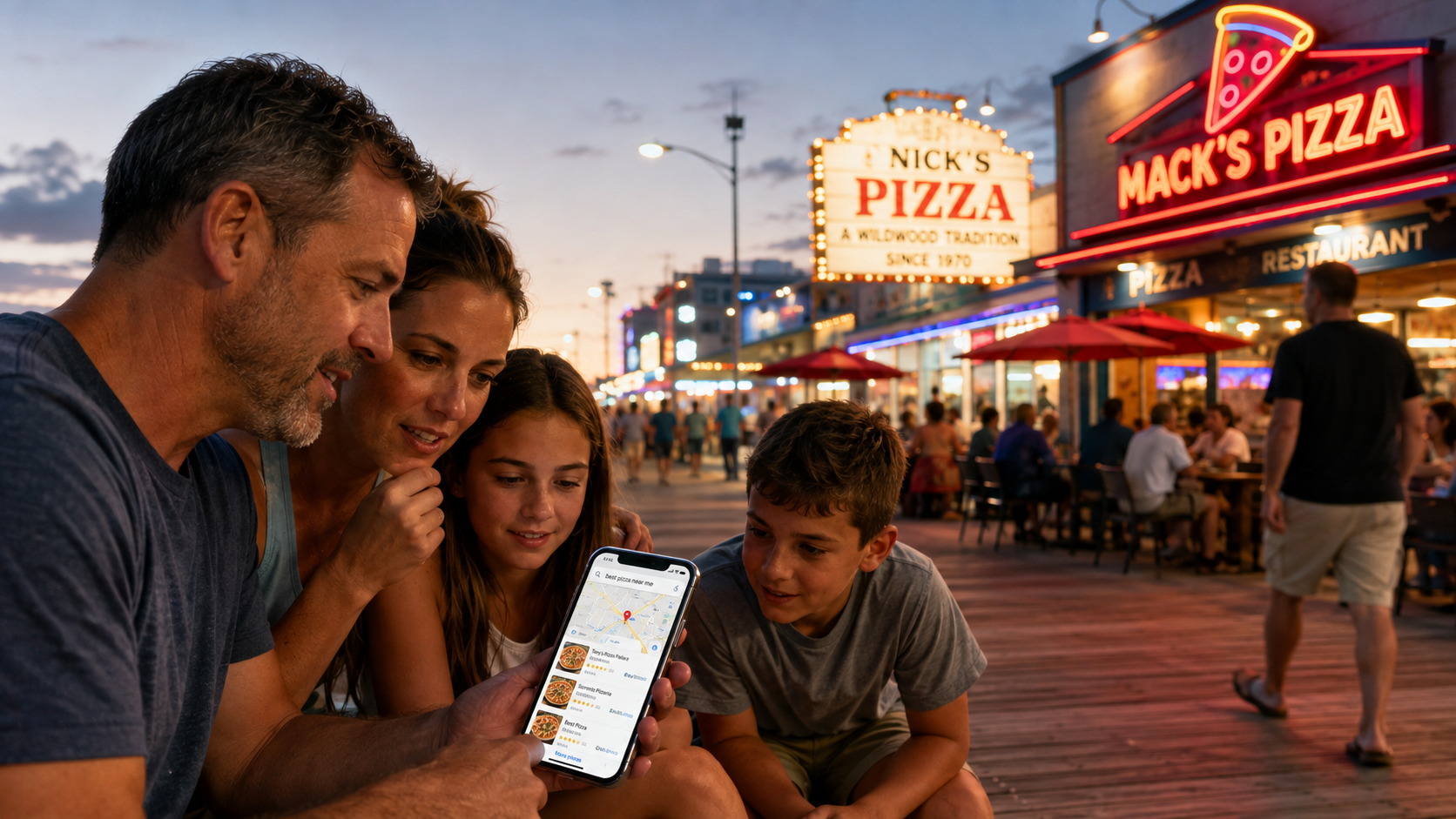
It's 6:30 on a July evening, and a family of five has just claimed a bench on the Wildwood boardwalk. Dad's sunburned. The youngest is melting down. Nobody can agree on dinner, so Mom does what every hungry human on vacation now does: she pulls out her phone and types "best pizza near me."
That search — that exact moment — happens thousands of times a night, all summer long, within a few hundred yards of your front door. And here's what should keep every boardwalk restaurant, bar, and breakfast spot owner up in the off-season: what appears on that phone in the next eight seconds decides your covers, and most Wildwood food businesses have done absolutely nothing to influence it.
The bench is the most important seat in your restaurant, and you've never bussed it.
This is the third letter in our series to Wildwood's family businesses — after the Doo Wop motels and the Shore's rental managers — and in one way, the restaurants have it hardest of all. A motel gets one booking decision per family per year. You need to win the same family three times a day, against fifty competitors visible from where they're sitting, in a decision that takes less time than your fryer takes to drop a basket.
The good news: the bar is on the floor. Let's go through why — and exactly what winning looks like.
Why Tourist-Town Restaurants Live on Search More Than Anyone Else
Every restaurant guide will tell you search matters: 93% of diners use online search to find restaurants, and 81% use Google Maps to decide where to eat. True everywhere. But a boardwalk restaurant faces a version of this math no neighborhood spot ever will: your customers are strangers, every single week.
A year-round restaurant in a normal town builds a base of regulars who buffer everything — they know you exist, they don't search, they just come. In Wildwood, the town's population turns over every Saturday. The family on that bench has never heard of you, has no habits, has no local friend to ask — and is starving right now. Their entire decision environment is one screen: 64% of diners check Google or Google Maps before deciding, and among mobile searchers, 88% visit or call within 24 hours. On vacation, compress that: the window between search and seated is about twenty minutes.
One more number that reframes the whole game: 79% of restaurant searches are non-branded — not your name, but "best breakfast Wildwood," "pizza near the boardwalk," "bar with outdoor seating near me." Nearly four out of five hungry searchers are winnable by whoever shows up best, regardless of who's been slinging slices longer. Sixty summers of reputation earns you nothing on a screen it never reached.
The Two Windows: The Planning Search and the Bench Search
The family decides where to eat in two distinct moments, weeks apart, and most restaurants compete in neither.
Window one: before the trip. Shore families plan food as part of the vacation — the breakfast spot for the first morning, the "we always get" traditions, the one nice dinner. They research from home: where to eat in Wildwood, best breakfast in North Wildwood, Wildwood boardwalk food you can't miss. Increasingly, they don't Google it — they ask: 22% of consumers have already used AI tools like ChatGPT or Gemini to help choose where to eat, and 55% of U.S. diners say they trust AI-generated review summaries when deciding. When someone asks ChatGPT "planning a week in Wildwood with kids — where should we eat?", the engine assembles an answer from published guides, reviews, and structured data — and hands back four or five names. The users rarely look for alternatives; they trust the suggestion and go. Either your restaurant is one of those names, or your competitor is having a very good August.
Window two: the bench. In-market, immediate, "near me." This one is decided almost entirely by the Google Local Pack — the map with three highlighted listings — and the prize is enormous: restaurants appearing in the Local Pack receive 126% more traffic than those that don't. Three slots. Fifty restaurants within walking distance. The pack is the boardwalk's real marquee.
Two windows, two different battles — planning content and AI visibility for the first, local search dominance for the second — and one shared foundation underneath both, which brings us to the uncomfortable part.
The Unmanaged Profile: Where Boardwalk Restaurants Bleed
Walk the boardwalk digitally sometime — search the restaurants you know, one by one — and you'll find the same wreckage almost everywhere:
The seasonal-hours disaster. This is the boardwalk's signature self-inflicted wound. Google profiles still showing winter hours in June. "Permanently closed" flags from an off-season Google update nobody caught — a death sentence, invisible to the owner, fatal to the searcher. Reopening weekends where the profile says closed while the fryers are on. For a seasonal business, hours hygiene isn't administrative trivia; wrong hours are a "do not visit" sign you're paying to display.
The profile treated as an afterthought while it's actually the restaurant. Google Business Profiles get roughly 7x more views than restaurant websites — for most boardwalk spots, the GBP is the online presence. Yet the photos are three years old, the menu is a blurry snapshot of a laminated page, the Q&A is unanswered, and the categories are wrong. Meanwhile 40% of people decide to visit a restaurant after looking at food photos — the cheapest conversion tool in hospitality, unused.
The website from another era. A Facebook page last updated in 2019, or a site that takes eight seconds to load a PDF menu on a phone baking in the sun. It matters more than owners think: 70% of restaurant searches are mobile, sites with sub-2-second load times rank about three positions higher, and a one-second delay cuts conversions by 20%. The family on the bench will not pinch-zoom a PDF. They'll tap the next listing.
The review vacuum — the biggest waste on the boardwalk. A busy Wildwood spot serves thousands of happy vacationers a week and captures reviews from almost none of them, because nobody asks. The math being left on the table: 81% of diners check Google reviews before choosing, a one-star rating increase drives a 5–9% revenue increase, and — critically for the ask-more-people strategy — a restaurant with 200 reviews at 4.4 stars consistently outperforms one with 30 reviews at 4.9, because volume signals legitimacy. You don't need perfection. You need velocity — and velocity, for a place feeding 500 sun-happy tourists a day, is one QR code on the receipt and one line from the server away. (It's the restaurant-speed cousin of the review system we built for businesses where asking requires far more delicacy.)
None of this is a talent problem. It's a bandwidth problem — you're working eighteen-hour days keeping a kitchen alive in a fourteen-week season. Managing a digital storefront in the same hours was never realistic. That's the job you hand to us.
The Story Layer: Why the Fudge Shop Beats the Franchise (If Anyone Can See It)
Here's the through-line from every letter in this series: your differentiation is real, and it's invisible.
Wildwood's boardwalk food isn't interchangeable — it's mythological. The pizza rivalries families argue about for generations. The breakfast counter where the same cook has flipped eggs since the Doo Wop signs were new. The custard stand in its fourth generation of the same family. That's not decoration; in a tourist market where AI engines pull from reviews, menus, and overall online presence to decide who gets recommended, a documented, distinctive story is ranking material — the reason an engine names you instead of describing "several pizza options." It's also the content the planning-window family actually wants: nobody drives three hours to eat somewhere that could be anywhere.
This is the same heart-made-tangible work we do for every family business: your history, your family, your "since 1957," published properly, structured so both Google and the AI engines can verify and cite it — plus the local-fluency content that puts you inside every "where to eat in Wildwood" answer being assembled this winter for next summer's trips.
What the Engagement Looks Like
For a boardwalk restaurant, the engine is lighter than a motel's — no booking infrastructure — and faster to pay back:
The profile, run like a station. Complete rebuild and ongoing management of the Google Business Profile: seasonal hours discipline (with reopening-day precision), real photography, full menu, categories, attributes, Q&A, and posts — because the profile out-earns the website 7-to-1 and deserves to be run like one.
A website that loads before the craving passes. One fast, mobile-first page that converts: menu as text (not PDF), hours, location, photos, story — built to pass the speed thresholds that move you up three map positions.
The review velocity system. QR on receipts and table tents, a one-line server script, and response management — targeting volume and recency, the two signals Google explicitly ranks on.
The planning-window content and AI visibility. The story pages, the "best of Wildwood" positioning, and the entity and structured-data work that puts your name in the answers — Google's and ChatGPT's — that next summer's families are collecting right now.
Measurement in covers, not clicks. Local Pack rankings, profile actions (calls, direction taps), review velocity, and season-over-season comparison — reported the way we report everything: openly, against a forecast, the same way we publish our own numbers.
And the calendar note that applies to every business on this island: the build happens in the off-season. The planning-window content needs to exist by early spring; the profile needs to be spotless before reopening weekend. A boardwalk restaurant that starts this in June has already lost the summer it's paying to win.
Frequently Asked Questions
Do boardwalk restaurants really need SEO if they're right on the boardwalk?
Foot traffic gets you seen; search gets you chosen. The family walking past fifty storefronts doesn't pick by proximity — 93% of diners search before deciding, 79% of those searches are non-branded, and the three restaurants in the Google Local Pack capture 126% more traffic than everyone else on the map. In a tourist town, physical visibility and digital visibility are separate contests — and the digital one increasingly decides where the physical crowd walks.
What's the single biggest digital mistake seasonal restaurants make?
Hours and status neglect. Seasonal businesses routinely enter summer with winter hours on Google, miss "permanently closed" flags applied during the off-season, and reopen to a profile telling every searcher to stay away. Because the Google Business Profile draws about 7x the views of the website, profile errors are storefront errors. The fix is unglamorous — a managed hours-and-status discipline with reopening-day precision — and it's routinely worth more than any advertising a seasonal restaurant buys.
How many Google reviews does a restaurant actually need?
Volume and recency beat perfection: a restaurant with 200 reviews at 4.4 stars consistently outperforms one with 30 reviews at 4.9, because review count, recency, and rating are all Local Pack ranking signals. For a boardwalk spot serving thousands of visitors weekly, the opportunity is velocity: a QR code on receipts and table tents plus a one-line ask converts a fraction of already-happy tourists into a steady review stream — and each full star of rating improvement is worth an estimated 5–9% in revenue.
Are people really asking ChatGPT where to eat on vacation?
Yes, and the share is compounding: 22% of consumers have used AI tools to choose where to eat, and 55% of diners trust AI-generated review summaries. Vacation planning is a natural fit — one question ("where should we eat in Wildwood with kids?") returns a short, trusted list, and users typically go with the suggestion rather than browsing alternatives. The engines build those lists from reviews, structured menu and hours data, and published local content — which means the restaurants investing in exactly those assets are quietly claiming the recommendation slots for every summer to come.
Does a boardwalk restaurant even need a website, or is Google enough?
You need both, sized correctly. The profile does the heavy lifting, but the website is where planning-window families confirm the choice, where your story lives in citable depth, and where speed and mobile performance feed your rankings— a slow PDF-menu site actively costs map position. For most boardwalk spots the right answer is one excellent, fast, mobile-first page rather than a sprawling site: menu as real text, hours, photos, story, done.
When should a seasonal restaurant invest in this work?
September through March — full stop. The planning-window content that wins next summer's "where to eat in Wildwood" searches and AI answers must be published and indexed by early spring, the profile rebuild belongs ahead of reopening weekend, and the review system should be printed and staff-trained before the first Saturday crowd. Off-season is when the owners finally have bandwidth and when every dollar of the work compounds into the season ahead; starting in June means paying full price for half a summer's return.
The Bench Is Filling Up Again Tonight
Somewhere on the boardwalk this evening — every evening, all season — a hungry family is holding the decision in one hand. Your food would have made their vacation. Your grandmother's recipe, your sixty summers, your line cooks who've done this since they were sixteen — none of it reaches the bench unless the screen carries it there.
We'll show you exactly what that family sees right now when they search — your profile, your reviews, your AI answer — and what it would take to win the bench by Memorial Day.
Book a free 30-minute strategy call → An honest audit of your Google presence and AI visibility, a forecast in covers rather than clicks, and a clear next step within one business day. Best done while the fryers are cold.
Sources
Restaurant Velocity — Restaurant SEO Complete Guide for Operators 2026 (93% search before choosing; 81% use Maps; 79% non-branded searches)
DoorDash for Merchants — SEO for Restaurants in 2026 (22% AI-assisted dining choices; 55% trust AI review summaries; 76% visit within 24 hours)
Wiser Review — Google Restaurant Reviews Guide 2026 (Local Pack +126% traffic; 1 star = 5–9% revenue; volume-over-perfection review data)
Restroworks — Google Restaurant Search Statistics (GBP 7x website views; 40% decide from food photos; 92% read reviews)
SeedTech — Restaurant SEO Statistics 2026 (88% visit within 24 hours; mobile share; Core Web Vitals and load-speed effects)
FSR Magazine — How Search, Maps, and AI Decide Where People Eat in 2026 (AI recommendation behavior; trust-the-suggestion dynamics)
Chowly — Restaurant SEO: The 2026 Playbook (GBP as primary asset; review volume dynamics)