The Big Morning: How Wildwood's Charters, Jet Skis, and Surrey Fleets Win the One Decision Every Vacation Contains
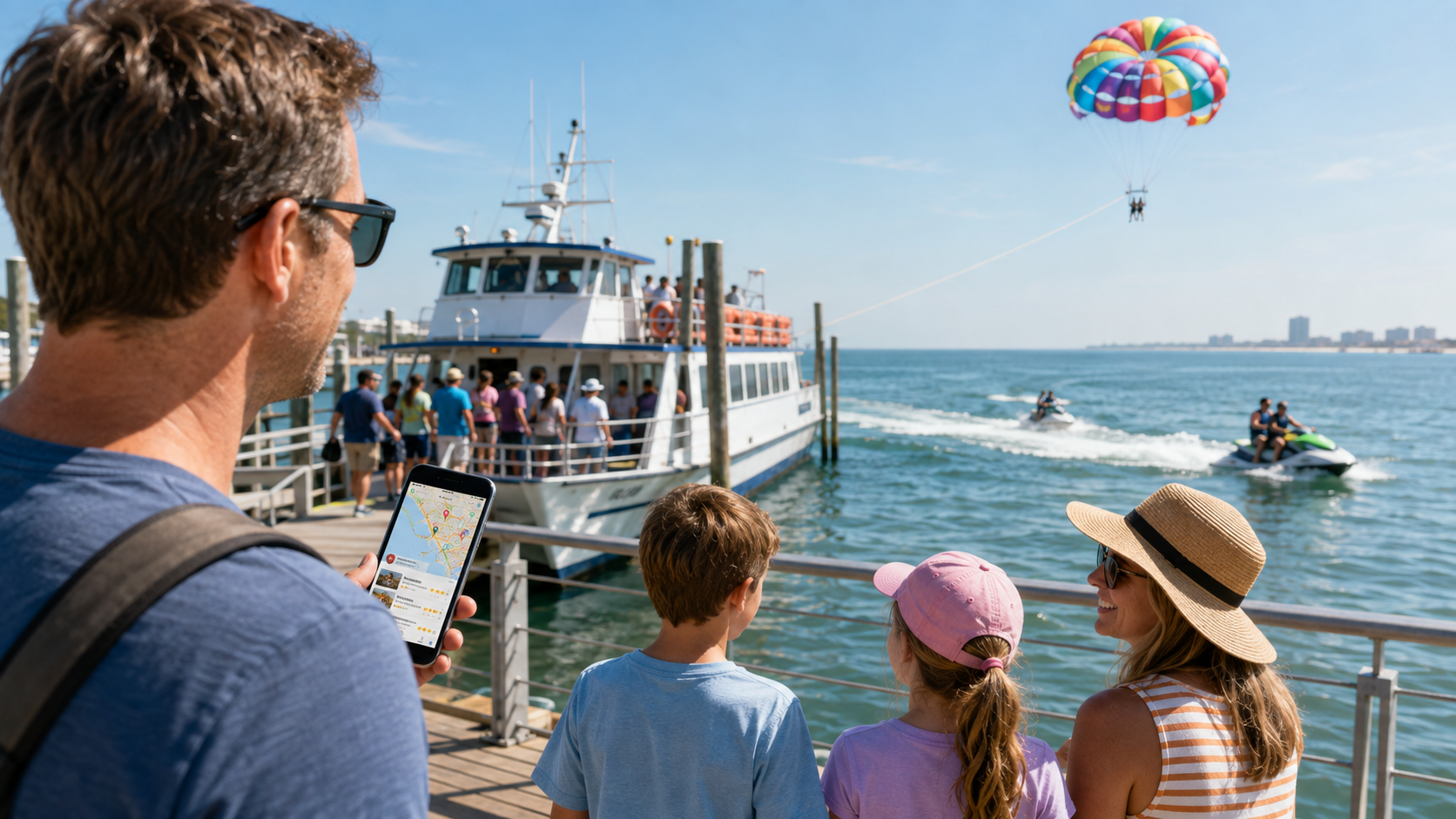
Every Wildwood vacation contains one Big Morning.
It's the day the family does The Thing — the dolphin cruise Grandma's been talking about since Christmas, the parasail the teenagers demanded, the fishing charter Dad quietly booked as his one day, the sunrise surrey ride that ends up as the photo on next year's holiday card. Every family budgets for one or two Big Things per trip. The rest of the week is beach and boardwalk; the Big Morning is the memory.
And here's the thing about how that memory gets purchased: it is decided almost entirely on a phone, almost entirely from two inputs — your position on the map, and what strangers said about you. No other category of Shore business is this purely search-decided. A motel has a neon sign working the boardwalk for it. A restaurant has the smell of fried dough drifting fifty yards. A parasail operator has a dot on Google Maps, a star rating, and eleven seconds of a parent's attention while the coffee brews.
Which is why this letter — the fourth to Wildwood's family businesses, after the motels, the rental managers, and the boardwalk restaurants — is about the highest-margin, most search-dependent, and most under-marketed businesses on the island. And about a storm you can still get ahead of: the commission platforms that hollowed out the lodging industry have found your category, and they're charging even more.
First, the Warning: The 20–30% Toll Is Coming for Experiences
We've written at length about what OTA commissions did to Wildwood's motels (15–30% all-in). The experiences version is worse, and most operators don't see it coming because the platforms — Viator, GetYourGuide, and their resellers — feel optional today.
The rates: tour and activity OTA commissions run 20–30% of gross booking value, with 20–25% the most common band. GetYourGuide's standard starting rate for new operators is 30%; Viator's flat 20% base comes with a per-product listing fee and an "Accelerate" program that lets operators bid higher commissions for better placement — an arms race where the platform wins every round. And the contract rate isn't the real rate: operators who reconcile actual payouts against gross bookings find the true take sitting three to five points above the headline — 28–29% on a "25%" agreement once processing, promotions, and fees are counted.
The trendline is the alarming part: OTA share of tour and activity bookings surged to 37% in 2025, up from 33% a year earlier, while direct operator-website bookings fell from 29% to 25% — the exact channel migration that captured lodging a decade ago, now running through experiences. On a $120 parasail seat, 28% is $33 per person. On a $1,400 charter, it's $390 — per trip.
Here's the strategic difference that makes your position better than the motels' ever was: in Wildwood, you don't need the platforms yet. Your demand is destination-driven — the family is already here, already committed to a Big Morning, already searching locally. The platforms add the least value precisely where demand is already local and intent is already high. Which means the operators who build a dominant direct presence now — before the marketplaces intermediate the category here the way they have in Orlando and Charleston — get to simply never pay the toll. And there's even a zero-commission channel sitting in plain sight: Google's Things to Do surfaces bookable experiences at 0% commission for operators with a connected booking system. Free distribution, on the exact surface where your customers already decide. Almost nobody on the island has claimed it properly.
The Two Decisions: The Planned Big Thing and the Morning Pivot
Like every Shore business, you're actually competing in two separate moments.
Decision one: the Planned Big Thing. Weeks before the trip, from a couch in Cherry Hill or Philly: "things to do in Wildwood with kids," "dolphin watching Cape May or Wildwood," "is parasailing safe for a 10-year-old," "best fishing charter Wildwood." Increasingly this planning happens inside an AI conversation — consumer use of AI tools for recommendations jumped from 6% to 45% in a single year — and "plan our Wildwood week" prompts return a short, trusted list of activities and the operators to book them with. The engines assemble that list from published content, reviews, and structured data. The operator who has answered the actual questions — the safety question, the what-to-expect question, the which-morning-has-calmer-water question — is the operator the engines cite. Right now, for most Wildwood activities, nobody has answered them. The lane is empty.
Decision two: the Morning Pivot. In-market, same-day, weather-shaped: the family at breakfast deciding what today is; the "jet ski rental near me" impulse at 11am; the rainy-forecast scramble — "what to do in Wildwood when it rains" — that sends a thousand families searching at once; the windy afternoon that cancels the parasail and frees up a family with money already mentally spent. This is pure map-pack warfare: position, rating, review count, photos, hours, and — uniquely important for your category — visible same-day availability, because the pivot searcher books whoever makes right now easy.
The Morning Pivot matters more for you than for anyone else on the island because of a brutal fact of your business model: experiences are perishable — the 9am boat that leaves with six empty seats cannot resell them at 10am. A motel's unsold Tuesday hurts; your unsold seats vanish, trip after trip, all season. Every empty seat filled by a same-day searcher is nearly pure margin — which makes owning the pivot searches the highest-ROI visibility on the Shore.
Reviews Aren't Marketing for You. They're the Product Inspection.
For most businesses, reviews are social proof. For yours, they're something heavier: a parent is deciding whether to strap their child to a parachute behind your boat. Nobody can test-drive a parasail, kick the tires on a charter, or inspect a jet ski's maintenance log from a beach chair. The review section is the only inspection the customer will ever perform — which is why activity businesses live and die on rating and volume more than any category in local search, and why the standard rules bite hardest here: nearly half of consumers won't use a business with fewer reviews than they expect, and 73% only trust reviews written in the last month. A five-year-old wall of praise loses to a competitor whose reviews arrived last Tuesday.
Now the good news, and it's almost unfair: you own the single best review-generation moment in all of commerce.The family that just watched dolphins breach off the bow, the teenager pulling off a helmet grinning, the dad holding a fish — these people are at the absolute peak of goodwill, adrenaline, and photo-taking, standing on your dock, phones already out. A QR code at the dock rail, a one-line ask from the captain ("if you had fun, that code takes ten seconds and it keeps a family business running"), and a light follow-up text with their trip photos attached — asking works: 83% of people asked for a review leave one — and your review velocity becomes something no competitor can match without matching your actual product. Bonus: those reviews arrive with photos and videos, which feed the map pack, the AI answers, and every planning-window search at once.
The Story Layer: Captains Beat Marketplaces
The same thesis that runs through this whole series applies here with salt on it. A marketplace listing flattens you into "Parasailing — 4.7 ★ — from $89." What it cannot show: the captain with thirty summers reading these waters, the family that's run the surrey fleet since the bikes had banana seats, the mate who's spotted more dolphins than any human in Cape May County, the safety record you're quietly proudest of. That's not sentiment — it's the answer to the actual questions in the buyer's head (is this safe, do these people know what they're doing, will my kids remember this forever), and it's the distinctive, verifiable material AI engines cite when they choose which operator to name. Published properly — the captain's page, the how-we-run-a-trip page, the honest weather-policy page — the heart of the business becomes the conversion engine. Same job we do for every family business. Yours just comes with better photos.
The Engagement, Charter Edition
The zero-commission foundation: Google Business Profile rebuilt and run like an asset (categories, real photos and video, Q&A answering the safety and what-to-expect questions, hours-and-weather-status discipline), plus Things to Do connectivity so the free channel is fully claimed. The direct booking spine: one fast, mobile-first site with real online booking, visible same-day availability, and clear weather/refund policies — the trust removers that turn pivot searchers into seats. The two-window content engine: planning-window guides (the family's Wildwood activity questions, answered better than anyone) and pivot-window pages (today, rainy-day, windy-day, last-minute) built in our content-systems architecture. The dock-rail review system. And measurement in the metric that matters: seats. Empty-seat fill rate, direct-booking share, same-day capture, review velocity — forecast first, then reported the way we report everything, in the open.
Built, as always on this island, in the off-season — because the planning-window content that wins next July's Big Mornings needs to be indexed by March, and the dock-rail QR codes should be laminated before the first boat splashes.
Frequently Asked Questions
Should a Wildwood charter or watersports business list on Viator or GetYourGuide?
Cautiously, if at all — and never as the primary channel. Experience OTAs charge 20–30% of gross booking value, with GetYourGuide starting new operators at 30% and real all-in takes running 3–5 points above contract rates. In destination markets like Wildwood, where guests are already local and searching, the platforms add the least value at the highest price. The stronger sequence: dominate the free channels first — the map pack, Google's zero-commission Things to Do, direct booking — and treat marketplaces as optional overflow, priced so their commission never sets your margin.
What searches matter most for activity and rental businesses?
Two families of them. Planning-window searches made before the trip ("things to do in Wildwood with kids," "best dolphin cruise near Wildwood," "is parasailing safe for kids") decide the vacation's one or two Big Things — and increasingly happen inside AI conversations. Pivot searches made in-market ("jet ski rental near me," "what to do in Wildwood today," rainy- and windy-day queries) fill same-day capacity. The pivot searches are disproportionately valuable because experience inventory is perishable — unsold seats on a departing trip are revenue gone forever — so every same-day capture is nearly pure margin.
Why do reviews matter more for charters and watersports than other businesses?
Because the purchase is a trust decision about safety and competence that can't be inspected any other way — parents are choosing who straps their kids into equipment. Rating, volume, and recency function as the product inspection: 47% of consumers won't use a business with fewer reviews than expected, and 73% trust only reviews from the last month. Activity operators also hold the best generation moment in commerce — the post-trip adrenaline peak at the dock — which a QR code and a one-line ask from the captain converts into review velocity competitors can't fake.
What is Google Things to Do, and why should operators care?
It's Google's bookable-experiences surface — activity listings with pricing and booking links shown directly in Search and Maps — and operators with a connected booking system participate at 0% commission, versus 20–30% on the experience OTAs. It puts "book now" on the exact screens where Wildwood visitors already decide, for free. Participation requires a modern booking system and proper setup, which is precisely why almost no Shore operator has claimed it — and why the first movers in each activity category will enjoy an uncontested paid-placement-quality position at zero marginal cost.
How should a weather-dependent business handle search and bookings?
Turn weather from a liability into a capture mechanism. Publish honest weather and refund policies prominently (the #1 booking hesitation for parasail and charter customers), maintain live same-day availability so pivot searchers can act instantly, and build the rainy-day and windy-day content that owns the searches every weather change triggers island-wide. A cancellation elsewhere is a family with budget already committed and a morning suddenly open; the operator visible for "what to do in Wildwood today" inherits that demand every time the forecast shifts.
When should an activity operator start this work, and how fast is payback?
Off-season, like everything on the island: planning-window content indexed by March, the profile and booking spine rebuilt before the season, review systems laminated before the first trip. Payback is unusually fast in this category because the economics are pure — high-margin, perishable seats where each incremental fill is nearly all profit, and (unlike lodging) usually no existing commission channel to displace. A handful of additional full boats per week, or a season of same-day jet ski captures, typically covers the engagement several times over; we model your specific fleet's numbers before any work begins.
The Big Morning Is Being Decided Right Now, From a Couch in Cherry Hill
Somewhere tonight, a family is planning next summer's week — and the one memory they'll spend real money on is being assigned to whichever operator the map, the reviews, and the AI answer put in front of them. Thirty summers of reading these waters should win that decision every time. It just has to be visible from the couch.
We'll show you exactly what that family sees when they search your category — map position, reviews, AI answers, and the empty free channels waiting to be claimed — and what a season of filled seats is worth.
Book a free 30-minute strategy call → An honest audit, a forecast in seats rather than clicks, and a clear next step within one business day. Best done while the boats are wrapped.
Sources
SambaHQ — Tour OTA Commission Rates 2026 (cross-platform experience commission bands)
Automate.travel — Viator vs GetYourGuide for Operators 2026 (GYG 30% starting rate; per-booking economics)
OTA Playbook — OTA Commission Models for Tour Operators (real take rates 3–5 points above contract)
JungleBee — GetYourGuide vs Viator for Small Tour Operators (Viator Accelerate placement bidding; rate-change risk)
AtlasPerk — OTA Integration for Travel: Viator, GetYourGuide & Bokun (OTA share 33%→37%; direct decline; perishable inventory; Google Things to Do at 0%)
CCC — Local Consumer Review Survey 2026 Insights (AI recommendation usage growth)
BizIQ — Online Reviews Statistics 2026 (review-count thresholds; recency trust; ask-and-receive rates)