Half of Cape May County's Homeowners Live Three States Away. They Hire Contractors Sight Unseen — From Google.
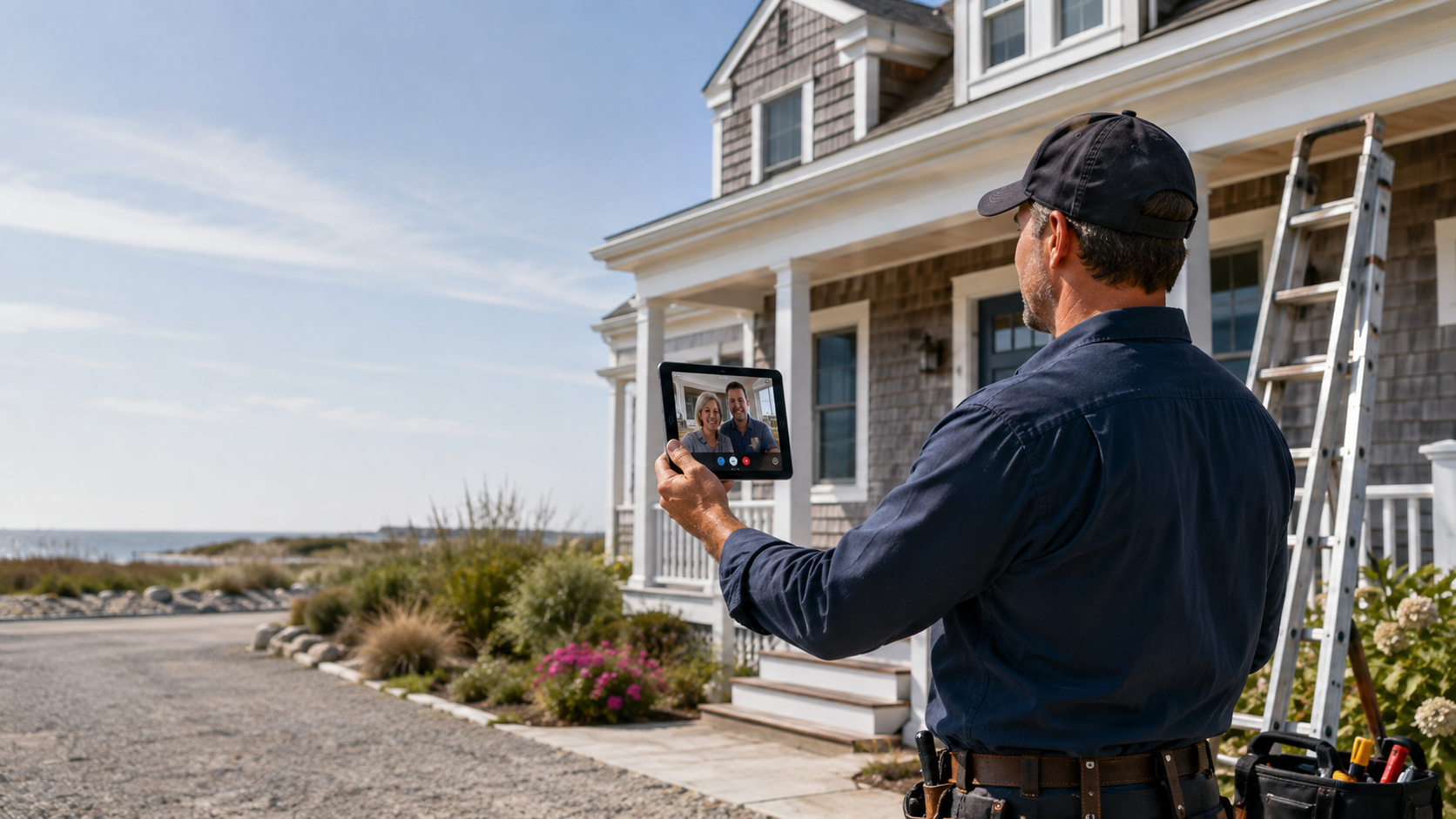
The call comes from a 215 number, or a 717, or a 732 — never a 609.
"Hi — we have a place in Wildwood Crest. We're up in Harrisburg. Our neighbor just texted that water's coming off the ceiling in the back bedroom, and we can't get down there until Saturday. Can you get in today? There's a key with the lady next door."
Every shore contractor knows this call. What most haven't fully reckoned with is what it represents: a customer who will hire you, pay you, and hand you the keys to an empty house — without ever shaking your hand, seeing your truck, or meeting a soul who's used you. No inland contractor ever meets this buyer. On the island, they're not the exception. They're the market.
The census math is staggering: Cape May County holds roughly 100,000 housing units with an estimated vacancy rate of 52% — the majority of those vacant homes being seasonal rentals and second homes. The Census Bureau itself uses "beach houses in Cape May County, New Jersey" as its textbook example of seasonal housing. Half your addressable roofs, pipes, compressors, decks, and pools belong to somebody in Pennsylvania or North Jersey — somebody who cannot ask a neighbor at the diner, cannot swing by your shop, and will make the entire hiring decision from a screen, three states away.
This is the fifth letter in our series to the businesses of the Wildwoods — after the motels, the rental managers, the restaurants, and the charters — and it's the one about the year-round money. Because while the boardwalk sleeps all winter, the absentee homeowner never does: pipes freeze in January, nor'easters peel shingles in March, and the deck has to be done before Memorial Day. The contractor who becomes findable and trustworthy to a stranger on a screen owns the steadiest revenue on the island.
The Strangest Customer in Home Services
In a normal market, contractors live on referrals — the neighbor's recommendation, the church connection, the guy your brother-in-law used. The absentee shore owner has access to none of it. Their social graph is in Doylestown; their leaking roof is in North Wildwood. So they do the only thing available: they search, they read, and they judge you entirely on digital evidence.
Which changes what "marketing" means for a shore contractor. You're not competing to be known — you're competing to be verifiable by a nervous stranger. That stranger is asking four silent questions, in order:
Can I even find someone down there? (Search visibility — the map pack, from a Philadelphia couch.)
Are they real and competent? (Reviews, photos, license and insurance made explicit.)
Can I trust them alone in my house? (The keyholder question — the deepest one, and the one almost no contractor addresses out loud.)
Will they deal with the fact that I'm not there? (Remote communication: photos, video, updates, payment without a driveway conversation.)
Every one of those questions can be answered in advance, publicly, on your website and profile — and almost no contractor in the county has done it. The ones who do will find that the scariest customer in the trades converts into the best one: higher-value properties, urgency-driven decisions, less price shopping (you can't get three driveway estimates from Harrisburg), and — as we'll get to — the most retainer-like revenue in residential contracting.
The Middleman Toll, Contractor Edition
Before the playbook, the pattern we've now traced through every industry on this island: wherever a business's customers are strangers, a platform inserts itself between them and charges rent. The motels got Expedia. The charters got Viator. You got Angi and HomeAdvisor — and your version of the toll may be the ugliest of the three.
The model: contractors pay $15–$120+ per homeowner contact, with each lead typically sold to between three and eight competing contractors simultaneously. Run the real math and a $50 shared lead at typical close rates works out to roughly $333–$444 per booked job — before the office hours burned racing four competitors to a phone number that may not even work. The quality problem isn't anecdotal: Angi's HomeAdvisor operation paid a $7.2 million FTC settlement in 2023 over misrepresenting lead quality and origins, plus a $6.82 million settlement over background-check advertising claims, and contractors report 30–50% denial rates when disputing plainly bad leads. In high-ticket trades, individual leads have been reported at $230, $317, even $400.
And the deepest cost is the one that never appears on the invoice: every dollar spent on shared leads builds zero long-term marketing equity — it's a treadmill, not a growth engine. Ten years of Angi spend leaves you with exactly what you started with: a login. Ten years of owning your visibility leaves you with rankings, reviews, content, and a brand that absentee owners find first — an asset that compounds and, unlike the lead bill, never re-prices itself upward at renewal.
For paid demand while the asset builds, there's even a structurally better option: Google Local Services Ads deliver exclusive leads — not shared — at comparable per-lead costs with dramatically higher booking rates, with the Google Guaranteed badge doing trust work that matters double for a sight-unseen buyer. LSAs plus an owned engine is the modern stack. Shared-lead platforms are what contractors run when nobody's built them anything better.
What the Absentee Owner Actually Searches (Four Demand Streams)
1. The emergency. "Plumber Wildwood Crest emergency," "water leak shore house," "storm damage roofer North Wildwood." These spike violently after weather — every nor'easter triggers a wave of panicked searches from living rooms in three states, and the contractor who ranks inherits the whole wave. Emergency demand is where the sight-unseen dynamic peaks: no time for diligence, total reliance on what the screen shows right now.
2. The recurring rituals. "Winterize shore house Cape May County," "shore house opening service," "pool opening Wildwood." This is the gold seam, and it deserves its own section below.
3. The projects. "Deck builder Wildwood," "HVAC replacement shore house," "coastal roofing contractor NJ." Planned from home, months out, research-heavy — the perfect match for content that demonstrates coastal expertise (and increasingly initiated by asking an AI, where recommendation usage has jumped from 6% to 45% in a year: "find me a well-reviewed deck builder near Wildwood who works with second-home owners").
4. The verification. Your name plus "reviews." The final gate before every hire above. What they need to find: volume, recency (73% only trust reviews from the last month), and — the detail almost everyone misses — reviews visibly written by other out-of-state owners. "We live in Bucks County and they handled everything remotely, sent photos every day, and locked up when they left" is worth twenty generic five-stars, because it answers the exact fear the searcher brought. Your happiest absentee clients will write these if asked; a light, systematized ask — the same review operations we build across every vertical — turns them into a wall of proof no competitor can counterfeit.
The Trust Stack: How a Stranger Decides to Mail You a Key
Winning the sight-unseen hire is a buildable system, not a mystery. The layers:
Say the quiet part on your website. A page literally titled "For Second-Home Owners" — how you handle keys and codes, how you document (photos before, during, after every visit, sent same day, because you can't drive down), how remote estimates and payment work, how you secure the house when you leave. Nobody in the county has this page. The first contractor in each trade who publishes it becomes the category's default answer — in Google and in the AI responses assembling recommendations from published evidence.
Make the credentials machine-verifiable. License numbers, insurance, bonding, years, the family behind the company — stated explicitly and structured so engines can confirm them. A nervous stranger's browser does the vetting a neighbor used to do; give it something to find.
Own the coastal expertise lane. Inland contractors chase shore work every summer; your moat is that salt air is a different physics — and content proves you know it. What salt air does to HVAC condensers (and the coatings that fight it). Wind ratings and fastening schedules for coastal roofs. Decking materials that survive the island. Flood-zone plumbing realities. This is the heart-made-tangible work in contractor form: expertise your hands already hold, published so a stranger in Harrisburg can see it — and so the engines cite it.
Dominate the map from three states away. The absentee owner's search behaves locally (the query names your towns) but happens remotely — meaning local-pack position, profile completeness, and review velocity decide hires made from Philadelphia living rooms. Same battlefield as every letter in this series; higher ticket sizes than any of them.
The Retainer Play: Winterize, Watch, Open, Repeat
Here's the strategic prize hiding inside the second-home market, and the reason this letter is subtitled "the year-round money": the absentee owner doesn't want transactions. They want a standing relationship with someone on the island.
They need the house winterized in November and opened in April. They'd gladly pay for a monthly walk-through all winter — after every big storm, someone checking the pipes didn't burst and the door held. They want one number to callfor the place they love and can't see. Packaged and marketed properly — seasonal contracts, house-watch plans, priority emergency status for members — this converts the trades' famously lumpy revenue into something close to subscription income: predictable winter cash flow, guaranteed first call on every repair the walk-throughs surface, and a client relationship that compounds for decades and refers the whole beach block.
Almost no shore contractor markets this, because almost no shore contractor's marketing was ever built around the absentee owner at all. The search demand exists ("shore house winterization," "house watch service Cape May County"), the willingness to pay is obvious, and the content required to own the category would take one off-season to build. It's the closest thing to found money in the county's trades — and it's the exact revenue-shape transformation we look for in every engagement: less churn, steadier retainers, compounding relationships. We'd know; it's how we built our own business, and we publish the numbers to prove the model monthly.
Frequently Asked Questions
Why is marketing different for shore-town contractors than inland ones?
Because roughly half the customer base is physically absent: about 52% of Cape May County's housing units are vacant, overwhelmingly seasonal and second homes, owned by people whose referral networks live three states away. Inland contracting runs on word of mouth; shore contracting runs on a stranger's screen. That flips the marketing job from "being known locally" to "being verifiable remotely" — search position, review volume and recency, explicit credentials, and published answers to the trust questions an absentee owner can't ask a neighbor.
Are Angi and HomeAdvisor worth it for shore contractors?
The math argues strongly against dependence on them: leads run $15–$120+ and are sold to 3–8 competitors at once, working out to roughly $333–$444 per booked job, the parent company has paid over $14 million in regulatory settlements tied to lead quality and advertising claims, and every dollar spent builds zero owned equity. For paid demand, Google Local Services Ads deliver exclusive leads at similar costs with far higher booking rates — and the durable answer is an owned engine (rankings, reviews, content) that compounds instead of re-billing.
How does a contractor win a customer who will never meet them before hiring?
By answering the four silent questions in advance: findability (map-pack position for your towns, searched from out of state), competence (review volume and recency, real project photos, explicit license and insurance details), key-trust (a published second-home-owner page describing key handling, same-day photo documentation, and lock-up procedures), and remote workability (estimates, updates, and payment that never require a driveway meeting). Each answer is publishable; the contractor who publishes them first in each trade becomes the default recommendation — to Google's map pack and to the AI engines now assembling nearly half of consumer recommendations.
What reviews matter most for winning second-home owners?
Reviews from other absentee owners, by a wide margin. A five-star review is generic proof; "we're in Bucks County, they coordinated everything remotely, sent photos daily, and secured the house when they finished" answers the specific fear every sight-unseen hirer carries. Combined with recency — 73% of consumers only trust reviews written in the last month — a systematized ask targeted at your happiest out-of-state clients builds a wall of exactly-on-point social proof competitors can't replicate without replicating your service.
What's the recurring-revenue opportunity in the second-home market?
Seasonal-care contracts: winterization, spring opening, storm-check walk-throughs, and house-watch plans with priority emergency status. Absentee owners actively want a standing island relationship rather than one-off transactions, search demand for these services already exists, and almost no contractor packages or markets them. Structured as annual memberships, they smooth the trades' lumpy revenue into predictable winter cash flow, guarantee first call on every repair the visits surface, and create decades-long client relationships — the closest thing to subscription income available in residential contracting.
When should a shore contractor build this, and how fast does it pay back?
Now, in whatever season you're reading this — unlike the boardwalk businesses, your demand never sleeps: winterization searches peak in fall, freeze emergencies in January, storm damage in March, and project research all winter for pre-Memorial Day completion. Payback runs on ticket size: shore roofing, HVAC, and deck projects run four and five figures, so a modest monthly flow of owned leads typically covers an engagement several times over — especially measured against the $300–$450 per-job cost of the shared-lead treadmill it replaces. We forecast your trade's specific numbers before any work begins.
The Key Is Already in the Mail. The Only Question Is Whose Name Is on the Envelope.
Tonight, somewhere in Pennsylvania, a homeowner is worrying about a house they love on an island they can't get to — and next week, or after the next nor'easter, they'll type your trade and your town into a search bar and hire whoever the screen tells them to trust. That decision is winnable in advance. Every layer of it — the map position, the reviews, the second-home page, the coastal-expertise content, the care-plan offer — can be built, owned, and compounding before the next storm season.
We'll show you exactly what the absentee owner sees today when they search your trade in your towns — and what the sight-unseen market is worth to your book of business.
Book a free 30-minute strategy call → An honest audit, a forecast in booked jobs and contract revenue, and a clear next step within one business day. Bring your lead-platform invoices; we'll do that math live, too.
Sources
Cape May County Herald — The Wrap: 2024 Census Estimates (~100K housing units, 52% vacancy, seasonal/second-home composition)
U.S. Census Bureau — Most U.S. Vacant Housing Is Seasonal Housing (Cape May County beach houses as archetypal seasonal housing)
LeadTruffle — The Complete Guide to Angi Leads for Home Service Contractors in 2026 (lead pricing, 3–8-way sharing, FTC and DA settlements)
HomeShowoff — Best Lead Generation for Contractors: Real Lead Costs in 2026 (cost-per-booked-job math across platforms)
Astra Results — Why Plumbers Pay $80+ Per Lead on HomeAdvisor (high-ticket lead pricing reports; treadmill economics)
BaaDigi — HomeAdvisor vs Angi for Contractors 2026 (dispute denial rates; shared-lead mechanics)
The Valley Marketing Group — Angi Leads Cost Per Lead 2026 (Google LSA exclusive-lead economics; follow-up conversion data)
CCC — Local Consumer Review Survey 2026 Insights (AI recommendation usage growth)
BizIQ — Online Reviews Statistics 2026 (review recency and trust thresholds)