Your Next Wildwood Buyer Is on a Couch in Doylestown, Three Years From Closing. Zillow Plans to Sell Them to You for 35%.
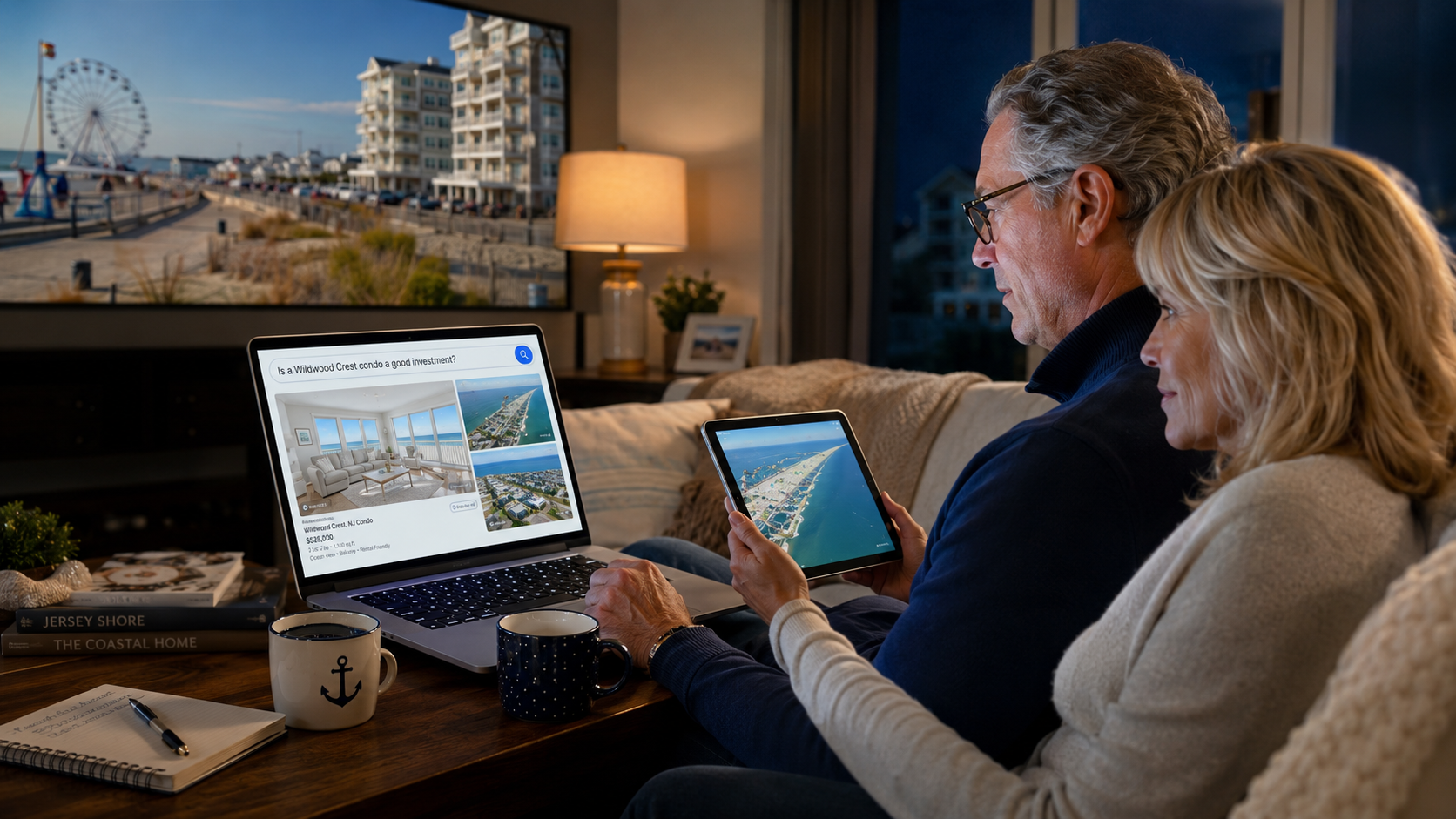
Right now — tonight — your next closing is sitting on a couch in Doylestown, or Cherry Hill, or Basking Ridge, with a laptop open and a glass of wine going, typing something like: "Is a Wildwood Crest condo a good investment?"
They are not buying this year. Maybe not next year. They're in the dreaming phase — the long, wandering, screenshot-collecting stage every shore purchase begins with, where a family that just spent their eleventh July on the island starts wondering, on the drive home up the Parkway, what it would take to stop renting the memory and start owning it.
Eventually, that couch produces a wire transfer with six zeros in it. The only open question — the question this entire letter is about — is whose name is attached to the transaction when it happens: the agent who spent three years answering that family's questions before they ever asked one out loud… or whoever a listing portal sells them to, at the door, for a third of the commission.
This is the sixth letter in our series to the businesses of the Wildwoods and the Shore — the motels, the rental managers, the restaurants, the charters, and the contractors — and by now you know the pattern we keep finding: wherever a Shore business's customers are strangers deciding from screens, a platform inserts itself between them and charges rent. For real estate, the toll collector has a name every agent already resents, and a rate that makes Expedia look gentle.
First, Know Exactly Who You're Selling To (The Data Is Startling)
The national numbers describe the shore buyer almost perfectly, because the national market has become the shore buyer. Per NAR's 2025 Profile of Home Buyers and Sellers: repeat buyers now make up 79% of all purchases, with a median age of 62, a median 23% down payment — the highest since 2003 — and 30% paying all cash. The overall median buyer age hit a record 59. Older, equity-rich, financing-optional, buying a lifestyle rather than a starter — that's not a demographic trend to a Cape May County agent. That's Tuesday.
And this buyer lives on a screen: 52% of buyers found the home they purchased online, 70% searched on mobile, and searching online has been the most common first step in the process for six straight years. For the out-of-market shore buyer, "online" isn't one channel among several — it's the only channel for years. They can't drive past your signs in February. They don't know the island's agents by reputation the way a local would. Their entire early relationship with the market — which towns, which blocks, condo versus single, what things really cost, whether the numbers work — is mediated by whatever the internet serves them.
Here's the strategic reading of the 10-week median search time NAR reports: that's the active phase. The shore buyer's real funnel is the ten weeks plus the two to five years of dreaming that precede them — the longest, most content-hungry, least-contested buyer journey in residential real estate. Almost every agent competes ferociously for the ten weeks. Almost nobody farms the years. Hold that thought.
The Toll, Real Estate Edition: 35% at the Door
You know the machine, but the current numbers deserve to be stated plainly. Zillow's Flex/Preferred model charges agents referral fees that run 15–40% of the commission depending on price band and market — with seller connections at a flat 40%, and typical buyer-side fees landing around 35%. Run it on a real island transaction: a $700,000 Wildwood Crest condo at a 2.5% side is a $17,500 commission — of which roughly $6,000–$7,000 goes to Zillow for having intercepted a buyer who was, in many cases, going to find that exact listing anyway.
The scale and the consequences are now a matter of public record: a February 2026 Consumer Policy Center report named Zillow the largest single referral player — more than 1.4 million buyer connections — and argued that 30–40% referral fees keep overall commission rates high, because agents with a third of their income pre-committed to the referrer can't afford to negotiate down. One industry analysis put it in exactly the language we've used for every business on this island: it's not innovation — "that's a toll booth", one where every "Request a Showing" routes the consumer through a paid gate.
And the post-NAR-settlement world raises the stakes on both sides: with buyers now signing written buyer-broker agreements that spell out exactly what their agent costs, your value has to be provable to a stranger before they sign — while a giant slice of it, if the lead came through the portal, is being provably shipped to Seattle. The escape isn't quitting the portals in a huff. It's the same move every letter in this series lands on: build the owned channel that reaches the buyer earlier than the toll booth does. In real estate, "earlier" is measured in years — which is precisely why it's winnable.
The Long Funnel Nobody Farms
Go back to the couch in Doylestown and read the search history over the family's shoulder. Over three winters, it looks like this:
Is a Wildwood condo a good investment? Wildwood vs. Wildwood Crest vs. North Wildwood — which is right for us? Does a shore house pay for itself? What does flood insurance cost in Wildwood? Wildwood Crest condo fees — what's normal? Can we rent it the weeks we're not there? Best blocks in North Wildwood. Shore house closing costs NJ. What did the condos on our rental block sell for?
Every one of those queries is a hand raised years before a transaction — and almost none of them has a good local answer. The portals answer with listings (they monetize inventory, not education). National content farms answer generically. The agent who publishes the genuinely excellent local answers becomes the family's advisor for the entire dreaming phase — the trusted voice they've read for three years — so that when the active ten weeks finally arrive, there is no "choosing an agent" step at all. There's just calling the person who already taught them the market.
This is doubly true in the AI era. Those couch questions are increasingly typed into ChatGPT — AI recommendation usage has jumped from 6% to 45% in a single year — and "should we buy in Wildwood or Ocean City?" is exactly the kind of comparative, judgment-laden question AI answers with synthesized local content, citing whoever wrote the best of it. Right now, for nearly every question on that list, the citation slot for Cape May County is sitting empty.
The content lanes, concretely:
The island fluency layer. Real, opinionated town-and-block guides — Wildwood vs. Crest vs. North Wildwood vs. Diamond Beach, written by someone who knows which end floods first and where the Doo Wop signs still glow — the local-context fluency that can't be templated and that both buyers and AI engines instantly recognize as the real thing.
The investment math layer. The shore buyer's biggest question is financial: does it work? Honest rental-income analysis by property type and town, the gross-vs-net reality (management fees, the platform commissions we broke down for rental managers — a natural referral alliance, incidentally), taxes, insurance, and what "pays for itself" actually requires. Agents avoid this content because the honest answer is complicated. That's exactly why publishing it honestly wins — the same radical-transparency positioning that outperforms in every vertical we've built for.
The fear-killer layer. Flood zones, elevation certificates, insurance costs, condo association health, coastal construction, what a nor'easter actually means for a block — the questions that quietly kill out-of-market deals when they surface late. Answered early and plainly, they build the trust that closes instead.
The seller side. The county's sellers skew local and long-tenured, and they hire on visible authority: 35% of sellers cite the agent's reputation as a deciding factor, and 66% choose via referral or past relationship. A public body of work — the market reports, the sold stories, the "what your Crest duplex is worth in this market" analysis — is a listing presentation that runs 24 hours a day, and it compounds with every buyer-side asset above.
The Verification Layer: Winning a Client Who Can't Meet You
Like the contractors' sight-unseen customer, the out-of-market buyer must verify you remotely — and the same trust stack applies, translated:
Reviews from other out-of-market buyers, specifically. "We bought from Pittsburgh — she FaceTimed us through eleven showings, flagged a flood-insurance issue we'd never have caught, and handled the closing while we were home"answers the exact anxiety every remote buyer carries, in a way twenty generic five-stars never will. A light, systematic ask aimed at your happiest long-distance clients — the review operations we build everywhere — plus recency (73% only trust reviews from the last month) builds the wall of proof.
The published remote-buyer process. A page that says out loud how you work with buyers three states away: video showings as standard practice, the vetting you do on their behalf, digital everything, your network of inspectors, insurers, and contractors who work with absentee owners. Nobody in the county has this page either. First mover becomes the category's default answer — on Google and in the AI responses assembling "find me an agent in Wildwood who works with out-of-state buyers."
The entity layer. Your team, your years, your production, your island story — stated explicitly, structured so the engines can verify and cite it. In a profession where every agent claims local expertise, machine-checkable proof of it is the differentiator.
All of it built on the compounding content-system architecture we run for every client, measured the only way that matters here — pipeline entered years early, and referral fees never paid — and held to the standard we hold ourselves to: our own performance numbers, published monthly, in public.
Frequently Asked Questions
Why is shore real estate more search-driven than other markets?
Because the buyer is structurally out-of-market: predominantly older repeat buyers (median age 62, 30% all-cash) living in Pennsylvania and North Jersey, researching a discretionary purchase for years before acting. They can't absorb the market through local presence the way a primary-residence buyer does — over half of buyers now find their home online and online search is the most common first step nationally, and for the remote shore buyer that share approaches totality. Every stage of their journey, from dreaming to diligence, runs through a screen someone else currently controls.
How much does Zillow actually take from a shore transaction?
Under the Flex/Preferred model, referral fees run 15–40% of the agent's commission — typically around 35% on buyer connections, and a flat 40% on seller connections. On a $700,000 island transaction at a 2.5% side, that's roughly $6,000–$7,000 per closing paid to the portal. A 2026 Consumer Policy Center report identified Zillow as the largest referral player in the industry and argued these fee levels keep overall commissions elevated — the same intermediary economics we've documented across every Shore industry, at real estate's price points.
Should agents stop using Zillow leads entirely?
No — the same surgical logic applies here as everywhere in this series: portals deliver genuine incremental demand, and a referral fee on a buyer you'd never have met can pencil out. The strategic error is dependence — building a business where the toll booth owns the front door. The durable move is farming the long funnel the portals ignore: the multi-year dreaming phase, where content, AI visibility, and published expertise capture buyers years before they become sellable leads. Every client won there is a full commission kept and a relationship the platform never touches.
What content actually wins out-of-market shore buyers?
Four layers: honest town-and-block fluency (the Wildwood-vs-Crest-vs-North-Wildwood guides only a real local can write), transparent investment math (rental income, carrying costs, and what "pays for itself" truly requires), fear-killers (flood zones, insurance, elevation, condo-association health — the issues that sink remote deals when discovered late), and a published remote-buyer process describing exactly how you serve clients three states away. Each layer answers questions increasingly posed to AI engines, where the local citation slots remain almost entirely unclaimed.
How do out-of-market buyers choose an agent they've never met?
Through remote verification: search visibility for the questions they're asking, review volume and recency with testimonials from other long-distance buyers specifically, visible production and credentials structured for machine verification, and published proof of a remote-friendly process (video showings, digital transactions, an on-island professional network). Nationally, 43% of buyers find their agent through referral — but the out-of-market buyer's referral network doesn't know the island, which reroutes that entire decision through whatever the screen can prove.
How long does this take to pay back for a shore agent or team?
Two clocks run simultaneously. The fast clock: active-phase visibility (map pack, brand searches, remote-buyer proof) influences deals already in motion within a season. The slow clock — the more valuable one — is the dreaming-phase pipeline, where content published this winter greets buyers who close in two to four years, at full commission, with zero referral fee. The economics forgive the wait: a single portal-free $700,000 closing returns $6,000–$7,000 in avoided fees alone, before counting the transactions the engine originates outright. We forecast both clocks for your specific market before any work begins.
The Couch Is Deciding Right Now
Somewhere up the Parkway tonight, a family is three winters into falling in love with your island — collecting screenshots, running numbers, typing questions into search bars and AI chats that nobody local has bothered to answer. They will absolutely buy. They will absolutely use an agent. The only variable is whether the years of trust get built by you, in public, for free — or skipped entirely, so a portal can introduce you to them at closing for a third of your commission.
We'll show you exactly what that family finds today when they ask the internet about buying in your towns — and what the long funnel is worth to your team's pipeline.
Book a free 30-minute strategy call → An honest audit of your visibility across Google and the AI engines, a two-clock forecast in closings and referral fees avoided, and a clear next step within one business day.
Sources
NAR / Realtor Store — 2025 Profile of Home Buyers and Sellers (52% found home online; 70% mobile; record median buyer age)
CrossCountry Mortgage — NAR Profile of Home Buyers and Sellers 2025 Summary (79% repeat buyers; median age 62; 30% all-cash; search timelines)
Virginia REALTORS® — Key Takeaways from NAR's 2025 Profile (agent-selection and seller-reputation data)
The Close — Is Zillow Flex Worth the 35% Referral Fee? (Flex fee structure and typical rates)
Humaniz — Zillow Flex Program: Requirements, Fees, Pros & Cons (per-transaction fee math)
EffectiveAgents — Zillow Preview Explained (2026 Consumer Policy Center report; 1.4M buyer connections; commission-rate effects)
Sold the Neighborhood — The Zillow Toll (Flex economics post-NAR settlement)
CCC — Local Consumer Review Survey 2026 Insights (AI recommendation usage growth)
BizIQ — Online Reviews Statistics 2026 (review recency and trust thresholds)