The Professionals' Letter: How Wildwood-Area Doctors, Dentists, and Law Firms Win Clients in a Town Where Half the People Are Strangers
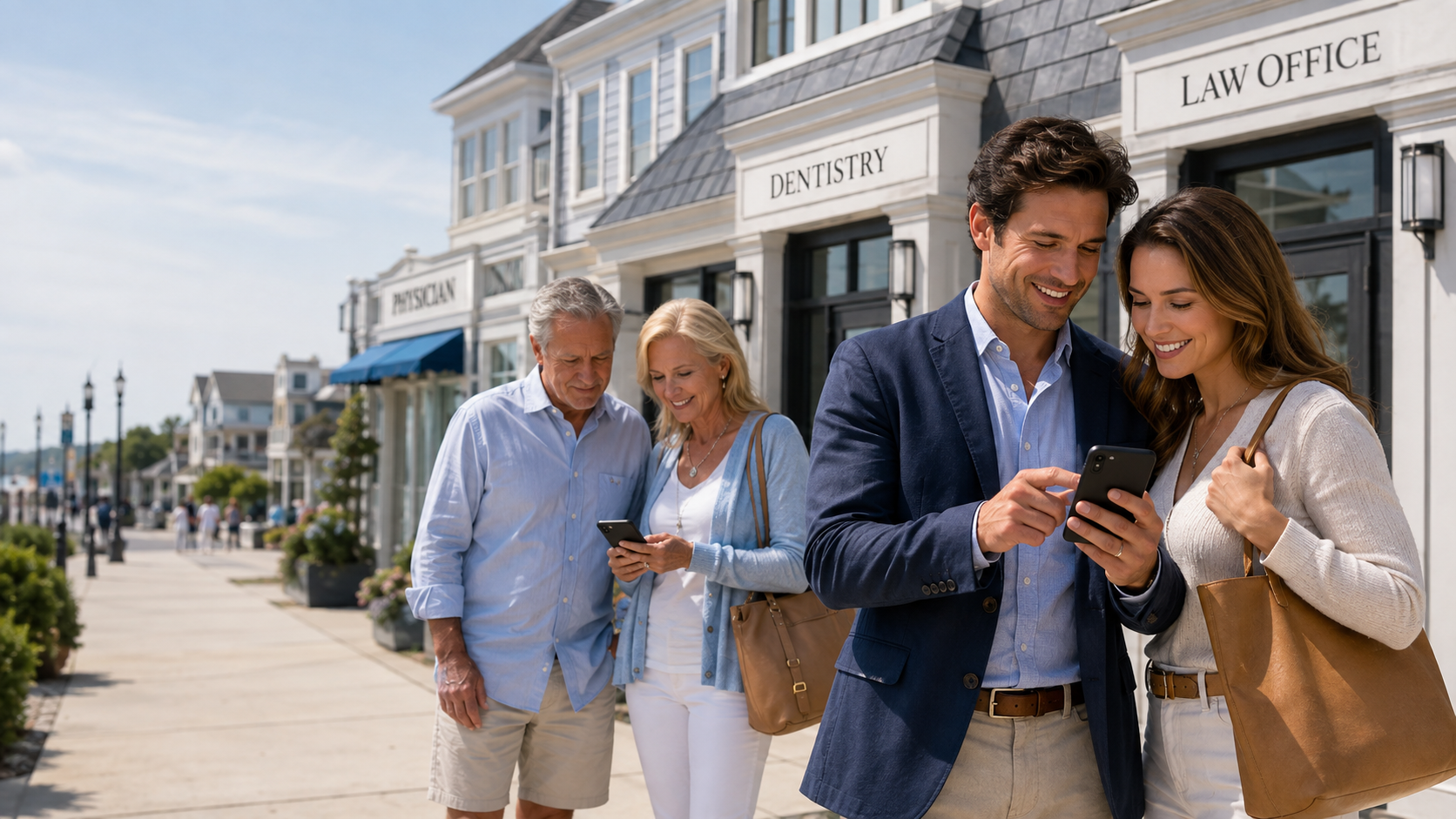
Picture two waiting rooms, a few blocks apart, on the same October morning.
In the first — a dental practice off Route 9 — a new patient is filling out forms. She and her husband sold the house in Havertown in June and moved to the Crest full-time, the retirement they'd promised themselves through thirty summers of rentals. She needs a new dentist, a new GP, a new cardiologist, a new everything. She knows exactly one healthcare provider in Cape May County: the urgent care that looked at her grandson's ear infection two Augusts ago.
In the second — a law firm's conference room — a couple from Basking Ridge is signing estate documents. New Jersey residents their whole lives, but shore residents as of this spring, with a house that needs to go into the trust, a will that names the wrong state's realities, and a family attorney back home who's three hours and one career-stage away from being the right person for any of it.
Neither of these clients arrived by referral. Neither could have — their referral networks live in Delaware County and Somerset County, and their new lives live here. They arrived the way every transplant, every visitor, and every absentee owner in this county now arrives at a professional's door: through a search bar.
This is the seventh letter in our series to the businesses of the Wildwoods and the Shore — after the motels, the rental managers, the restaurants, the charters, the contractors, and the real estate teams — and it's addressed to the practices that quietly anchor the county's year-round economy: medicine, dentistry, and law. Your industries were built on the strongest referral cultures in commerce. This letter is about what happens when the population your referral network was built for stops being the population you serve.
The Referral Network Is Thinning — and the Data Says So on Both Sides
Cape May County's demographic engine produces professional-services clients with no local roots, continuously. The county skews sharply older than the state — youth are just 16% of the population versus 22% statewide — because the same migration that fills the real estate letter's couches in Doylestown eventually fills your intake forms: renters become owners become retirees become residents — residents whose doctors, dentists, and lawyers are all three hours north, and whose replacement decisions will be made almost entirely from a screen.
The national behavior data confirms the referral era is fading even where roots exist. In healthcare: 77% of patients begin their search on Google, and only 29% rely primarily on another provider's referral — the professional referral, medicine's ancient client channel, is now a minority behavior. Patients then research like procurement officers: the average patient compares 21 distinct provider profiles before booking. In law, it's starker still: 96% of people with legal problems start with an online search, "near me" lawyer searches are up 42% in two years, and 71% of legal searchers contact a firm within 24 hours.
For a shore professional, layer the local reality on top: the transplant has no network, the summer visitor has no network, the absentee owner has no network — and even the year-rounder's network is aging out. The practice that dominated the county through relationships in 1995 and the practice that will dominate it through visibility in 2030 may be the same practice. But only if it makes the transition on purpose.
For the Medical and Dental Practices: Three Patient Streams, One Screen
Stream one: the relocating retiree — the most valuable new-patient event in healthcare. The Havertown couple isn't choosing one appointment; they're choosing their providers for the last third of their lives — implants and crowns, joint replacements, cardiology, the whole continuum — and they're choosing all of it at once, in one research burst, with zero local input. What decides it: search visibility for "[specialty] Cape May Court House," a Google profile that answers the questions transplants ask (accepting new patients? which insurance? Medicare?), and reviews — where the platform data is blunt: providers with 10+ reviews get 3x as many bookings as those with none, and volume-plus-recency is the whole game. The review that closes this patient, like the contractor's out-of-state review, is the one written by someone like her: "We moved down from PA and needed everything new — this practice made it easy."
Stream two: the summer surge. The island's population multiplies for fourteen weeks, and with it every urgent need — the boardwalk ankle, the toothache in a rental, the sunburned kid at 7pm. These patients search exactly like the restaurant letter's bench family: mobile, immediate, map-pack-decided, hours-sensitive. And note the after-hours reality: 43% of appointments are booked between 5pm and 9am — a practice whose booking stops when the front desk leaves is invisible to nearly half its demand.
Stream three: the platform toll, healthcare edition. The pattern from every letter in this series has its medical version: booking platforms like Zocdoc charge a per-new-patient fee on every booking they originate — while, per their own documentation, bookings from your website and your Google Business Profile are free. Read that twice: the toll and the toll-free road are published side by side. The strategy writes itself, and it's the same one as always — platforms for incremental discovery if the math works, owned visibility for everything that should never have paid a fee: your name searches, your existing-patient rebookings, and the transplant who was going to choose somebody in the county anyway.
For the Law Firms: The Shore Shapes Your Practice Areas — and Your Clients Search From Out of State
A Cape May County firm's caseload is a map of everything this series has described, and each practice area has its own search battlefield:
Estate planning — the quiet goldmine. Every relocating retiree in the county needs updated documents, a trust that holds the shore house, and a local attorney to replace the one up north. The demand is demographic and perpetual — and the conversion economics are the best in law: trust and estate attorneys set consultations for 27% of their leads, the highest rate of any practice area (the all-practice average is 14%). Content answering the transplant's actual questions — does my PA will work in NJ, how do we title the shore house, what does NJ's estate landscape mean for us — farms this stream for a fraction of what any other practice area's client costs.
The vacation-incident client — who searches from three states away. The visitor arrested on a July Saturday, the family whose teenager got a municipal summons, the tourist injured on a rental bike or a boardwalk ramp — they go home, and then they search: "DUI lawyer Cape May County," "personal injury attorney Wildwood NJ" — from a living room in Pennsylvania. It's the contractors' sight-unseen dynamic in legal form: a client who cannot ask around, hiring entirely on what the screen proves, with urgency (71% contact a firm within 24 hours). The firm that publishes the calm, authoritative answer to "what happens if you got a summons in Wildwood and live out of state" owns a client stream competitors don't even realize renews every single summer.
The absentee-owner and transaction work. Closings for the out-of-market buyers, landlord-tenant and rental-regulation questions for the owners and managers — a natural referral web with every business in this series, formalized by being the firm whose content those industries already cite.
And the cost of renting demand instead of owning it. Legal marketing's toll booths are the most expensive in local commerce: personal injury clicks run $150–$300+ each, and purchased leads range from $100 to $1,000 — while 97% of legal professionals using PPC say it's too expensive to produce good ROI. Against that: law firms average a 526% ROI on SEO over three years, firms with blogs generate 3.4x more leads, and firms above 4.5 stars generate 3.2x more. The owned engine isn't the idealistic option in law. It's the arithmetic one.
The AI Front — Where We Can Show You Our Own Receipts
Both professions are watching the same migration every letter has documented: the questions are moving into AI conversations. "Find me a dentist near Cape May Court House taking new Medicare patients." "My son got a summons in Wildwood and we live in Harrisburg — what do we do?" "Do we need a New Jersey attorney to update our estate plan after moving to the shore?" AI recommendation usage has grown from 6% to 45% in a single year, the engines answer from published, structured, verifiable content — and for nearly every professional-services question in this county, the citation slots sit empty.
Here we can do something no other letter in this series could: show you our own evidence, in your own vertical. We asked ChatGPT, Gemini, and Claude directly who does AI search optimization for New Jersey law firms — and published the full exchanges, including the pushback. That's not a case study we're describing; it's the method itself, run on ourselves, receipts attached — the same entity, structure, and authority work we'd run for your practice, held to the standard we hold everything: our numbers, published monthly, in public.
One operational note before the FAQ, because it's the cheapest revenue in this letter: visibility only pays if intake answers. Law firms miss roughly 36% of incoming calls, and 34% of those callers never try again; medical demand books nearly half its appointments after hours. Whatever engine we build, the first audit is always the same: call your own front desk at 6:15 on a Tuesday, and see what your marketing budget is currently paying to send to voicemail.
Frequently Asked Questions
Why do shore-area professional practices need SEO if they've always grown by referral?
Because the population the referral network was built for is being replaced by one that has no network: relocated retirees, summer visitors, and absentee owners whose entire professional graph lives out of county. The behavior data confirms the shift even nationally — only 29% of patients rely primarily on provider referrals, while 77% start on Google, and 96% of legal consumers begin with an online search. In Cape May County, where the client base structurally skews transplant, search isn't replacing referral. It has already replaced it; the only question is which practices notice first.
What's the most valuable patient or client the shore demographics produce?
The relocating retiree, in both professions at once. In healthcare, they select an entire provider roster — dental, primary, specialty — in a single research burst, with decades of care value attached and 21 provider profiles compared per decision. In law, they need estate plans rebuilt for New Jersey and the shore house — the practice area with the highest lead-to-consultation conversion in the profession at 27%. Content and visibility aimed squarely at "we just moved here and need everything new" captures both versions of this client at their single moment of maximum openness.
How should practices think about Zocdoc, legal directories, and lead services?
The way every business in this series should think about its toll booth: as optional overflow, never the front door. Zocdoc charges per new-patient booking while bookings from your own website and Google profile are free; legal leads run $100–$1,000 each with PI clicks at $150–$300+. Owned visibility — rankings, reviews, content, AI citations — costs the same whether it delivers one client or one hundred, compounds instead of re-billing, and captures the name-searchers and transplants who were choosing a local provider regardless. Rent for the increment; own the base.
How do out-of-state clients choose a Cape May County lawyer they've never met?
Through the sight-unseen verification stack this series keeps finding: search position for the exact predicament ("out-of-state DUI Cape May County," "summons in Wildwood"), published content that calmly explains what happens next, review volume and recency — firms above 4.5 stars generate 3.2x more leads — and fast response, since 71% of legal searchers contact a firm within a day and most never call twice. The summer-incident client renews annually with the tourist population; the firm that owns those searches owns a perpetual stream competitors haven't noticed is a stream.
Are patients and legal clients really using AI to choose providers?
Increasingly and measurably: AI tool usage for recommendations jumped from 6% to 45% in one year, and professional-services questions — insurance fit, jurisdiction, "who handles X near Y" — are precisely the multi-constraint queries AI answers best. The engines cite whoever has published verifiable, structured, authoritative answers, and in Cape May County those slots are almost entirely unclaimed. We've tested the dynamic on ourselves in the legal vertical and published the full AI exchanges — the method transfers directly to any practice willing to build the evidence.
What's the fastest payback move for a shore professional practice?
Fix intake before touching visibility: 36% of calls to law firms go unanswered and a third of those callers are gone forever, while 43% of medical bookings happen after hours — meaning many practices already generate demand they're paying to lose. After that, the review engine (volume and recency, with transplant and out-of-state testimonials prioritized) and the relocating-retiree content layer typically move first, with the full engine forecast — in patients, consultations, and matters rather than clicks — built before any work begins.
The Forms Are Being Filled Out Somewhere. Make Sure It's Your Waiting Room.
The Havertown couple found a dentist last month. The Basking Ridge couple signed with a firm this spring. Both decisions were made in under a week, from a screen, by people who would have been referral clients in any other era — and both went to whichever practice the county's search results happened to favor that day. Favor is buildable. It compounds. And in a county that manufactures rootless clients year-round, it's the closest thing to the old referral network your profession will ever have again.
We'll show you exactly what the transplant, the tourist, and the out-of-state searcher find today when they look for your specialty in your towns — Google, maps, reviews, and the AI engines alike.
Book a free 30-minute strategy call → An honest audit, a forecast in patients and matters rather than impressions, and a clear next step within one business day — from a firm that ran this exact playbook on itself and published the results.
Sources
Net One Click — How Patients Will Find Their Doctors in 2026 (77% start on Google; 29% referral reliance)
Zocdoc — What Patients Actually Look for When Choosing a Doctor in 2026 (21 profiles compared; decision behavior)
Zocdoc — Provider Acquisition Facts (pay-per-booking model; free owned-channel bookings; 43% after-hours; 10+ reviews = 3x bookings)
Searchlab — Legal Sector Marketing Statistics 2026 (96% online start; near-me growth; 24-hour contact; review and blog multipliers)
CASEpeer — Personal Injury Law Statistics 2026 (consultation conversion by practice area; T&E at 27%)
Web Tonic — Personal Injury Digital Marketing Stats 2026 (PI CPC and lead-cost ranges; map-pack economics)
SeoProfy — 92 Legal Marketing Statistics for 2026 (PPC ROI sentiment)
Intercore — Personal Injury Marketing Statistics (526% three-year SEO ROI; 96% online start)
Hyperleap — Legal Client Intake Statistics 2026 (missed-call and callback data)
Cape May County Herald — 2024 Census Estimates (county age structure)
CCC — Local Consumer Review Survey 2026 Insights (AI recommendation usage growth)