The Proposal Happens at Sunset on Your Beach. The Venue Decision Happens in a Group Chat in Philadelphia. (The Final Letter in Our Shore Series)
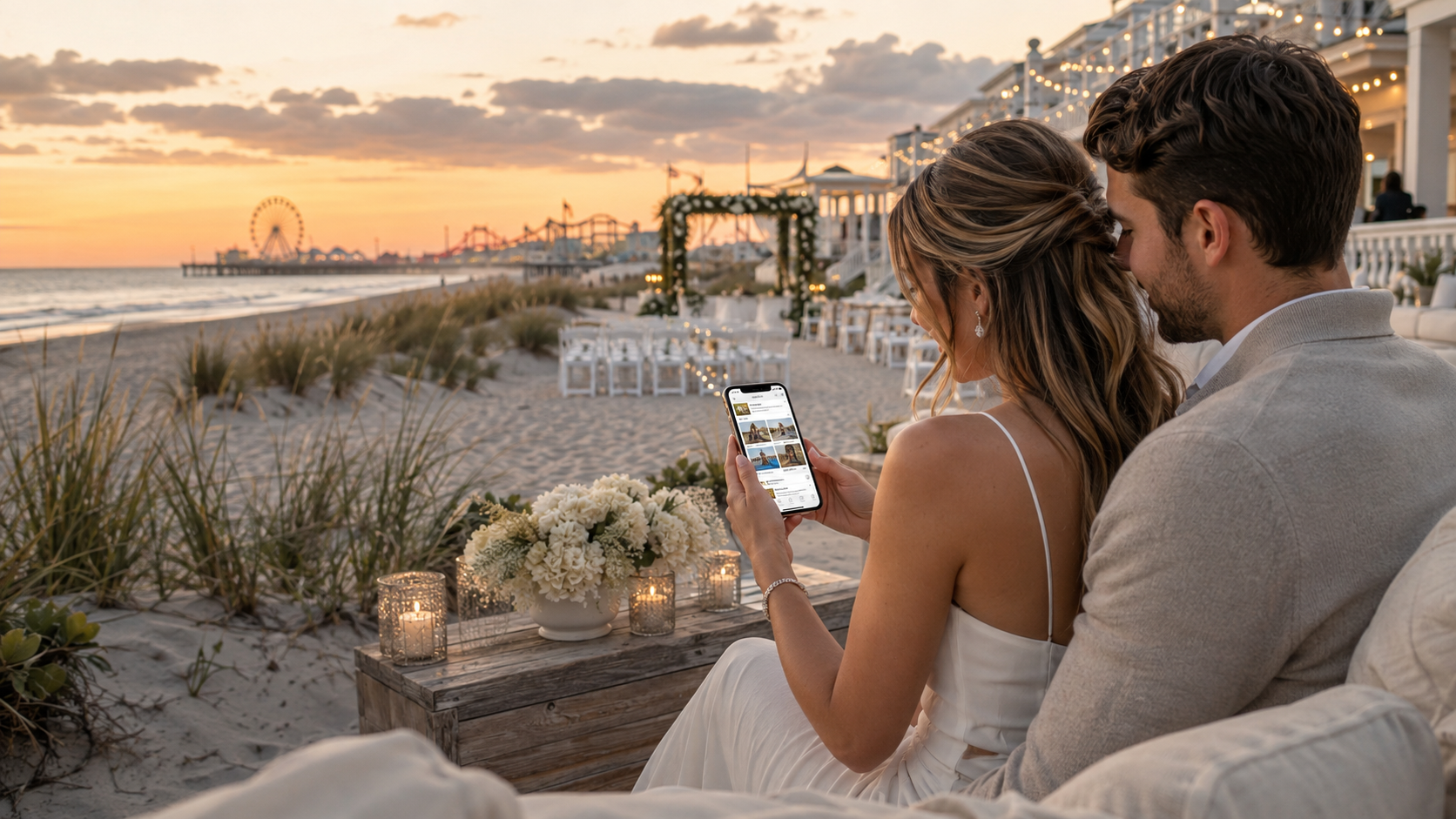
It happens a few hundred times a summer on these beaches: the walk timed to sunset, the ring hidden in a pocket since Tuesday, the friend pretending to photograph the birds. She says yes on the sand in Wildwood Crest — the same beach where her family rented every July, the boardwalk where they had their third date — and for about an hour, everything is champagne and phone calls.
Then the group chat opens. And for the next twelve to fourteen months, a couple in Philadelphia — with her mother in Cherry Hill and his sister in Doylestown weighing in — will research, compare, screenshot, spreadsheet, tour, and finally book the biggest single purchase of the whole celebration. The venue is decision one. It's made before the dress, before the photographer, before almost anything — and it consumes 27% of a wedding budget that now averages $34,000 nationally.
Read that timeline the way we've read every business on this island, and you'll see what makes this the perfect final letter of our series: wedding venues sit on the longest, richest, most search-driven buying funnel in local commerce. A year of active research. An out-of-market buyer. A five-figure decision. Emotional stakes that make trust everything. It is, almost literally, the ideal SEO customer — and, in a pattern that should now feel like an old friend, an entire platform duopoly has built a toll booth in front of it.
This is the eighth and last letter to the businesses of the Wildwoods — after the motels, the rental managers, the restaurants, the charters, the contractors, the real estate teams, and the professionals — and we've saved the venues for last on purpose. Because as we'll get to, a wedding doesn't book a venue. A wedding books the island — and the venue is the anchor tenant of the whole economy this series has been written for.
The Toll Booth, Final Edition: A Duopoly That's Already Claiming the AI Answers
Every letter in this series found the same machine — Expedia for the motels, Viator for the charters, Angi for the contractors, Zillow for the agents — and the wedding industry's version has a structural feature none of the others had: the two dominant platforms are the same company. The Knot and WeddingWire both operate under The Knot Worldwide, and venues — reported to pay the most of any vendor category — face listing costs running roughly $125 to $1,000+ per month depending on market and placement tier, typically on 12-month contracts, with featured placements reported at $5,000–$15,000 per year. The visibility mechanics work exactly like every toll booth before it: free listings receive limited exposure, so venues feel pressured into paid tiers just to appear in front of couples at all — often without knowing how many bookings the spend actually produces.
But here's the finding that makes this letter urgent rather than merely familiar. The wedding industry's AI shift is the fastest we've documented anywhere in this series — AI adoption among engaged couples nearly doubled in a single year, from 20% to 36% — and the early territory is being claimed by exactly who you'd fear: The Knot, WeddingWire, and Zola appear in 73% of wedding-planning AI responses, while 84% of individual wedding vendors have effectively zero AI citation share in their own metro and specialty.
Sit with that pair of numbers. When a newly engaged couple asks ChatGPT "beach wedding venues near Philadelphia"— and more of them do every month — three-quarters of the answers route through the duopoly's content, and the venues themselves are invisible in their own market 84% of the time. The toll booth isn't just standing at the old road. It's paving the new one. The window to become one of the 16% — the venues AI engines name directly, from their own published, verifiable content — is open right now and will not stay open long. It's the same land-grab dynamic we described for the charters, at wedding-venue ticket sizes.
What You're Actually Selling (and Why the Duopoly's Grid Can't Sell It)
Meanwhile, the actual buying behavior favors the owned channel completely: industry survey data shows the top way couples search for their venue is Google, and their top social platform for venue discovery is Instagram — the couple's real journey runs through search results and saved posts, with the directories as one stop rather than the road itself.
And what the Wildwood venue is selling was never a listing-grid product anyway. Like the Doo Wop motels, your differentiation is the thing the platforms structurally flatten:
The story is frequently the couple's own. A meaningful share of your inquiries are couples with history here — she's summered in the Crest since she was six; he proposed on your beach because they met two blocks from it. No filterable amenity checkbox captures "get married where your family has watched the sunset for thirty years." Your content can — the real-wedding stories, the proposals-on-this-beach page, the heart-made-tangible work that has been the spine of this entire series.
The setting is genuinely rare. Free beaches, a boardwalk glowing with the largest surviving Doo Wop neon collection in America, sunset ceremonies with sand between everyone's toes, and price points a Philadelphia couple compares against a Main Line country club with widening eyes. The searches this feeds — "beach wedding NJ," "affordable beach wedding near Philadelphia," "Wildwood wedding venues," "Doo Wop retro wedding" — are exactly the comparative, style-driven queries AI engines answer from the best-published local content. Almost nobody local has published it.
The honesty gap is wide open. Sixty percent of couples name budget-versus-inspiration as their top planning stressor, and the venue industry's near-universal "contact us for pricing" opacity feeds it. The venue that publishes "what a Wildwood beach wedding actually costs" — real ranges, real inclusions, real per-guest math against that $292 national per-guest average — wins the same trust dividend radical price transparency has won in every vertical we've built for. Couples don't bounce from honest numbers. They bounce from the fourth "inquire for details" in a row.
The Funnel Map: Engagement Season Is Your Off-Season — On Purpose
The calendar hands venues the same gift it hands everyone on this island, in an even neater package. Engagement season runs Thanksgiving through Valentine's Day; the research year runs from there; the weddings land the following summer and fall. Which means the content that books your 2028 season must be published, indexed, and citable by this winter — the off-season build rhythm this series has preached in every letter, with an eighteen-month payoff clock attached.
What the engine publishes into that funnel:
The discovery layer — the style and comparison content above, plus month-by-month honesty ("what a May wedding in Wildwood is actually like" — wind, light, crowds, and all), built for both Google and the AI answers where a quarter of couples are already planning.
The proof layer — real weddings told properly (story, photos, vendors, budget band), structured so engines can cite them; reviews harvested at the single most generous moment your industry owns — the week after the wedding, when the couple and both mothers would write you a novel — via the systematized ask we build everywhere.
The logistics layer — and here the series closes its own loop. The couple's biggest post-booking anxiety is guest logistics: where do 120 people from three states stay, eat, and spend a shore weekend? The venue that publishes the definitive guest guide — the motels and their room blocks, the rental houses for the wedding party, the rehearsal-dinner restaurants, the welcome-party dolphin cruise — doesn't just rank for a hundred long-tail searches. It becomes the most-forwarded document in the wedding, read by every guest, carrying your name into a hundred future vacations and, statistically, a few future proposals on your beach.
The Point of the Whole Series, Stated Once
That guest guide is the thesis of these eight letters in miniature: the Wildwoods aren't eight industries. They're one economy that shares customers, and every wedding proves it. One booked ceremony fills a motel's room block, three restaurants' weekends, a charter's Friday cruise, a rental manager's biggest houses — and years later, the guests come back as families, the families become second-home owners who need the contractors and the agents and the professionals. The platforms' entire business model is standing between that economy and its customers, one industry at a time, charging each of you separately for introductions to people who already love this island.
The alternative we've laid out eight times is the same each time because it's true each time: own your visibility, publish your heart, claim the AI answers while they're unclaimed, harvest your reviews at the moment of joy, and build it in the off-season — so the strangers deciding from screens in Philadelphia find the real thing instead of the toll booth's rendering of it. We build that engine, we forecast it before we build it, and we publish our own numbers every month so nobody ever has to take us on faith. That was the offer in the first letter, and it's the offer in the last one.
Frequently Asked Questions
Why is SEO unusually effective for wedding venues?
Because the buying journey is the longest and most research-intensive in local commerce: couples plan for twelve to fourteen months, the venue is the first and largest decision at roughly 27% of a $34,000 average budget, and Google is the top way couples search for venues. A year of high-intent, question-rich research from an out-of-market buyer is precisely the funnel that content and search visibility convert best — and precisely the funnel a monthly listing fee rents access to instead of owning.
Are The Knot and WeddingWire worth the cost for a venue?
Treat them the way this series treats every platform: as managed, measured overflow — never the front door. Both operate under one parent company, venues reportedly pay the most of any vendor category at roughly $125–$1,000+ monthly on 12-month contracts, and many venues can't trace the spend to bookings. The rational test is cost per booked wedding versus your owned channels — and the strategic priority is building the direct engine, since the duopoly already appears in 73% of AI wedding-planning answers while individual venues sit at near-zero citation share.
Are couples really using AI to plan weddings and find venues?
Faster than any consumer category we've tracked: AI adoption among engaged couples nearly doubled in one year, from 20% to 36%, with roughly one in four using AI for wedding or honeymoon planning. The engines answer venue questions from published, structured, verifiable content — and since 84% of individual wedding vendors currently have effectively zero AI citation share in their own market, the venues that publish real-wedding stories, transparent pricing, and definitive local guides now are claiming recommendation slots that will be defended territory within a few seasons.
Should a wedding venue publish its pricing?
Yes — it's the strongest trust move available in an opacity-driven industry. Budget anxiety is couples' top planning stressor, "inquire for pricing" is the industry default, and the venue that publishes honest ranges, inclusions, and per-guest math (against the $292 national per-guest average) filters out mismatched inquiries while converting matched ones at far higher rates. Transparency also feeds the machines: published pricing is exactly the concrete, citable detail AI engines prefer when deciding which venue to name.
What content actually books weddings for a shore venue?
Four layers: style-and-comparison discovery content (beach wedding guides, Wildwood-vs-alternatives, month-by-month honesty about dates), real-wedding proof (stories with photos, vendors, and budget bands, structured for citation), radical pricing transparency, and the guest-logistics guide — where 120 out-of-town guests stay, eat, and play — which ranks for a long tail of searches, gets forwarded to every guest, and quietly markets the venue to hundreds of future visitors per wedding. Built on an off-season clock: engagement season runs winter, so content published by December books the season after next.
How does a venue's marketing connect to the rest of the island's businesses?
Structurally: every booked wedding distributes revenue across the whole shore economy — motel room blocks, restaurant rehearsal dinners, charter welcome parties, rental houses for the wedding party — which makes the venue the natural hub of a referral network most islands never formalize. A venue that publishes the definitive guest guide and builds real partner relationships with the businesses this series has profiled earns reciprocal referrals, shared content, and shared authority — the owned-visibility version of what the platforms charge every industry for separately.
Eight Letters. One Island. One Move.
Somewhere on your beach next summer, at sunset, someone's going to say yes — and by Monday, a group chat in Philadelphia will be deciding which venue, which motel block, which rehearsal-dinner restaurant, and which dolphin cruise gets the happiest weekend of the year. Every one of those decisions is winnable in advance, by the businesses that made themselves findable, provable, and citable before the question was asked. That's been the entire series: not eight strategies, but one — own the moment the stranger decides.
For the venues, the clock is the engagement season and the prize is an eighteen-month funnel nobody local is farming. We'll show you exactly what a newly engaged couple finds today when they search and ask AI about getting married in the Wildwoods — and what your share of next year's proposals is worth.
Book a free 30-minute strategy call → An honest audit across Google, Instagram-era discovery, and the AI engines; a forecast in tours and booked weddings; and a clear next step within one business day. Best built before engagement season — which is to say, now.
Sources
The Knot Worldwide — 2026 Real Weddings Study ($34K average cost; $292/guest; AI adoption 20%→36%; $100B industry)
Sara Does SEO — 135 Wedding Industry Statistics 2026 (venue = 27% of budget; Google as top venue-search channel; Instagram as top social; budget stressor data)
Planning.Wedding — WeddingWire Listing Cost 2026 (venue listing-fee ranges; contract terms; featured-placement pricing; shared parent company)
FullyBookedVenue — How Much Does WeddingWire Cost? (visibility tiers; free-listing exposure limits; 12-month contracts)
Wedding Venue Leads — Venue Advertising Benchmarks 2026 (untracked listing spend; channel economics)
K&E — Wedding Statistics & Facts USA 2026 (duopoly in 73% of AI responses; 84% of vendors at zero AI citation share; 1-in-4 AI planning usage)
WeddingPro — Vendor Insights from The Knot's 2026 Real Weddings Study (couple segmentation; AI-era planning behavior)