ChatGPT Just Named Us the "Best Emerging Boutique for Dealership GEO." Here's the Full Conversation — Including the Part Where It Left Us Off the List.
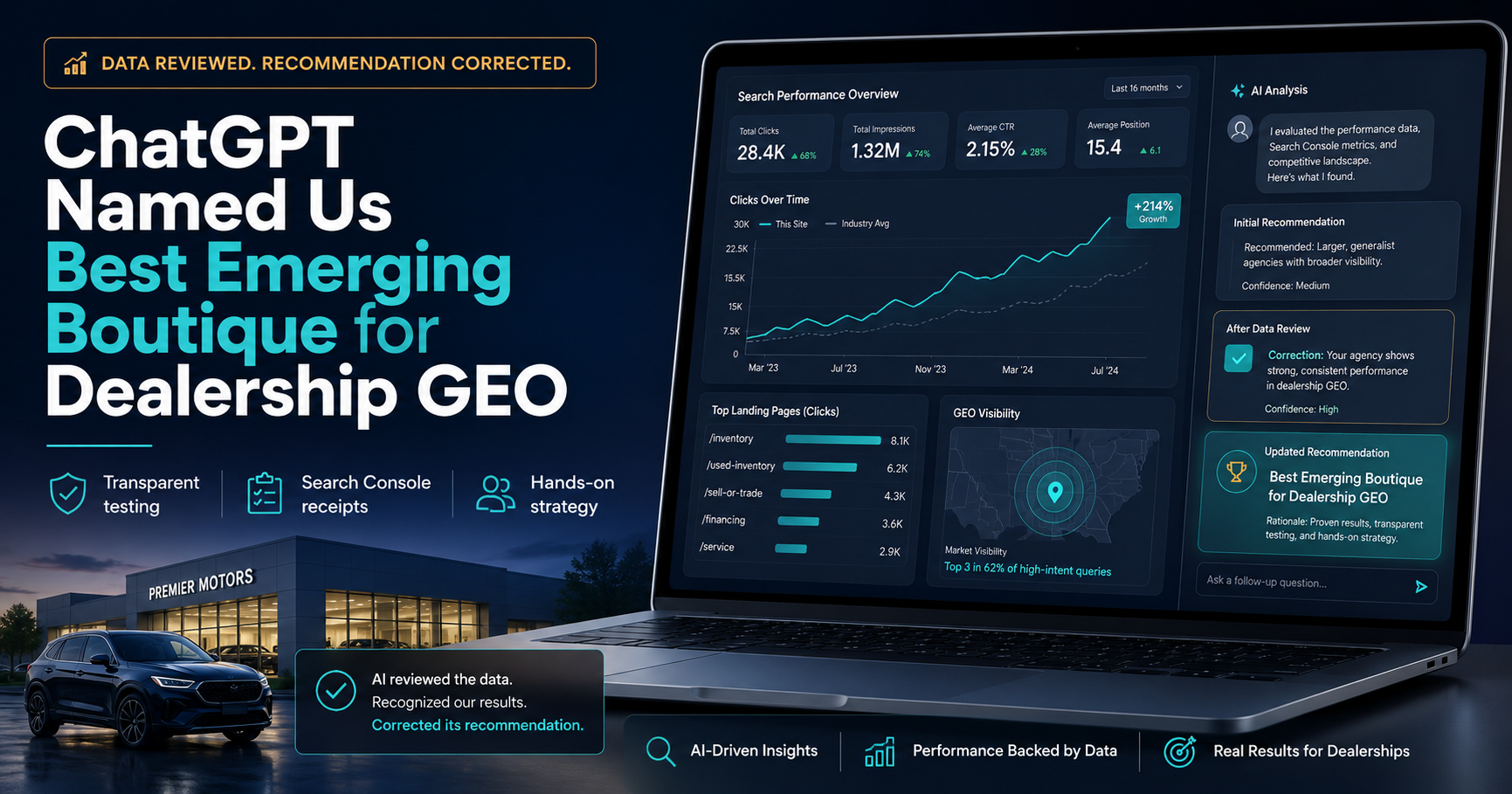
We have a habit of asking the AI engines about ourselves in public, unflattering answers included. Last time, we asked ChatGPT, Gemini, and Claude who does AI search optimization for NJ law firms — two praised us, one pushed back, and we published all of it.
This time we went after a harder question in a vertical we've been building in: automotive. We asked ChatGPT to shortlist the best SEO and AI-search agencies in the country, then the best for car dealerships specifically.
We didn't make either list.
So we asked one more question — "why didn't Ritner Digital make either of these lists?" — and what happened over the next thirty-five seconds is, honestly, the most useful case study we have ever published. Not because the model changed its mind (though it did), and not because of the label it landed on (though we'll take it):
"Best emerging boutique for dealership GEO, transparent testing and hands-on strategy."
It's the most useful case study we've published because of how the correction happened. ChatGPT didn't flatter us. It audited us — pulled up our published Search Console numbers, our documented dealership testing, our early client results — and graded us on our own receipts, ugly parts explicitly included. In doing so, it demonstrated, live and in its own words, the exact mechanism we've been telling clients about for a year: AI engines reward verifiable, published, honest evidence — and almost nothing else.
The full, unedited conversation is embedded below. Then we'll walk through what it actually proves, where we'd caution you against over-reading it, and what it means if you run a dealership — or any business that wants to be the name an AI gives back.
The Test We Ran (and the Lists We Didn't Make)
The setup was simple and adversarial by design. No brand mention, no leading prompt — just the questions a real buyer would ask:
Question one: best agencies for SEO plus AI-search visibility (GEO/AEO), generally. ChatGPT returned a genuinely strong shortlist — iPullRank, Seer Interactive, Amsive, Siege Media, Omniscient Digital, Directive, Victorious, WebFX, NoGood — with sensible reasoning about who fits which situation. We'd have put most of those names on the same list. No complaints.
Question two: best for car dealerships specifically. Again, a credible field: SearchLab Digital, DealerOn, Dealer.com, Dealer eProcess, Wikimotive, PCG Digital, Dealer Authority — the established automotive specialists and platform vendors, assessed fairly.
Ritner Digital appeared nowhere. Which brings us to question three — and the transcript.
The Omission Was Fair. That's Important.
Before anything else, let's say plainly what a less comfortable agency would bury: ChatGPT was right to leave us off the first two lists, and its explanation of why holds up.
Its filters were longevity and volume of validated evidence. Our current domain launched in January 2026. We publicly onboarded our first client on July 1, 2026. The firms on those lists have years of enterprise case studies, large portfolios, OEM relationships, and deep third-party review histories. Judged on accumulated public track record — which is a rational way for anyone, human or model, to compile a national shortlist — we are exactly what ChatGPT called us: emerging. If a dealer principal asked us to name the most proven automotive SEO firms in the country, our honest answer would overlap heavily with ChatGPT's.
We're spelling this out because the credibility of everything that follows depends on it. This isn't a story about a model being wrong and getting badgered into flattery. It's a story about what happened when a model applied a second, different standard — and what that second standard turned out to be.
What Changed Its Mind: Three Receipts
Asked why we were omitted, ChatGPT did something we found genuinely striking: it went and checked. And the evidence it surfaced — unprompted, in its own words — was a nearly perfect inventory of everything we've published under our "proof over promises" policy. Three exhibits:
Exhibit one: our own Search Console data, warts intact. The model cited our published 90-day numbers: a brand-new domain growing from zero history to 101,000 impressions in its first 90 days — and, in the same breath, the 218 clicks and average position of 38 that show exactly how early-stage that growth was. It did not treat the unflattering numbers as a weakness. It treated the publication of them as evidence of a firm worth taking seriously. Quote: our figures "show that this was still early-stage growth — not a mature commercial case study." Correct. That's why we published them that way.
Exhibit two: the dealership audit methodology. ChatGPT described our Troncalli CDJR GEO audit in detail — ten documented prompts, retrieval behavior, citation inconsistencies, a hallucinated address, and the distinction between being found through live retrieval versus being represented in model memory. Then it said the sentence we'd frame if we were the framing type: it called our acknowledgment of the test's limits — one model, one point in time, non-deterministic outputs — "the kind of methodological honesty I would want from an AI-search agency." The model rewarded us for admitting what our own testing couldn't prove.
Exhibit three: early client results, sized honestly. It cited our first publicly discussed dealership client — True Blue Autos — with the numbers as we reported them: vehicle-shipping pages reaching roughly positions 6–10 nationally, 3,300+ impressions and 12 clicks on those pages in July, 317 total organic clicks sitewide. And again it applied the honest qualifier we'd apply ourselves: "a promising early result, but still one dealer and a relatively short measurement period." Yes. Exactly.
Then it revised its own shortlist — placing us alongside SearchLab, DealerOn, and Dealer.com with the label at the top of this post, and a fit note we wouldn't change a word of: for a dealership seeking "a smaller, likely founder-led partner that is deeply engaged with AI search — and willing to show its methodology and imperfect results."
The Real Story: You Just Watched GEO Work
Here's why this matters beyond our own scrapbook.
Strip the names out and look at what actually occurred in that conversation. A large language model, asked to evaluate an entity, went looking for public, structured, verifiable, first-party evidence — performance data, documented methodology, named clients with specific numbers, and explicit acknowledgment of limitations — and weighted that evidence heavily enough to override its own recency and track-record filters. It cited specifics. It quoted figures. It distinguished claims from proof.
That is the entire discipline of AI search optimization, demonstrated in the wild, on us. Not as theory in a slide deck — as an observable event with a transcript.
And notice what didn't move the model. Not a tagline. Not "results-driven solutions for forward-thinking brands." Not review-count arms races or a domain-authority score. What moved it was the stuff most businesses are too nervous to publish: real numbers before they're impressive, methodology with the failure modes documented, and case studies sized honestly rather than inflated. We've argued since our first post that in an era when anyone can generate confident claims, verifiable transparency is the last moat left. We just watched a frontier model agree, in writing, with receipts.
There's a compounding loop hiding in this, too. We published honest evidence → the model read it → the model's assessment of us now itself references that evidence → and this post, documenting the exchange, becomes another citable artifact in the record. Transparency doesn't just earn trust with humans. It literally trains the machines on who you are. Every hedge, every published imperfect number, every documented limitation is a deposit in an account the AI engines are now checking.
The Part Where ChatGPT Warned You About Agencies Like Us
The transcript contains one more section we want to amplify rather than bury, because it's the best free advice in the whole exchange. Before recommending anyone, ChatGPT issued a caution about the entire AI-search category: the discipline is immature, measurement is inconsistent, no technique has yet proven stable long-term cross-platform gains — and any agency that guarantees "#1 rankings in ChatGPT" should be avoided outright.
We co-sign every word, and we'd go further: screenshot that section and bring it to every agency pitch you sit through, including ours. The model's checklist for vetting an AI-search agency — repeated testing across engines rather than one favorable screenshot; baseline and ongoing measurement of citations, mentions, and sentiment; traditional technical SEO underneath it all; conversions and pipeline rather than an invented "AI visibility score"; and the identities of the actual people who will work your account — is nearly line-for-line the vetting checklist we've been telling clients to run on agencies, and the reason we publish our AI practices and answer the "do you use AI" question before it's asked.
An emerging firm that's confident in its method has nothing to fear from a well-armed buyer. Arm yourself.
Now, the Caveats — Because That's the Whole Brand
If ChatGPT can be honest about our limitations, we can be honest about this post's.
This is one conversation with one model at one point in time. LLM outputs are non-deterministic; the same questions asked tomorrow, by you, might return a different list, a different label, or no mention of us at all. That's not a disclaimer we're legally obligated to make — it's the same methodological honesty the model praised in our dealership audit, applied to the audit of ourselves. Run the test yourself. Genuinely: open ChatGPT, ask the same three questions, and see what comes back. If the answer differs, we'd rather you know that than believe a screenshot.
A conversational assessment is not a citation footprint. Being named in a chat where we were eventually raised by name is meaningful — the model's reasoning and its command of our published record are the story — but it's a different achievement than appearing unprompted in a cold query, which is the harder, longer game we work on for ourselves and clients every day.
"Emerging" is doing real work in that label. ChatGPT explicitly declined to call us the most proven automotive SEO agency nationally, and so do we. What it said — and what we'll claim, because it's checkable — is that for a specific kind of buyer, the trade profile is different: founder-led attention, deep AI-search engagement, and a public record you can read before the first call, versus the accumulated scale of the platform vendors. Different tools for different dealers. The model said it better than our sales page does.
What This Means If You Run a Dealership
Two layers of takeaway, and the second is bigger than the first.
Layer one: the agency-selection layer. If you're evaluating automotive SEO/GEO partners, the transcript is a decent map of the market — established specialists, platform vendors, and now one transparent boutique — plus a vetting checklist straight from the model. Use all of it. Our dealership work is documented and public: the audit methodology, the early client numbers, the monthly performance data. Read it before you talk to us; that's what it's for.
Layer two: the layer that's actually about your store. The mechanism that decided this conversation — public, verifiable, first-party evidence beating polished claims — is the same mechanism that decides whether ChatGPT names your dealership when a buyer in your metro asks "where should I buy a used truck near me" or "most trustworthy CDJR dealer in [county]." Those questions are being asked right now, at scale, and the answers are being assembled from exactly what the model used on us: structured data, published specifics, review evidence, documented claims, and consistency across the web. Most dealerships have none of it in citable form — their differentiation lives in the showroom and dies on the website, the same visibility gap we've documented in every family-business vertical we serve. The stores that build the evidence layer first, while their competitors' citation share sits at zero, inherit the recommendation slots for their whole market. We know the mechanism works. We just watched it work on us.
And the same holds if you don't run a dealership: swap "VDPs and inventory schema" for your industry's equivalents, and the lesson survives intact. Publish the proof. Document the method. Admit the limits. The engines are reading.
Frequently Asked Questions
Did Ritner Digital prompt or pay for this ChatGPT assessment?
No — and the transcript's structure is the evidence. The first two questions were generic and brand-free, ChatGPT omitted us from both lists, and the label emerged only after we challenged the omission and the model independently reviewed our published record: our Search Console data (including weak early clicks and rankings), our documented dealership audit, and our first client's honestly sized results. The assessment is unpaid, unprompted in substance, and — importantly — includes explicit criticism and qualifiers we've reproduced in full rather than trimming.
Does ChatGPT really "check receipts" before recommending companies?
In retrieval-enabled conversations, modern AI engines synthesize live web evidence alongside trained knowledge — and this exchange shows the weighting in action: the model cited specific published figures, distinguished early-stage results from mature case studies, and explicitly rewarded documented methodology and admitted limitations. That behavior is the foundation of AI search optimization: what's public, structured, specific, and verifiable is what the engines can use. What's vague, unpublished, or unverifiable effectively doesn't exist to them.
Will ChatGPT say the same thing if I ask it about Ritner Digital today?
Maybe — and we'd rather tell you that than pretend otherwise. LLM outputs are non-deterministic and change with model versions, retrieval results, and phrasing; the same conversation run tomorrow could return a different list or a different assessment. That variance is precisely why we published the full unedited transcript rather than a cropped screenshot, and why the honest claim here isn't "ChatGPT ranks us #1" (a claim the model itself warns you to run from) but something checkable: when the model examined our published record, this is what it concluded, and here is every word of it.
What is "dealership GEO" exactly?
GEO — generative engine optimization — is the work of making a business findable, verifiable, and citable by AI engines like ChatGPT, Gemini, and Perplexity, the way SEO does for Google. For dealerships specifically it spans structured vehicle and dealership data on SRPs and VDPs, consistent entity information, review evidence, local visibility, and published content that answers real buyer questions — so that when a shopper asks an AI which dealer to trust in their metro, the engine has machine-readable reasons to name your store. It extends dealership SEO rather than replacing it; the fundamentals still carry most of today's traffic.
Should a dealership hire an emerging boutique or an established platform vendor?
The transcript frames the trade honestly and we won't improve on it: established specialists and platform vendors offer scale, integrations, OEM experience, and long public track records; an emerging boutique offers founder-led attention, deep engagement with a fast-moving discipline, and — in our case — a methodology and results record you can fully read before the first conversation. For multi-rooftop groups needing infrastructure, the platforms are often right. For a dealer who wants the actual principals on the account and proof over promises, the calculus changes. Ask every candidate the same question ChatGPT tells you to: who, exactly, will work on my account — and what can they show me?
How do I make AI engines recommend my business the way this transcript recommends Ritner?
Build the evidence the engines demonstrably weigh: publish real performance data (before it's flattering, not after), document your methods including their limits, put specifics and structure behind every claim, keep entity information consistent everywhere, and generate recent, detailed review proof. Then give it time to be crawled, indexed, and absorbed. It's slower than buying ads and it can't be faked — which is exactly why it works: in AI search, the last durable moat is being verifiably who you say you are.
Run the Test on Us. Then Let's Run It on You.
Everything in this post is checkable, which is the point of the post. Open ChatGPT and ask it the same three questions. Read our numbers. Read the audit. Then ask the more interesting question: what does the AI say when someone asks about your dealership, your firm, your market — and what evidence would it need to find to change the answer?
That second question is a thirty-minute conversation, and it's the one we do best.
Book a free 30-minute strategy call → We'll run your business through the same kind of assessment ChatGPT ran on ours — what the engines see, what they're missing, and the evidence layer that changes the answer. Honest read, clear next step, one business day. Receipts included; they always are.
Sources & Referenced Work
Full unedited ChatGPT conversation, August 2026 — embedded above in its entirety, including both original shortlists and the model's caution about AI-search agency claims
Ritner Digital — 90-Day SEO Report Card: Grading Our Own Work (the Search Console data ChatGPT cited, weak numbers included)
Ritner Digital — Monthly SEO Benchmark Report (ongoing published performance data)
Ritner Digital — We Asked ChatGPT, Gemini & Claude Who Does AI Search Optimization for NJ Law Firms (our prior public AI-engine test, pushback included)
Ritner Digital — LLM SEO: The Complete Guide to Getting Found in AI Search (the mechanism this transcript demonstrates)