Why Washington Township Medical Practices Need to Invest in SEO and AI Search
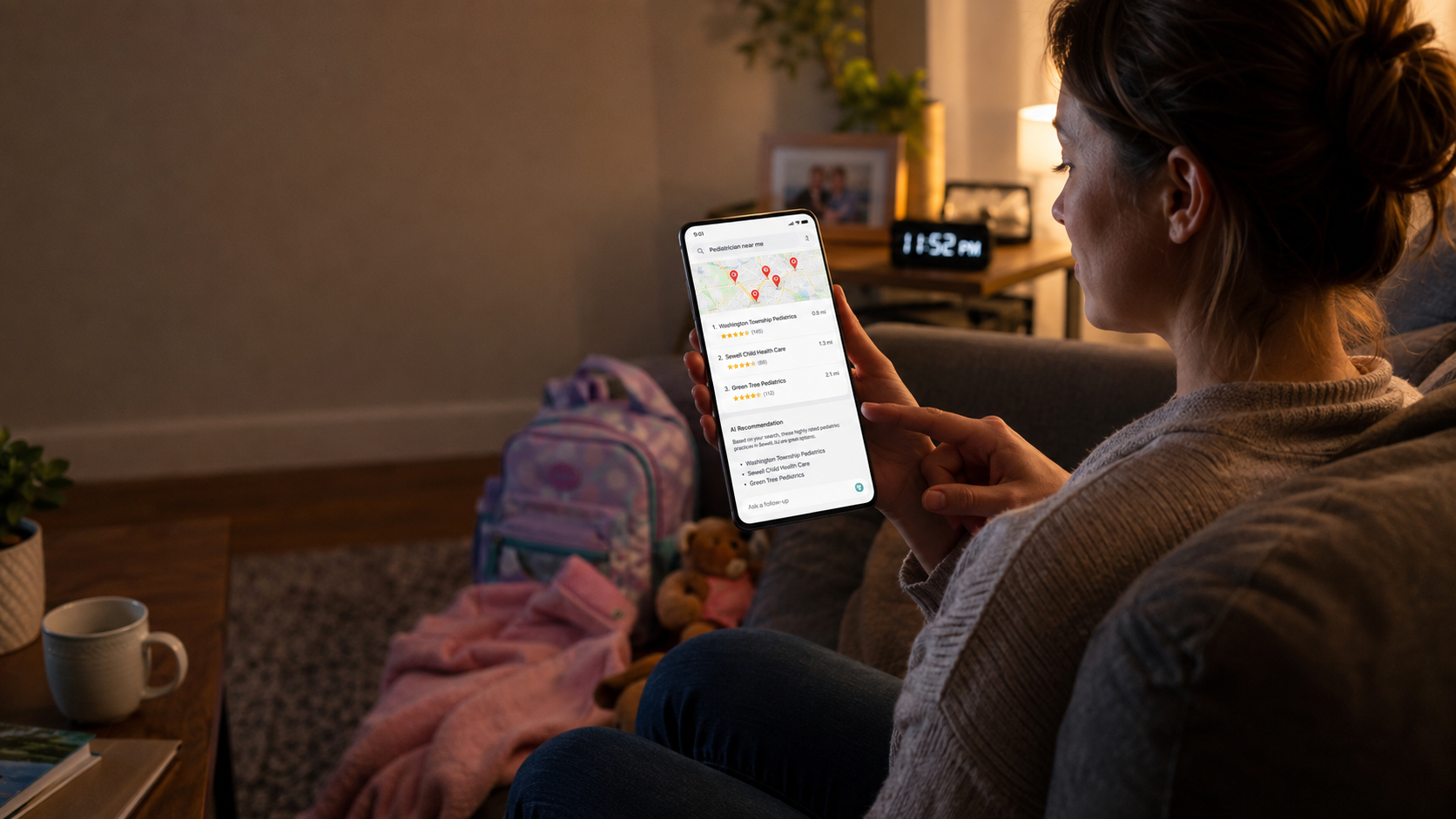
It's 11:52 on a Tuesday night in Sewell. A mom is sitting on the edge of her kid's bed with her phone out. The kid has a toothache, the pediatric dentist they used to see retired last year, and she's doing what roughly 49,000 of your neighbors do when they need care now: she's searching.
Maybe she Googles "pediatric dentist near me." Maybe she opens Maps and starts reading reviews. And — increasingly likely in 2026 — maybe she just asks ChatGPT who to see near Cross Keys and takes the answer.
Somewhere in Washington Township, one practice is going to get that family. Not because they're the best clinicians in Gloucester County — the mom has no way to evaluate that at midnight — but because they were findable, their information was correct, their reviews looked human, and their new-patient page answered her questions before she had to call anyone.
That's the whole argument for this post, and we're going to make it with data, not vibes. Every claim below is linked to its source, because that's how we do everything — and because if you're a physician or a practice owner, you already know the difference between an assertion and a citation.
The referral era is over. Here's what replaced it.
For decades, a medical practice grew on two engines: physician referrals and word of mouth. Both still matter. Neither is the front door anymore.
According to Tebra's annual Patient Perspectives survey, 77% of patients look for doctors online often or sometimes — and among millennials, the generation currently buying houses in Washington Township and choosing pediatricians for their kids, that behavior is nearly universal.
And here's the part that should get every referral-dependent practice's attention: the online check happens even when a referral exists. A survey commissioned by Doctors.com and covered by Inc. found that the overwhelming majority of patients read reviews about a provider even after being referred to them, and that a strong online presence is itself a deciding factor for most patients choosing between providers. A referral gets a patient looking in your direction. What they find when they look is what actually books the appointment.
What they're looking at, specifically:
Reviews, first and hardest. Research from Reputation and YouGov found that over 70% of consumers read patient reviews when searching for a healthcare provider, and 72% prefer providers rated four stars or higher. More recent data says the number has only climbed: a 2026 rater8 survey covered by Medical Economics put review-checking before appointments at 84% of patients.
How you respond to reviews. The same Reputation research found that 64% of consumers say it's important for healthcare providers to respond publicly to reviews. Most practices don't — usually because nobody on staff is sure what's HIPAA-safe to say, so nobody says anything, and the one bad review sits on top doing damage every night. (There is a HIPAA-safe way to answer reviews. We cover it on our medical office page — short version: thank the reviewer, keep it generic, never confirm anyone is a patient, never reference conditions or visits.)
Your Google Business Profile, as much as your website. The Reputation study also found that Google has become the single most important place patients find and choose care — with a majority of searches converting inside the Google experience, without the patient ever visiting the practice's website. Your listing's hours, photos, reviews, and booking link are doing front-desk work whether anyone at your office is tending them or not.
Put that together and the picture is simple: the patient journey now runs through screens you may have never once looked at as a marketer. The practices that win are the ones treating those screens like the front door they've become.
Why Washington Township specifically
Everything above is true everywhere. Three things make it sharper here.
First, the market is real. Washington Township is the largest municipality in Gloucester County — roughly 49,000 residents with a median household income around $114,000, comfortably above both the county and state medians. That's a big, insured, family-heavy patient base packed into about 21 square miles — plus the draw from Turnersville, Blackwood, Glassboro, Williamstown, and Sicklerville that every practice along the Egg Harbor Road and Route 42 corridors already feels in the waiting room. A one-spot improvement in local visibility here isn't an abstraction; it's measured in patient families.
Second, you're competing with a health system's marketing department in your own ZIP code. With a major hospital campus and its constellation of affiliated practices right in town, page one for almost any medical search in this area has enterprise-level competition on it — a system with a content team, a dedicated SEO vendor, and thousands of pages of accumulated authority. An independent practice is not going to outrank a health system for "knee replacement" as a topic, and anyone who promises you otherwise is selling something.
But here's the honest counterpoint, and it's the entire local opportunity: big systems are consistently weak at the local, specific, human level. Generic location pages. Hours that lag reality. Reviews that go unanswered for months because replies route through a corporate queue. No page that plainly answers "do you take my plan and can I get in this week." Searches like pediatric dentist Sewell NJ, physical therapy Turnersville accepting new patients, and the AI question "who should I see near Cross Keys" are decided by local signals — a tended profile, a real page per service, answered reviews, correct data — and those are fights an independent practice can absolutely win. That asymmetry is the strategy.
Third, the directory sites are charging you for your own patients. Search your own practice's name right now. In many markets, a booking platform or directory outranks the practice for its own name — then charges per-booking fees for patients who were looking for that practice anyway, while displaying three competitors alongside the profile. That's not marketing; it's a toll booth on traffic you should own. The fix isn't rage-quitting the directories — it's building an owned presence strong enough that most patients never need to route through one.
The AI shift isn't coming. It already happened.
If the last section described a game most practices at least know exists, this one describes the game most practices haven't checked once.
In a single year, the share of U.S. adults using AI chatbots for health questions doubled — from 16% to 32% — according to Rock Health's 11th annual Consumer Adoption of Digital Health Survey of 8,000 U.S. adults. And it's not casual: 64% of those users engage with AI on health topics at least weekly, and nearly three-quarters are using general tools like ChatGPT rather than anything their doctor or insurer built.
A West Health–Gallup poll landed in the same place from a different direction: a quarter of U.S. adults have used AI for health information, and — this is the part that matters for a practice — 59% of those users research on their own beforevisiting a doctor. The AI conversation is happening upstream of your front desk, shaping which front desk gets called.
OpenAI's own data, reported by Fierce Healthcare, says roughly one in four of ChatGPT's 800+ million regular users submits a healthcare-related prompt every week. And the 2026 rater8 survey mentioned earlier found that 70% of patients are open to or already using AI tools to research physicians specifically — not just symptoms. Provider selection itself is moving into the chat window.
Now ask the uncomfortable question: what do those engines say about your practice?
We run this test for businesses constantly, and the results follow a pattern — strong in one narrow spot, absent or wrong everywhere else. We published a full sample of what that audit looks like on a real local business: prompt-by-prompt results, in public. For medical practices the failure modes are predictable and worse, because the stakes are personal: AI naming a provider who left two years ago. The old office address. Insurance you stopped taking. Or — most common — nothing at all, while it confidently recommends the health system or a practice two towns over.
Here's the mechanism to understand: AI engines don't invent answers about local practices out of thin air. They assemble them from what's findable and machine-readable — your website's content, your structured data, your Google profile, your citations across the web, what's written about you. AI visibility isn't a separate magic trick. It's the compounding output of the same signals that drive search — done deliberately, with the engines' reading habits in mind. We wrote a full guide to that discipline: entity SEO, explained plainly, and a companion piece on which content formats AI engines actually cite, based on what we see across client sites.
Meanwhile, Google itself changed underneath you
Even if every patient stayed on Google forever, the Google they're on is not the one your website was built for.
Google now shows AI Overviews — its own generated answer, above the links — on a large and growing share of searches. And the effect on clicks is not subtle. Pew Research Center's behavioral study, which tracked tens of thousands of real searches, found users clicked a traditional result only 8% of the time when an AI Overview was present, versus 15% without one — roughly half. SparkToro's 2026 analysis found that around two-thirds of Google searches now end without a click to any website at all, with AI Overviews appearing on more than a fifth of searches and cutting click-through rates by nearly 60% when they do. Health-related queries, being heavily informational, trigger these AI answers more often than almost any other category.
For a medical practice, the takeaway is not "SEO is dead." It's sharper than that: being a blue link is no longer enough. You have to be the answer.
The click that survives this environment is the high-intent local one — the map pack, the "accepting new patients" search, the practice whose information Google and the AI layer can read cleanly enough to present directly. The visibility that survives is being cited and named inside the answers themselves. Both are earned the same way: structured data, real service pages, authoritative content, a tended profile, and trust signals. Which brings us to what the work actually is.
What "investing in SEO" actually means for a practice
Strip the jargon and it's four jobs. (This is the same structure as our medical office services page, where each is broken down further.)
1. The Google Business Profile, claimed and tended. Correct hours — including the Wednesday ones. Real photos of your actual office, not stock models in scrubs. Services listed. The booking link working. Reviews earned systematically and answered the HIPAA-safe way. Remember the Reputation finding above: a majority of patient conversions now happen inside the Google experience itself. This listing is a front desk. Most practices are running it unstaffed.
2. A real page for every service you offer. Here's the most common finding in every practice audit we run: the website lists services as six words on the homepage — "Family Medicine • Pediatrics • Women's Health" — and has no actual page for any of them. A page can't win a search it doesn't have. "Pediatric dentistry Washington Township NJ" is winnable by a real page with a real title, plain-English answers, the insurance list in text (not a PDF), an FAQ, and a booking button. It is not winnable by a bullet point. Every service without a page is a nightly search you've conceded to the health system or the directory sites.
3. Content patients actually search for — reviewed by your providers. Patients search symptoms and questions weeks before they search practice names: "does a cavity in a baby tooth need a filling," "knee pain going down stairs," "how to find a therapist that takes my insurance." Honest, provider-reviewed answers to those questions put your practice in the research phase every competitor skips — and they're precisely the content format that search and AI engines hold to the highest trust bar in healthcare, which is why generic content-mill material fails there and provider-backed content gets cited.
4. The unglamorous website work. None of the above matters if the appointment form has been silently broken since March, the SSL certificate lapsed, or the domain is registered to a former office manager's personal email. This is why webmaster services are folded into everything we do: forms test-submitted monthly, hours and provider rosters updated in days not months, domain and DNS in the practice's name, backups and monitoring running. A broken form is a patient who knocked and heard nothing — and you'll never know it happened.
Do those four jobs consistently and something compounds: Google trusts the site more, the map pack ranks you higher, reviews accumulate, AI engines have clean material to cite, and each new page adds surface area. Skip them and you're renting all your visibility — from ad platforms, booking directories, and an algorithm's mercy — at prices that only go up.
The economics, in plain numbers
Marketing math for a medical practice is unusually forgiving, because a new patient isn't one transaction. A new-patient family in a town like this is often years of primary care, dental cleanings, or PT courses — frequently for multiple family members — from a single moment of being findable at the right time. Depending on your specialty, the lifetime value of one household plausibly covers months of serious marketing investment by itself.
Now compare the two ways to buy visibility:
Rented: per-booking directory fees, Google Ads that stop producing the day you pause them, platform profiles that display your competitors next to your name. Real leads, real costs, zero equity. Every January you start from zero.
Owned: service pages, a tended profile, reviews, provider-reviewed guides, clean structured data. Slower to build — and then it works every night at no marginal cost, compounds year over year, and nobody can raise the rent on it. The new-patient page that books a visit at 11:52 PM tonight will still be booking visits at 11:52 PM in three years.
Most practices should run some of both. But if 100% of your visibility budget is rented — and for many offices it is — every trend in this post is working against you at once: AI answers replacing clicks you were paying for, directories inserting themselves between you and your own patients, and a health system compounding owned authority while you don't.
The honest part
Two things we'd tell any Washington Township practice before taking a dollar, because they're true and most agencies won't say them:
Nobody can guarantee rankings — least of all in healthcare. Google holds medical content to its strictest quality standards, and that's a good thing; it's also why the work takes months, not weeks. Our published, honest timeline is here: early signals — indexing, impressions, map-pack movement, first AI mentions — typically inside 60–90 days, with meaningful new-patient movement building from there. Anyone promising page one in 30 days is selling something, and in this vertical they may be selling you a Google penalty.
You shouldn't have to take any of it on faith. The reason this post links its sources is the same reason we publish our own Google Search Console data every month, dips included — July's full report is here, and the warts-and-all 180-day report card grades our own first six months from a brand-new domain. If a practice hires us, that's the reporting standard they get: real numbers, plain English, every month, with the only note being that client data gets published only with written permission — and never anything patient-related. HIPAA governs the marketing too, and it should.
The bottom line
Here's the whole post in four sentences. Your next patient family is choosing a practice tonight, on a phone, from the couch — 77% of patients search online, most read your reviews first, and one in three now asks AI. The screens where that decision happens can be measured, fixed, and won — locally, even against a health system. Every month a practice waits, those screens are recommending somebody else. And in a township of 49,000 people, "somebody else" is a competitor five minutes up Egg Harbor Road.
Frequently Asked Questions
How much does SEO cost for a medical practice in Washington Township?
Ours is $1,000 a month, flat — the whole job: AI search visibility, local SEO, service and new-patient pages, review strategy, webmaster services, and a plain-English report every month. Industry-wide, healthcare SEO retainers commonly run $1,500–$5,000+ a month, often with setup fees and long contracts. We keep it flat and cancellable with one email because the published numbers are what hold the engagement together, not a signature. The more useful frame than cost is payback: for most specialties, one new-patient family covers months of the work by itself.
How long until a medical practice sees results from SEO?
Months, not weeks — and anyone promising faster is selling something, especially in healthcare, where Google applies its strictest quality standards. Early signals like indexing, impressions, map-pack movement, and first AI mentions typically show inside 60–90 days, with meaningful new-patient movement compounding from there. We published the full honest timeline, month by month, including what's normal and when to actually worry.
Can an independent practice really outrank a hospital system?
For broad medical topics, no — and we'll never pretend otherwise. For local, high-intent searches, yes. "Pediatric dentist Sewell NJ," "physical therapy Turnersville accepting new patients," and the map pack for your specialty are decided by local signals — a tended Google Business Profile, a real page per service, answered reviews, correct information — and large systems are consistently weak on exactly those. That gap is the entire independent-practice strategy.
Is SEO for doctors HIPAA-compliant?
Done properly, yes — because the work never touches PHI. It lives entirely on the public side of the practice: the website, the Google listing, the content. The one place practices get nervous is review replies, and the rule there is simple: thank the reviewer, keep it generic, and never confirm anyone is a patient or mention conditions, visits, or dates. If your compliance officer or attorney wants to review content before it publishes, that's a normal part of the workflow, not a problem.
What is AI search optimization (GEO) for medical practices?
It's the work of getting your practice named — correctly — when patients ask ChatGPT, Gemini, or Google's AI who to see. AI engines assemble answers from what's findable and machine-readable about you: your site's content, structured data, Google profile, and citations across the web. GEO builds and cleans those signals deliberately, then tests the results prompt by prompt. It's not separate from SEO; it's entity SEO and citation-worthy content done with the engines' reading habits in mind.
Do patients actually use ChatGPT to find doctors?
Yes, and the data is recent and unambiguous: Rock Health found that AI chatbot use for health questions doubled to 32% of U.S. adults in a single year, Gallup found most of those users research before seeing a doctor, and a 2026 rater8 surveyfound 70% of patients are open to or already using AI to research physicians specifically. The question isn't whether patients are asking AI about care in Washington Township — it's what AI says when they do.
What does the free practice visibility check include?
Two things, in plain English: an AI visibility test (we ask ChatGPT, Gemini, and Claude who to see for what you treat in and around Washington Township and record whether your practice is named — and whether what they say is even correct) and a read on your Google Business Profile, map-pack standing, and site health, with what we'd fix first. Here's a published sample of the standard yours would follow. It's yours whether or not you hire us.
Find out what patients see when they search for you
We'll run the check for your practice, free: we ask ChatGPT, Gemini, and Claude who to see for what you treat in and around Washington Township and record exactly what they say about you (and whether it's even correct), then give you a plain-English read on your Google listing, map-pack standing, and site health — what's strong, what's missing, and what we'd fix first. It's yours whether or not you ever hire us, and it comes as a real reply from the founder within one business day. No pressure, no pitch deck.
Get your free practice visibility check → — just mention "medical" in the form.
Sources
Tebra, Patient Perspectives survey — 4 ways patients find doctors online
Reputation / YouGov — Over 70% of consumers read online reviews when considering a new doctor
TechTarget (Reputation survey coverage) — 72% of patients view online reviews when selecting a new provider
Medical Economics (rater8 survey) — Patients turn to AI, social media when choosing doctors
Inc. (Doctors.com survey) — New research shows why doctors need a strong online presence
Rock Health — 11th Consumer Adoption of Digital Health Survey
West Health–Gallup — Americans turning to AI to supplement healthcare visits
Fierce Healthcare (OpenAI data) — 40M people use ChatGPT to get answers to healthcare questions
Search Engine Journal (Pew Research / field experiment coverage) — AI Overviews cut organic clicks
Search Engine Land (SparkToro study) — Google zero-click searches reach 68%
Omnibound (aggregated AI SEO data) — AI SEO statistics 2026
Census Reporter — Washington Township, Gloucester County, NJ profile
Gloucester County, NJ — Fast Facts