There's a lot of confident advice floating around about "writing for AI search," and most of it is vibes. Write helpful content. Be authoritative. Answer questions. All true, all useless as a content plan, because none of it tells you which formats actually earn the citation.
The good news is that 2026 produced something the field badly needed: large-scale, independent citation studies that move the conversation from assumptions to observable patterns. And the most consistent finding across all of them is concentration — AI systems do not cite every format evenly. A handful of formats earn the lion's share of citations, and the gap between them and everything else is wide. As one analysis put it, AI engines don't reward content for sounding impressive; they reward content that helps them answer the next question with confidence (ALM Corp, 2026).
Here's what the data actually shows about which formats win — and, just as importantly, why.
The headline: three formats earn over half of all citations
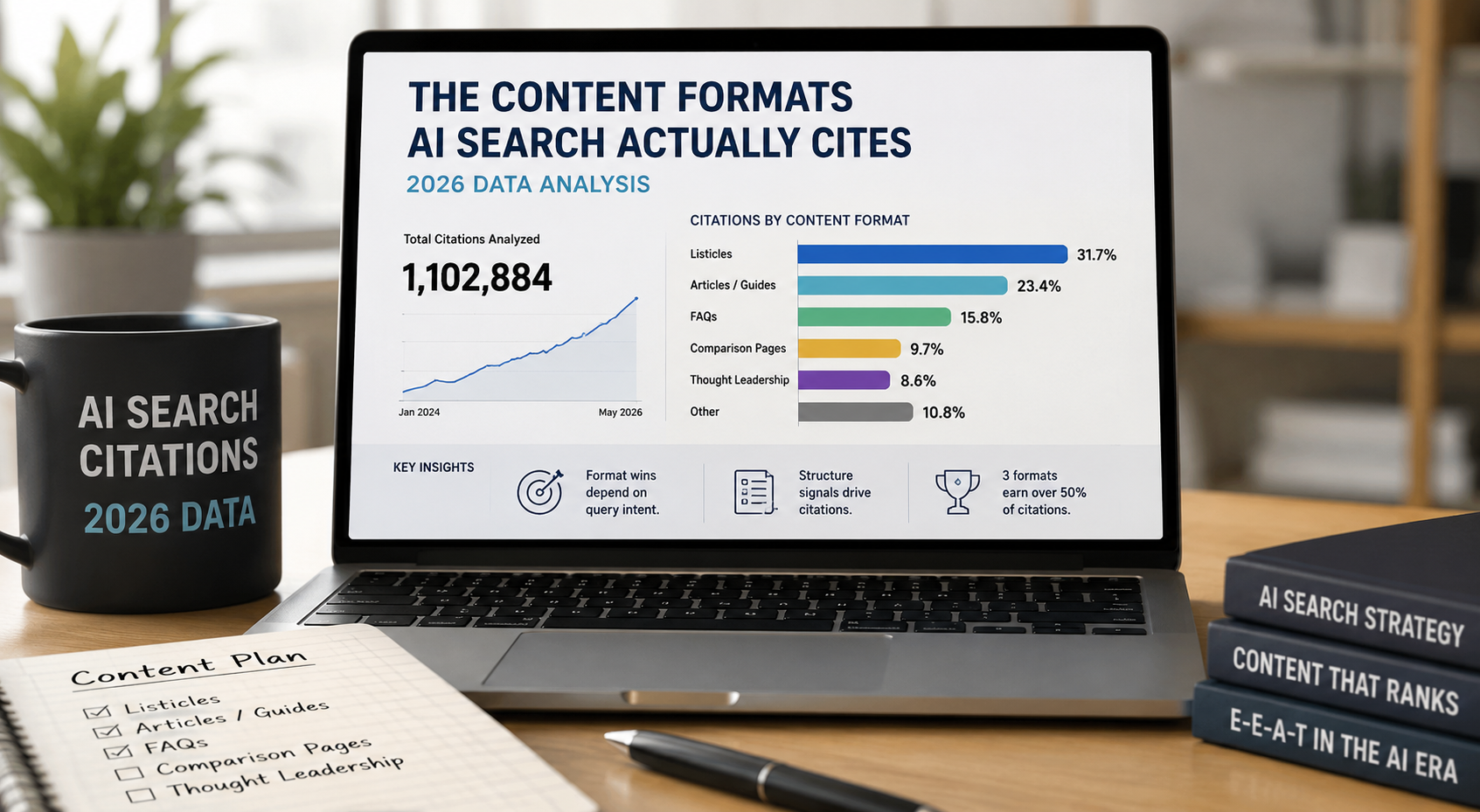
Let's start with the single most cited statistic in this space, because multiple independent datasets converge on it. Across all intents and verticals, listicles account for 21.9% of AI citations, articles for 16.7%, and product pages for 13.7% — together making up more than half of all citations (Search Engine Land, 2026). That finding comes from Wix Studio's AI Search Lab research and is echoed in HubSpot's State of AEO 2026 report, two datasets that analyzed over a million citations between them (HubSpot, 2026).
Sit with the concentration for a moment. Listicles, articles, and product pages — three formats — own the majority of the citation economy. Meanwhile, the formats many brands pour the most ego and budget into don't make the cut. Product alternative and comparison pages, as a standalone format, pull in less than 3% of citations across all verticals (Wix, 2026) — a counterintuitive number we'll untangle in a moment.
A separate study tracking 768,000 citations found that product-related content tops AI citations entirely, accounting for 46% to 70% of all sources referenced, while news and research articles accounted for only 5% to 16% (Vemetric, 2026). The exact percentages shift between studies and methodologies, but the directional truth holds: practical, structured, decision-oriented formats dominate; prestige formats lag.
The real predictor isn't format — it's intent
Here's the insight that changes how you should use everything above. The format that gets cited depends almost entirely on what the user is trying to do. Query intent was more predictive of which content type gets cited than either industry or which AI model you're optimizing for (Wix, 2026).
That's a big deal. It means there's no universal "best format" — there's a best format per intent. The data breaks down cleanly:
For informational queries ("what is X," "how does Y work"), articles dominate, cited 2.7x more than other formats and capturing around 45.5% of citations (Search Engine Land, 2026). When someone wants to understand a concept, AI reaches for the in-depth explainer.
For commercial queries ("best X," "top tools for Y"), listicles take over, capturing roughly 40% of commercial-intent citations — nearly double any other type (Search Engine Land, 2026). When someone is comparing options, AI reaches for the structured list.
For transactional and navigational queries, product and category pages win, taking around 40% combined (Search Engine Land, 2026). When someone is ready to act or find a specific destination, AI reaches for the page that closes the loop.
The practical translation: articles educate, listicles drive comparison, and product pages convert. Map content types to user goals rather than just producing more content (Search Engine Land, 2026). If you're writing a deep explainer to win a "best of" comparison query, you've format-mismatched the intent and you'll lose the citation to a listicle, no matter how good your writing is.
Why listicles win comparison — even though "comparison pages" don't
That earlier stat deserves a second look, because it confuses people: listicles dominate commercial and comparison queries, yet dedicated "comparison pages" earn under 3% of citations. How can both be true?
The answer is in why AI cites listicles. LLMs cite listicles constantly because they summarize a category well, define tradeoffs, compare features and pricing, and mirror the way people actually evaluate options (Omniscient Digital, 2026). A strong listicle ("Best [category] tools for [use case]") is the comparison the buyer wants — it does the comparison work in a format AI can lift cleanly. A standalone "X vs Y" page, by contrast, only covers two options and reads as more self-interested. The listicle owns the comparison conversation; the narrow comparison page mostly doesn't.
The takeaway for your strategy: if you want to win comparison and "best of" queries, the move is to own the listicle — ideally on credible third-party sites, not just your own — rather than betting everything on owned head-to-head comparison pages.
The structural signals that decide which listicles and articles get cited
Format gets you eligible. Structure gets you cited. Two listicles on the same topic can have wildly different citation rates, and the difference comes down to a consistent set of on-page signals the research keeps surfacing.
The pages that win pair the right format with citation-correlated structural elements: statistics and data, visible last-updated dates, author bios, and FAQ sections with schema (HubSpot, 2026). Each of these has a clear reason behind it. Pages with FAQ sections and inline citations rank about 40% higher in source selection than pages without them (Vemetric, 2026) — which is why FAQs are quietly becoming one of the most important citation surfaces on the page (ALM Corp, 2026). FAQ and how-to formats achieve disproportionately high citation rates because clear question-answer pairs align perfectly with how AI retrieves information for a query (Am I Cited, 2026).
A few more structural truths worth internalizing:
Answer fast or get skipped. If a page answers the question clearly within the first 200 words, its chances of being cited go up significantly (Vemetric, 2026). Content that hides the main point behind long introductions, storytelling, or fluff gets passed over (The Creative Digital, 2026).
Factual density beats length-for-its-own-sake. AI engines reward high factual density; thin content with vague statements and generic advice rarely gets cited. Comprehensive long-form pages do earn significantly more citations than shallow ones — but the operative word is comprehensive, not merely long (The Creative Digital, 2026). Long and empty loses to concise and fact-rich.
Originality is a moat. Derivative "me-too" articles provide little citation value because AI has already seen the same information across hundreds of similar pages (The Creative Digital, 2026). This is exactly why original research and benchmark reports punch above their weight — they create unique, citable data that doesn't exist anywhere else (GetMentioned, 2026). (Worth noting: a post like this one, with your own client data layered in, is itself a citation-earning asset for precisely that reason.)
Where thought leadership actually lands
Now to the question the title promised: does thought leadership earn citations? The honest, data-backed answer is mostly indirectly — and that's an important distinction, not a dismissal.
When content gets sorted into citation tiers, the highest-frequency tier is dominated by comparison tables, step-by-step guides, data-backed research, structured FAQs, how-to tutorials, definition pages, and original research reports. Thought leadership, press releases, webinar transcripts, and podcast show notes fall into the lowest, "supporting content" tier for direct link citations (AnswerManiac, 2026).
But "rarely cited as a link" isn't the same as "worthless." Press releases, for instance, get cited as a direct link infrequently, yet are cited highly for the underlying factual claims about your company — when ChatGPT says "Company X raised $50M" or "launched [product] in 2026," the source is often a press release feeding the AI's knowledge base (AnswerManiac, 2026). The same logic applies to thought leadership: it builds the authority and entity understanding that lifts your ability to win citations on the formats that do get cited. Authority lifts your citation odds on the top-tier formats because models and search engines learn you're reputable enough to recommend (Omniscient Digital, 2026).
So thought leadership isn't where you earn the citation — it's part of how you earn the right to be the listicle entry or the cited article. Treat it as authority infrastructure, not as a direct citation play.
The role of social proof and third-party sources
One more pattern that consistently surprises brands: a large share of citations doesn't go to your owned content at all. For branded queries specifically, 57% of citations go to product and company reviews, listicles, forums, social media, and case studies (Omniscient Digital, 2026). Reviews seem less biased than your own product pages because they come from a third party, and social proof is the strongest form of evidence that makes buyers trust a brand (Omniscient Digital, 2026).
This connects to the broader citation landscape: an analysis of 30 million sources found Reddit is the most-cited domain in AI search, followed by YouTube, LinkedIn, and Wikipedia, with the mix varying significantly by platform — ChatGPT leans toward long-form editorial sources while Google's AI platforms favor social content (Vemetric, 2026). Your owned content matters enormously, but it operates inside an ecosystem where third-party validation is doing a lot of the citation work.
Putting it into a content plan
Pulling the data together, here's the practical hierarchy:
Match format to intent first. Build articles for informational queries, listicles for commercial and comparison queries, and well-structured product and category pages for transactional ones. Don't fight the intent-format pairing — it's the strongest predictor in the entire dataset.
Layer the citation signals onto every format: answer in the first 200 words, add a schema-marked FAQ section, include real statistics and data, show a visible last-updated date, and attach a credible author bio. These aren't decoration; FAQs and inline citations alone correlate with roughly 40% higher source selection.
Invest in originality. Original research, benchmark reports, and proprietary data create citable assets competitors can't replicate — the single most durable citation advantage available.
Use thought leadership as authority fuel, not as a direct citation bet, and actively cultivate third-party presence — reviews, listicles you appear in, community discussions — because a majority of branded-query citations live outside your own domain.
And measure it. The whole point of formats-by-intent is that you can test it: track which of your pages actually earn citations across each engine, and double down on the patterns your own data confirms.
The bottom line
The "write helpful content" advice was never wrong, just incomplete. The 2026 citation research fills in the missing half: AI cites a concentrated set of formats, the right format depends on query intent more than anything else, and within each format a specific set of structural signals separates the cited from the ignored. Listicles own comparison, articles own education, product pages own transaction, FAQs supercharge everything, and original data is the one moat nobody can copy. Thought leadership and social proof do their work upstream, building the authority that makes the citations possible.
The brands winning AI citations aren't producing more content. They're producing the right format for the right intent, structured to be extracted — and then proving it with their own citation data.
Want to know which of your pages AI is actually citing — and which formats you're missing? Ritner Digital audits your content against the formats and intent patterns AI search rewards, identifies the citation gaps costing you visibility, and builds a plan to win the listicles, articles, and answer surfaces your buyers rely on. Let's see what AI is citing in your category →
Frequently Asked Questions
Which content formats does AI search cite most often?
Across more than a million analyzed citations, three formats dominate: listicles (21.9% of citations), articles (16.7%), and product pages (13.7%) — together making up over half of all AI citations (Search Engine Land, 2026). These findings come from independent 2026 datasets including Wix Studio's AI Search Lab and HubSpot's State of AEO 2026 (HubSpot, 2026). The consistent theme is concentration — AI doesn't cite formats evenly; a handful earn the lion's share.
What matters more for citations — format or search intent?
Intent. Query intent was more predictive of which content gets cited than either industry or which AI model you optimize for (Wix, 2026). Articles dominate informational queries (cited 2.7x more than other formats), listicles capture roughly 40% of commercial-intent citations, and product or category pages win transactional and navigational queries (Search Engine Land, 2026). There's no universal best format — only the best format for each intent.
Why do listicles win comparison queries when "comparison pages" barely get cited?
Because a strong listicle is the comparison. LLMs cite listicles constantly because they summarize a category, define tradeoffs, and compare features and pricing in a format AI can lift cleanly (Omniscient Digital, 2026). A standalone "X vs Y" page only covers two options and reads as more self-interested, which is part of why dedicated comparison pages pull under 3% of citations (Wix, 2026). To win comparison queries, own the listicle.
Do FAQ sections actually help with AI citations?
Yes, measurably. Pages with FAQ sections and inline citations rank about 40% higher in source selection than pages without them (Vemetric, 2026). FAQ and how-to formats achieve disproportionately high citation rates because clear question-answer pairs match how AI retrieves information for a query (Am I Cited, 2026). A schema-marked FAQ is one of the highest-leverage additions to almost any page.
Does long-form content earn more citations than short content?
Comprehensive long-form pages do earn significantly more citations than shallow ones — but the operative word is comprehensive, not just long (The Creative Digital, 2026). AI rewards high factual density, not word count. A concise, fact-rich page beats a long, padded one, and content that buries its main point behind storytelling or fluff gets skipped. Answering clearly within the first 200 words meaningfully raises citation odds (Vemetric, 2026).
Does thought leadership get cited by AI?
Mostly indirectly. Thought leadership falls into the lowest tier for direct link citations, behind formats like comparison tables, how-to guides, structured FAQs, and original research (AnswerManiac, 2026). But it builds the authority and entity understanding that lifts your ability to win citations on the formats that do get cited (Omniscient Digital, 2026). Treat it as authority infrastructure, not a direct citation play.
What's the most durable citation advantage I can build?
Original research and proprietary data. Derivative "me-too" content provides little citation value because AI has already seen the same information across hundreds of similar pages (The Creative Digital, 2026). Benchmark reports and original data create unique, citable assets that don't exist anywhere else (GetMentioned, 2026) — a moat competitors can't easily copy.
How much of my AI visibility depends on third-party sources versus my own content?
A lot more than most brands expect. For branded queries, 57% of citations go to third-party sources — reviews, listicles, forums, social media, and case studies (Omniscient Digital, 2026). Reddit is the single most-cited domain in AI search, followed by YouTube, LinkedIn, and Wikipedia (Vemetric, 2026). Your owned content matters, but it operates in an ecosystem where third-party validation does heavy citation work.
Do the same formats win across every AI platform?
No — the citation mix varies meaningfully by platform. ChatGPT leans toward long-form editorial sources like Forbes, TechRadar, and Wikipedia, while Google's AI platforms favor social content (Vemetric, 2026). This is why a single blended strategy underperforms; you'll get more from tracking which formats win on each engine and adapting accordingly.
How do I find out which of my pages AI is actually citing?
Test it directly. Build a query bank of the informational, commercial, and transactional prompts your buyers ask, run them across ChatGPT, Perplexity, Gemini, and AI Overviews on a regular cadence, and record which of your pages appear, in what format, and on which engine. Pair that with GA4 tracking of AI referral traffic, and trend the results over time so you can double down on the format-and-intent patterns your own data confirms.