Every marketing team with a finite budget eventually hits the same wall. The agency or the strategist says, "You need to invest in GEO now — AI search is eating your visibility." And the team, looking at a content calendar already stretched thin and an SEO program that still isn't where it should be, asks the obvious question: do we stop doing SEO to do this AI thing? Do we split the budget? Where do we even start?
It's the right question, and the answers floating around the internet are mostly unhelpful, because they tend to argue one of two extremes. One camp says SEO is dead and you should pour everything into GEO. The other treats GEO as a fad you can safely ignore. Both are wrong, and both will cost you.
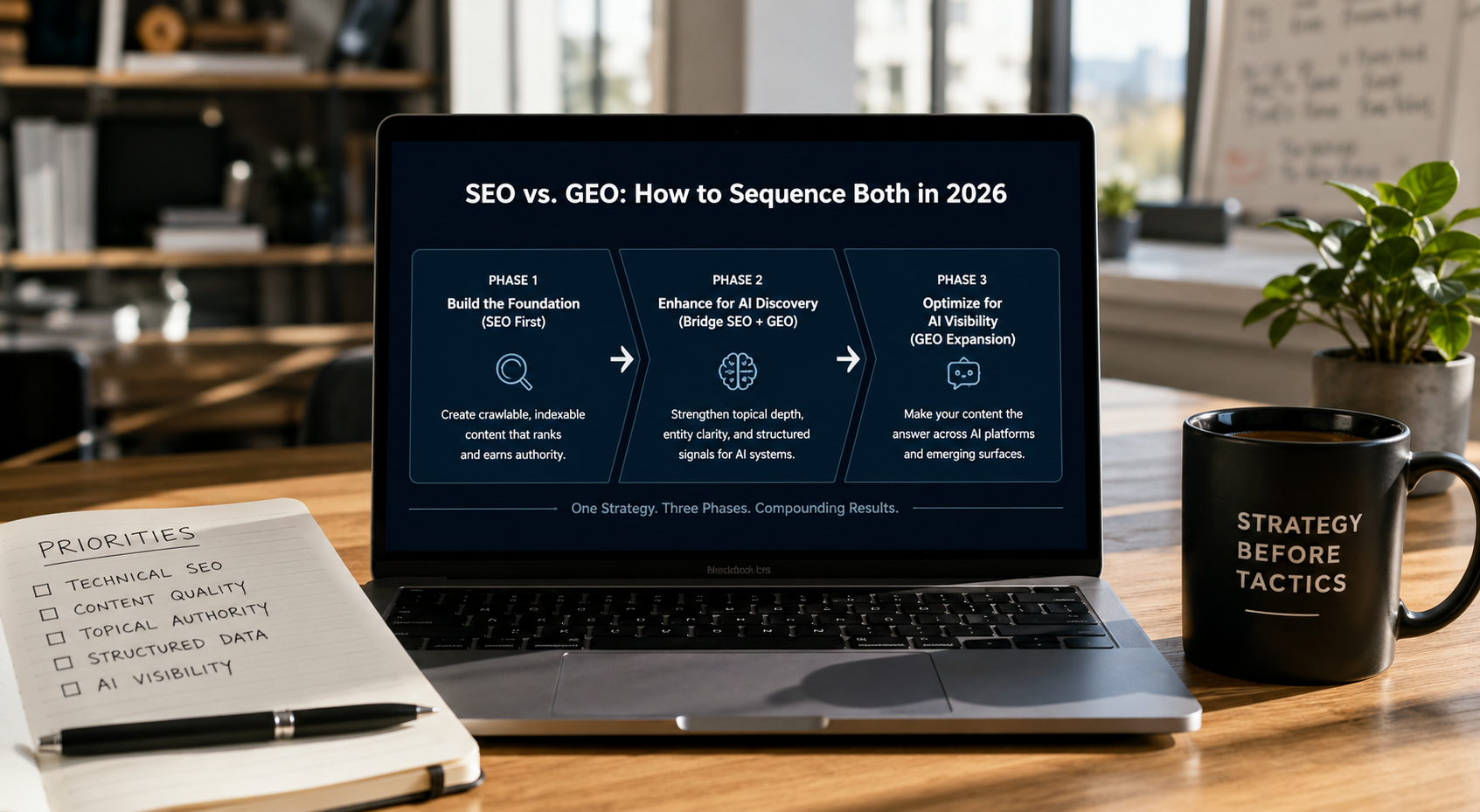
Here's the more useful frame: you don't have to choose between traditional SEO and Generative Engine Optimization, because they aren't actually competing strategies. They share most of their underlying foundation. But you do have to sequence them — to decide what gets your limited time and attention first, second, and third — because doing them in the wrong order wastes effort, while doing them in the right order means each layer reinforces the next.
This is a tactical prioritization framework for exactly that situation: a real team, with real bandwidth constraints, trying to figure out where to put the next hour of work.
First, the thing nobody tells you: they're mostly the same work
Before we sequence anything, you need to internalize the single most important fact about SEO and GEO, because it dissolves the false dilemma entirely. The signals overlap heavily — entity authority, schema, editorial mentions, content quality, link equity. What primarily changes between SEO and GEO is the measurement framework and the prioritization of off-site work, not the fundamental disciplines (Nico Digital, 2026).
This matters enormously for a resource-strapped team, because it means most of what you do for one helps the other. By doing SEO well, you're often laying the groundwork for GEO automatically; and the structuring and authority work you do for GEO circles back to benefit traditional rankings (Arc Intermedia, 2026). A single well-crafted article can rank on Google, get pulled as a featured snippet, and be cited by ChatGPT — one piece of content, three surfaces (Arc Intermedia, 2026).
There's strong evidence the two are deeply linked rather than opposed: the brands winning AI search are almost always brands that already rank well organically, because the signals that decide which sources Gemini, ChatGPT, and Perplexity cite are largely the same signals that earned a top-10 organic ranking — authority, content depth, schema clarity, and editorial corroboration (Nico Digital, 2026). SEO is being reshaped, not killed.
So the framing isn't SEO versus GEO. It's a shared foundation with a sequencing decision on top. Which brings us to the order.
The sequencing principle: fix the foundation before you optimize for AI
The clearest piece of prioritization advice in the entire field is also the most repeated: fix your SEO fundamentals first, then layer GEO on top. Because so much of GEO overlaps with SEO, fundamental issues like poor structure, weak authority signals, or unclear content will hold your AI visibility back just as much as they hurt your rankings (Writesonic, 2026). The consistent recommendation is to start with a solid SEO foundation, then add GEO-specific optimizations (Writesonic, 2026).
Think of it like building a house. GEO is the interior finish work — the part buyers actually see and respond to. But if the foundation is cracked (your site isn't crawlable, your content has no authority, your structure is a mess), no amount of beautiful finish work makes the house stand. You'd be optimizing for AI citation on top of pages that AI can't reach, can't parse, or doesn't trust. There's a useful reason this works in your favor: optimizing for Google AI Overviews specifically creates a solid foundation for multi-platform AI citation without requiring separate optimization strategies for each platform (Panstag, 2026). Get the shared foundation right and you've done most of the work for every engine at once.
But — and this is the nuance that makes it a real framework rather than a slogan — "foundation first" doesn't mean "finish all of SEO before touching GEO." That would take forever, and the AI visibility window is closing while you wait. The right move is to sequence by layer, doing the foundational layer across both disciplines before moving to the AI-specific layer. Here's how that breaks down in practice.
The three-phase prioritization framework
For a team with limited bandwidth, sequence your work in three phases. Each phase should be largely complete before you pour resources into the next, because each one is a prerequisite for the next paying off.
Phase 1: Shared technical and structural foundation (do this first, always)
This is the work that serves SEO and GEO simultaneously, and skipping it kneecaps everything downstream. In priority order: implement comprehensive structured data, provide semantic HTML markup, build topical authority through related content, earn external citations and brand mentions, and monitor AI presence on your top commercial queries (Progress Sitefinity, 2026).
The encouraging news for resource-strapped teams is that the structural changes GEO requires — answer-first format, question-style headings, shorter paragraphs — don't hurt your traditional rankings; they help both (Panstag, 2026). So Phase 1 is pure leverage: every hour here pays off twice. Concretely, this phase means making sure your site is crawlable (by both Googlebot and the AI crawlers like GPTBot and PerplexityBot), your content has clear H1→H2→H3 hierarchy, your schema is implemented and complete, and your pages answer their core question early and clearly. Don't move to Phase 2 until this is solid, because Phase 2 work built on a broken foundation is wasted.
Phase 2: GEO-specific content optimization (once the foundation holds)
With the shared foundation in place, now you make the AI-specific moves that turn good pages into cited pages. The highest-leverage version of this for a constrained team is to optimize existing winners rather than create everything new. The recommended approach: prioritize your highest-traffic informational articles for GEO updates — add key-takeaway boxes, convert headings to question format, update FAQPage schema, and refresh content freshness (Panstag, 2026).
This is deliberately a retrofit-first strategy. You already have pages with authority and traffic; making them citable is far cheaper than building citable authority from scratch. The shift in mindset here is from "can I rank?" to "can an AI quote me accurately?" — SEO gets you indexed, GEO/AEO gets you cited (Lasso Up, 2026). The reason this is Phase 2 and not Phase 1 is that there's no point making a page quotable if the page has no authority and AI has no reason to trust it. Foundation, then citation.
Phase 3: Off-site authority and ongoing measurement (the compounding layer)
The third phase is where GEO genuinely diverges from classic SEO in emphasis, and where the off-site work gets prioritized. This is brand mentions, editorial corroboration, presence in third-party sources, reviews, and the kind of external validation AI engines weight heavily. It's Phase 3 not because it's least important — over the long run it may be the most durable advantage — but because it's the slowest to build and depends on the first two phases being in place to be worth it.
This phase also includes the measurement layer that ties everything together. A serious 2026 program runs SEO, AEO, and GEO as one integrated effort with a single content roadmap and three measurement layers: rankings, AI Overview presence, and LLM citation share (Nico Digital, 2026). You measure all three because they're one program — but you build them in sequence.
How to decide where you specifically are right now
The framework above assumes you're starting from scratch, but most teams aren't. So here's the diagnostic to figure out which phase deserves your next hour.
If your organic rankings are weak or your site has technical issues: you're in Phase 1, full stop. Don't let anyone sell you on GEO yet. The brands winning AI search already rank well organically (Nico Digital, 2026), so shoring up traditional rankings is your GEO investment right now. Fixing SEO fundamentals is the prerequisite, and it happens to be the highest-ROI AI-visibility work you can do at this stage.
If you already rank well but you're invisible in AI answers: you're in Phase 2. Your foundation is sound; you just haven't made your authoritative pages quotable. This is the sweet spot — you can win AI citations relatively quickly because the hard part (authority) is done. Retrofit your top pages.
If you rank well, get cited sometimes, but competitors dominate the answers: you're in Phase 3. The gap is off-site authority and third-party validation, and that's where the next investment goes.
One urgency note that should inform how fast you move through these phases: the GEO priority shifted from "interesting experiment" to "primary strategy for informational content" in roughly 18 months. In early 2024, AI Overviews appeared on about 6–8% of US searches; by early 2026, they appear on 50–60%, and the traffic divergence between cited and non-cited sites has become severe (Panstag, 2026). "Sequence it" is not permission to defer it indefinitely. It's permission to do it in the order that works, starting now.
A note on what NOT to do
Two failure modes are worth naming, because both come from misunderstanding the relationship.
The first is splitting your team into a "SEO team" and a "GEO team" running separate roadmaps. The signals overlap too much for that to make sense — you'd be paying twice for work that's mostly the same, and the two efforts would step on each other. Run them as one integrated program with one content roadmap (Nico Digital, 2026).
The second is abandoning SEO to chase GEO. Traditional SEO remains the bedrock — it's still essential for classic search visibility and direct traffic, and as generative engines capture more queries, ignoring GEO risks losing AI presence (TheeDigital, 2026). The answer isn't either/or. It's a strong SEO foundation plus targeted GEO, in that order.
The bottom line
You don't have to choose between traditional SEO and GEO, because they're not rivals — they're two layers of one discipline that share most of their underlying work. But with limited bandwidth, the order matters enormously. Build the shared technical and structural foundation first, because it pays off twice and because AI won't cite pages it can't reach or trust. Then retrofit your highest-authority pages to be quotable. Then invest in the off-site authority and measurement that compound over time.
The teams that get stuck are the ones treating this as a binary — pick SEO or pick GEO — when the real decision is a sequence. Get the order right, and every phase makes the next one easier. Get it wrong, and you'll spend money optimizing for AI citation on a foundation that can't support it.
Figure out which phase you're in. Then do that phase well before moving on.
Not sure whether you should be shoring up rankings or chasing AI citations first? Ritner Digital diagnoses exactly which phase your business is in — auditing your SEO foundation, your AI visibility, and the gaps between them — then builds a single prioritized roadmap that sequences the work for maximum impact on a real budget. Get a clear picture of where to start →
Frequently Asked Questions
Do I have to choose between SEO and GEO?
No. They aren't competing strategies — they share most of their underlying foundation, including entity authority, schema, editorial mentions, content quality, and link equity (Nico Digital, 2026). What primarily changes between them is the measurement framework and the emphasis on off-site work, not the core disciplines. The real decision isn't which one to pick; it's what order to do the work in.
Should I do SEO or GEO first?
Fix your SEO fundamentals first, then layer GEO on top. Because so much of GEO overlaps with SEO, foundational issues like poor structure, weak authority, or unclear content hold your AI visibility back just as much as they hurt rankings (Writesonic, 2026). There's no point optimizing a page for AI citation if AI can't reach it, parse it, or trust it. Build the shared foundation, then make pages quotable.
Does "foundation first" mean I should finish all my SEO before touching GEO?
No — that would take too long while the AI visibility window closes. Sequence by layer, not by discipline. Complete the shared technical and structural foundation (crawlability, schema, clear hierarchy, answer-first content) across both, then move to GEO-specific optimization, then off-site authority. Each phase should be largely solid before you pour resources into the next, but you're not finishing all of SEO before starting GEO.
Does doing GEO hurt my traditional SEO rankings?
No. The structural changes GEO requires — answer-first format, question-style headings, shorter paragraphs — help both disciplines rather than trading one off against the other (Panstag, 2026). Foundation work like schema and clear content structure is pure leverage: every hour spent there pays off in rankings and AI citations at once.
If my rankings are weak, is it too early to think about GEO?
In a sense, fixing your rankings is your GEO investment right now. The brands winning AI search are almost always brands that already rank well organically, because the signals that decide which sources AI cites are largely the same ones that earn a top-10 ranking (Nico Digital, 2026). If your foundation is weak, shoring up traditional SEO is the highest-ROI AI-visibility work you can do.
I already rank well but don't show up in AI answers. What should I focus on?
You're in the retrofit phase. Your authority is established; you just haven't made your pages quotable. Prioritize your highest-traffic informational articles — add key-takeaway boxes, convert headings to question format, update FAQPage schema, and refresh content freshness (Panstag, 2026). This is the fastest path to citations because the hard part (building authority) is already done.
Should I split my team into a separate SEO team and GEO team?
No — that's one of the most common mistakes. The signals overlap too much, so separate roadmaps mean paying twice for nearly identical work while the two efforts step on each other. Run SEO, AEO, and GEO as one integrated program with a single content roadmap and three measurement layers: rankings, AI Overview presence, and LLM citation share (Nico Digital, 2026).
How urgent is GEO, really? Can't I just defer it?
The window is closing fast. AI Overviews appeared on roughly 6–8% of US searches in early 2024 but 50–60% by early 2026, and the traffic gap between cited and non-cited sites has become severe (Panstag, 2026). GEO moved from "interesting experiment" to "primary strategy for informational content" in about 18 months. "Sequence it" means do it in the right order starting now — not defer it indefinitely.
Does optimizing for one AI platform mean I have to optimize separately for all the others?
Mostly not. Optimizing for Google AI Overviews creates a solid foundation for multi-platform AI citation without requiring separate strategies for each engine (Panstag, 2026). Because the underlying signals overlap, getting the shared foundation right does most of the work across ChatGPT, Perplexity, Gemini, and AI Overviews simultaneously — though tracking per-platform performance still helps you refine.
How do I know which phase I'm in right now?
Use a quick diagnostic. Weak rankings or technical issues mean you're in Phase 1 (foundation). Strong rankings but invisible in AI answers means Phase 2 (retrofit your top pages to be quotable). Ranking well and cited sometimes, but competitors dominate the answers, means Phase 3 (off-site authority and validation). Identify your phase, then do that phase well before moving on.