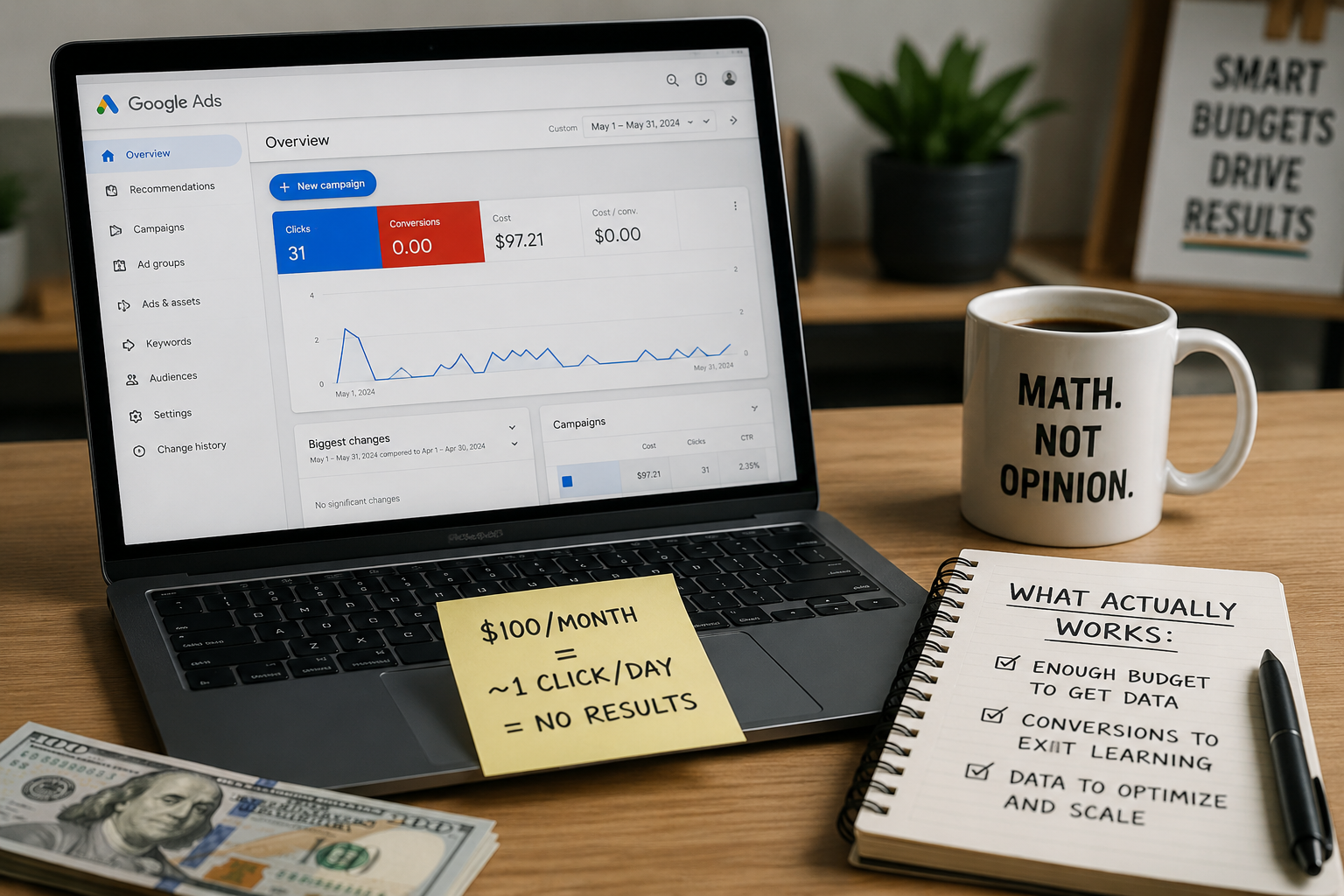
Let's be direct, because this topic doesn't deserve hedging: a $100-per-month Google Ads budget will not work. It cannot work. And if an agency or "marketing consultant" pitched you a $100/month ad budget as a real strategy — especially if they're charging you a management fee on top of it — you should treat that as a disqualifying red flag and find someone else.
That's a strong claim, so we're going to back it up with the actual mechanics of how Google Ads works in 2026. This isn't an opinion about taste or style. It's math. The reason tiny budgets fail isn't that you "need to spend more to make more" in some vague motivational sense. It's that modern Google Ads has hard, structural data requirements, and $100/month falls so far below them that the system literally cannot do its job. You're not buying a small amount of advertising. You're buying nothing, slowly, while paying someone to watch it happen.
Here's exactly why.
The math: $100/month buys almost no clicks
Start with the raw arithmetic, because it's the part people skip. Google smooths your monthly budget across the month, so your effective daily budget is your monthly figure divided by about 30.4 (AdNabu, 2026). A $100/month budget gives you roughly $3.29 per day.
Now apply real cost-per-click rates. Cross-industry average CPC on Google Search runs between roughly $2.96 and $4.22 in 2026 (BizIQ, 2026). Do the division. At $3.29 a day against a $3–$4 click, you're buying roughly one click per day. Sometimes less. In competitive industries with higher CPCs, you might not even get that — at $10/day you'd see just one or two clicks in competitive industries, which is already not enough data to optimize anything (StubGroup, 2026). At $3.29/day, you're well below even that floor.
So before we talk about conversions, leads, or ROI, sit with the base reality: a $100/month budget purchases approximately one website visitor per day. One. You cannot build a business — or even a meaningful test — on one click a day. And it gets worse from here, because of how the platform actually decides whether to show your ads.
The real killer: you'll never escape the "learning phase"
This is the part most business owners don't know, and it's the part that makes small budgets not just limited but actively broken.
Google Ads doesn't just take your money and show your ad. Its bidding algorithm has to learn — it needs to gather enough conversion data to figure out who to show your ads to, when, and at what bid. Until it has that data, it operates in what's called the "learning phase," during which performance is unstable and inefficient. The threshold to exit it is specific and well-documented: the average account needs about 4–6 weeks and 100+ conversions for the algorithm to optimize effectively (Get-Ryze, 2026). Smart Bidding generally needs roughly 30+ conversions per month, per campaign, to work as designed (AdsGo, 2026).
Now connect that to your $100 budget. You're getting about one click per day — call it 30 clicks a month. Even with a strong landing page converting at, say, 5%, that's between one and two conversions per month. The algorithm needs 30. You are not going to reach 30 conversions a month on 30 clicks a month — it's mathematically impossible. Which means your campaign will sit in the learning phase forever, never gathering enough signal to optimize, perpetually showing your ads inefficiently to the wrong people.
The expert consensus is blunt about this. Budgets under $30/day in competitive industries prevent campaigns from exiting Google's learning phase, because the algorithm needs sufficient volume to identify patterns (Get-Ryze, 2026). A $100/month budget is one-tenth of that $30/day threshold. You're not in a small version of a working system; you're below the floor where the system functions at all.
You won't even have enough data to know what's happening
Here's the insult on top of the injury. Even setting aside whether the campaign performs, a $100 budget doesn't generate enough data to tell whether it performed. You can't optimize what you can't measure, and you can't measure with this little volume.
The benchmarks for statistical confidence are clear. Under 100 clicks is too early to judge performance at all. Directional data begins to appear around 200–300 clicks. Stronger confidence in optimization decisions requires 500+ clicks (New Frame Digital, 2026). At one click a day, reaching even the bottom of that range — 100 clicks — takes you over three months. Reaching the 500-click threshold for real confidence takes well over a year.
So the $100/month campaign isn't just underperforming; it's invisible to analysis. Any agency telling you they'll "optimize" a $100/month account is selling you something that doesn't exist, because there's no data to optimize with. As one consultant framed the budget-vs-strategy distinction: budget without tracking is spend without signal (AdsGo, 2026) — and a budget this small is spend with no meaningful signal either way.
What you're actually doing with $100/month
Pull it together and here's the honest picture of what a $100/month Google Ads budget produces: about one click per day, far too few conversions to ever exit the learning phase, and not nearly enough volume to generate statistically meaningful data. The algorithm never optimizes. The campaign never stabilizes. And you never get enough information to know whether to continue, change course, or quit.
You haven't run an advertising campaign. You've donated $100 a month to Google in exchange for the feeling of advertising. And if an agency is charging you a management fee on top of that $100, the economics get genuinely absurd. Consider: many agencies charge 10–20% of ad spend, or a flat minimum fee. On a $100 budget, even a modest flat fee might mean you're paying more to manage the ads than you're spending on the ads — and the ads can't work regardless. You'd be paying a premium to operate a system that is structurally incapable of producing a result.
Why recommending this is a fireable offense for an agency
Now to the part that might feel harsh but isn't. Why does recommending a $100/month budget disqualify an agency, rather than just being a minor misjudgment?
Because any competent paid-search professional knows everything in this article. The learning-phase thresholds, the conversion-volume requirements, the CPC math — this is foundational, day-one PPC knowledge. An agency that recommends a $100/month budget is doing one of two things, and both should end the relationship:
Either they don't understand how Google Ads works — in which case they're not qualified to manage your advertising, full stop. The minimum viable budgets are not secret. A pro knows that local lead gen typically needs $30–$100/day ($900–$3,000/month) and B2B or SaaS often needs $50–$200/day ($1,500–$6,000/month) to gather enough conversion data for bidding to work (AdsGo, 2026). An agency unaware of this is incompetent at the one thing you hired them for.
Or they understand perfectly well and recommended it anyway — to land you as a client by quoting a budget you'd say yes to, knowing they'll collect a management fee regardless of whether the campaign can possibly work. That's worse. That's an agency whose incentives are openly misaligned with yours, willing to take your money for a strategy they know is doomed. Their fee gets paid whether you get leads or not, so a non-functional $100 account is, from their perspective, a perfectly fine arrangement. From yours, it's a slow bleed.
There's no charitable third option. Either they don't know, or they don't care. Neither is who you want running your marketing budget.
What good advice actually sounds like
For contrast, here's what a competent advisor tells you when your budget is genuinely tight — because plenty of small businesses legitimately can't spend thousands a month, and the answer is never "throw away $100 anyway."
A good agency separates budget issues from strategy issues so you fix the right problem (Sarah Stemen, 2026). If you can't fund a Google Search campaign to the minimum viable threshold for your industry, they tell you so honestly — and they redirect you. The disciplined approach for a small budget is to concentrate, not scatter: spreading budget thin across multiple campaigns is a top mistake, because it prevents any single one from reaching optimization thresholds (Get-Ryze, 2026). Better to fund one tightly targeted campaign properly than five campaigns that all starve.
They'll point you toward tactics that fit the budget: tight exact-match keywords tied directly to revenue, aggressive negative-keyword lists, narrow geographic targeting down to specific zip codes (which can cut required budget 20–40% while keeping lead quality), and ruthless weekly waste removal (Whistler Billboards, 2026; Get-Ryze, 2026). On a reduced budget, removing waste is often more powerful than increasing bids (Whistler Billboards, 2026).
And critically, they'll tell you when paid search isn't the right channel for your budget at all — when your money is better spent on SEO, on local listings, on content that builds organic and AI-search visibility, or on saving up until you can fund paid search properly. A good advisor protects your budget and tells you the truth about what it can and can't do. They don't take a fee to run a campaign they know is dead on arrival.
The bottom line
A $100/month Google Ads budget fails not because of bad luck or poor execution, but because of math and mechanics that no amount of cleverness can overcome. It buys about one click a day, never produces enough conversions to escape the learning phase, and never generates enough data to be measured or optimized. It is, structurally, money set on fire.
Any agency worth its fee knows this. So if yours recommended a $100/month budget — or worse, charged you to manage one — that tells you everything you need to know about either their competence or their honesty. Stop the campaign. Reallocate the money to a channel that can actually work at your budget level. And find an advisor who tells you the truth about what your dollars can do, even when that truth is "not this."
Has an agency had you running a budget that was never going to work? Ritner Digital tells you the truth about what your marketing budget can realistically achieve — and builds a strategy that fits it, whether that's properly funded paid search, SEO, AI search visibility, or a smarter mix. No fees for campaigns that can't succeed. Get an honest assessment of your budget and strategy →
Frequently Asked Questions
Is there a minimum budget required to run Google Ads?
Technically no — Google Ads has no minimum spend requirement and will let you run a campaign on almost any budget (AdNabu, 2026). But "allowed" and "effective" are very different things. There's no enforced minimum, yet there's a very real functional minimum below which the system can't gather enough data to work. A $100/month budget falls far below that functional floor.
Why exactly does $100/month fail?
Three reasons stack on top of each other. First, the math: at a $3–$4 average CPC, $100/month (about $3.29/day) buys roughly one click per day (BizIQ, 2026). Second, the learning phase: Google's algorithm needs about 30+ conversions per campaign per month to optimize, and 100+ conversions over 4–6 weeks to fully stabilize (Get-Ryze, 2026) — impossible on ~30 clicks a month. Third, the data: under 100 clicks is too little to judge performance at all (New Frame Digital, 2026). The campaign never optimizes and never produces measurable results.
What is the Google Ads "learning phase" and why does it matter so much?
It's the period when Google's bidding algorithm is still figuring out who to show your ads to. Until it gathers enough conversion data, performance is unstable and inefficient. Budgets under roughly $30/day in competitive industries prevent campaigns from ever exiting it (Get-Ryze, 2026). A $100/month budget is one-tenth of that threshold, so the campaign stays stuck in learning permanently — showing ads inefficiently and never reaching optimized performance.
What's a realistic minimum Google Ads budget in 2026?
It depends on your industry's CPC and competition, but the working ranges are well established: local lead generation typically needs $30–$100/day ($900–$3,000/month), and B2B or SaaS often needs $50–$200/day ($1,500–$6,000/month) to generate the ~30 conversions per month that bidding requires (AdsGo, 2026). The number isn't arbitrary — it reflects the minimum spend needed to produce enough conversion data for the system to function.
Why should I fire an agency that recommends a $100/month budget?
Because the thresholds above are foundational, day-one PPC knowledge. An agency recommending $100/month is either unaware of how Google Ads works — which makes them unqualified for the job — or aware and recommending it anyway to land you as a fee-paying client on a strategy they know can't work. Both are disqualifying. Their management fee gets paid whether your campaign succeeds or not, so a non-functional account costs you while costing them nothing.
Isn't some advertising better than none?
Not in this case. A $100/month campaign doesn't deliver "a little" advertising — it delivers no meaningful result while consuming money and, often, a management fee. Budget without enough volume to optimize is spend without signal (AdsGo, 2026). You'd get more value reallocating that $100 to a channel that can actually function at small scale, or saving it until you can fund paid search properly.
I genuinely can't spend more than a small amount. What should I do instead?
A competent advisor separates budget problems from strategy problems and redirects you honestly (Sarah Stemen, 2026). If you can fund one campaign to its viable minimum, concentrate everything there rather than spreading thin across several (Get-Ryze, 2026). If you can't reach the minimum at all, your money is usually better spent on SEO, local listings, AI search visibility, or content — channels that build value at low spend levels.
If I have a small-but-viable budget, how do I avoid wasting it?
Discipline beats scale. Focus on tight exact-match keywords tied directly to revenue, build an aggressive negative-keyword list, narrow your geographic targeting (zip-code or radius targeting can cut required budget 20–40% while keeping lead quality), and review your search term report weekly to cut waste fast (Whistler Billboards, 2026; Get-Ryze, 2026). On a small budget, removing waste is often more powerful than raising bids.
Does a bigger budget guarantee Google Ads will work?
No — budget is necessary but not sufficient. Plenty of well-funded accounts waste money through poor structure: missing conversion tracking, no negative keywords, overly broad targeting, or weak landing pages (New Frame Digital, 2026). The point isn't "spend more and you'll win." It's that below the functional minimum, no level of skill can make the campaign work — and above it, structure and management determine your results.