For years, you've built your marketing around a number that felt close to a law of physics: roughly two-thirds of the buying journey happens before a prospect ever talks to your sales team. The implication was clear and well understood — buyers educate themselves first, so you flood the early funnel with helpful content, nurture them along, and let sales take over once they raise their hand. Whoever produced the most useful content during that self-directed research phase earned the right to the conversation.
That core insight was right. It's just become radically more extreme, and the mechanism behind it has fundamentally changed. The "two-thirds before sales" era assumed buyers were doing that research by visiting your website, reading your blog, downloading your guides, and comparing vendors across a dozen open browser tabs. In 2026, a huge and growing share of that research isn't happening on your site at all. It's happening inside an AI conversation you will never see.
This isn't a tweak to the old model. It's a structural shift in where the early journey takes place — and if your content strategy is still optimized for a buyer who lands on your site to learn, you're producing content for a stage of the journey that increasingly bypasses you entirely.
The number didn't shrink. It moved — and grew.
Start with what the data says about the size of the pre-sales journey, because it confirms your existing instinct while raising the stakes.
Forrester's 2025 survey of more than 4,000 buyers found that 61% of the buying journey completes before the buyer contacts a vendor — and that figure increases when AI tools provide the synthesized comparisons that previously required multiple site visits (Loganix / Yahoo Finance, 2026). Other analyses put the independent research phase even higher, at 65–75% of the journey, and attribute the expansion directly to AI tools (Pedowitz Group, 2026). One striking framing of the ratio: for every hour a buyer spends with a vendor's sales team, they've already spent about five hours researching independently — and the majority of that research now happens inside AI search tools like ChatGPT, Perplexity, and Google's AI Mode, not on Google itself (Start Some Shift / National Law Review, 2026).
So the old number wasn't wrong. It was the floor. The journey-before-sales is now larger than ever, and the venue has shifted from your owned properties to AI engines.
The scale of AI's role is hard to overstate. Forrester's 2026 Buyers' Journey Survey of nearly 18,000 global business buyers found that generative AI and conversational search are now the most meaningful source of vendor research — outranking vendor websites, product experts, and sales reps — with twice as many buyers naming AI as their top source compared to any other (Machine Relations, 2026). The proportion of buyers using AI in their purchase process grew from 89% in 2025 to 94% in 2026 (Machine Relations, 2026). Estimates put B2B-related research prompts across ChatGPT, Claude, Copilot, Perplexity, and Gemini combined at 80 to 100 million every single day (TestimonialStar, 2026).
The funnel inverted: the shortlist forms before you know they exist
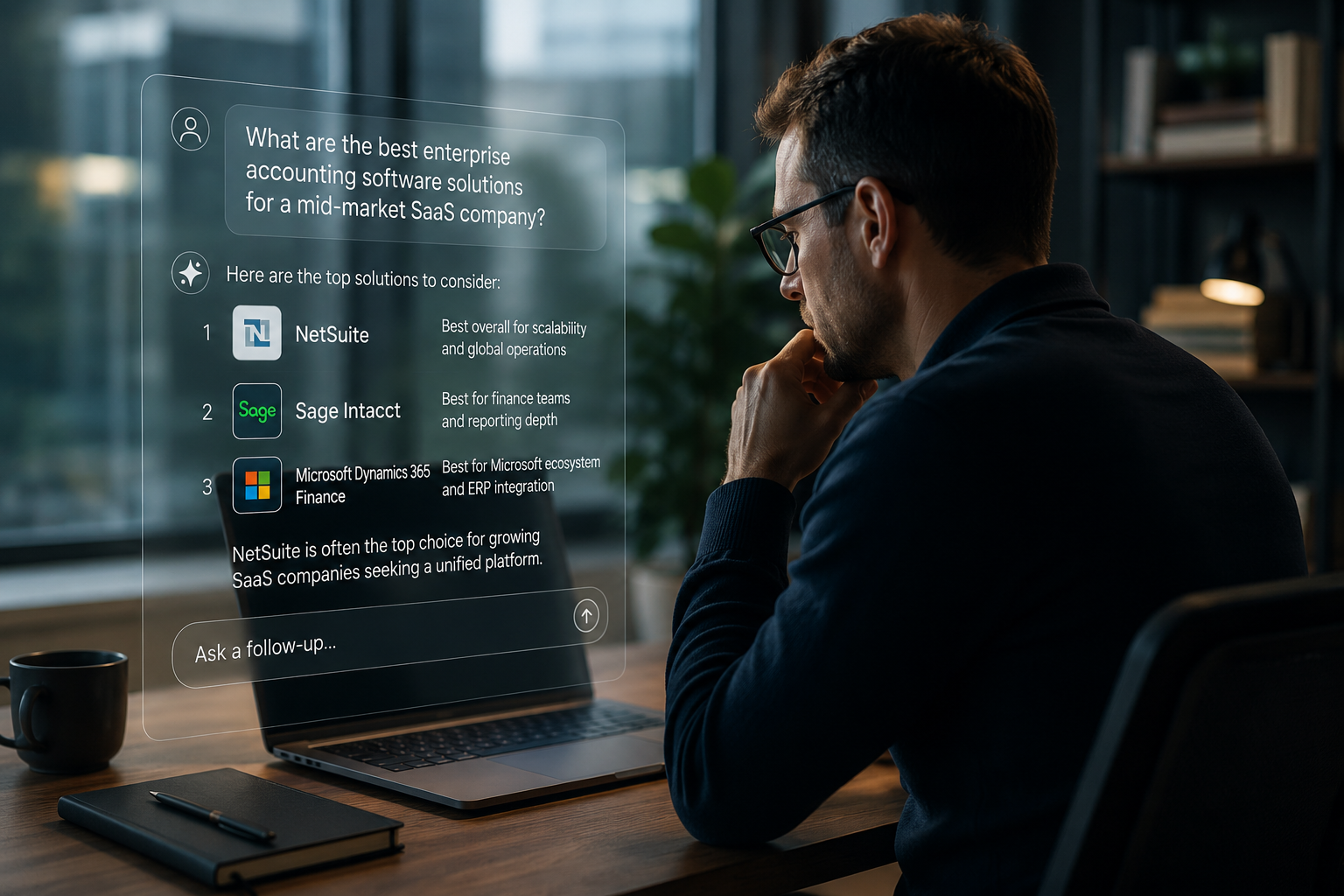
Here's the shift that should reframe your entire content strategy. The traditional funnel assumed a sequence: buyers discover you, get nurtured by your content, then talk to sales. That sequence has effectively inverted. The shortlist is now formed before sales is involved — and by the time a buyer fills out a contact form, the decision to engage has already been made inside an AI conversation no one at the vendor ever sees (Start Some Shift / National Law Review, 2026).
Picture the concrete scenario. A VP of Operations gets budget approved for a new CRM implementation. Their first move is no longer to call a vendor or attend a conference — it's to ask an AI tool, "What are the best CRM implementation partners for manufacturing companies?" A list of five or six firms appears in about ten minutes, with brief descriptions, with zero human interaction. They visit the top three websites and read a couple of pieces of content per site (Pedowitz Group, 2026).
Notice what just happened. If your brand wasn't in that AI-generated list of five or six, you never made the initial shortlist — and your website, your nurture sequence, and your sales team never even got the chance to compete. As one analysis put it bluntly: if your brand is not present in AI responses to category and comparison queries, you may never make the shortlist at all (Pedowitz Group, 2026).
This matters enormously because of how B2B deals are actually won. Around 80% of deals go to the vendor who was the buyer's pre-contact favorite, and 70–80% of buying research happens before a buyer contacts any sales team (TestimonialStar, 2026). The favorite is being chosen in a room you're not in. Your job is to make sure your brand walks into that room with the right reputation, carried by the AI itself.
Buyers now lead with commercial intent from the first query
There's a second, subtler shift that changes what kind of content you need. The old model treated the early journey as a gentle awareness phase — buyers casually learning about a problem space, not yet ready to evaluate. So early-funnel content was often soft: broad thought leadership, light educational pieces, top-of-funnel awareness plays.
That framing no longer holds. Buyers entering the AI research phase are not browsing. They lead with commercial intent from the very first query — asking AI tools to compare options, build shortlists, evaluate pricing, and even draft RFP questions. They're in evaluation mode before they've visited a single vendor website (Start Some Shift / National Law Review, 2026). Forrester's data shows the specific use cases: 54% of buyers use AI to research product information, 55% to compare vendors against each other, and 47% to build internal business cases before engaging any vendor (Machine Relations, 2026).
These aren't peripheral activities. They're the exact tasks that determine whether you make the shortlist. Which means the content that matters most isn't just your awareness-stage blog posts — it's your comparison pages, your pricing transparency, your case studies, and your service pages, all structured so an AI can extract and present them accurately.
This is where most B2B marketing is now aimed at the wrong moment. Most programs are designed for the sales-led portion of the journey — the demo, the proposal, the closing call (Start Some Shift / National Law Review, 2026). But that's now the final fraction of a process that's already been mostly decided. And the visibility gap at the top is stark: a 2026 index of 70 B2B companies found that only 4.3% appear at the top-of-funnel stage where influence is actually formed, before buyers make up their minds (2X Marketing, 2026). The early funnel is wide open precisely because almost no one has adapted their content to it.
What this means for your content strategy
So how do you show up at every stage of a journey that increasingly happens without you in the room? The strategy reorients around being citable and consistent across the moments AI research touches.
Build content for every research task, not just awareness. Because buyers use AI to compare vendors, evaluate pricing, and build business cases, your content has to serve those specific jobs. Don't optimize only your blog. Comparison pages ("X vs Y"), alternatives pages, pricing pages, case studies, and service pages are what AI cites when buyers ask evaluation questions — and ignoring them means AI keeps citing competitors when someone asks for the "best" option in your category (Wellows, 2026). Map your content to the actual questions: category ("best [solution] for [industry]"), comparison ("[you] vs [competitor]"), and validation ("is [you] any good").
Make your content extractable, not just readable. AI engines reward content they can lift cleanly — answer-first structure, clear definitions, hard statistics, and tables rather than dense prose. The goal is to be quotable inside an answer even when your site isn't the destination. If your content can't be reused by AI, it stops influencing decisions even if it still ranks (Chad Wyatt, 2026).
Get validated by sources outside your own walls. Buyers validate AI findings across peer networks, review sites, technical documentation, and professional networks, which means you need presence across multiple channels at once, not just your website (Search Engine Journal, 2026). AI engines pull heavily from third-party sources — listicles, comparison sites, review platforms, and community discussions — so your reputation in those places directly shapes whether you make the shortlist. Public testimonials and customer outcomes increasingly become the primary input for an automated evaluation, especially as Gartner projects 90% of B2B buying will be agent-intermediated by 2028 (TestimonialStar, 2026).
Account for the dark funnel. Much of the modern B2B conversation happens off your radar — untracked sharing of links and AI summaries via email, messaging apps, and private Slack groups (Altair Media, 2026). You can't track every touch, so optimize for being mentioned accurately and favorably everywhere, rather than obsessing over attributing each click.
Measure what almost no one measures. Here's the opportunity hiding in the data: AI search traffic converts at 14.2% versus Google organic's 2.8% — a 5.1x advantage — yet only 22% of marketers currently track AI visibility, and fewer than 26% plan to (Loganix / Yahoo Finance, 2026). The buyers arriving from AI research are higher-intent and convert dramatically better, and almost no one is measuring whether they show up in that channel. That's a wide-open advantage for the brands that start now.
The bottom line
Your "two-thirds of the journey before sales" insight was never wrong — it was prophetic. AI search took that truth and made it bigger, faster, and invisible. The pre-sales journey is now larger than ever, it happens inside AI conversations you can't observe, and the shortlist that decides 80% of deals is assembled before your sales team knows the buyer exists.
The content strategy that fits this reality isn't a reinvention of what you know — it's an extension of it. Keep producing genuinely useful content, but build it for the specific evaluation tasks buyers now hand to AI, structure it so it can be extracted and cited, validate it across the third-party sources AI trusts, and measure your presence in the answers themselves. The brands doing this are claiming the top-of-funnel influence that 95% of their competitors have left unguarded. The ones still optimizing only for the demo and the closing call are showing up to compete after the decision has already been made.
Is your brand making the AI shortlist — or getting decided against before you know the buyer exists? Ritner Digital helps B2B companies show up at every stage of the modern buying journey, from the category and comparison queries that form shortlists to the content and validation signals AI engines actually cite. Let's make sure you're in the room where decisions get made →
Frequently Asked Questions
How much of the B2B buying journey now happens before talking to sales?
Estimates vary by study, but they all point in one direction: most of it. Forrester's 2025 survey found 61% of the journey completes before a buyer contacts a vendor, a figure that rises when AI tools provide synthesized comparisons (Loganix / Yahoo Finance, 2026). Other analyses put the independent research phase at 65–75% (Pedowitz Group, 2026). One firm frames it as roughly five hours of independent research for every one hour spent with a vendor's sales team (Start Some Shift, 2026).
How is this different from the old "two-thirds before sales" idea?
The insight is the same, but the mechanism changed. The old model assumed buyers did that research on your website, blog, and comparison tabs. Today a large and growing share happens inside AI conversations — ChatGPT, Perplexity, Gemini, Google's AI Mode — that you never see (Start Some Shift, 2026). The pre-sales journey didn't just hold steady; it grew and relocated off your owned properties.
What does it mean that the funnel has "inverted"?
It means the shortlist now forms before sales is involved, rather than after. A buyer asks an AI tool for "the best [category] solution for a [size] company in [industry]" and gets a list of five or six vendors in about ten minutes, with no human contact (Pedowitz Group, 2026). By the time a contact form gets filled out, the decision to engage is already made. If you weren't in that AI list, your website and sales team never got to compete.
Why does AI shortlist inclusion matter so much for winning deals?
Because the favorite is usually chosen early. Around 80% of deals go to the vendor who was the buyer's pre-contact favorite, and 70–80% of research happens before any sales contact (TestimonialStar, 2026). If AI doesn't surface your brand during the category and comparison queries that build shortlists, you may never make the initial cut (Pedowitz Group, 2026).
Are buyers really in evaluation mode that early?
Yes. Buyers entering the AI research phase aren't casually browsing — they lead with commercial intent from the first query, asking AI to compare options, evaluate pricing, and draft RFP questions (Start Some Shift, 2026). Forrester found 54% use AI to research products, 55% to compare vendors, and 47% to build internal business cases before engaging anyone (Machine Relations, 2026).
What content should B2B marketers prioritize now?
Go beyond awareness-stage blog posts. Because buyers use AI to compare and evaluate, your comparison pages ("X vs Y"), alternatives pages, pricing pages, case studies, and service pages matter as much as thought leadership — ignore them and AI keeps citing competitors for "best" and "alternatives" queries (Wellows, 2026). Structure all of it to be extractable: answer-first, with clear stats, definitions, and tables (Chad Wyatt, 2026).
What is the "dark funnel" and how do I handle it?
The dark funnel is the untracked layer of the journey — links, recommendations, and AI summaries shared privately via email, messaging apps, and closed Slack groups (Altair Media, 2026). You can't attribute every touch, so the strategy shifts from tracking clicks to ensuring you're mentioned accurately and favorably everywhere AI and peers might surface you.
Should I worry about losing visibility I can't see?
That's exactly the risk. Buyers form opinions and build shortlists in AI conversations that never register in your analytics. A 2026 index of 70 B2B companies found only 4.3% appear at the top-of-funnel stage where influence is actually formed (2X Marketing, 2026) — meaning the early journey is wide open for brands that adapt while most competitors haven't.
Is AI search traffic actually worth pursuing, or just hype?
The conversion data makes the case. AI search traffic converts at 14.2% versus Google organic's 2.8% — a 5.1x advantage — yet only 22% of marketers track AI visibility and fewer than 26% plan to (Loganix / Yahoo Finance, 2026). Higher-intent buyers, dramatically better conversion, and almost no one measuring it — that combination is a clear, time-limited advantage.
How do I measure whether my brand shows up in AI research?
Build a query bank of the category, comparison, and validation prompts your buyers actually ask, then test them regularly across ChatGPT, Perplexity, Gemini, and AI Overviews — recording whether you appear, in what position, and how you're described. Set up GA4 to capture AI referral traffic as a directional signal, and trend results over time rather than relying on one-time snapshots.