The GEO Audit: 7 Things to Check If You're Not Showing Up in AI-Generated Answers
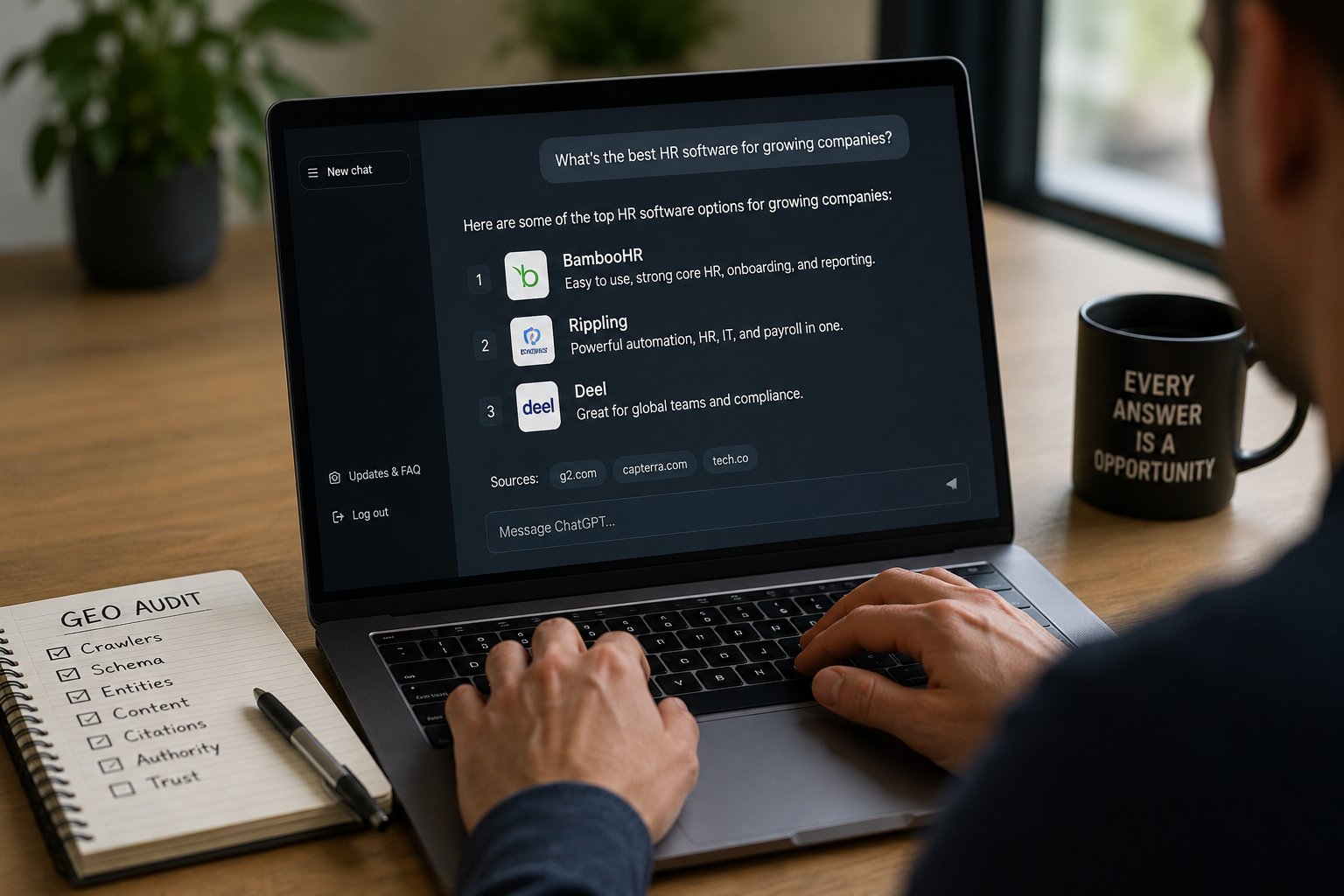
You've typed the question into ChatGPT yourself. "Best [your category] company," or "top tools for [the thing you do]." You watched the answer generate, scanned the names that came up, and yours wasn't one of them. A competitor's was. Maybe two of them were.
That sting is becoming one of the most common experiences in marketing right now, and it's also one of the most fixable — if you understand why it's happening. Showing up in AI-generated answers isn't luck, and it isn't a black box. It's the product of a specific set of signals that AI systems use to decide which brands they can find, understand, trust, and quote. When you're absent from the answer, it's almost always because one or more of those signals is broken or missing.
The discipline of fixing this is called Generative Engine Optimization, or GEO. And a GEO audit is the systematic process of figuring out why your brand appears — or fails to appear — across ChatGPT, Perplexity, Gemini, and Google's AI Overviews (SEO Strategy, 2026). It's not the same as an SEO audit. A traditional SEO audit asks whether you rank in Google's organic results. A GEO audit asks a different question entirely: do AI tools talk about you, trust you, and recommend you — and if not, why?
The stakes are worth being blunt about. Ahrefs' February 2026 analysis found that AI Overviews now reduce clicks to the top-ranking page by 58% (Vryse, 2026). If you're invisible inside AI answers, you're missing discovery at a scale that doesn't show up as a single dramatic number on any dashboard — it just quietly bleeds away.
Here are the seven things to check, in roughly the order that matters. Work through them top to bottom, because the early items are gatekeepers: if you fail them, nothing further down the list can save you.
1. Can AI bots actually crawl your site?
This is the foundation, and it's where a surprising number of brands silently fail. If AI bots can't read your site, nothing else on this list matters.
AI systems use specialized crawlers that are distinct from Google's traditional bots — GPTBot and OAI-SearchBot for OpenAI, ClaudeBot for Claude, PerplexityBot for Perplexity, and others. The critical and frequently overlooked problem is that your current settings may be blocking these bots without you realizing it (Genrank, 2026). A robots.txt rule someone added years ago, an overzealous WAF or CDN configuration, or a default security setting can quietly exclude you from an entire channel.
These crawler tokens operate independently. Allowing Googlebot does nothing for GPTBot. Blocking the training crawler doesn't necessarily block the search crawler. The fix is to audit your robots.txt and server-level rules to confirm that the AI search and indexing bots you want to be visible in are explicitly allowed. Pair this with the SEO basics that still apply: snippet eligibility and proper indexation are required for inclusion in AI features, because there's no separate "AI schema" that bypasses them (201 Creative, 2026).
Start here. Run your key pages and your robots.txt through a check before touching anything else, because every other fix is wasted effort if the crawlers can't get in.
2. Does your content answer the question in the first one or two sentences?
AI systems extract answers. They don't reward the slow build, the clever throat-clearing, or the key fact buried in the third paragraph. They reward content that states the answer immediately and clearly.
The test is simple: for each important page, does each section answer its implicit question within the first one to two sentences, or is the critical information buried further down (SEO Strategy, 2026)? The rule of thumb that GEO practitioners keep returning to is that if it's easy for a human to read and lift, it's easy for an AI to use (Buried Agency, 2026).
This is an answer-first structure. Lead with the direct response, then provide the supporting detail and nuance afterward. Use a clear hierarchical heading structure — H1 to H2 to H3 — so the topic architecture is legible to a machine, and phrase your H2s as the actual questions people ask rather than vague labels (Chad Wyatt, 2026). There's a useful shortcut here, too: content that already wins featured snippets in Google is structurally close to GEO-ready, because snippets are concise, well-formatted, and built for answer extraction. If you appear in snippets, you're one short step from being reusable by an LLM.
3. Is your content formatted to be cited — with stats, tables, and definitions?
Among the most actionable findings in this whole field is that how you format information dramatically changes whether it gets pulled into an answer. This isn't a vague best practice; the effect sizes are large.
Research has consistently shown that citation-ready formatting — clear statistics, definition blocks, and structured data presentation — significantly increases the likelihood that AI systems extract and cite your content (Buried Agency, 2026). Concrete numbers, named facts, and clean definitions give an answer engine something it can lift with confidence. Vague prose gives it nothing to grab onto.
When you audit a page, ask: does it include hard statistics with sources? Are there explicit definition blocks ("X is...") that an AI can quote verbatim? Are processes broken into scannable, numbered steps? Is comparative information presented in tables rather than buried in paragraphs? Tables and lists are disproportionately citation-friendly because their structure maps cleanly to how AI systems organize information. If your money pages are walls of unbroken text, that's a primary reason competitors with the same information — formatted better — are getting quoted instead of you.
4. Is your schema markup present and complete?
Schema (structured data) is how you hand AI systems an explicit, machine-readable description of your content so they don't have to guess. As one technical SEO discussion framed it, you add schema not because it makes you "rank better," but because you want to make it as easy as possible for crawlers to understand your content when they're hunting for the best candidate in your category (Onely, 2026).
Run your key pages through Google's Rich Results Test and Schema.org's validator, and check for the schema types that directly support AI extraction: Organisation (with complete sameAs links to your social and directory profiles), FAQPage (explicit question-answer pairs AI can extract with high confidence), HowTo (step-by-step processes), Article (with proper author attribution), and Speakable (marking content suited for voice and AI extraction) (SEO Strategy, 2026).
But presence alone isn't enough — completeness is the part most audits miss. An Organisation schema listing only your name and URL is far less useful than one that also includes a description, founding date, areaServed, knowsAbout, sameAs links, and employee references (SEO Strategy, 2026). The richer and more complete the markup, the more confidently an AI system can identify and represent you. One caution from experienced GEO auditors: only add schema the page actually supports. Marking up content that doesn't exist on the page (unsupported schema) is a common GEO-killing mistake that erodes trust rather than building it (Wellows, 2026).
5. Is your brand entity clear and consistent across the web?
This is the subtle one, and it's where I see otherwise strong brands quietly fail. AI systems need to resolve your brand as a coherent entity — a single, well-defined thing they understand. When the signals about who you are conflict across the web, that entity confidence collapses, and a confused AI is far less likely to recommend you.
The failure mode is concrete. One auditor described a B2B SaaS client whose Person schema listed the CEO as "Marketing Strategist," while their LinkedIn headline said "Growth Advisor," and other sources described them differently again (Nadia Mohamed, 2026). Conflicting credentials and descriptions weaken entity resolution. The AI can't decide which version is true, so it deprioritizes you in favor of a competitor whose identity is unambiguous.
The fix is cross-platform entity alignment. Verify that your brand name, description, category, and key people's credentials match exactly across your website, LinkedIn, industry publications, and directories (Nadia Mohamed, 2026). Implement Person schema on authored content with complete sameAs arrays linking to verified external profiles, and make sure your canonical name and positioning are identical everywhere. Generic, vague positioning is itself an entity-trust problem — "we do digital solutions" tells an AI nothing it can use to categorize and recommend you (Wellows, 2026).
6. Do credible third-party sources mention and validate you?
Here's a hard truth the data keeps surfacing: AI systems often trust what others say about you more than what you say about yourself. Your own pages establish your story; third-party sources establish your credibility. Both feed the answer.
When competitor domains and editorial outlets keep outranking your owned properties in citation frequency, the lesson is that distribution and external validation matter enormously. The audit step is to identify the publications, comparison sites, listicles, review platforms, and community discussions that mention — or should mention — your brand (Vryse, 2026). AI engines pull heavily from exactly these kinds of authoritative third-party sources, which often don't match Google's top organic results at all.
So map your current footprint. Where does your brand already appear in the source types AI engines favor? Where are you conspicuously absent from "best of" lists and category comparisons in your space? This is where E-E-A-T trust signals — demonstrated experience, expertise, authoritativeness, and trustworthiness — connect directly to whether you get cited (Wellows, 2026). Author bylines, real expert insight, and consistent mention-building across credible sites are what convince an AI you're a safe brand to recommend.
7. Are you actually measuring your AI visibility over time?
The final check is the one that determines whether the other six stick: are you monitoring your presence in AI answers on an ongoing basis, or did you treat this as a one-time project?
Treating GEO as a one-time task is the single most common GEO-killing mistake. Agencies and teams run a single audit, ship the fixes, and stop monitoring — and then visibility quietly drops as AI answers shift, because no one re-tests the prompts, refreshes the pages, or tracks citation changes (Wellows, 2026). This isn't a maintenance preference; it's a response to genuine volatility. AI platform algorithms change frequently, and Ahrefs' data shows citation overlap between platforms runs below 15% — meaning what wins on ChatGPT does not automatically transfer to Perplexity or Gemini, and each platform's behavior evolves independently (Vryse, 2026).
The practical answer is a cadence, not a single event. Run a full audit across all seven areas annually. Check prompt coverage and citation share monthly. Spot-check schema and crawlability quarterly (Vryse, 2026). Build a baseline query bank of the prompts your buyers actually ask, set up GA4 to capture AI referral traffic as a directional signal, and trend the results so you can tell whether your fixes are working (Nadia Mohamed, 2026).
The bottom line
If you're not showing up in AI-generated answers, it's almost never bad luck — it's one or more of these seven signals failing. Work them in order. Confirm the crawlers can get in. Make your content answer-first and citation-ready. Get your schema complete and your brand entity consistent everywhere. Earn credible third-party validation. Then measure it all on a repeating cadence, because the ground keeps moving.
A thorough first pass across all seven areas typically takes a few weeks for a mid-sized site, with crawlability and schema fixable in days and entity authority and prompt coverage running as ongoing programs rather than one-and-done tasks (Vryse, 2026). The brands doing this work now are claiming answer-layer real estate that gets harder and more expensive to take every quarter. The ones who keep refreshing the same Google SEO checklist will keep watching competitors get named in the answers they should be winning.
Not sure which of these seven is keeping you out of the answer? Ritner Digital runs full GEO audits — testing the prompts your buyers actually ask, pinpointing the crawl, schema, entity, and authority gaps holding you back, and building a prioritized plan to get you cited across ChatGPT, Perplexity, Gemini, and AI Overviews. Find out why you're not showing up — and how to fix it →
Frequently Asked Questions
What is a GEO audit?
A GEO (Generative Engine Optimization) audit is the systematic process of evaluating how — and whether — your brand appears across AI-powered search platforms like ChatGPT, Perplexity, Gemini, and Google AI Overviews (SEO Strategy, 2026). Instead of asking "do we rank on Google?" it asks "do AI tools find us, understand us, trust us, and recommend us — and if not, why?" (Buried Agency, 2026).
How is a GEO audit different from an SEO audit?
They overlap but answer different questions. A traditional SEO audit assesses your visibility in Google's organic results. A GEO audit assesses your visibility in the AI-generated answers that are increasingly replacing those results as the first point of discovery (SEO Strategy, 2026). Much of the technical foundation is shared — there's no separate "AI schema," and snippet eligibility plus proper indexation are still required (201 Creative, 2026) — but GEO adds layers like entity clarity, citation-ready formatting, and prompt coverage that traditional SEO doesn't measure.
Why am I not showing up in AI answers even though I rank well on Google?
Ranking in Google is a head start, not a guarantee. AI engines pull heavily from third-party sources — listicles, review platforms, comparison sites, and community discussions — that often don't match Google's top organic results (Vryse, 2026). You may also be failing an upstream gatekeeper, like blocking AI crawlers without realizing it, or having inconsistent entity signals that make AI systems unsure who you are. Strong Google rankings can coexist with near-zero AI visibility.
What's the single most common reason brands are invisible in AI answers?
Two stand out. The first is a technical one: AI bots like GPTBot, ClaudeBot, and PerplexityBot being silently blocked by robots.txt, WAF, or CDN settings the team didn't know about (Genrank, 2026). The second is treating GEO as a one-time task — running a single audit, shipping fixes, and never re-checking, so visibility drifts away as AI algorithms shift (Wellows, 2026).
Does schema markup really help me show up in AI answers?
Yes, but completeness matters as much as presence. Schema gives AI systems an explicit, machine-readable description of your content so they don't have to guess (Onely, 2026). An Organisation schema with only a name and URL is far weaker than one that includes a description, founding date, areaServed, knowsAbout, and sameAs links (SEO Strategy, 2026). One caution: only mark up content that actually exists on the page — unsupported schema erodes trust rather than building it (Wellows, 2026).
How does content formatting affect whether AI cites me?
Significantly. AI systems extract answers, so citation-ready formatting — hard statistics, clear definition blocks, scannable lists, and tables instead of dense prose — meaningfully increases the odds your content gets pulled into an answer (Buried Agency, 2026). The practical rule: if it's easy for a human to read and lift, it's easy for an AI to use. Walls of unbroken text are a common reason better-formatted competitors get quoted instead.
What is "entity clarity" and why does it matter?
Entity clarity is how well AI systems can resolve your brand as a single, coherent, well-defined thing. When signals conflict — a CEO listed as "Marketing Strategist" in your schema, "Growth Advisor" on LinkedIn, and something else elsewhere — entity confidence collapses and AI deprioritizes you (Nadia Mohamed, 2026). The fix is cross-platform alignment: your brand name, description, category, and key credentials should match exactly across your site, LinkedIn, publications, and directories.
How often should I run a GEO audit?
Treat it as a cadence, not a one-time project. Run a full audit across all areas annually, check prompt coverage and citation share monthly, and spot-check schema and crawlability quarterly (Vryse, 2026). The frequency reflects real volatility — citation overlap between platforms runs below 15%, so each engine evolves independently and what wins on one doesn't automatically transfer to another.
How long does a GEO audit take?
A thorough first pass across all seven areas typically takes two to four weeks for a mid-sized site (roughly 100–500 pages). The crawlability and schema sections can often be completed in a few days, while prompt coverage mapping and entity authority building are ongoing programs rather than one-time fixes (Vryse, 2026).
Can GEO guarantee I'll appear in AI answers?
No, and be wary of anyone who promises otherwise. GEO improves your eligibility and odds of being found, trusted, and cited — it doesn't force inclusion or guarantee attribution (Chad Wyatt, 2026). What it does reliably is remove the barriers keeping you out and strengthen the signals that make AI systems more likely to choose you over a competitor.