Why We Ran This
Our first audit of Troncalli Chrysler Dodge Jeep Ram found a dealership with genuinely excellent fundamentals — 4.6 stars across 2,430 Google reviews, 2,134 more on DealerRater, family ownership since 1951 — undermined by a fractured citation layer. The dealership's own website publishes an address that contradicts Google, Yelp, Kelley Blue Book, and its own parent company site. A phone conflict propagates through the Cox Automotive ecosystem. Autotrader carries the store across seven different city-path URLs, one of which still conflates it with the Subaru dealership two doors down.
Our conclusion was that these problems impose a ceiling. We argued that citation consistency has become entity verification infrastructure, and that Google's AI-powered local results rely heavily on the ability to verify that a business is a distinct, real-world entity with consistent, cross-verified information. Navoto
That was a theory. This piece tests it.
We ran ten prompts through Claude Opus 4.8 in July 2026 — five hyperlocal queries about Cumming and Forsyth County, five regional queries about Georgia and the Southeast. Each prompt ran in a fresh conversation with no context carryover. We recorded the full response, whether web search fired, which sources were cited, and whether Troncalli appeared at all.
We expected to find a dealership performing moderately across the board, with accuracy problems traceable to the NAP conflict.
That is not what we found.
The Headline Finding
Troncalli's AI visibility splits almost perfectly along a single line: whether the model looked them up or remembered them.
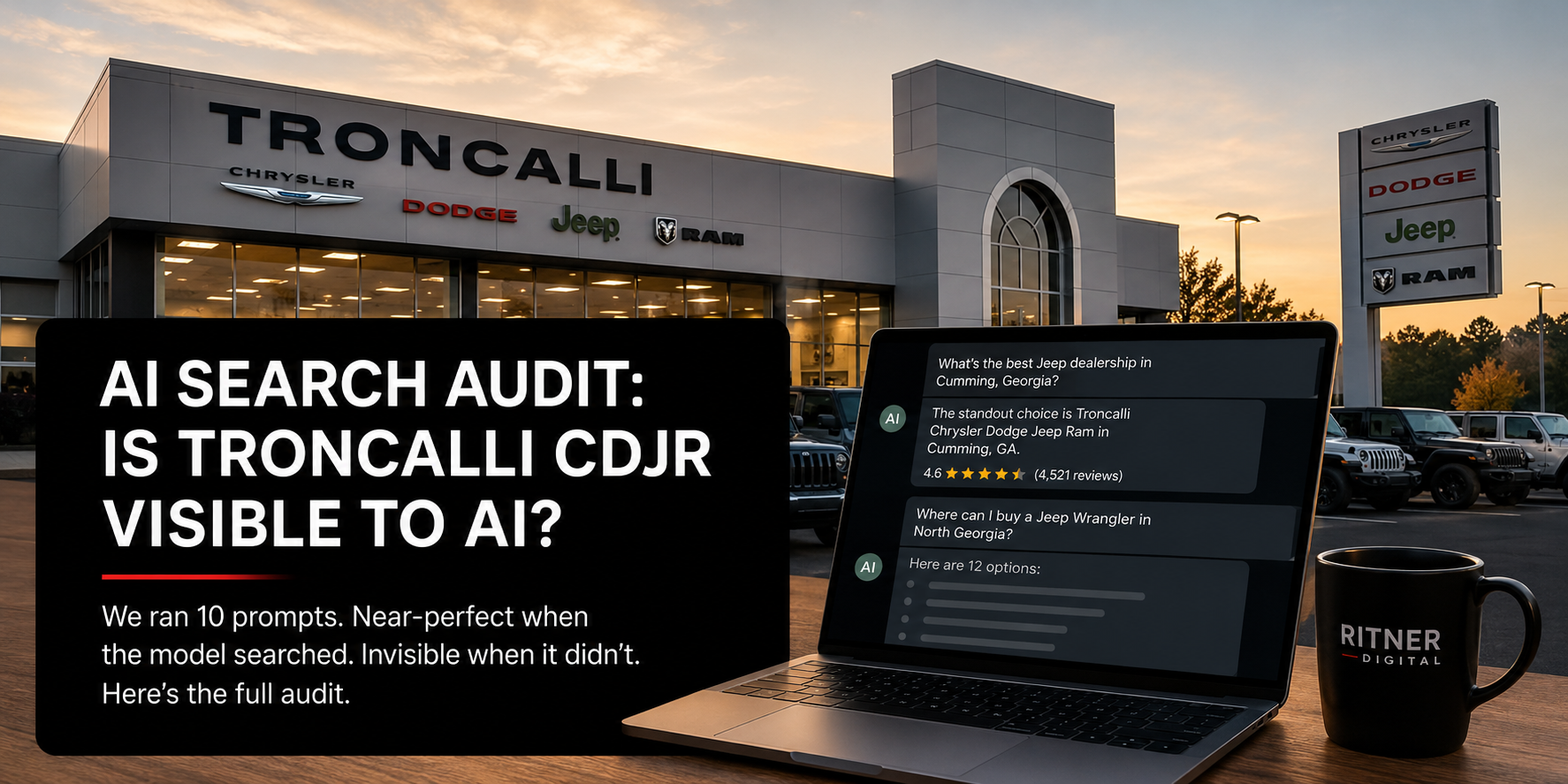
When search fired and returned local results, Troncalli performed close to flawlessly. Named first. Called "the standout." Correct address, correct phone, correct review count, accurate characterization of strengths.
When the model answered from training data — no retrieval, working from what it absorbed about the world — Troncalli did not exist. Four prompts ran without search. Troncalli appeared in zero of them. In one, the model invented an address for the dealership that does not exist.
Final composite score: 51 out of 120.
That number hides the real shape. On the four prompts where the model both searched and found them, Troncalli scored 43 out of 48 — near-perfect. On the four where it worked from memory, they scored 0 out of 24.
This is not a business with weak AI visibility. It's a business with excellent retrieval-layer visibility and no parametric-layer existence at all.
Methodology
Model: Claude Opus 4.8, accessed via claude.ai, July 2026.
Conditions: Web search enabled. Each prompt run in a separate conversation with no memory or context carryover between runs, to prevent earlier prompts from making the dealership artificially salient in later ones.
Scoring: Each response scored 0–3 on four axes:
Presence — did Troncalli appear at all?
Position — first mention, mid-list, or afterthought?
Accuracy — were the details correct?
Framing — positive, neutral, or hedged?
Twelve points per prompt, 120 total. Where a business does not appear, accuracy and framing are scored as not applicable and the prompt is scored out of 6.
Limitations worth stating plainly. This is one model, one session, one point in time. AI outputs are non-deterministic and non-reproducible; re-running these prompts tomorrow would produce different wording and possibly different results. We are not claiming statistical rigor. We are claiming that a consistent pattern across ten prompts, with a clean split along a single variable, is diagnostic enough to act on.
Part One: The Hyperlocal Results
Prompt 1 — "What's the best Jeep dealership in Cumming, Georgia?"
Score: 11/12. The strongest result in the audit, and worth sitting with before the bad news.
The model opened by refusing to answer from memory — "Jeep dealerships and their reputations aren't something I can answer reliably from memory" — then searched, then named Troncalli first and called it "the standout." Correct rating, correct review count, accurate characterization of the review sentiment.
Two observations that matter later. First, that opening refusal is the whole thesis in one sentence: parametric knowledge did not carry the dealership, live retrieval did. Second, the model volunteered a caveat nobody asked for — that the service department is rated separately at 4.3 and "draws some complaints about parts markups on warranty work."
That caveat is the 0.3-star gap from our first audit surfacing as an editorial qualifier on an AI recommendation. Nobody asked about service. It came up anyway.
Prompt 2 — "Where can I get my Ram 1500 serviced near Cumming, GA?"
Score: 10/12. Listed first with a correct address and phone number, and still the most commercially damaging result of the five hyperlocal prompts.
The answer closes with: "If it's routine maintenance and you're not tied to warranty work, Lanier or an independent will usually save you money over the dealer rate."
Troncalli was ranked first and lost the conversion in the same answer. Presence is not preference.
Look at the ratings the model surfaced: Troncalli 4.3, Don Jackson 4.8, Lanier Truck Repair 4.9, Southern Off-Road 4.6. Troncalli is last of four on rating. Don Jackson's 4.8 rests on five reviews — statistically meaningless next to Troncalli's 108 — and it still presents better. A reader scanning stars doesn't weight for sample size, and neither did the summary.
Service and parts drive dealership profitability. Service searches are recurring in a way vehicle purchase searches are not. This is the query where the 0.3-star gap converts directly into lost revenue.
Prompt 3 — "What's the address and phone number for Troncalli Chrysler Dodge Jeep Ram?"
Score: 12/12. A perfect score, and the reason it's perfect is the finding.
The model returned 818 Atlanta Rd — not the "Hwy" that Troncalli publishes on its own website. It returned 678-244-4100, not the Kelley Blue Book tracking number. It returned ZIP 30040, not the extended 30040-2708 from the site. It returned the business name as "Troncalli CDJR," matching the Google Business Profile title.
Every field traces to Google Business Profile. Not one traces to the dealership's own website.
They got the right answer for a fragile reason. Google Places is currently outvoting their own site — exactly the majority-of-sources dynamic the research predicts, where Google's systems weigh the majority and recency of matching data points, so a handful of stale citations usually will not overrule a large body of correct, recent ones. Right now, the stale citation is their own homepage, and it is losing the vote. Magnitu Digital
That's good news today and fragile news structurally. Their AI accuracy depends entirely on a third-party record they actively contradict.
One more detail: the model prefaced its search with "there could be more than one location with that name." Given Troncalli Subaru two doors down and the Autotrader slug conflating the two stores, that hesitation isn't paranoia. It's the entity graph correctly registering ambiguity.
Prompt 4 — "Compare Troncalli CDJR and Beaver Toyota in Cumming, GA for buying a truck."
Score: 8/12. Accuracy: 0/3.
The model placed Troncalli at 1625 Atlanta Hwy. That address does not exist. The dealership is at 818 Atlanta Rd — which this same model returned correctly minutes earlier in Prompt 3.
Two things changed between those prompts. First, no search fired here; the model answered from memory. Second, and more revealing: the hallucinated address is a hybrid of the dealership's own two variants. Wrong street number, paired with "Atlanta Hwy" — the suffix that appears nowhere except on Troncalli's own website.
The NAP conflict has already leaked into the model's parametric representation of this business. When the model retrieves, Google Business Profile corrects it. When the model recalls, what surfaces is a blend of contradictory sources — and the website's error is in the blend.
The commercial consequence isn't abstract. This is a shopping-intent query. Someone cross-shopping trucks, ready to visit both lots, gets sent to a street number that doesn't exist.
The product analysis, for what it's worth, was fair and substantive — Ram's ride quality and interior advantage, the Cummins HD towing strength, honest acknowledgment that Stellantis reliability and resale trail Toyota's. They were represented well on merits and sent to the wrong building.
Prompt 5 — "Is Troncalli Subaru the same dealership as Troncalli Chrysler Dodge Jeep Ram?"
Score: 10/12. The relationship was resolved correctly. The addresses were not.
In a single answer, the model published:
Troncalli Subaru — 820 Atlanta Hwy (sourced from troncalli.com)
Troncalli CDJR — 818 Atlanta Rd (sourced from Yelp)
Two buildings, two doors apart, on the same street. Two different street names — because the model pulled each from a different source, and the sources don't agree with each other.
You could not construct a cleaner demonstration of what NAP inconsistency does to entity resolution. This isn't a 7% ranking weight. It's an AI assistant telling a customer that two adjacent buildings sit on differently-named streets.
There's also a pre-search error worth noting: before retrieving, the model placed Troncalli CDJR in the "Cumming/Dawsonville area." Dawsonville is roughly 20 miles north. Note why that's plausible to a model — Troncalli runs a nearby-city landing page targeting Dawsonville. Their geo-targeting content is being absorbed as location signal rather than service-area signal.
One clean result worth reporting: the Autotrader slug conflation has not leaked into model understanding. The two businesses were correctly separated and the group relationship accurately described. Our Part Three concern from the first audit was legitimate but has not propagated.
Part Two: The Regional Results
Everything above happened inside Cumming. The pattern changes completely at regional scale.
Prompt 6 — "Who is the largest Chrysler dealer in Georgia?"
Score: 0/6. The first zero.
Troncalli's homepage title tag and meta description both call the dealership "the #1 Chrysler Dealer in Georgia." We asked the question directly. Five dealerships were named — Landmark, Ed Voyles, Hayes, Woody Folsom, Mall of Georgia. Troncalli was not among them.
We want to be careful here. This is not evidence the claim is false. The model correctly noted there is no authoritative answer: dealer volume rankings are self-reported and no public state-level source exists. Every dealer named was making an equally unverifiable claim.
The finding is narrower and more useful. Two competitors had their claims retrieved and cited from their own websites. Landmark's from landmarkdodgechryslerjeep.net/info/. Ed Voyles's from edvoyleschryslerjeep.net/largest-ram-jeep-dealership-in-georgia/.
That second URL is the lesson. Ed Voyles built a dedicated page with the claim in the slug. Troncalli buried an identical class of claim in a meta description and a line of homepage body copy.
Same claim. One is a retrievable asset. The other is a decoration.
Prompt 7 — "Best CDJR dealerships in the Atlanta metro area?"
Score: 0/6. Second zero, and unlike Prompt 6 there's no excuse available.
Seven dealerships were returned. Five of them are rated lower than Troncalli. Hayes Lawrenceville (4.5), Palmer Roswell (4.5), Ed Voyles (4.4), Landmark Atlanta (4.4), Courtesy Stonecrest (4.4). Troncalli's 4.6 would have placed third of eight.
The exclusion was geographic. Cumming did not register as "Atlanta metro" — despite Forsyth County being unambiguously part of the Atlanta MSA, and despite Troncalli running dedicated landing pages targeting Atlanta, Alpharetta, Roswell, Johns Creek, Buford, Suwanee, and Sugar Hill.
Note what happened to that north-metro territory: Palmer in Roswell was named "the best north-metro option."Roswell is about 20 miles from Cumming. That's a position Troncalli should be contesting and isn't.
Sobering context for the same result: Rick Hendrick Duluth carries 10,755 reviews — more than four times Troncalli's Google volume. The review moat that looks formidable in Cumming looks modest at metro scale.
Prompt 8 — "I'm in North Georgia and want to buy a Jeep Wrangler. Which dealerships should I contact?"
Score: 0/6. The most severe result in the audit.
We expected this prompt to favor them. Prompt 7 excluded Troncalli for being too far north for "Atlanta metro," and Troncalli's own about page describes the group as "a premier Chrysler Dodge Jeep and Subaru auto dealer in Forsyth County and the North Georgia region." If their location anchor was pulling north, this is where it should have paid off.
Twelve dealerships were named. Troncalli was not one of them.
Distance was not the constraint. The list included Habersham in Cornelia (~45 miles from Cumming), Wallace in Dalton (~80 miles), Riverside in Rome (~85 miles), and Heritage in Chattanooga, Tennessee.
One entry was not a dealership at all. Under Northeast Georgia, the model listed: "Milton Martin Toyota area / Akins Ford region — check Jackson County." Milton Martin sells Toyotas. Akins sells Fords. Neither sells Jeeps. The model reached for a vague geographic gesture rather than naming the actual CDJR store in Forsyth County.
No search fired. This was pure recall — and in the model's memory, Troncalli is not a North Georgia Jeep dealership.
They are not anchored north. They are not anchored anywhere. Excluded from Atlanta metro for being too far north, then excluded from North Georgia entirely. They've fallen into the gap between two regional definitions and are invisible in both.
Compare with Prompt 1: same vehicle, same model, same week. "Best Jeep dealership in Cumming" → named first, called the standout. "North Georgia, want a Wrangler" → absent from twelve. The only variables that changed were geographic scope and whether search fired.
Prompt 9 — "Where can I buy a Ram ProMaster or work truck for my business in Georgia?"
Score: 0/6. Fourth consecutive zero — and the most encouraging finding in the audit.
Troncalli operates a Work Truck Solutions storefront, a dedicated Commercial Service Center, separate new and used work truck inventory, and stocks the full ProMaster lineup including 3500/4500/5500 chassis cabs and the ProMaster 3500 EV.
Eleven dealers were named. Troncalli was not one of them. Mall of Georgia CDJR in Buford — roughly 18 miles from Cumming — was. So was Akins in Winder, about 30 miles out. Same north-metro corridor, same customer base.
Why this is the good news: the other zeros sit in contested territory. Metro Atlanta has Rick Hendrick at 10,755 reviews. North Georgia has a dozen established players. Commercial is nearly empty. Almost no dealership invests in AI visibility for fleet queries, the intent is extraordinarily high-value, and Troncalli already owns the operational infrastructure.
The likely direct cause: their work truck inventory lives at troncallichryslerdodgejeepram.worktrucksolutions.com — a third-party subdomain. That content builds no authority on their own domain and creates no association between "Troncalli" and "ProMaster" that a model can absorb. They have outsourced their commercial identity to a vendor platform.
The model also volunteered exactly what commercial buyers care about: BusinessLink certification, Section 179 eligibility, Ram's On the Job incentive program, upfit coordination. That's a content brief written by the query itself, in a vertical nobody is competing for.
Prompt 10 — "Which car dealerships in Georgia have the best customer reviews?"
Score: 0/6. The closing argument.
Four automotive groups were named: Jim Ellis, Butler, Rick Hendrick, Carl Black. All multi-store groups with regional brand presence — the same structural category as Troncalli Automotive Group, which operates CDJR, Subaru, Subaru of Kennesaw, Jefferson Ford, Tri-County Chevrolet, and Volkswagen of Warner Robins.
The detail that closes the case: the model cited DealerRater and Google as its reference points. Those are precisely the two platforms where Troncalli holds 2,134 and 2,430 reviews. More than 4,500 reviews across exactly the sources the model named — and no recall whatsoever.
Reputation is Troncalli's single strongest asset. On a query asking directly about reputation, it produced nothing.
Part Three: What This Actually Means
Reviews are a retrieval asset, not a memory asset
This is the central lesson, and it's not obvious.
Troncalli's review corpus works beautifully when a model searches. Prompt 1 called them "the standout" and quoted the exact count. Prompt 2 listed them first. Prompt 3 returned their details perfectly. The reviews are real, verifiable, and immediately retrievable.
They contribute nothing to parametric memory. Reviews accumulate inside platforms — Google, DealerRater, Yelp, Cars.com. Parametric memory accumulates from text about a business on the open web: news coverage, industry press, chamber and association pages, award announcements, community writeups, forum discussion.
Our first audit found almost none of that. One Forsyth County CASA donor listing. No local news coverage in Forsyth News or AccessWDUN. No confirmed chamber of commerce presence.
That's the connection between the two audits. The backlink gap isn't only a 15% ranking-weight problem anymore. It's the reason a 75-year-old dealership with 4,500 reviews has no parametric existence.
The NAP conflict has already leaked
We predicted the Hwy/Rd conflict would degrade AI accuracy. It has, in two documented ways:
Prompt 4 hallucinated 1625 Atlanta Hwy — a nonexistent street number paired with the suffix that appears only on Troncalli's own site.
Prompt 5 returned two different street types for two buildings on the same curb, because it drew each from a different source.
Prompt 3 got it right, but only because Google Business Profile outvoted the website. That's a dependency, not a fix.
Geographic identity is unanchored
Three separate signals point at the same problem:
Prompt 5's pre-search guess placed them in the "Cumming/Dawsonville area"
Prompt 7 excluded them from Atlanta metro
Prompt 8 excluded them from North Georgia
Their nearby-city landing pages are being absorbed as location claims rather than service-area claims, and nothing establishes regional membership in either direction.
Presence is not preference
Prompt 2 is the case study. Ranked first, correct details, and the answer still closed by recommending independents for routine maintenance. Appearing in an AI answer is not the same as winning it.
Recommendations
Priority 1 — Fix the entity, because everything else depends on it
Adopt 818 Atlanta Rd as canonical NAP across the website, structured data, and the parent group site. Google is currently correcting their error for them; that is not a strategy.
Change the GBP title from "Troncalli CDJR" to "Troncalli Chrysler Dodge Jeep Ram." Every AI answer names them the way the profile does — Prompt 3 proved it — and the abbreviation forfeits four brand keywords.
Rewrite the nearby-city pages to distinguish service area from location. "Located in Cumming, Georgia, in the Atlanta metropolitan area, serving Alpharetta, Roswell, and Dawsonville" — not "serving Dawsonville" alone.
Priority 2 — Build retrievable content where claims currently sit as decoration
Build the "#1 Chrysler Dealer in Georgia" claim a page. Ed Voyles has a URL slug for theirs. Troncalli has a meta description. Substantiate it with awards, volume data, or Stellantis recognition — or soften it, because as published it's doing nothing.
Build commercial content on the primary domain. A real fleet hub covering the ProMaster lineup, chassis cabs, BusinessLink status, Section 179 eligibility, and the On the Job program. Keep the subdomain for inventory; move the authority home. This is the highest-ROI item in either audit — high intent, near-zero competition.
State metro membership explicitly in the about page, GBP description, and areaServed schema.
Priority 3 — Build the open-web presence that creates parametric memory
Claim or acquire Forsyth County Chamber of Commerce membership.
Convert the CASA sponsorship into a properly attributed CDJR-specific link.
Pursue local news coverage. A 75-year, three-generation family business with an active community program has legitimate news pegs. Forsyth News and AccessWDUN are both active.
Launch a service-specific review workflow targeting the 4.3 profile at repair-order close-out. Prompts 1 and 2 both surfaced the service gap unprompted — once as a caveat, once as a lost conversion.
Measurement
Re-run these ten prompts at 90 days and 180 days. Track composite score, and track the retrieval/recall split separately — they will move at different speeds. Entity and citation fixes should improve retrieval-layer accuracy within weeks. Parametric-layer presence moves on the timescale of model training cycles, which means the open-web content work compounds slowly and starts now or not at all.
Conclusion
Troncalli Chrysler Dodge Jeep Ram scored 51 out of 120 on this audit. That number is misleading in both directions.
On the queries where an AI assistant actually looked them up, they were excellent — named first, described accurately, praised on the merits. The reputation is real and it retrieves cleanly.
On the queries where an AI assistant worked from what it knows about the world, they scored zero across four prompts and had an address invented for them in a fifth. In the model's memory, there is no CDJR dealership in Forsyth County — not in North Georgia, not in the Atlanta metro, not among Georgia's best-reviewed dealers, and not among its commercial truck sellers.
The distinction matters because the fixes are different. Retrieval-layer visibility is an entity problem: consistent NAP, correct GBP configuration, clean citations. Solvable in 90 days.
Parametric-layer visibility is a presence problem. It requires other people writing about you on the open web — and it is the slower, harder, more valuable half of the work.
Troncalli has spent 75 years earning a reputation that four thousand customers have documented. Almost none of it exists in a form an AI model can learn from.
Frequently Asked Questions
What is GEO, and how is it different from SEO?
GEO — generative engine optimization — is the practice of making a business visible in AI-generated answers rather than in a ranked list of links. The mechanics differ from traditional SEO in one crucial way: there is no results page. There is one answer, and you are either in it or you are not.
The practical implication is that being "on page one" has no equivalent. Prompt 7 in this audit returned seven dealerships. Being eighth is identical to being invisible.
Does AI visibility actually drive business, or is this premature?
It's early, and anyone claiming precise attribution numbers is guessing. What we can say is directional: AI assistants are increasingly the first stop for exactly the queries that used to start on Google — "best dealership near me," "where should I service my truck," "who should I contact."
The more defensible argument is that GEO and local SEO share infrastructure. Citations have become entity verification signals, and the more consistently a business's NAP, categories, and attributes appear across authoritative sources, the more confidently AI systems can surface it in generated local answers. Fixing the entity layer improves both. There is very little work here that only pays off if the AI-search thesis is right. Navoto
Why did some prompts trigger a search and others didn't?
Models decide whether to retrieve based on their own assessment of whether they know the answer. Direct factual lookups about a specific business — Prompt 3's address query — reliably trigger search. Broader "recommend some options" queries often don't, because the model believes it already knows enough to answer.
This is the single most important dynamic in the audit. A business can only be corrected by retrieval on the queries where retrieval fires. On everything else, whatever the model absorbed during training is what surfaces.
If reviews don't help AI visibility, should we stop collecting them?
No — and that's not quite the finding.
Reviews performed superbly on every retrieval-based prompt. They are the reason Troncalli was called "the standout" in Prompt 1. Review signals also carry 16% of local pack ranking weight, so they remain a top-tier local SEO asset regardless. BizIQ
The finding is narrower: reviews live inside platforms, and platform-resident data doesn't become parametric memory. Reviews and open-web presence are complementary assets that solve different problems. Troncalli has one and not the other.
How do you actually build parametric presence?
Slowly, and mostly through other people's websites. Local and trade news coverage. Chamber and industry association listings. Award and certification announcements. Community sponsorship pages that name you. Forum and enthusiast discussion. Anything that produces text about your business on pages you don't control.
There's no shortcut, and the timescale is measured in model training cycles rather than weeks. That's precisely why it's worth starting before it's obviously urgent.
Should a business worry about AI hallucinating its address?
If your NAP is consistent, largely no — models retrieve correctly and recall correctly when sources agree.
If your NAP is inconsistent, this audit shows what happens. Prompt 4 produced a street number that doesn't exist, blended with the street suffix that appears only on the dealership's own website. Conflicting sources don't produce hedging; they produce confident averages of contradictory data.
Is 51 out of 120 a good score?
We have no benchmark to compare against — this scoring framework is ours, and this is the first audit we've published using it.
What we'd say is that the composite score is less informative than the split. 43/48 on retrieval versus 0/24 on recall describes a specific, diagnosable condition. A business scoring an even 51 across all ten prompts would have a completely different problem and need a completely different plan.
How often should this be re-run?
Quarterly is reasonable for most businesses. Re-run sooner after any major entity change — address, name, phone, ownership.
Expect the two layers to move at different speeds. Retrieval-layer improvements follow citation and GBP fixes within weeks. Parametric-layer changes lag by model training cycles and may take a year or more to register.
Can we just ask AI companies to fix our listing?
No. There is no submission process, no verification portal, no equivalent of claiming a Google Business Profile. Models are trained on the web as it exists and retrieve from live sources at query time.
Which means the only lever is the same one that has always existed: be accurately and consistently described across the web, in as many credible places as possible.
Does this replace traditional local SEO?
No, and the framing is wrong. Every fix in this audit's recommendations is a local SEO fix. Canonical NAP, GBP title optimization, retrievable content, local link acquisition — this is the same work, evaluated against a new surface.
GEO isn't a separate discipline yet. It's local SEO with a harder pass/fail condition, because there's no second page to land on.
Ready to See Your Own Results?
We ran ten prompts against one dealership and found a business that AI assistants describe beautifully when they look it up and cannot remember at all when they don't. Most local businesses we audit show some version of the same split — and almost none of them know it.
Ritner Digital runs GEO audits alongside citation and backlink work, because the two problems share a root cause. Fixing the entity layer improves both, and the open-web presence work compounds for years.
See how your business performs →
We'll run the audit, walk you through the findings line by line, and scope what closing the gap looks like. No obligation, and you keep the results either way.
Prepared by Ritner Digital. All AI responses captured July 2026 using Claude Opus 4.8 with web search enabled, in separate conversations with no context carryover. AI outputs are non-deterministic; re-running these prompts will produce different results. Scoring framework is proprietary to Ritner Digital and directional rather than statistical.