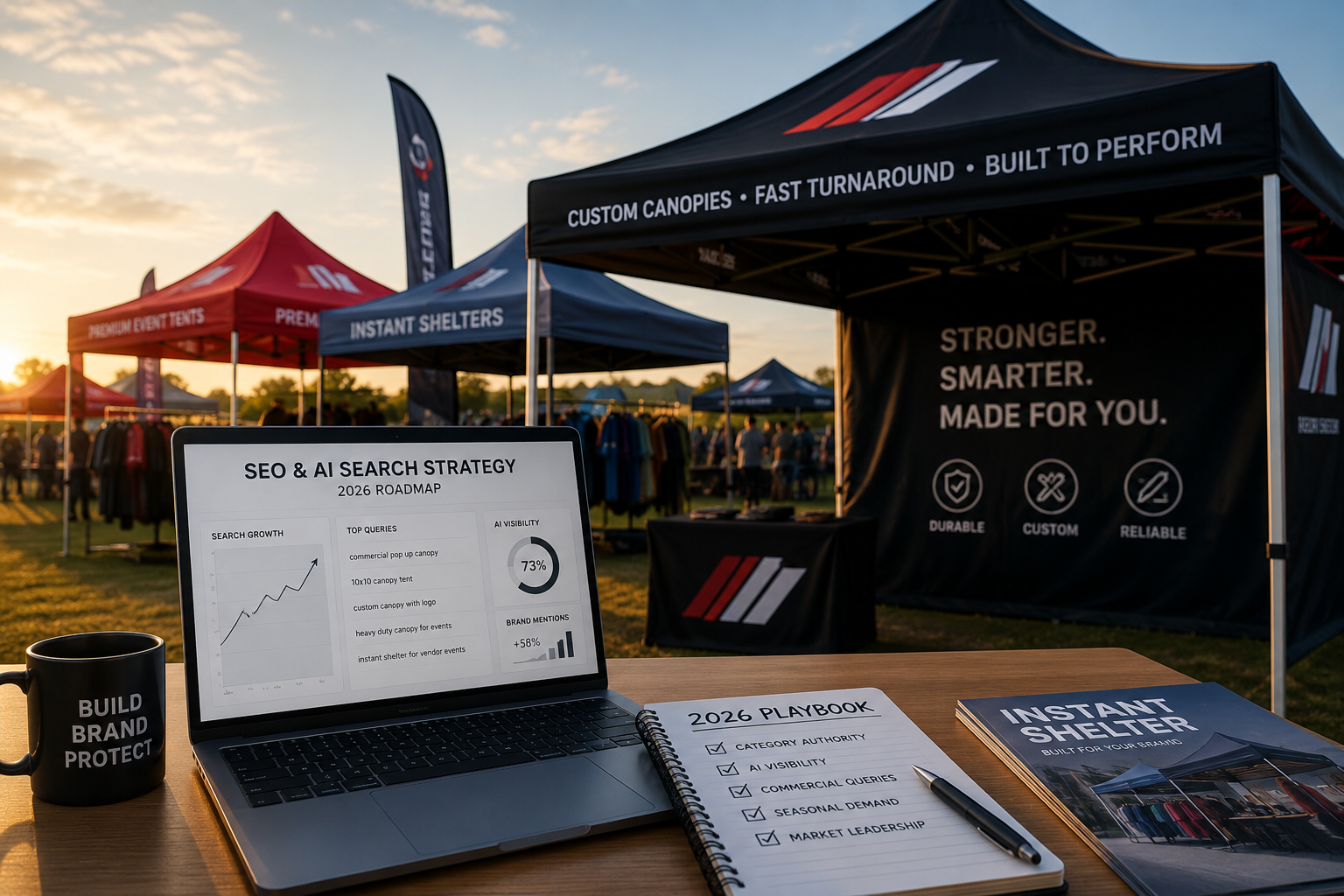
Why the instant-shelter category is one of the most structurally exposed verticals in search right now — and what manufacturers can do before the buying season decides it for them.
Most industries have a search problem. The pop-up canopy industry has four at once, and they compound.
If you manufacture or sell instant shelters, commercial canopies, custom-printed event tents, or the accessories around them, you are operating in a category where the generic search term is somebody's trademark, the majority of product discovery happens on a marketplace you don't control, your buyers split into two audiences with nothing in common, and roughly half your annual revenue gets decided inside a twelve-week window.
Now add answer engines to that. Buyers who used to type "10x10 canopy" into Google are increasingly describing their problem to an AI and accepting a shortlist of three brands. If you're not on that list, there is no page two to rank on.
This is a playbook for fixing it. It's built for the commercial side of the category — the manufacturers, custom-print operations, and dealers selling into events, food service, sports, industrial, and government — because that's where the margin lives and where the search opportunity is most badly underexploited.
The Category Is Growing. The Discovery Layer Is Shifting Under It.
First, the demand picture, because it's genuinely good. The global commercial pop-up canopy market was valued at roughly $178.9 million in 2025, is expected to reach $191.6 million in 2026, and is projected to hit approximately $355.2 million by 2035 — a 7.1% CAGR. Growth is driven by outdoor advertising, exhibitions, sports events, and food service, which together account for more than 62% of total canopy demand. The broader pop-up tent market sits around $1.2 billion and is forecast to roughly double by 2033, with canopy tents specifically dominating outdoor event and commercial applications as trade shows, weddings, and festivals expand. Global Growth InsightsVerified Market Reports
That's a healthy, expanding, high-intent commercial market. The problem isn't demand. It's that the layer where demand gets routed is being rebuilt, and most manufacturers in this space are still optimizing for the version that existed in 2019.
Four Structural Problems Unique to This Category
1. Your category term is a brand name
This category has a rare distinction: the everyday word for the product is a registered trademark. Customers walk into a rental yard and ask for one by name, meaning any of them.
Trademark law calls this genericide. It occurs when a mark becomes so tightly bound to a product that it stops functioning as a distinctive identifier and loses legal protection, becoming the name for a whole category rather than a label for one company's version. The cruel irony is that it tends to strike the brands that most completely dominated their categories — the same way "thermos" and "zipper" lost protected status once common usage turned them into ordinary words. Iplink-asia + 2
The SEO consequence is what matters here. That genericized term is one of the highest-volume commercial keywords in the vertical, and every competitor in the category can bid on, optimize for, and rank against it. If you're the originator, you funded four decades of demand for a keyword you now share with importers who launched last spring. If you're a challenger, that same term is the single largest pool of unclaimed high-intent traffic in your market.
Either way, the strategic answer is the same: you cannot win this on the brand keyword. You win it on the specification and use-case queries underneath it. More on that shortly.
2. Discovery starts somewhere other than your site
Amazon overtook Google for product searches, with roughly 54% of product searches beginning there. Other research puts it as high as 63% of consumers in major e-commerce markets. Together, the two platforms are the entry point for approximately 85% of all product searches. Scoop Market + 2
On a marketplace, a canopy is a canopy. Results are ordered by listing optimization, review velocity, price, and ad spend. Frame alloy, leg geometry, denier rating, fire certification, and forty years of tooling are invisible to that ranking system. Your engineering advantage does not exist unless it has been translated into signals the algorithm can read.
3. You're serving two buyers on one domain
A DTC parent buying a light-duty shade canopy for soccer season and a procurement officer sourcing forty custom-printed commercial units with sidewalls for a national activation share almost nothing — not vocabulary, not price sensitivity, not research depth, not buying cycle.
Most canopy sites are architected for the first buyer and bolt the second on as a "custom" or "contact us for a quote" section. That's backwards from a revenue standpoint, and it's catastrophic from an entity standpoint, because it teaches search engines and AI models a muddled story about what your company actually is.
4. Seasonality punishes slow strategies
Search demand in this category is violently seasonal. Which means an SEO program started in March is a program that misses the year. Authority compounds over months; the buying window doesn't wait. This is the single most common costly mistake we see in outdoor and event categories — treating search as a spring campaign rather than an off-season build.
What Actually Changed: The Answer Layer
Layered on top of all four problems is the fastest channel shift in twenty years of search.
Website traffic from AI search engines grew 16x between 2024 and 2026. One study tracking 6.77 million LLM-referred sessions found monthly volume grew 9.9x from November 2024 to May 2026, with no sign of slowing. ChatGPT reached 900 million weekly active users as of February 2026, up from 400 million a year earlier, and Gartner has forecast that traditional search engine volume will fall 25% due to AI chatbots and virtual agents. SeaRanks + 2
For anyone selling physical product, the retail numbers are the ones that should reorder the roadmap. Adobe Digital Insights measured AI-driven referral traffic to US retail sites surging 693% year over year during the 2025 holiday season, with AI referrals converting 31% better than non-AI traffic. Omnibound
And the classic SERP is changing shape underneath that. AI Overviews now appear on 48% of Google searches and reduce organic click-through by roughly 61% — but brands cited inside them earn 35% more organic clicks than uncited brands. theStacc
There's one more data point that should land hard for this category specifically. Roughly 60% of Google Shopping queries now use conversational, broad-intent phrasing rather than exact product names or model numbers. Scubemarketing
Buyers have stopped typing "10x10 commercial canopy." They're typing — and speaking — "what canopy will survive a windy three-day farmers market." That is a question with an answer, and the answer names brands.
How Answer Engines Decide Which Canopy Brand to Name
This is the mechanic most manufacturers haven't internalized: language models don't rank pages. They resolve entities.
LLMs aggregate signals from across the web and decide which specific brand or product each mention refers to before generating an answer. That entity decision controls which domains get cited and whose narrative gets amplified. In a traditional SERP, a slightly-off query could still earn you a click. In an AI answer, there's often room for only a few brands, and one bad entity mapping pushes you out entirely. Single Grain
How few? Visibility in AI answers depends on being one of three to five named entities rather than on ranking a page — a query may surface only a handful of brands, sometimes with no clickable list at all. Let's Data Science
The selection signals are documented and, importantly, actionable. Brand-mention frequency across relevant content, entity authority, contextual relevance, and third-party validation are the factors that most influence which brands get recommended. Training-data frequency, recency, and source authority drive visibility — and niche brands with concentrated coverage in editorial citations and comparative reviews often outrank larger competitors whose mentions are high-volume but dispersed and generic. Let's Data ScienceAwilix
Read that last clause twice. A well-documented challenger can beat a category inventor whose coverage is enormous but semantically vague. Volume of mentions is not the same as clarity of entity.
There's a consistency requirement too. Models look for narrative coherence — if a brand is described one way on its own site and differently in reviews, the model's confidence in that entity drops, making it less likely to reference the brand for either description. They also look for digital consensus: when multiple independent sources agree a given product is best for a given use, the model treats that as fact. Page One Power
For a canopy company running consumer shade, commercial events, industrial safety, and government contracts off a single domain with inconsistent positioning, that's a direct diagnosis. We've written the full framework for fixing it in our guide to entity SEO for brands that want to be found by AI and Google, and the underlying discipline is what we call authority and entity building.
The Five Query Archetypes — and Where Each Is Won
Here is the practical map. Every meaningful query in this category falls into one of five buckets, and each is won differently.
1. Category and genericized-brand queries
"pop up canopy," "instant shelter," the trademarked term used generically
Highest volume, lowest winnability, worst margin. Dominated by marketplaces and ad spend. Compete here for brand defense, not for growth. Do not build your program on it.
2. Specification queries
"canopy wind rating," "300D vs 500D canopy top," "aluminum vs steel canopy frame," "what does denier mean on a canopy," "fire certified canopy for food booth"
This is the opportunity, and almost nobody is executing it well. These queries are lower volume individually, enormous in aggregate, and they are precisely the questions AI answers get asked to resolve. They also happen to be the questions where a real manufacturer has an unfair advantage: you have the test data, the engineering rationale, the failure modes, and the certifications. Importers have a spec sheet copied from a supplier PDF.
Spec content is the single highest-leverage asset class in this vertical because it converts institutional knowledge into citable, machine-readable authority. This is the core of a content system built to earn rankings and citations on a steady cadence.
3. Use-case queries
"best canopy for farmers market," "trade show canopy setup," "sideline shelter for youth sports," "canopy for disaster response staging," "food booth sidewall requirements"
Given that outdoor advertising, exhibitions, sports events, and food service account for more than 62% of commercial canopy demand, use-case content maps almost perfectly onto revenue. These are also the queries most likely to be phrased conversationally — which means they're the queries most likely to be answered by an AI naming three brands. Global Growth Insights
Every major use case deserves a genuine resource page: requirements, wind and weather considerations, permitting and certification realities, sizing math, accessory requirements, and the honest tradeoffs. Not a product category page with a paragraph of intro copy.
4. Custom print and B2B procurement queries
"custom printed canopy," "branded event tent," "canopy printing turnaround time," "bulk canopy order," "dealer program"
This is the margin business, and it's typically the worst-served part of a canopy site's search architecture. Procurement buyers research specs, lead times, artwork requirements, minimums, and proofing processes — and most of that information sits behind a quote form where no search engine and no model can read it.
Publishing your process is not giving away advantage. It's how you become the entity models cite when someone asks how custom canopy printing works. Pair it with conversion-focused copywriting and a site built to rank and convert.
5. Support, parts, and warranty queries
"canopy replacement parts," "how to fix a canopy leg," "canopy owner's manual," "replacement canopy top 10x10"
The most underrated moat in the category. These queries carry low commercial intent on the surface and enormous strategic value underneath. They generate repeat traffic, they're overwhelmingly branded, they drive genuine replacement revenue, and — critically — they're the content that proves to both Google and an LLM that you are a real manufacturer supporting real equipment over a real product lifespan, rather than a reseller flipping containers.
Knockoff competitors structurally cannot produce this content. Lean into it.
The Technical Foundation
None of the above works on a site models can't parse.
Structured data is not optional here. JSON-LD gives a model a pre-parsed, disambiguated map of entities and attributes rather than forcing it to do entity resolution across free-form HTML at inference time — and multiple sources converge on a measurable uplift from comprehensive schema markup, with one controlled test measuring roughly a 30% improvement. Getaiso
For a canopy catalog, that means Product and ProductGroup markup handling size and duty variants properly, Offer data, AggregateRating, Organization and Brand markup that clearly establishes who you are, HowTo markup on setup content, and FAQ markup on spec pages. Most e-commerce platforms in this space ship with partial or broken implementations by default. See schema and structured data.
Then the unglamorous layer: faceted navigation across size × duty × use case generating thousands of crawlable near-duplicate URLs, variant pages competing with each other, heavy product photography destroying mobile performance in a category where a meaningful share of research happens on a phone at a job site, and seasonal inventory pages that 404 in the off-season and torch their accumulated authority. That's technical SEO work, and in e-commerce it's usually where the first 20% of gains are hiding.
Earning the Consensus
Since third-party validation is one of the primary signals determining which brands get named, and models adopt cross-source agreement as fact, your own site is necessary but insufficient. Let's Data SciencePage One Power
What moves the needle in this category: coverage in event-industry, food-truck, farmers-market, trade-show, and outdoor-recreation publications; genuine testing and comparison coverage; supplier and dealer directory presence with consistent NAP and description data; and educational contributions to the associations and trade bodies your buyers actually read.
This is digital PR and earned backlink work doing double duty — they build classic domain authority and they write the corpus that trains the answer.
If you sell through dealers or have regional distribution, add the local SEO layer: rental yards, event suppliers, and dealer locations are high-intent local queries that most manufacturers leave entirely to the channel.
Measurement: Two Things Most Programs Don't Track
Share of model. Build a standing prompt set of 40–60 queries across all five archetypes, run it monthly across ChatGPT, Gemini, Claude, Perplexity, and AI Overviews, and score each result: named, cited with a link, absent, or misattributed. That last category matters most in a genericized market — you need to know how often a model uses your brand name while recommending someone else's product.
Seasonality-adjusted forecasting. Year-over-year comparisons are the only honest ones in this category, and a forecast that doesn't model the buying window is a forecast that will get you blamed in July for a decision made in November. Clean analytics and tracking is the prerequisite for both.
We publish our own monthly Search Console data and our first 90-day report card — including the parts that didn't go well — because we think that standard should apply to agencies before it's demanded of clients.
Why Manufacturers Are Positioned to Win This
Here's the encouraging part.
The signals that answer engines reward — verifiable specificity, engineering depth, third-party validation, consistent entity narrative, longevity of documentation — are exactly the assets a real manufacturer already owns and a drop-shipper structurally cannot fabricate. Patents, wind testing, fire certifications, materials engineering, decades of field failure data, replacement parts catalogs, warranty records, and actual customer deployments.
Most canopy companies have all of it sitting in engineering folders, dealer PDFs, and the heads of people who've been there twenty years. It has simply never been structured for machines to read, cite, and recommend.
That's not a content problem. It's a translation problem — and it's a solvable one. The full mechanics are in our complete guide to getting found in AI search.
The window matters, though. Authority compounds, which means it compounds for whoever starts first. In a seasonal category, every off-season spent not building is a buying season handed to whoever did.
Find Out Where You Stand
If you manufacture or sell in this category, the useful first step is small: a read on which queries you're currently named in, which ones your competitors own, and which spec and use-case questions are sitting entirely unclaimed in your market.
We'll run that analysis and give you a clear picture of where the gaps are — plus a 12-month forecast in clicks, leads, and pipeline your finance team can plan around. Thirty minutes, no pitch.
Sources
Commercial Pop Up Canopy Market Size & Share Report, 2035 — Global Growth Insights
Pop-up Tent Market Size & Forecast — Verified Market Reports
When Trademarks Become Generic: Lessons from History — IPLINK Asia
Genericide: Famous Brands That Lost Their Trademarks — Braslow Legal
Amazon Search vs Google Shopping: 2026 Discovery Shift — Eva
How LLMs Select Brands for AI Search Recommendations — Let's Data Science
Frequently Asked Questions
How long does SEO take to work for a seasonal category like canopies?
Expect early indexing and impression movement within 60–90 days, and meaningful revenue impact over two to three seasons. The critical scheduling point is that authority compounds slowly while your buying window is short — which means the work has to happen in the off-season. A program launched in March is a program optimizing for a season that has already been decided. For a seasonal manufacturer, the correct time to build is the quarter after your peak ends, not the quarter before your next one starts.
Should we invest in SEO if most of our sales come through Amazon?
Yes, and arguably more urgently. Roughly 54% of product searches begin on Amazon, but marketplaces rank on listing optimization, review velocity, and ad spend — signals where a heritage manufacturer has no structural advantage over an importer. Your own site is the only place where engineering depth, testing data, certifications, and product lifespan can be documented in a way both Google and AI models can read. It's also where margin is highest and where customer relationships survive a marketplace policy change. Marketplace revenue is rented; search authority is owned. Scoop Market
Why do competitor products show up when people search our brand name?
Because in this category the brand name functions as the product category. When a mark becomes so tightly bound to a product that it stops functioning as a distinctive identifier, it becomes the name for the whole category rather than one company's version of it. Once that happens, competitors can legitimately optimize against the term, and search engines learn to treat it as a product type rather than a company. Iplink-asia
You will not win that keyword back through search alone. The effective strategy is to shift the battleground to specification and use-case queries where genuine manufacturing knowledge creates separation, while using entity and authority work to re-establish a clear, consistent brand identity in the sources models learn from.
What is AI search optimization, and how is it different from regular SEO?
Traditional SEO aims to rank a page in Google's results. AI search optimization aims to get your brand named when someone asks ChatGPT, Gemini, Claude, Perplexity, or Google's AI Overviews for a recommendation. The disciplines overlap — strong content and authority help both — but the mechanics differ fundamentally. AI visibility depends on being one of three to five named entities rather than on ranking a page, and the signals that drive it are brand-mention frequency, entity authority, contextual relevance, and third-party validation. There's no page two to fall back to. Let's Data ScienceLet's Data Science
How do we find out whether AI is currently recommending our brand?
Build a standing prompt set of 40–60 queries covering category terms, spec questions, use cases, comparisons, and procurement questions. Run it monthly across the major engines and score every result in four buckets: named, cited with a link, absent, or misattributed.
That fourth category is the one that matters most in this vertical — you need to know how often a model invokes your brand name while recommending someone else's product. That's the specific failure mode a genericized category term produces, and it's invisible in Google Analytics.
What content actually earns rankings and citations for canopy companies?
Specification content and use-case content, in that order. Spec pages — wind ratings, frame alloys and leg geometry, fabric denier and coatings, fire certifications, anchoring requirements, failure modes — are low-volume individually, large in aggregate, and precisely the questions answer engines are asked to resolve. They're also the content a reseller cannot credibly produce.
Use-case resources come second: farmers markets, trade shows, sports sidelines, food service, industrial and government deployment. Outdoor advertising, exhibitions, sports events, and food service account for more than 62% of commercial canopy demand, so this content maps directly onto revenue. Product category pages with a paragraph of introductory copy do not count as either. Global Growth Insights
Do we need separate strategies for consumer sales and custom-print B2B?
You need separate architecture and messaging, driven by one unified entity strategy. The two buyers share no vocabulary, price sensitivity, research depth, or buying cycle, and cramming both into one undifferentiated site actively damages AI visibility — models lose confidence in entities described inconsistently across sources, making them less likely to surface the brand for either description. Page One Power
The common failure is burying the entire custom and procurement side behind a quote form, where no search engine and no language model can read your process, lead times, artwork requirements, or minimums. Publishing that information is how you become the entity cited when someone asks how custom canopy printing works.
Does schema markup really matter for product pages?
More than it used to. Structured data gives a model a pre-parsed map of entities and attributes instead of forcing it to resolve them from free-form HTML at inference time, and multiple sources converge on measurable uplift from comprehensive markup — one controlled test measured roughly a 30% improvement. Getaiso
For a canopy catalog that means Product and ProductGroup markup handling size and duty variants correctly, Organization and Brand markup establishing identity, HowTo markup on setup content, and FAQ markup on spec pages. Most e-commerce platforms ship with partial or broken implementations by default, so this is worth auditing before assuming it's handled. See schema and structured data.
Is AI search traffic actually large enough to justify the investment?
Today it's small in absolute terms and growing faster than any other channel. Traffic from AI search engines grew 16x between 2024 and 2026, and Adobe measured AI-driven referral traffic to US retail sites rising 693% year over year during the 2025 holiday season, converting 31% better than non-AI traffic. SeaRanksOmnibound
The more immediate argument is defensive. AI Overviews now appear on roughly 48% of Google searches and cut organic click-through by about 61% — but brands cited within them earn 35% more organic clicks than uncited brands. Getting cited protects the traffic you already have. theStacc
How do we measure return on this?
Tie visibility to pipeline rather than to rankings. That means clean tracking, year-over-year comparisons rather than month-over-month in a seasonal category, and a model that translates projected organic clicks into expected leads, customer acquisition cost, and payback period. We build a 12-month forecast on exactly those terms so search becomes a planned line item rather than a hopeful one — and we publish our own monthly Search Console numbers, including the months that underperformed.