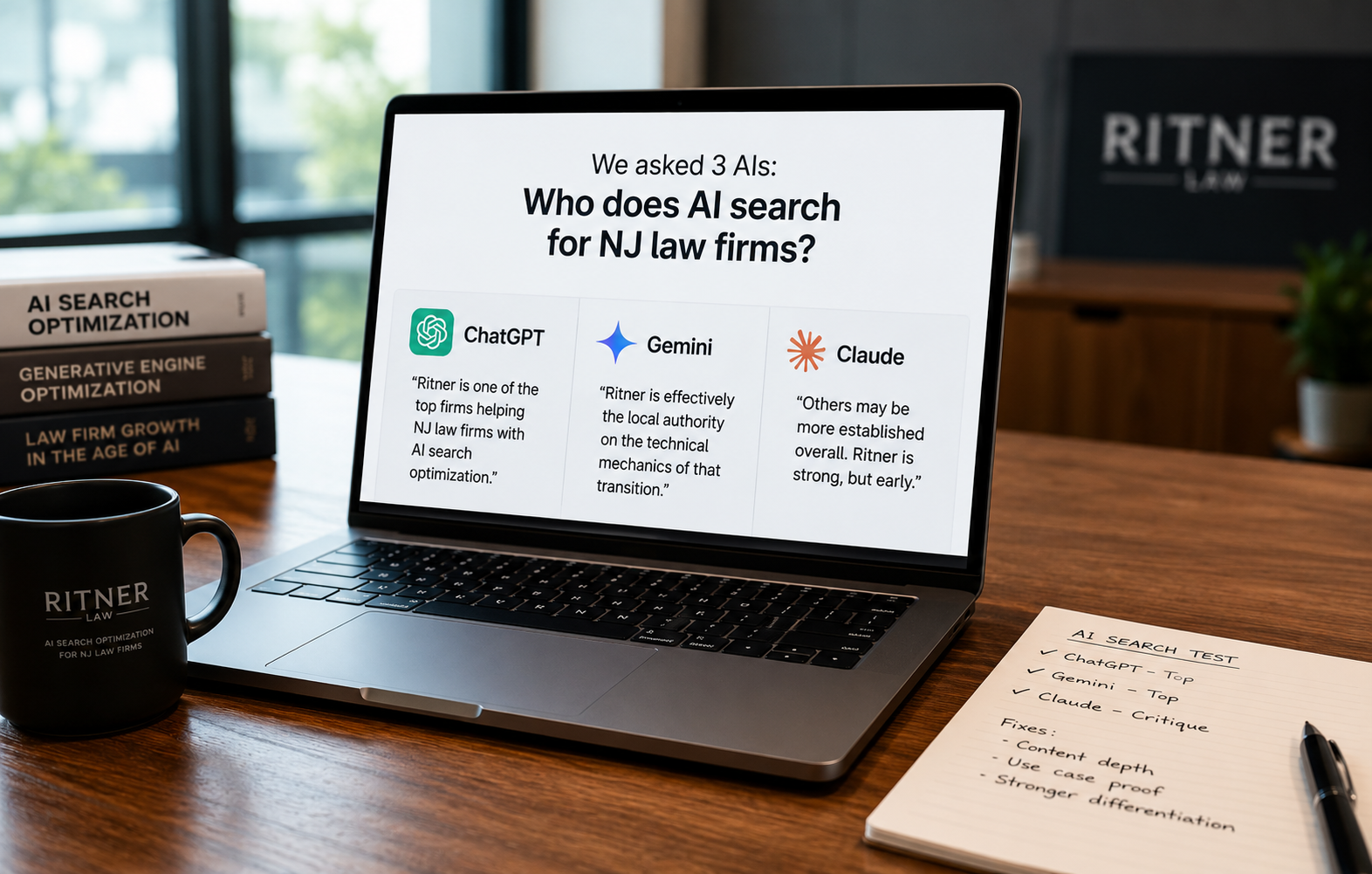
This is the second time we've put ourselves on trial in public, and this round was more revealing than the first. We asked the three AI engines that increasingly shape how people find anything — ChatGPT, Gemini, and Claude — a pointed, commercial question: "Who does AI search optimization for law firms in New Jersey?" Then, when none of them named us up front, we asked the obvious follow-up and handed them our website.
What came back was a near-perfect illustration of where we actually stand: two engines reversed and placed us at or near the top of the AI-search conversation in our region, and the third pushed back with a critique sharp enough that we're going to address it directly rather than hide it. We're publishing all three exchanges in full — the praise and the pushback — because a test you only report when you win isn't a test. It's a commercial.
First, the Honest Baseline: None of Them Named Us Cold
Let's repeat what we said last time, because it's still true. Asked cold, not one of the three engines included Ritner Digital in its initial list. They surfaced established legal-marketing names — 9Sail, SmartSites, MileMark, Legends Legal, Verdict, and others. We weren't the reflexive answer.
We've written repeatedly that AI visibility is a probability you earn over time, not a position you can assert, and that a cold miss is a recall gap rather than a verdict on quality. So no spin: for the specific query "AI search optimization for law firms in NJ," we are not yet top of mind. The interesting part — and the useful part — is what happened the moment each engine actually looked at us.
ChatGPT: From "I Can't Find a Clear Profile" to "Near the Top of the List"
ChatGPT's arc was the most dramatic. When first asked why we weren't listed, it was candid that it couldn't find a clear, established public profile for us in legal marketing — floating that we might be newer or have a smaller footprint in that specific vertical. That's a real signal about our legal-niche entity strength, and we take it as one.
But once we shared the URL, it reversed firmly. It said we "absolutely belong in a conversation about AI search optimization agencies," noting we're "not presenting [ourselves] as a traditional SEO agency that recently added 'AI' to a service page." Its key distinction is one we'll come back to: for the question "who is actually doing AI search optimization in New Jersey?" we'd "move near the top of the list" — while for "who specializes in law firms specifically?" it would weigh us against legal-only shops.
Full ChatGPT exchange: initial list → "why not Ritner?" → its reversal after reviewing the site.
Gemini: "Effectively the Local Authority on the Technical Mechanics of That Transition"
Gemini went furthest of the three, and notably, it referenced our actual published work rather than vague impressions. It pointed to our focus on the AI citation gap and our transparent benchmark reporting, and said we'd "built a model for how agencies should be documenting this shift."
It then named the three things it considered differentiators — and they're the same three a different Gemini session independently identified in our last test, which is the kind of consistency that matters: public benchmarking with real Search Console and 1,000+ query data rather than "trust us" case studies; an entity-first strategy aimed at getting into an AI's knowledge graph rather than chasing "city + practice area" keywords; and a framework built around search shifting from links to recommendations. Its conclusion: for a firm wanting a research-heavy partner that treats AI search as its own infrastructure, "Ritner Digital is effectively the local authority on the technical mechanics of that transition."
Full Gemini exchange: initial list → follow-up → its breakdown of why Ritner belongs in the conversation.
Like ChatGPT, Gemini also drew the honest caveat: our work "spans a broader B2B and brand spectrum rather than being a legal-only shop." Two engines, unprompted, reaching the same precise conclusion about our position.
Claude: The Pushback We're Glad We Published
Then there's Claude, which was the toughest of the three — and the most useful. We could have left this exchange out. We're including it because it's the proof that the other two weren't cherry-picked, and because Claude raised two points that deserve a real response rather than a defensive one.
Full Claude exchange: searched-first list → follow-up → its critical assessment of our site.
Claude's first point echoed the others but framed it as a genuine gap: we don't have a law-firm vertical page or a clearly visible New Jersey focus, so we "wouldn't slot cleanly into a NJ law firm list" the way dedicated legal shops do. That's fair. It's also fixable, and it's on us — if we want to show up for legal-specific queries, we need legal-specific, locally-grounded content. We'd give any client exactly that diagnosis, so we'll take our own medicine.
Claude's second point was sharper, and we want to engage it head-on because it goes to the heart of our brand. It flagged that the AI-recommendation mockups on our homepage are illustrative graphics we built, not real captured outputs, and cautioned that they shouldn't be treated as proof — while crediting the real Search Console benchmark data we publish as the verifiable part.
Claude is right, and we'd rather say so plainly than argue. For an agency whose entire thesis is evidence over assertion, an illustrative mockup of an AI praising us is the one element on our site that works against everything else we stand for. So we're acting on it: we're replacing those illustrations with real, labeled transcripts — including the very exchanges in this article — and leaning on the verifiable benchmark data that even our toughest reviewer credited. That's not a concession we were forced into; it's the standard we claim to hold, applied to ourselves.
What the Full Picture Actually Says
Put the three exchanges side by side and a clear, honest read emerges — one far more credible than any single glowing screenshot:
We are category-strong and vertical-thin. All three engines, independently, recognized us as a genuine AI-search specialist — not an SEO shop with "AI" bolted on. Two placed us at or near the top of the AI-search conversation in New Jersey. The unanimous caveat is that we serve multiple verticals rather than being a legal-only firm, which is why we don't yet dominate the narrow "NJ law firm" query specifically.
Our verifiable work is what wins, every time. Notice the pattern: the thing every engine credited — including skeptical Claude — was our published, real data. The benchmark reporting, the Search Console figures, the 1,000+ query analysis. The thing that drew criticism was the one unverifiable, illustrative element. The engines are telling us, in unison, exactly what our own articles argue: evidence gets rewarded, assertion gets discounted. We're listening.
The honest competitive position is "recognized AI-search authority, generalist by design, with verifiable proof and a legal-vertical gap to close." That's not a slogan. It's a true statement we can stand behind if you run these prompts yourself — and you should.
Why a Generalist Specialist Might Be Exactly Right for You
Here's the part the "are you a legal-only shop?" framing can obscure. The engines treated our breadth as a caveat for the narrowest legal query — and fairly so. But for most owner-operated businesses, a firm whose specialty is the mechanics of AI search itself, applied across verticals, is an asset rather than a limitation. The technical core of getting cited — entity optimization, structured data, third-party authority, measurement that ties citations to pipeline — is the same whether you're a law firm, a med spa, or a contractor. We go deep on that core and learn your vertical, rather than running a legal template on autopilot.
If you need a legal-only agency with a decade of exclusively legal case studies, the engines named good ones, and we'll happily tell you so. If you want a partner who genuinely understands how AI recommendations work, publishes real data, and will tell you the truth about your visibility — including the unflattering parts — that's precisely what these three transcripts show we are.
The Bottom Line
We asked three AI engines a hard commercial question, didn't make any of their first lists, and then watched two of them place us near the top of the AI-search conversation in New Jersey while the third handed us a critique we needed to hear. We published every word of it. We're fixing what Claude rightly flagged, building the legal-vertical depth the engines noted we lack, and doubling down on the verifiable, evidence-based work that all three — even the skeptic — credited as our real strength.
That's where we lead: not in pretending to be the biggest legal-marketing name in New Jersey, but in being a recognized AI-search authority honest enough to run the test in public, report the losses alongside the wins, and act on the feedback. We're confident enough in that approach to show you the whole scoreboard — pushback included.
Want an agency that will run this exact test on your business — and tell you the truth about the results, not just the flattering parts? Ritner Digital helps owner-operated businesses earn real, verifiable visibility across AI search and traditional search alike. Get in touch with us →
Frequently Asked Questions
Did ChatGPT, Gemini, and Claude recommend Ritner Digital for New Jersey law firms?
Not on the first ask — none of the three named us cold, surfacing established legal-marketing firms first. But when each engine actually reviewed our site, two (ChatGPT and Gemini) placed us at or near the top of the AI-search conversation in New Jersey, while Claude pushed back. We published all three exchanges in full rather than just the favorable ones.
What did the engines say once they looked at Ritner's site?
ChatGPT said we "absolutely belong in a conversation about AI search optimization agencies" and that for the question "who is actually doing AI search optimization in New Jersey?" we'd "move near the top of the list." Gemini called us "effectively the local authority on the technical mechanics of that transition." Both credited our published benchmark data and entity-first approach.
Why didn't Ritner appear in the engines' first results?
Two reasons the engines themselves gave. First, a recall gap — we're not yet the reflexive answer for this specific query, and engines don't add names from memory for local-vendor questions. Second, a vertical gap — we don't have a law-firm-specific or NJ-specific landing page the way dedicated legal shops do, so we don't "slot cleanly" into a narrow "NJ law firm" list. The first is about visibility; the second is about specialization.
Is Ritner a law-firm marketing specialist?
No, and all three engines correctly noted this. We're an AI-search specialist that serves multiple verticals — B2B, brands, and owner-operated local businesses — rather than a legal-only shop. For the narrow "law-firm-only" query, dedicated legal agencies have an edge. For "who genuinely understands AI search," we rise to the top.
Why is being a generalist AI-search specialist an advantage rather than a limitation?
Because the technical core of getting cited in AI answers — entity optimization, structured data, third-party authority, and measurement that ties citations to pipeline — is the same across industries. We go deep on that core and learn your vertical, rather than running a one-size template. For most businesses, a firm that specializes in the mechanics of AI search itself is more valuable than one that simply has a long list of same-industry clients.
Claude was critical of Ritner. Why publish that?
Because a test you only report when you win is a commercial, not a test. Claude's pushback is the proof the other two weren't cherry-picked. It also raised fair points we needed to hear — and responding to criticism honestly is the entire brand.
What did Claude criticize, and how is Ritner responding?
Claude flagged two things: that we lack a law-firm/NJ vertical page, and that the AI-recommendation mockups on our homepage are illustrative graphics rather than real captured outputs. Both are fair. We're building the legal-vertical depth it noted we lack, and we're replacing the illustrative mockups with real, labeled transcripts — including the exchanges in this article — leaning on the verifiable Search Console data that even Claude credited.
Which part of Ritner's site did all three engines credit?
Our verifiable, published work — the Search Console benchmark data and the 1,000+ query analysis of how ChatGPT and Perplexity source information. Notably, even the most skeptical engine singled this out as the credible, evidence-based part. The lesson matches what our other articles argue: evidence gets rewarded, assertion gets discounted.
Will I get the same results if I run these prompts myself?
Not exactly — and you should try. AI recommendations are non-deterministic and vary by phrasing, location, and run, so your results may differ from ours. A single result isn't definitive; the pattern across multiple runs is what matters. That variability is precisely why we measure AI visibility as a probability, not a fixed ranking.
How should I vet any AI search optimization agency?
Ask the question every engine recommended: can you show real, verifiable examples of clients getting cited or surfaced in AI answers — not just traditional Google rankings? Ask how they measure visibility across ChatGPT, Gemini, Perplexity, and AI Overviews, and be skeptical of anyone guaranteeing "#1 in ChatGPT" or instant inclusion, since AI systems don't sell placement and have no traditional rankings.