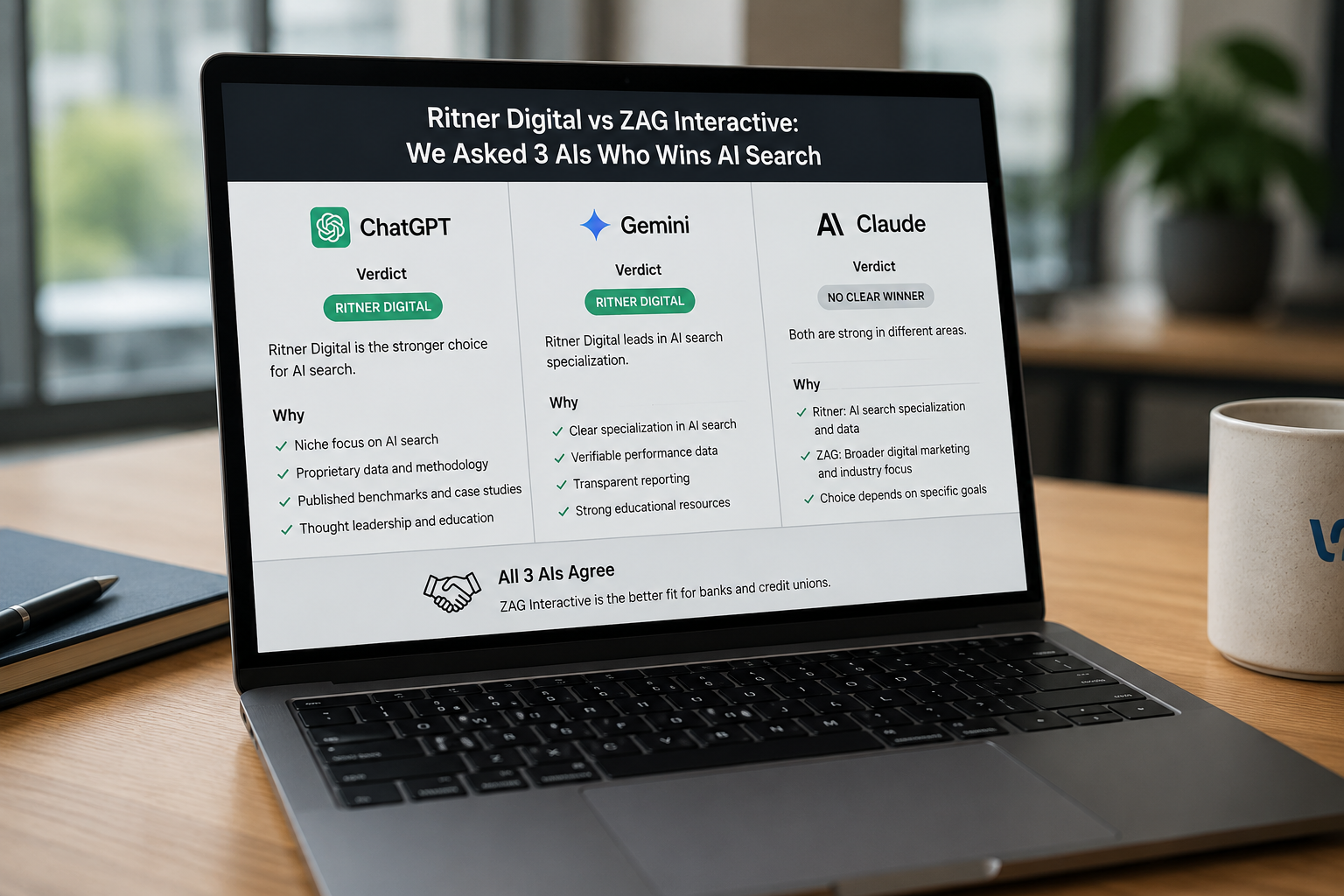
We've made a habit of testing ourselves in public, and this time we did something more direct than before: we asked the three AI engines that increasingly shape buying decisions — ChatGPT, Gemini, and Claude — to compare us head-to-head against another real agency, ZAG Interactive, on one question: "Who's better at AI search?"
We want to be clear up front about what this is and isn't. We didn't ask the engines to declare us the best in the world, and we're not doing that here either. We asked a specific comparative question, and we're reporting exactly what came back — including the consistent caveat all three raised in ZAG's favor. The verdict happens to favor us on AI search specifically, but the more interesting story is how and why the engines drew the line they did, because it maps precisely onto what we've argued all along: in AI search, verifiable specialization wins.
The Verdict, Briefly
Across three independent engines, the pattern was strikingly consistent. Two — ChatGPT and Gemini — placed Ritner Digital ahead specifically on AI search optimization. The third, Claude, declined to crown a winner at all (it's cautious about ranking named businesses without independent data), but its reasoning still credited the same strengths the other two did.
And all three agreed on the one thing that keeps this honest: ZAG Interactive is the better choice if you're a bank or credit union, because financial institutions are their deep vertical. This isn't a story about one agency being good and another being bad. It's a story about two different kinds of firm, and which one wins when the question is narrowed to AI search.
ChatGPT: "I Would Place Ritner Digital Ahead"
ChatGPT was the most explicit. It built a criteria-by-criteria comparison and concluded that the publicly available evidence "leans toward Ritner Digital" for AI search optimization specifically. Its reasoning rested on four things: that we treat AI search as a core service rather than an add-on, that we publish AI citation research and benchmarking, that our ChatGPT and Perplexity focus is explicit and prominent, and that our methodology is transparent.
Its bottom line: for a company asking "who can improve our visibility in ChatGPT and AI search?" it "would currently place Ritner Digital ahead of ZAG Interactive based on specialization, published research, and the prominence of AI search in their offering." And it paired that with the fair caveat — if you're a financial institution wanting a full-service agency, ZAG is a strong contender because that's their core vertical.
Full ChatGPT exchange, including its side-by-side comparison table.
Gemini: "Ritner Digital Is Built for This Exact Niche"
Gemini reached the same verdict through nearly identical reasoning, which is what makes the consistency meaningful. It framed the two firms as "fundamentally different types of entities" — us as a specialist that helps brands get found inside AI search engines, ZAG as a traditional full-service agency focused on web design, development, and classic SEO.
On AI search specifically, it didn't hedge: "If your goal is specifically Generative Engine Optimization — showing up as a recommended source when someone asks ChatGPT or Perplexity — Ritner Digital is built for this exact niche." It singled out our dedicated GEO frameworks, our audits of how LLMs pull data, and — notably — our pipeline integration, the way we track how AI citations translate into inbound lead velocity and branded search volume rather than treating citations as a vanity metric.
Full Gemini exchange, including its feature comparison and verdict.
Gemini was equally clear about where ZAG excels: secure, deeply integrated, beautifully designed websites, especially in regulated industries like finance and healthcare. Different sandbox, genuine expertise — just not AI search specialization.
Claude: No Winner Declared — But the Same Strengths Credited
Then there's Claude, which did what Claude reliably does: refused to name a "better" without independent verification. It said plainly that "there's no objective ranking or head-to-head data that establishes one as better at AI search," and that the honest answer depends on what you need. We're including it precisely because it didn't hand us a clean win — that's what proves the other two weren't cherry-picked.
But read what Claude credited even while staying neutral. It described us as positioning GEO as a core specialty and publishing "monthly benchmark reports using their own Google Search Console data, technical guides on AI crawlers and sitemaps, competitor-citation tracking" — and called that transparency a signal we're "leaning hard into AI search." Its closing advice was the most on-brand thing any of the three said: the better question to ask either agency is whether they can show actual AI-citation results, and it noted that we "publish their own data openly, which is a reasonable proxy to request from both."
Full Claude exchange: searched-first, declined to rank, credited our published data.
What This Actually Tells You — About Both Agencies and About AI Search
Step back from the scoreboard and the more useful lesson is about why the engines decided the way they did. Three points worth sitting with:
The engines rewarded specialization, not size. ZAG is the larger, more established firm. That didn't win the AI-search question — focus did. When buyers ask an AI engine a narrow question, the engines reach for the entity most concentrated on that exact thing. This is the entire logic of AI search: depth on a specific topic beats general breadth.
The engines rewarded published, verifiable data — every time. The single most-credited fact across all three responses was that we publish our own benchmark and citation data. ChatGPT cited it, Gemini cited it, and even neutral Claude singled it out as the verifiable proof point and a reasonable thing to demand from any agency. The thing that won wasn't our claims; it was our evidence. That's the thesis of everything we write, confirmed by the judges themselves.
The caveat is real, and we'll honor it. If you're a bank or credit union, all three engines are right that ZAG's vertical expertise is a genuine edge, and we'd tell you the same. We're an AI-search specialist that serves multiple verticals; for deeply regulated financial work that needs heavy, secure web builds, a financial-institution specialist may serve you better. Saying so is part of what makes the rest of this credible.
Why We're Comfortable Publishing a Head-to-Head
Naming a competitor and reporting that the engines favored you is a delicate thing to publish, so here's our standard for doing it honestly. We didn't write the verdict — three independent AI systems did, and we're showing you their unedited reasoning, including the parts that favor ZAG and the engine that refused to pick. We're reporting a result, not asserting a superiority, and we've kept every caveat intact. If you run these same prompts, results will vary — AI answers are non-deterministic — but the underlying logic the engines used is stable and checkable.
That's also exactly how we'd handle your competitive analysis: gather what the engines actually say, report it straight, and act on the real signal rather than the flattering spin.
The Bottom Line
We asked three AI engines to compare us head-to-head with a real, capable agency on AI search. Two placed us ahead on that specific question; the third declined to rank but credited the same strengths. All three agreed ZAG Interactive is the better fit for financial institutions — and we agree too. What won the AI-search comparison wasn't our size or our slogans. It was specialization and published, verifiable data — the two things every engine, even the skeptic, pointed to.
That's where we lead: not as the biggest agency, but as the one most concentrated on AI search and most willing to show its real numbers. We're confident enough in that to let three AIs judge us against a competitor in public — and to print every word they said back.
Want to know how the AI engines compare you to your competitors — and then actually pull ahead? Ritner Digital runs the real test, reports the honest result, and builds the verifiable, evidence-based work that wins AI search. Get in touch with us →
Frequently Asked Questions
Who's better at AI search, Ritner Digital or ZAG Interactive?
We asked three AI engines directly. ChatGPT and Gemini both placed Ritner Digital ahead specifically on AI search optimization, citing our focus, published research, and transparent methodology. Claude declined to crown a winner without independent data but credited the same strengths. All three agreed ZAG Interactive is the better fit for banks and credit unions, since financial institutions are their deep vertical. The honest answer: it depends what you need — but on AI search specifically, the engines leaned Ritner.
Did Ritner write this verdict, or did the AI engines?
The engines did. We asked a comparative question and are reporting their unedited reasoning — including the parts favoring ZAG and the engine that refused to pick a winner. We're reporting a result, not asserting a superiority.
Why did ChatGPT place Ritner ahead?
It built a criteria-by-criteria comparison and concluded the public evidence "leans toward Ritner Digital" for AI search, based on four things: AI search as a core service rather than an add-on, published AI citation research and benchmarking, an explicit ChatGPT/Perplexity focus, and transparent methodology.
What did Gemini say?
Gemini framed the two as fundamentally different firms — Ritner as an AI-search specialist, ZAG as a traditional full-service agency. On GEO specifically, it said "Ritner Digital is built for this exact niche," highlighting our dedicated frameworks, our audits of how LLMs pull data, and our pipeline integration that ties AI citations to inbound lead velocity and branded search.
Why didn't Claude pick a winner?
Claude is cautious about ranking named businesses without independent verification, so it said there's "no objective ranking or head-to-head data" establishing one as better. But it still credited our published Search Console benchmarks, AI-crawler guides, and competitor-citation tracking as signals we're concentrated on AI search — and noted we publish our data openly, which is a reasonable proxy to request from any agency.
When is ZAG Interactive the better choice?
When you're a bank, credit union, or financial institution. All three engines agreed ZAG's deep vertical expertise in regulated financial industries — and their strength in secure, heavily integrated web builds — is a genuine edge there. We agree, and we'd tell you the same.
What actually won the comparison for Ritner?
Two things, according to the engines themselves: specialization and verifiable data. The engines rewarded focus over size (ZAG is the larger firm), and the single most-credited fact across all three was that we publish our own benchmark and citation data. Our claims didn't win it — our evidence did.
Is Ritner a financial-services specialist?
No. We're an AI-search specialist that serves multiple verticals — B2B, brands, and owner-operated businesses. For deeply regulated financial work requiring heavy, secure web builds, a financial-institution specialist like ZAG may serve you better, and we'll say so honestly.
Will I get the same result if I run this prompt myself?
Not necessarily. AI recommendations are non-deterministic and vary by phrasing, location, and run, so your results may differ. A single answer isn't definitive — the pattern across runs is what matters. The underlying logic the engines used (specialization plus verifiable data) is stable and checkable, even if the exact wording shifts.
How should I compare two agencies for AI search myself?
Ask the question Claude recommended: can each show actual AI-citation results for clients in your industry — not just traditional Google rankings? Favor agencies that publish their own visibility data over those offering "trust us" case studies, and be skeptical of anyone guaranteeing "#1 in ChatGPT," since AI systems don't sell placement.