The Parent Deciding Where to Send Their Kid Is Asking AI First. Is Your Franchise in the Answer?
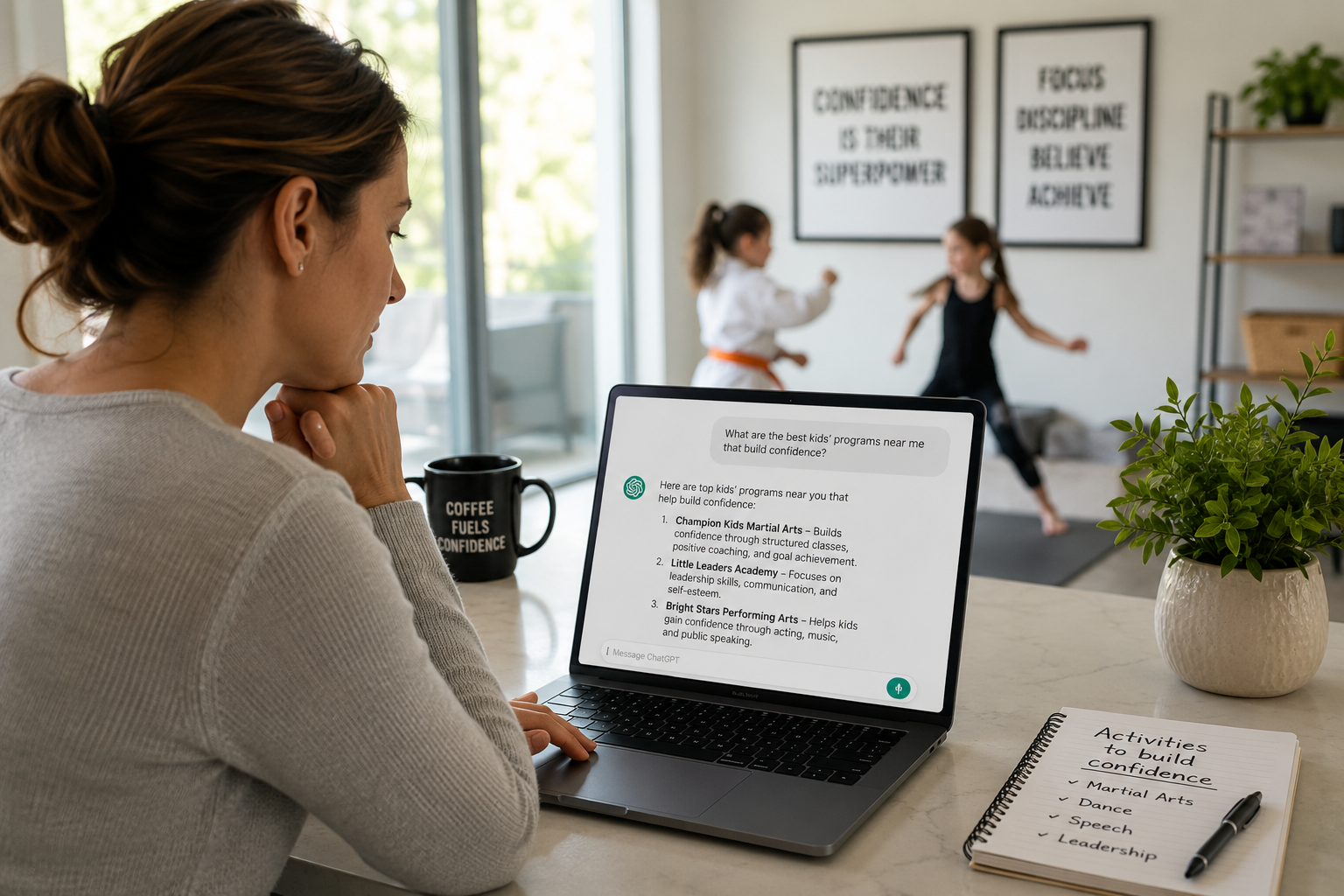
A parent in a new suburb opens their phone on a Tuesday night. Their five-year-old has energy to burn and a shyness they'd love to soften. They don't type a URL. They don't scroll a directory. They open ChatGPT and ask: "What are the best programs near me for building confidence and coordination in young kids?"
Whatever comes back in the next four seconds shapes where that family spends the next two years and several thousand dollars. If your brand is named, you're on the shortlist before a human ever visits your website. If you're not, you were never in the running — and you'll never see it on a dashboard.
This is the quiet shift reshaping how multi-location, parent-facing businesses get discovered. And most of the brands it affects most — youth enrichment, kids' fitness, early-childhood programs, tutoring franchises — are still optimizing for a version of search that's rapidly being replaced.
Search didn't get smaller. It split in two.
The instinct is to assume AI is stealing search traffic. The data says something more precise: search has forked. There's the Google index you've always known, and there's a fast-growing answer layer where buyers ask a question and get a recommendation instead of ten blue links.
That answer layer is no longer fringe. One large-scale study found that AI platforms now generate roughly 45 billion sessions per month globally — equal to about 56% of worldwide traditional search engine volume, with U.S. AI sessions growing around 300% year over year. ChatGPT alone reached 900 million weekly active users by early 2026, up from 400 million a year earlier.
For local, parent-driven decisions specifically, the behavior change is even starker. BrightLocal's consumer research shows the share of consumers using AI for local business recommendations jumped from roughly 6% to 45% in a single year — described, fairly, as a permanent behavior change rather than a blip. Around 40% of consumers now say they trust AI-generated recommendations for local businesses.
Think about who's driving that number. Nearly 35% of Gen Z in the U.S. now use AI chatbots to search for information, and Gen Z and Millennials together exceed 70% AI-search usage. Those aren't abstract demographics — they're the exact parents of preschool and elementary-age kids who make up your enrollment.
Why AI-referred families are worth more than the raw numbers suggest
Here's the part that should change how you budget. AI traffic is still smaller in raw volume than Google organic — most studies put it between 0.1% and 2.8% of total website traffic today. But it converts far better, because the person arrives having already been pre-sold by a trusted answer.
Similarweb's clickstream data found ChatGPT referral traffic converts at 7.1% — second only to paid search and ahead of organic, direct, social, and email. In operator data specifically pulled for local businesses, AI-referred visitors converted at 6.24% versus 3.29% for traditional organic — about 1.9x more likely to convert. Broader retail figures run even higher, with some studies showing AI referrals converting at 11.4% against 5.3% for organic.
The reason is intuitive once you picture it. A parent who lands on your "find a location" page after clicking a blue link is still comparing you against four other tabs. A parent who arrives because an AI assistant told them "this program is well-regarded for building confidence and coordination in kids under 11" has already had their objection handled. They're not shopping anymore. They're confirming.
That's the difference between renting attention and being recommended. And recommendation is the entire game for a business that lives on trust, safety, and word of mouth.
The other half of the equation: "near me" is still where the money is
None of this means classic local search is dead — for a multi-location brand, it's still the foundation. 46% of all Google searches carry local intent, and the action that follows is fast: 76% of people who run a "near me" search visit a business within 24 hours, and 28% of local searches lead to a purchase within a day. "Near me" search volume has grown more than 900% over recent years.
For businesses with physical locations, Google Business Profile is the single highest-leverage asset. A complete profile earns roughly 70% more location visits and makes customers 2.7x more likely to see the business as reputable. Profiles that appear in the Local Map Pack get 126% more traffic and 93% more calls, clicks, and direction requests than businesses ranked 4–10. And for a franchise, consistency across locations is a ranking factor in itself — consistent name/address/phone data across multi-location listings yields about a 31% SEO boost, while brands maintaining full NAP consistency across 70+ directories reportedly received 84% more inbound calls.
Here's why these two worlds are actually one problem
This is the insight most agencies miss, and it's the one that matters most for a multi-location parent brand: the AI answer layer and the local search layer feed from the same source data.
When a voice assistant or an AI chatbot answers a "best kids' program near me" question, it's pulling from Google Business Profiles, structured schema markup, reviews, and consistent directory data. As one local-search analysis put it plainly, a business with incomplete profile data, missing schema, or inconsistent listings is invisible to both voice search and AI local recommendations simultaneously — they share the same foundational data requirements.
That cuts both ways. Get the foundation right and you don't win one channel — you compound across both. And AI platforms are demonstrably picky about which local businesses they recommend: the average rating of local businesses recommended by AI runs around 4.3 on ChatGPT, 4.1 on Perplexity, and 3.9 on Gemini. Review quality, freshness, and volume aren't just conversion levers anymore — they're the price of admission to being named at all.
There's a data-accuracy gap hiding here too, and it's an opportunity. Only 68% of business contact details in ChatGPT and Perplexity match what's on the business's own Google Business Profile, which sends 21% of users back to Google to double-check. For a franchise with dozens of locations, that's dozens of chances for a parent to get the wrong address, the wrong hours, or a competitor's answer instead. Fixing it is unglamorous and enormously valuable.
The catch: this advantage compounds, and so does falling behind
Being cited isn't a one-time win — it's a position you hold or lose. Research found that only about 30% of brands stay visible across back-to-back AI responses to the same query, and AI Overview citations get replaced roughly half the time an answer refreshes. Visibility goes to brands that publish structured, authoritative, frequently updated content backed by real off-site signals.
The flip side is the reason to move now rather than next quarter. Authority compounds. The brand that starts building citations, reviews, structured data, and location authority this year owns those positions while a competitor is still deciding whether AI search is "real." Brands investing in generative engine optimization already report 30–40% higher AI referral traffic than SEO-only competitors. Every month a parent-facing franchise waits, a rival is earning the reviews, publishing the location content, and becoming the name the AI reaches for by default.
And the ecosystem is diversifying, which raises the stakes of doing this well. ChatGPT still leads referrals, but its share of measurable AI traffic fell from around 89% to roughly 63% as Claude, Gemini, and Perplexity grew. A brand can win one engine and be invisible on another — because each retrieves, reasons, and recommends differently. Optimizing for "AI search" now means optimizing for a set of distinct systems, not a single box.
What this actually looks like for a growing kids' brand
If you run — or are scaling — a multi-location youth enrichment or fitness concept, the path is concrete:
Every location needs a complete, verified, consistent Google Business Profile, because that's the shared substrate for local and AI discovery. Review generation and response can't be an afterthought, because ratings are the literal threshold for AI recommendation and a proven conversion multiplier. Your site needs schema and structured data so AI systems can read, trust, and cite you — clear headings, clean facts, verifiable proof. You need content that answers the exact questions parents ask AI: about confidence, coordination, social skills, age-appropriateness, safety, and what makes your program different. And it all has to roll up into reporting a franchise operator or CFO can actually plan around — not impressions, but leads, enrollment pipeline, cost per acquisition, and forecasted return.
That's the system. Visibility earns trust, trust earns citations and reviews, citations and reviews earn recommendations, and recommendations fill classes. Each part compounds into the next — and it works whether a parent finds you through a Google Map Pack at 9 p.m. or through an AI assistant answering a question about their kid's future.
The parent deciding where to send their child is going to ask. The only question is whether your brand is the answer.
Ready to be the name AI recommends?
Ritner Digital builds the local authority, structured content, and AI-search visibility that get multi-location, parent-facing brands found, trusted, and cited — across Google, ChatGPT, Perplexity, and Gemini. And we publish our own real Search Console data to prove the system works.
Book a free 30-minute strategy call → We'll show you exactly where your brand stands in AI and local search today — and give you a clear next step within one business day.
Frequently Asked Questions
Are parents really using AI to find kids' programs, or is this overblown?
They are, and the shift happened fast. The share of consumers using AI for local business recommendations jumped from roughly 6% to 45% in a single year, and about 40% now say they trust AI-generated local recommendations. The demographic driving that number is exactly your buyer: Gen Z and Millennials together exceed 70% AI-search usage — the parents of preschool and elementary-age kids. This isn't a future trend to watch; it's current enrollment behavior.
How is optimizing for AI search different from the SEO we already do?
Traditional SEO aims to rank a page in Google's results. AI search optimization aims to get your brand named and citedwhen a parent asks ChatGPT, Perplexity, or Gemini for a recommendation. The work overlaps — strong content, reviews, and consistent local data help both — but answer engines reward clear positioning, structured data, and verifiable proof in ways classic ranking doesn't. Critically, for a local brand the two layers share the same source data: a business with incomplete profile data or missing schema is invisible to both AI recommendations and voice search simultaneously. Fixing the foundation compounds across both.
Is AI traffic even worth it if the volume is still small?
Volume is smaller, but value is higher. AI referrals sit between 0.1% and 2.8% of total website traffic today — yet they convert far better because the visitor arrives pre-sold by a trusted answer. Operator data for local businesses shows AI-referred visitors converting at 6.24% versus 3.29% for organic — about 1.9x higher, and ChatGPT referral traffic converts at 7.1%, second only to paid search. A parent who lands on your page because an AI recommended you isn't comparing tabs anymore — they're confirming a decision.
Does classic "near me" local search still matter for a multi-location brand?
Absolutely — it's the foundation. 46% of all Google searches carry local intent, and the action is fast: 76% of "near me" searchers visit a business within 24 hours. Profiles in the Local Map Pack earn 126% more traffic and 93% more calls, clicks, and directions than those ranked 4–10. For a franchise specifically, consistent name/address/phone data across locations yields about a 31% SEO boost. Local search and AI discovery aren't competing priorities — they're one system.
Why do reviews matter so much for getting recommended by AI?
Because ratings are the literal threshold for being named. The average rating of local businesses recommended by AI runs around 4.3 on ChatGPT, 4.1 on Perplexity, and 3.9 on Gemini — so weak review profiles don't just hurt conversion, they keep you out of the answer entirely. Reviews also move enrollment directly: every 10 new reviews can lift a profile's conversion rate by 2.8%, and for multi-location brands, 91% of consumers say a single branch's reviews shape how they see the whole brand.
How long until we see results?
Visibility compounds over months, not days. Early signals — indexing, impressions, AI citations — typically appear in the first 60–90 days, with meaningful pipeline building from there. The reason to start now is that authority compounds both ways: brands already investing in generative engine optimization report 30–40% higher AI referral traffic than SEO-only competitors, and AI visibility is unstable enough that only about 30% of brands stay visible across back-to-back answers to the same query. The name AI reaches for by default is earned early and defended continuously.
Do we need to optimize for every AI platform separately?
Increasingly, yes — and that's why doing it well matters. ChatGPT still leads, but its share of measurable AI referrals fell from around 89% to roughly 63% as Claude, Gemini, and Perplexity grew. Each engine retrieves, reasons, and recommends differently, so a brand can win one and be invisible on another. There's also an accuracy gap worth closing: only 68% of business details in ChatGPT and Perplexity match the business's own Google Business Profile — for a franchise with dozens of locations, that's dozens of chances to hand a parent the wrong address or a competitor's answer.
What do you actually report on?
The numbers a franchise operator or CFO can plan around — not impressions, but leads, enrollment pipeline, cost per acquisition, and forecasted return. We also publish our own real Search Console data in public, because for a trust-driven business, proof beats promises. You'll always be able to see the line from what you invest to the families it brings in.