How a Turnersville Parent Actually Finds Your Kids' Program in 2026 (And Why "Near Me" Isn't Enough Anymore)
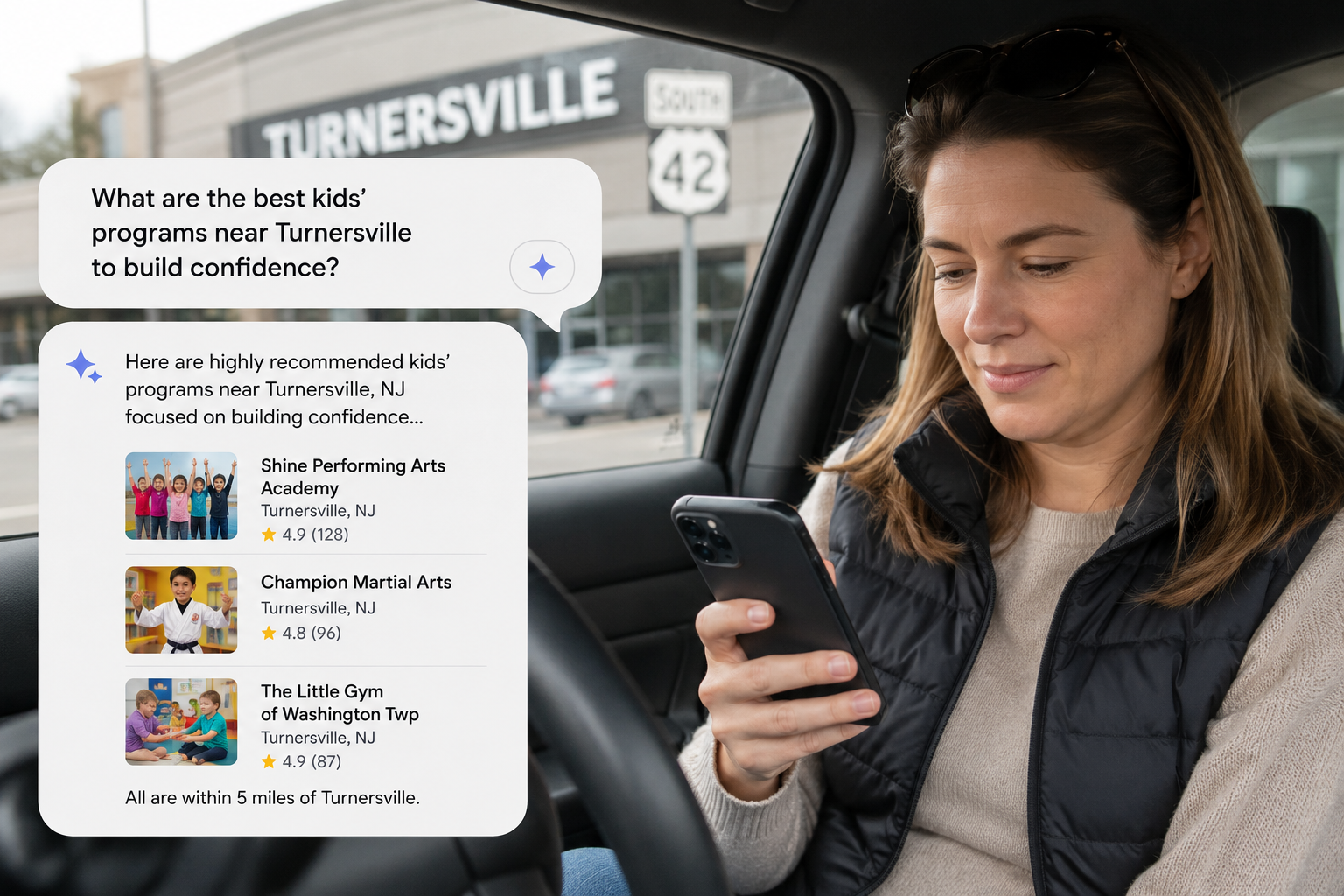
It's a Tuesday evening off Route 42. A family just moved into one of the new builds near Bells Lake, or maybe they've been in Washington Township for years and their four-year-old has finally aged into wanting something — a program, an activity, a place to burn energy and build a little confidence. The parent picks up their phone somewhere between dinner and bath time.
Ten years ago they'd have asked a neighbor or typed "kids classes Turnersville NJ" into Google. Today, a growing share of them open ChatGPT and ask: "What's the best program near Turnersville for building confidence and coordination in a preschooler?"
Whatever comes back in the next few seconds shapes where that family spends the next two years and a real chunk of their budget. If your location is named, you're on the shortlist before anyone visits your website. If you're not, you were never in the conversation — and nothing on your dashboard will tell you it happened.
This is the shift quietly reshaping how family-focused businesses in South Jersey get found. And the local brands it affects most are still optimizing for a version of search that's being replaced in real time.
Turnersville is a small name inside a big, family-dense market
Here's what makes local discovery tricky — and valuable — in this specific corner of Gloucester County.
"Turnersville" itself is small: an unincorporated community with a 2020 census population of just 3,594. But it sits inside Washington Township, Gloucester County's largest municipality at roughly 49,000 people across 23 square miles, spanning Turnersville, Hurffville, Grenloch, Cross Keys, Sewell, and more. Parents don't think in municipal boundaries. They think "near me," and "near me" for a Sewell or Blackwood family might well mean your Turnersville location.
And it's a genuinely family-heavy market. In Turnersville, more than a third of households have children under 18, and about 70% are married-couple households — the classic profile of a family with the time, income, and motivation to enroll a kid in a weekly program. The township runs a preschool, six elementary schools, three middle schools, and a high school complex, and its schools pull families in specifically for their quality. This is a community that shows up for its kids — the kind that buys speed-control devices near schools and preserves parkland like the 330-acre Washington Lake Park.
The catch: those same families are searching across a patchwork of ZIP codes and community names — 08012, 08080, Blackwood, Sewell, Turnersville — and the businesses that win are the ones an AI assistant and Google Maps can confidently connect to all of them.
Search didn't shrink around here. It split in two.
The mistake is assuming AI is just siphoning off Google traffic. What's actually happening is a fork: the Google index parents have always used, and a fast-growing answer layer where they ask a question and get a recommendation instead of a list.
That answer layer is now mainstream. AI platforms generate roughly 45 billion sessions per month globally — about 56% of worldwide traditional search volume, and ChatGPT alone hit 900 million weekly active users by early 2026. For local decisions specifically, the share of consumers using AI for business recommendations jumped from about 6% to 45% in a single year, and around 40% now say they trust those AI recommendations.
Who's driving that? Gen Z and Millennials together exceed 70% AI-search usage — which is to say, the exact parents of Washington Township's preschoolers and elementary kids.
"Near me" still moves fast — and it's still where the money is
None of this retires classic local search. For a business with a physical door on or near the Black Horse Pike corridor, it's the foundation. 46% of all Google searches carry local intent, and the follow-through is quick: 76% of "near me" searchers visit a business within 24 hours, and 28% of local searches lead to a purchase within a day. "Near me" search volume has grown more than 900% over recent years.
Your Google Business Profile is the single highest-leverage asset here. A complete profile earns roughly 70% more location visits and makes customers 2.7x more likely to see you as reputable. Rank in the Local Map Pack and you get 126% more traffic and 93% more calls, clicks, and direction requests than businesses stuck at positions 4–10. In a market threaded by Routes 42, 47, 168, and 534, being the pin that surfaces when a Sewell parent searches from their driveway is worth more than any brochure.
The two worlds are actually one problem — and that's the opportunity
Here's the insight most agencies miss, and it matters enormously for a family brand serving a spread-out township: the AI answer layer and the local search layer feed from the same underlying data.
When an AI chatbot or a voice assistant answers "best kids' program near Turnersville," it's pulling from Google Business Profiles, schema markup, reviews, and directory consistency. A business with incomplete profile data, missing schema, or inconsistent listings is invisible to both AI recommendations and voice search at the same time — they share the same foundational data requirements.
That cuts both ways. Fix the foundation and you don't win one channel — you compound across both. And AI is demonstrably selective about which local businesses it names: the average rating of AI-recommended local businesses runs about 4.3 on ChatGPT, 4.1 on Perplexity, and 3.9 on Gemini. For a program parents trust with their children, reviews aren't just a conversion lever — they're the ticket to being mentioned at all.
There's also a hidden accuracy gap that's pure opportunity in a multi-ZIP market like this one. Only 68% of business contact details in ChatGPT and Perplexity match what's on the business's own Google Business Profile, and 21% of users bounce back to Google to double-check. Every mismatched address or stale hour is a chance for a Blackwood or Grenloch parent to get sent to the wrong place — or to a competitor.
Why an AI-recommended parent is worth more than the raw traffic looks
AI referral volume is still smaller than Google organic — most studies put it between 0.1% and 2.8% of total website traffic. But it converts far better, because the parent arrives already pre-sold by a trusted answer.
Operator data for local businesses shows AI-referred visitors converting at 6.24% versus 3.29% for organic — about 1.9x higher, and Similarweb found ChatGPT referral traffic converting at 7.1%, second only to paid search. The reason is intuitive: a parent who clicks a blue link is still comparing tabs. A parent who arrives because an AI told them "this program is well-regarded for confidence and coordination in young kids near Washington Township" has already had the objection handled. They're not shopping anymore. They're confirming.
This advantage compounds — and so does waiting
Being named by AI isn't a one-time win; it's a position you hold or lose. Only about 30% of brands stay visible across back-to-back AI answers to the same query. Visibility goes to brands publishing structured, authoritative, frequently updated content backed by real reviews and off-site signals.
That's the case for moving now. Brands already investing in AI-search optimization report 30–40% higher AI referral traffic than SEO-only competitors. In a fast-growing, family-dense township where new homes keep filling in around Bells Lake and Cross Keys, every month you're not the default answer, a competitor is earning the reviews and location authority that make them the name the AI reaches for. Authority compounds — for whoever starts first.
What this looks like for your Turnersville location specifically
The path is concrete. Your Turnersville profile needs to be complete, verified, and perfectly consistent with every directory and your website — because that single dataset powers both Map Pack rankings and AI answers across all the surrounding ZIP codes. Review generation and response can't be an afterthought, because ratings are the literal threshold for AI recommendation and a proven conversion multiplier for local parents. Your site needs schema so AI can read and cite you with confidence. And you need content that answers the questions Washington Township parents actually ask — about age-appropriateness, safety, confidence, coordination, and what sets your program apart from everything else along Route 42.
Do that, and you become the answer whether a Sewell parent finds you through Google Maps at 9 p.m. or through an AI assistant answering a question about their kid's future. The parent off Route 42 is going to ask. The only question is whether your Turnersville location is the name that comes back.
Frequently Asked Questions
Do parents in Turnersville and Washington Township really use AI to find kids' programs?
Increasingly, yes. The share of consumers using AI for local recommendations jumped from roughly 6% to 45% in a single year, and about 40% now trust those recommendations. The people driving that — Gen Z and Millennials, who together exceed 70% AI-search usage — are exactly the young families that make up more than a third of Turnersville households with kids under 18.
My location is in Turnersville, but families search from Sewell, Blackwood, and Cross Keys. Does that hurt me?
Only if your data is inconsistent. Parents across Washington Township's many communities search "near me," not by municipal line, so the goal is to be the business Google and AI can confidently connect to the whole area. That depends on a complete Google Business Profile and consistent listings — NAP consistency across locations alone yields about a 31% SEO boost, and businesses with full directory consistency reportedly earn 84% more inbound calls.
Is "near me" search still worth focusing on, or is it all AI now?
It's still the foundation. 46% of Google searches carry local intent, and 76% of "near me" searchers visit within 24 hours. The point isn't to abandon local search — it's that AI discovery and local search feed from the same data, so a business with weak profile data is invisible to both at once. Getting the foundation right wins both.
Why do reviews matter so much for a kids' program?
Because ratings are the threshold for being recommended at all. AI-recommended local businesses average around 4.3 on ChatGPT, 4.1 on Perplexity, and 3.9 on Gemini — so a weak review profile keeps you out of the answer entirely. Reviews also convert: every 10 new reviews can lift a profile's conversion rate by 2.8%, and for parents choosing where to send a child, trust signals are everything.
AI volume sounds small. Is it actually worth the investment?
The volume is smaller, but the value is higher. AI referrals are still 0.1%–2.8% of total traffic, yet they convert far better because the parent arrives pre-sold — 6.24% for AI-referred local visitors versus 3.29% for organic. You're not buying raw clicks; you're becoming the recommendation a parent has already decided to trust.
How long until we see results for our location?
Visibility compounds over months, not days — early signals like indexing, impressions, and AI citations often appear within the first 60–90 days, with enrollment impact building from there. The reason to start now is that authority compounds for whoever moves first: brands already investing in AI-search optimization see 30–40% higher AI referral traffic than competitors who wait.
Ready to own "near me" in Washington Township?
Ritner Digital builds the local authority, structured content, and AI-search visibility that get family-focused brands found, trusted, and cited across Google, ChatGPT, Perplexity, and Gemini — and across every ZIP code that matters around Turnersville. We publish our own real Search Console data to prove the system works.
Book a free 30-minute strategy call → We'll show you exactly where your Turnersville location stands in AI and local search today — and give you a clear next step within one business day.