When a Williamstown Family Needs You, How Will They Find You? What Search Looks Like for Funeral Homes in 2026
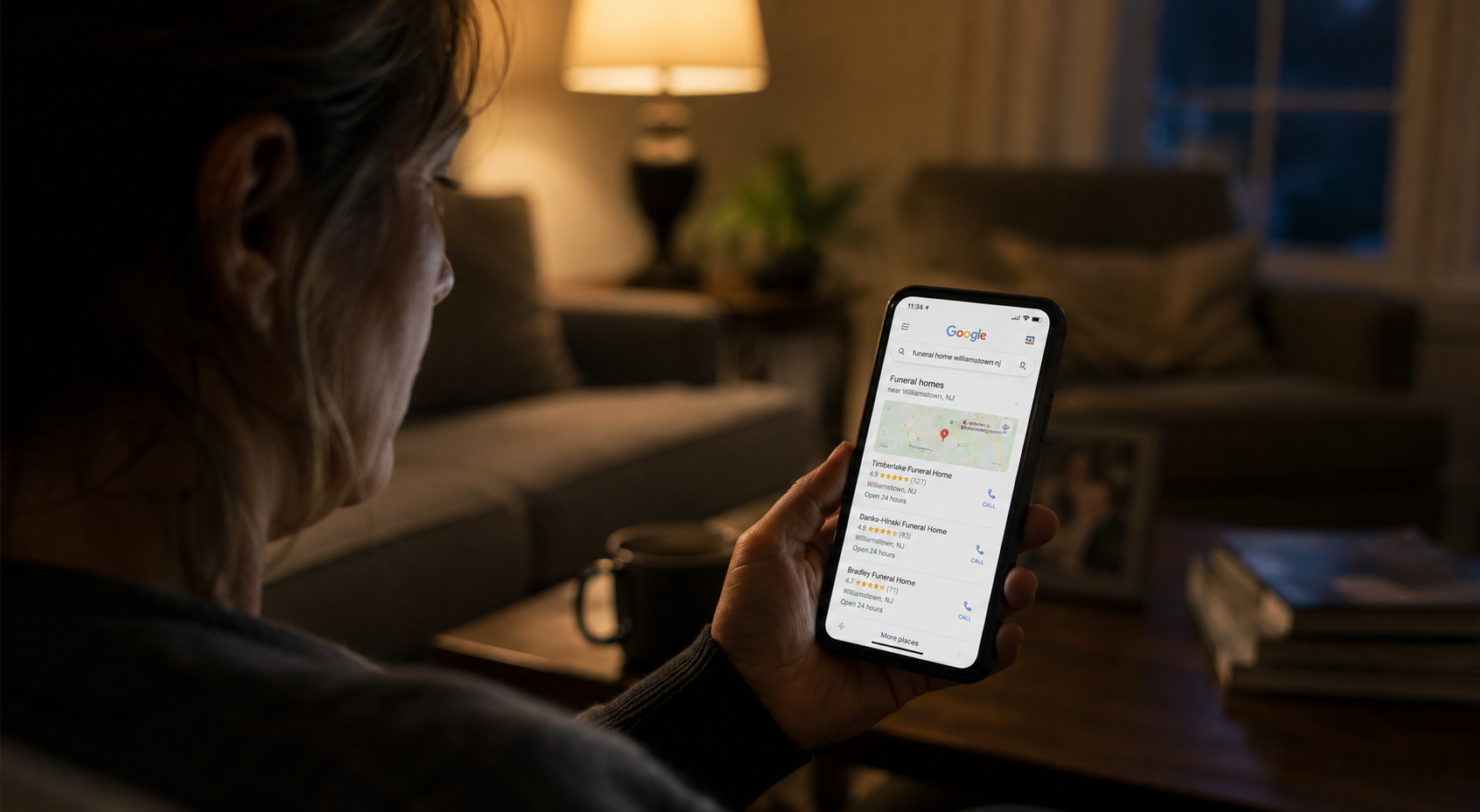
It's late, and a phone call has just changed everything for a family in Williamstown. A parent has passed. In the quiet that follows, someone has to make the next call — and often, they don't know who to call. They've never done this before. So they pick up their phone and search: "funeral home near me," or increasingly, they open ChatGPT and simply ask, "What do I do when someone dies at home in New Jersey?"
That moment is unlike almost any other in local search. The person isn't comparison shopping the way they would for a restaurant or a contractor. They're frightened, grieving, and looking for someone trustworthy to take the weight off their shoulders. Whoever they find — and trust — in those first few minutes is very often who they'll turn to.
For a family-run funeral home, being found in that moment, with the right information and an unmistakable signal of compassion, is the entire ballgame. And how families arrive at that moment has changed more in the last two years than in the previous twenty.
Families research long before the phone call — and more of that research is happening in AI
The old picture of funeral home discovery — a name passed down, a church recommendation, the home you drove past for years — still matters enormously. But it now sits alongside a digital-first reality. Most families begin their search online, even when planning for the future rather than responding to an immediate loss. And a meaningful share of that research has quietly moved into AI assistants.
Search itself has split into two channels: the familiar Google index, and a fast-growing answer layer where people ask a full question and receive a synthesized recommendation. That answer layer is now mainstream — AI platforms generate roughly 45 billion sessions per month globally, equal to about 56% of worldwide traditional search volume, and ChatGPT alone reached 900 million weekly active users by early 2026. Around 40% of consumers now say they trust AI-generated recommendations for local businesses.
For death care specifically, marketers who study the field note that AI platforms are quickly becoming part of how families research these sensitive, important decisions. And the questions are changing shape. Instead of typing "funeral home pricing," families now ask conversational questions like "What should I ask a funeral director before cremation?" A funeral home whose website answers those human questions — plainly and compassionately — is far more likely to be the one an AI surfaces and a family remembers.
"Near me" is still where families in crisis turn — and it moves fast
None of this replaces classic local search. For a funeral home, it may be the single most important channel, because so many families search in a moment of urgent need. 46% of all Google searches carry local intent, and local intent converts to real-world action quickly: 76% of "near me" searchers contact or visit a business within 24 hours. As one death-care analysis put it, citation accuracy matters especially for funeral homes because many families are making urgent decisions and relying on quick local searches.
Your Google Business Profile is the front door in that moment. A complete profile earns roughly 70% more location visits and makes people 2.7x more likely to view the business as reputable — and reputability is everything when a family is deciding who to trust with a loved one. Businesses that appear in the Local Map Pack receive 126% more traffic and 93% more calls, clicks, and direction requests than those ranked below the top three. When someone in Williamstown or the surrounding Monroe Township and Gloucester County area searches at 11 p.m., the goal is simple: your name, your phone number, and a clear path to help, right there.
The two channels feed from the same source — and reviews are at the center
Here's the connection that matters most, and it's one many funeral homes overlook: the AI answer layer and the local search layer draw from the same underlying data. When an AI assistant answers "compassionate funeral home near Williamstown," or when a voice assistant reads a result aloud, it's pulling from Google Business Profiles, structured data, reviews, and directory consistency. A business with incomplete profile information, missing schema, or inconsistent listings is invisible to both AI recommendations and voice search at the same time — they share the same foundational requirements.
Get that foundation right and you strengthen both channels at once. And for funeral homes, reviews carry unusual weight — not as star-count vanity, but as genuine trust signals. Death-care marketers now encourage families to leave reviews that describe staff compassion, responsiveness, how a memorial or cremation was handled, veteran services, and communication quality — because longer, detailed reviews are increasingly influential in both search visibility and consumer trust. AI is also selective about which local businesses it names at all: the average rating of AI-recommended local businesses runs around 4.3 on ChatGPT and 4.1 on Perplexity. A family's heartfelt words about how you carried them through the hardest week of their life are, quite literally, what helps the next family find you.
There's a data-accuracy issue worth closing, too. Only 68% of business contact details in ChatGPT and Perplexity match what's on the business's own Google Business Profile — which means a grieving family could be handed a wrong number or outdated hours at the worst possible moment. For a funeral home, an inaccurate AI answer isn't just a lost lead; it's a family that couldn't reach help when they needed it. Keeping that information correct across every platform is a quiet act of care.
Educational, compassionate content is what keeps you visible
AI systems increasingly pull from providers who publish genuinely helpful, trust-building material rather than bare transactional pages. As one analysis of the field observed, funeral homes that focus only on service-and-price pages may struggle to stay visible, while firms that publish educational, trust-building content — grief resources, FAQs, veteran information, cremation education, and preplanning guides — are more likely to remain visible as AI systems draw from broader sources.
This is where a funeral home's instinct and its digital strategy align perfectly. The content that helps a frightened family understand what to do when a death occurs, how to talk to children about grief, what Social Security benefits they may be owed, or how preplanning actually works is the same content that earns trust with AI systems and search engines. Helping people is the strategy. It simply needs to be findable.
Why preplanning families make this even more important
There's a second audience searching quietly, long before any crisis: people planning ahead. Preplanning has become a significant part of how funeral homes serve their communities — roughly 19.4% of surveyed adults have already preplanned and prepaid arrangements, largely to guarantee pricing and spare their families difficult decisions. These families are researching, comparing, and planning online, often long before they ever contact a funeral home.
That's a slower, gentler search journey — someone reading, considering, coming back weeks later. The funeral home that shows up consistently across that journey, with clear and reassuring information, becomes the first one families turn to when they're ready. Being visible and trustworthy today plants the seed for a family's decision months or years from now.
This visibility is earned, and it holds
Being the name that search and AI surface isn't a one-time setting — it's a position built through consistent, accurate, compassionate presence. Community mentions matter here too: search systems increasingly assess whether a business is part of the broader community conversation — local news, charity coverage, community events — which is exactly the kind of deep local roots a long-serving, family-run funeral home already has. The work is often simply making that existing goodwill visible online, where the next family will look.
For a business built on trust and community standing, that's not a foreign idea. It's the same thing you've always done — being present, being reliable, being there when someone needs you — carried into the places families now look first.
The family in Williamstown facing that late-night call is going to search. What they find in those first minutes should be your name, accurate information, and every signal that you'll handle their loved one with dignity. That's what modern search visibility protects.
Frequently Asked Questions
Do grieving families really use AI and online search to find a funeral home?
Increasingly, yes — alongside longstanding personal recommendations. Most families now begin their search online even when planning ahead, and death-care specialists note that AI platforms are becoming part of how families research these sensitive decisions. With about 40% of consumers now trusting AI recommendations for local businesses, being visible in both channels matters more each year.
Isn't "near me" search still the most important thing for a funeral home?
It's foundational, precisely because so many families search in a moment of urgent need. 46% of searches carry local intent, and 76% of "near me" searchers act within 24 hours. The key insight is that local search and AI discovery feed from the same data — a business with weak profile data is invisible to both at once — so getting the foundation right serves families searching in crisis and those planning ahead.
Why do online reviews matter so much for a funeral home specifically?
Because they're trust signals in a decision built entirely on trust. Detailed reviews describing staff compassion, responsiveness, and how services were handled are increasingly influential in both search visibility and consumer trust, and AI tends to recommend businesses with strong ratings — averaging around 4.3 on ChatGPT. A family's words about the care you gave them are what help the next family find and trust you.
What kind of website content actually helps us get found?
The compassionate, educational content you likely already want to provide. Funeral homes that publish grief resources, FAQs, veteran information, cremation education, and preplanning guides remain more visible as AI systems pull from broader sources, while those with only transactional pages can struggle. Helping families understand what to do is both the right thing and the findable thing.
How does this help with families who are planning ahead, not in crisis?
Preplanning families research quietly over weeks or months — roughly 19.4% of adults have already preplanned, often long before contacting anyone. Showing up consistently across that slower journey, with clear and reassuring information, helps you become the first funeral home they turn to when they're ready.
Our funeral home has served this community for years. Why do we need this?
Your deep community roots are an advantage — search systems increasingly reward businesses that are part of the broader local conversation. The work is usually just making that existing trust and goodwill visible online, where families now look first, and keeping your information accurate everywhere so no grieving family is ever handed the wrong number.
Let families find you when it matters most
Ritner Digital helps trusted, community-rooted businesses become visible, accurate, and easy to find across Google, ChatGPT, Perplexity, and Gemini — so that when a local family is searching in a moment of need, your name, your compassion, and the right information are there. We handle the local search foundation, the reviews, the structured data, and the trust-building content, and we publish our own real search data to show the work.
Book a free 30-minute strategy call → We'll show you exactly where your funeral home stands in local and AI search today, and give you a clear next step within one business day — no pressure, ever.