Your Program Is Great. Is Your Website Doing It Justice? A 2026 Look at How Parents Find (and Sign Up for) Kids' Soccer
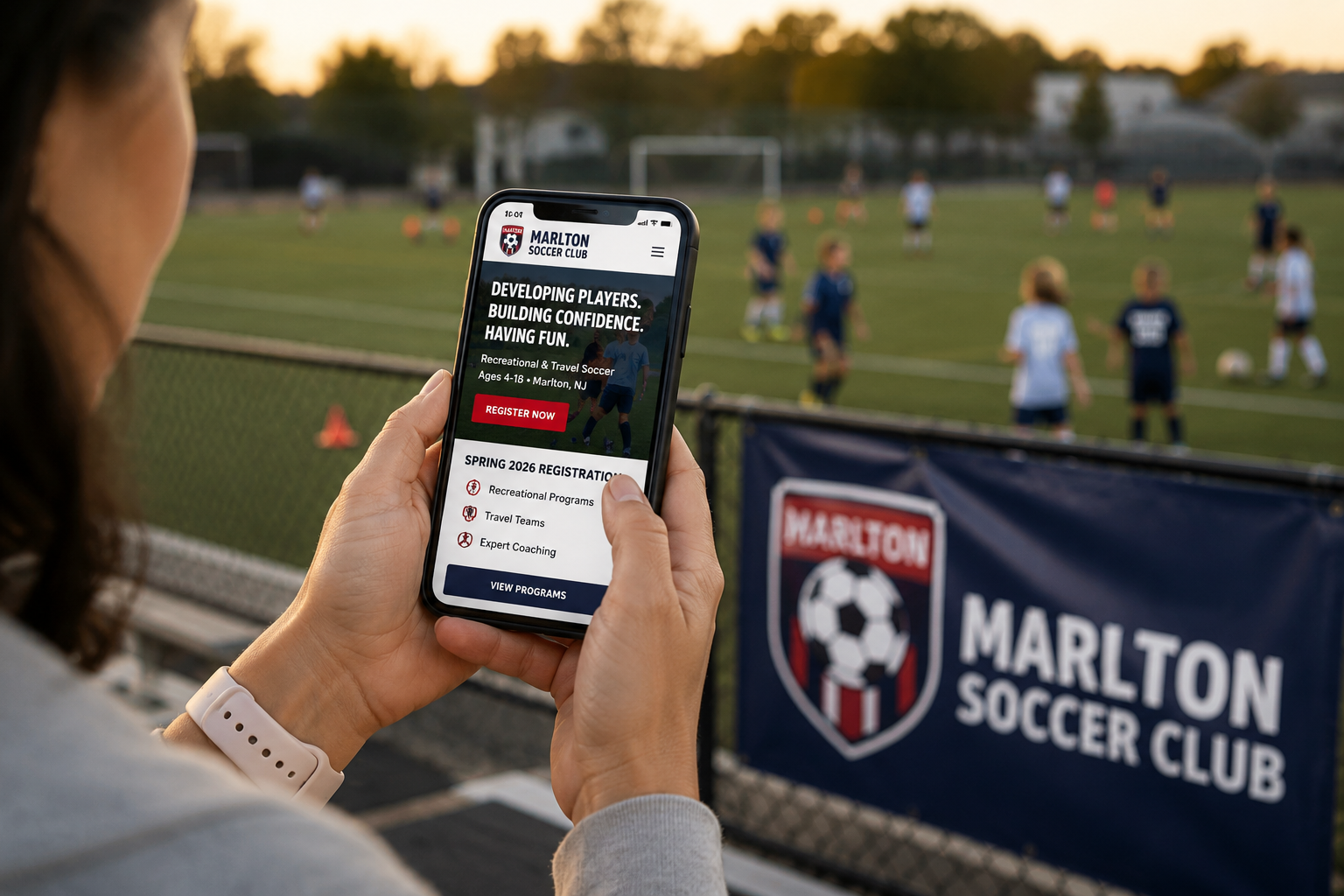
Picture a parent in Marlton or Robbinsville, standing in their kitchen with a squirmy three-year-old orbiting their legs. They've heard about a soccer program for little ones — maybe from another parent at preschool, maybe from a "Best of South Jersey" mention. They pull out their phone to check it out, ready to sign their kid up right then and there.
What happens in the next sixty seconds decides everything. If they land on a page that loads fast, looks polished, tells them exactly which town has a class and when, and lets them register from their thumb — you've got a new family. If they land on something sparse, hard to navigate on a phone, or missing the one detail they need, they close the tab. And here's the hard part: you never find out it happened. That parent doesn't email to say "I couldn't figure out your site." They just quietly go with the gymnastics place down the road.
For a mobile soccer program spread across ten-plus towns from Cherry Hill to Princeton Junction, the website isn't a brochure. It's the front door, the registration desk, and the first impression all at once. And in 2026, it's carrying more weight than ever.
Parents decide on their phones — and they decide fast
The behavior here is well documented. Most parents researching a kids' activity are doing it on a phone, often in stolen moments — a lunch break, the pickup line, the ten minutes after bedtime. Youth program operators consistently find that most parents register from their phones, and if the form doesn't work cleanly on mobile, it shows up directly in the drop-off rate.
The friction is measurable and brutal. Complex or clunky online forms drive abandonment rates as high as 27% — more than a quarter of interested families gone mid-signup. On the flip side, the upside of getting it right is enormous: research has shown a 160% lift in purchase completion when the process is genuinely mobile-optimized. Same program, same price, same wonderful coaches — the only variable is whether the site made it easy to say yes.
There's a spending-efficiency point buried in that, too. If you ever run a Facebook ad, post in a local moms' group, or hand out flyers at a birthday party, a difficult signup process quietly wastes all of it — you're paying to send families to a door that sticks. Fixing the website is often cheaper and more effective than buying more traffic to a site that isn't converting.
Design is trust — especially when it's someone's kid
Here's the part that's easy to underestimate. When a parent is handing over their toddler (and their money), your website isyour credibility. A clean, modern, professional site signals a clean, modern, professional program. A dated or sparse one plants a tiny seed of doubt — is this legit? is it still running? do they even have a class near me? — even when the actual program is fantastic.
That matters even more when what sets you apart is genuinely impressive and needs to be communicated: a program built by a U.S. Soccer Federation–licensed instructor, a 10:1 coach-to-kid ratio, a specialization in the 18-months-to-8 age range that most programs don't touch, a "Best of South Jersey" honor. Those are real differentiators. If a parent has to squint to find them, or they're buried in a wall of text, they may as well not exist. Good web design doesn't just look nice — it puts your best reasons-to-believe front and center, exactly where a scrolling parent will see them.
The broader youth-activity world has moved decisively toward web experiences that double as operational hubs — central places where schedules, town locations, and registration all live together so parents aren't digging through old emails, group chats, and social posts to find a practice time. For a multi-town mobile program, that's the whole game: a parent needs to instantly see "is there a class in MY town, and when?" — clearly, on a phone, in seconds.
The website is also what search and AI actually read
Here's where design and discovery connect, and it's the piece most local programs miss. Your website isn't just for parents who already found you — it's the raw material that Google and AI assistants use to recommend you to parents who haven't.
Search has split into two channels: the Google results parents have always used, and a fast-growing answer layer where they ask a full question and get a recommendation. That answer layer is now mainstream — AI platforms generate roughly 45 billion sessions per month globally, about 56% of worldwide traditional search volume — and around 40% of consumers now trust AI recommendations for local businesses. The parents driving that shift, Gen Z and Millennials, together exceed 70% AI-search usage — which is precisely who's signing up a toddler for soccer.
When a parent asks an AI assistant "where can my 3-year-old play soccer near Mt. Laurel?", the assistant is reading structured, crawlable website content, Google Business Profiles, and reviews. A site that's mostly images or thin on text gives those systems very little to work with. A well-built site — clear headings, each town named in readable text, class ages and details spelled out, proper structure under the hood — is one an AI can actually understand and confidently recommend. Design and findability aren't separate projects; the same rebuild that wins the parent also wins the algorithm.
"Near me" is still where families in every town search
Classic local search remains the backbone, and it favors programs whose information is complete and consistent. 46% of all Google searches carry local intent, and local intent converts fast: 76% of "near me" searchers act within 24 hours. A complete Google Business Profile earns roughly 70% more location visits and makes you 2.7x more likely to be seen as reputable.
For a program running in Lawrenceville, Hamilton, Westampton, Washington Township and beyond, the challenge is that parents search town-by-town — and the local and AI channels both feed from the same data. A program with thin or inconsistent information is harder for both to surface. Get the website and the profile right, and you become findable across every town you serve, not just the one where you started.
Why the parent who arrives pre-sold is worth the most
There's one more reason to invest in the site rather than just more ads. Families who find you through an AI recommendation or a strong search result arrive already convinced. Operator data shows AI-referred local visitors converting at 6.24% versus 3.29% for organic — nearly double — because they've effectively been vouched for before they land. But that only pays off if the page they reach is ready to convert them. A great recommendation pointing at a clunky signup form is a handshake with no follow-through.
Everything connects: a well-designed, fast, mobile-first website makes parents trust you, gives search and AI something to recommend, and turns the resulting visits into actual registrations. That's the full loop — and for a beloved program with a genuinely great story to tell, it's the difference between being South Jersey's best-kept secret and being the program every young family in ten towns already knows.
The parent in the kitchen is going to pull out their phone. Make what they find as good as the program itself.
Frequently Asked Questions
We have a website already. Why does the design matter that much?
Because for a parent choosing where to send their toddler, your website is your credibility, and it's where they decide to sign up or leave. Clunky forms drive abandonment as high as 27%, while a genuinely mobile-optimized experience can lift purchase completion by 160%. Same program — the design is often the deciding factor between a signup and a closed tab.
Most of our parents are on their phones. Does that change anything?
It changes everything. Most parents register from a phone in spare moments, and a form that doesn't work cleanly on mobile shows up directly in the drop-off rate. A mobile-first site — where a parent can find their town's class and sign up with their thumb in a couple of minutes — is now the baseline expectation, not a nice-to-have.
How does our website affect whether we show up in Google or AI results?
Directly. AI assistants and search engines read your website's text and structure to decide whether to recommend you. A sparse or image-heavy site gives them little to work with; a well-built one with clear headings and each town named in readable text is one they can understand and confidently surface. Design and findability are the same project.
We serve a lot of different towns. How do we get found in all of them?
Consistency and clarity. 46% of searches carry local intent and parents search town-by-town, so each location needs to be clearly presented on your site and consistent across your Google Business Profile and directories. Because local search and AI discovery feed from the same data, getting it right makes you findable everywhere you run classes.
We'd rather just run some ads. Isn't that easier?
Ads can help, but they're wasted if the site can't convert. A difficult signup process undercuts everything you spend on promotion — you're paying to send families to a door that sticks. Fixing the website first usually delivers more registrations per dollar than buying more traffic to a page that isn't ready.
What actually makes a parent trust a kids' program online?
Seeing your best reasons-to-believe immediately and clearly: your credentials, your ratios, your age specialization, your local recognition — presented on a clean, fast, modern site that works on a phone. Good design surfaces exactly the details that build confidence, right where a scrolling parent will see them, instead of burying them in text.
Ready to turn your website into your best coach?
Ritner Digital designs fast, modern, mobile-first websites that make young families trust you on sight — and builds them to be found and recommended across Google, ChatGPT, Perplexity, and Gemini, in every town you serve. Great design, real local visibility, and a signup flow that turns interested parents into registered kids. We publish our own real search data to prove the system works.
Book a free 30-minute strategy call → We'll take a look at your current site and show you exactly where you're losing families — and give you a clear next step within one business day.