
What Simon Sinek's philosophy of leadership reveals about human motivation, psychological safety, workplace culture, and the brands people genuinely want to be part of.
There's a difference between giving someone a job and giving them something to believe in.
A job comes with responsibilities, instructions, deadlines, and expectations. You know what you're supposed to do, when you're supposed to do it, and what success is supposed to look like.
A cause offers something different.
A cause gives people a reason to care about the outcome. It connects their individual contribution to something larger. It can turn an ordinary responsibility into something that feels personally meaningful.
But there's a problem with the way many organizations approach purpose.
They spend enormous amounts of time communicating their mission, developing company values, and telling employees what the organization stands for. Then, when those employees try to contribute their own ideas, challenge an existing process, or approach a problem differently, they encounter resistance.
They're encouraged to believe in the mission but discouraged from influencing how that mission comes to life.
That's what makes a statement from leadership author Simon Sinek so interesting.
In a widely shared quote about leadership, Sinek describes the responsibility of leaders as giving people a cause they can belong to, followed by the freedom to discover their own ways of advancing that cause.
The second part is what makes the idea powerful.
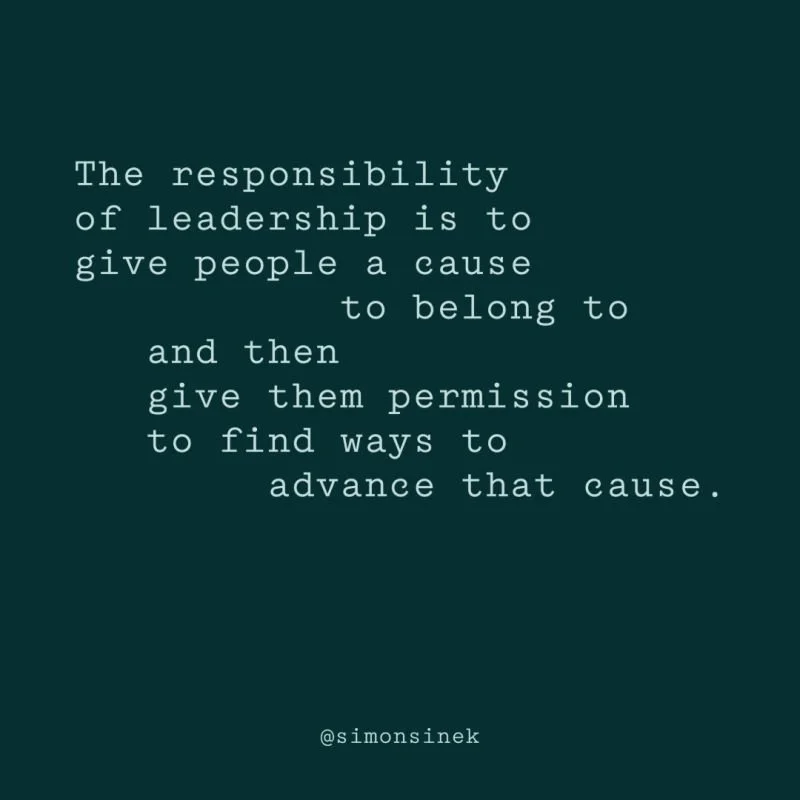
Leadership isn't simply about convincing people to believe in something. It's about trusting them enough to contribute to it.
And when you examine that idea through psychology, organizational behavior, and even marketing strategy, it reveals something important about how human beings develop commitment.
We don't just want to be included.
We want to know that our presence matters.
We want to have some influence over what happens next.
And perhaps most importantly, we want to feel that being part of something doesn't require abandoning who we are.
Let's explore why.
1. The Human Need to Belong Is More Than a Desire to Fit In
Human beings are social.
We form families, friendships, professional networks, communities, and shared identities. We develop attachments to groups that provide connection, familiarity, and a sense of meaning.
But belonging is more complicated than simply being surrounded by other people.
You can attend every team meeting and still feel excluded.
You can work for an organization for years without feeling connected to its purpose.
You can participate in a community while privately believing your opinions aren't welcome.
Physical or organizational inclusion doesn't necessarily produce psychological belonging.
One explanation comes from social identity theory, developed by psychologists Henri Tajfel and John Turner.
According to the American Psychological Association's definition of social identity theory, group membership can become an important part of how individuals understand themselves.
People don't identify exclusively as isolated individuals. They also understand themselves through the social groups they belong to.
Someone might think of themselves as a parent, entrepreneur, designer, teacher, athlete, or member of a particular community.
Those identities can influence how they interpret experiences, relationships, and responsibilities.
In the workplace, that means organizational identity can become more than a company name on a paycheck.
An employee may begin thinking, "This is the kind of work we do," or "These are the principles we care about."
When that identity aligns with their personal values, participation can feel more meaningful.
But identity also creates a potential vulnerability.
Belonging Can Become Conditional
There's an important distinction between feeling connected to a group and feeling pressured to conform to it.
A healthy organizational culture makes room for individual differences within a shared purpose.
An unhealthy one may communicate that belonging depends on agreement.
Consider two workplaces.
In the first, an employee proposes a different way of serving customers. Their manager listens, asks questions, and evaluates whether the approach supports the organization's goals.
In the second, the manager responds that the company has always done things a certain way and that questioning those practices demonstrates a lack of commitment.
Both workplaces might have an impressive mission statement.
Only one is allowing people to participate meaningfully in advancing it.
This is where the psychology of belonging begins intersecting with another fundamental human need: autonomy.
Because people generally don't want to belong to something that requires them to surrender their ability to think.
They want connection without losing agency.
2. The Psychology of Motivation: Autonomy, Competence, and Relatedness
To understand why shared purpose works best when accompanied by freedom, we need to look at one of the most influential frameworks in motivation research.
It's called self-determination theory.
Developed through decades of research by psychologists Edward Deci and Richard Ryan, self-determination theory examines the conditions that support human motivation, growth, and well-being.
At the center of the framework are three psychological needs:
Autonomy, competence, and relatedness.
The American Psychological Association's overview of self-determination theory explains how these needs are central to understanding self-directed motivation.
What's fascinating is how closely they connect to Sinek's leadership philosophy.
Autonomy: The Need to Have a Voice in Our Actions
Autonomy refers to experiencing our behavior as something we willingly endorse rather than something we feel forced to do.
It doesn't necessarily mean working independently or rejecting structure.
An employee can follow a process, collaborate with a team, and accept professional responsibilities while still experiencing autonomy.
The important distinction is whether they understand and accept the reasoning behind their actions.
Imagine a marketing director asking a team to improve customer retention.
One approach might involve assigning a rigid list of activities, requiring constant approval, and discouraging suggestions outside the original plan.
Another approach might establish the goal, explain its importance, clarify the available resources, and invite the team to propose solutions.
Both approaches provide direction.
But the second creates greater opportunities for autonomy.
Employees aren't merely completing instructions. They're participating in decisions about how to accomplish the objective.
Research reinforces the importance of that distinction.
A 2018 meta-analysis of leader autonomy support examined 72 studies involving more than 32,000 participants and found strong positive associations between autonomy-supportive leadership and employees' autonomous work motivation.
That doesn't mean autonomy alone guarantees exceptional performance.
It does suggest that the way leaders structure and communicate work matters for motivation.
Competence: The Need to Feel Capable and Effective
People also want to feel that they're becoming better at what they do.
Competence involves experiencing effectiveness and having opportunities to develop skills, overcome challenges, and contribute meaningfully.
This is an important part of leadership that can get lost in conversations about purpose.
A cause might be inspiring, but inspiration becomes frustrating when employees lack the tools, authority, training, or feedback necessary to contribute.
Imagine someone joining an organization because they believe deeply in its mission.
They're excited to help.
But their responsibilities remain unclear. They receive little guidance. Every mistake is criticized, and meaningful decisions happen without their involvement.
Eventually, enthusiasm may turn into uncertainty.
They still believe in the mission.
They simply no longer feel capable of advancing it.
This is why effective leadership requires more than motivational speeches.
People need opportunities to become competent contributors.
That includes useful feedback, realistic expectations, development opportunities, and responsibilities that fit their growing capabilities.
Relatedness: The Need to Feel Connected
The third need, relatedness, involves experiencing meaningful connection with others.
This is where belonging enters the picture most directly.
People want relationships in which they feel recognized, respected, and valued.
In organizations, relatedness can develop through supportive teamwork, mutual trust, genuine interest, and the sense that individual contributions matter to others.
An employee who feels connected to colleagues may experience their work differently from someone who feels isolated or interchangeable.
But the key insight from self-determination theory is that these needs work together.
Belonging without autonomy can feel controlling.
Autonomy without relatedness can feel isolating.
Responsibility without competence can feel overwhelming.
Strong leadership creates conditions where people can experience all three.
As Deci, Anja Olafsen, and Ryan explain in their review of self-determination theory in work organizations, satisfying these psychological needs is associated with autonomous motivation, quality performance, and well-being.
In other words, people don't simply need a cause. They need the psychological conditions that allow them to contribute to that cause.
3. Purpose Versus Control: Why the Difference Matters
Purpose is one of the most popular concepts in modern business.
Companies talk about purpose-driven leadership, mission-driven organizations, meaningful work, and values-based cultures.
And there are legitimate reasons these ideas resonate.
People often want their work to mean something beyond completing tasks.
They want to understand how their efforts contribute to customers, colleagues, communities, or broader organizational goals.
But purpose can become a problem when leaders use it as a substitute for trust.
Consider the difference between these two statements:
"We believe in creating better experiences for our customers, and we want you to help us figure out how."
And:
"We believe in creating better experiences for our customers, so you need to follow our instructions without questioning them."
Both statements appeal to the same mission.
But they create very different relationships between leadership and employees.
The first invites contribution.
The second uses the mission to justify control.
The Micromanagement Trap
Micromanagement often begins with understandable intentions.
A business owner wants quality.
A manager wants consistency.
A team leader wants projects completed on time.
Those are legitimate responsibilities.
But when leaders become overly involved in every decision, they can accidentally communicate that employees aren't trusted to exercise judgment.
An employee may start questioning whether they're allowed to make even minor decisions.
Instead of solving a problem, they wait for approval.
Instead of suggesting an improvement, they follow the existing process.
Instead of taking ownership, they focus on avoiding mistakes.
That can create a workplace where people appear compliant but aren't necessarily committed.
Sinek explores a related distinction in his article Leaders Should Assign Responsibility, Not Tasks, where he argues for giving people meaningful accountability instead of reducing their responsibilities to instructions.
The idea isn't that managers should abandon oversight.
It's that oversight should support people's ability to succeed rather than replace their judgment.
Purpose Needs Boundaries, Too
There is another side to this conversation that deserves attention.
Not every organization invoking a cause is automatically creating a healthy culture.
Purpose can also create pressure.
Employees who care deeply about a mission may feel guilty establishing boundaries, questioning workloads, or prioritizing their well-being.
In some environments, dedication becomes an unspoken expectation to continually sacrifice personal time.
A meaningful cause does not justify unhealthy working conditions.
Nor does believing in a mission require someone to agree with every decision their employer makes.
Research on meaningful work increasingly recognizes these possible downsides. A 2026 integrative review presented in the Academy of Management Proceedings discusses potential costs such as burnout and interpersonal conflict, while calling for a more balanced approach to purpose.
That doesn't mean meaningful work is inherently harmful.
It means leaders need to consider how the language of purpose interacts with actual organizational practices.
A workplace can believe deeply in its mission and still respect employee boundaries, compensation, dissent, and personal autonomy.
In fact, those conditions may help the mission remain sustainable.
4. Psychological Safety: Can People Disagree and Still Belong?
One of the most important tests of organizational culture occurs when someone disagrees with leadership.
It's easy to celebrate employee ideas when those ideas reinforce existing plans.
It's more difficult when someone challenges a strategy, questions an assumption, or suggests that the organization is making a mistake.
What happens in that moment reveals a great deal about the culture.
Does the leader become defensive?
Does the employee receive a genuine opportunity to explain their reasoning?
Does disagreement lead to a constructive conversation?
Or does everyone quietly learn that it's safer to remain silent?
These questions connect closely to research on psychological safety.
Harvard Business School professor Amy Edmondson introduced psychological safety as a shared belief that a team is safe for interpersonal risk-taking.
Her foundational 1999 study, Psychological Safety and Learning Behavior in Work Teams, examined 51 work teams and found that psychological safety was associated with team learning behavior.
The study helped establish an important organizational principle: people need to feel able to take interpersonal risks if they're going to contribute openly.
Those risks might include asking questions, admitting mistakes, offering suggestions, or expressing concerns.
Why Silence Is Not the Same as Agreement
Imagine a company meeting where leadership presents a new strategy.
Everyone nods.
Nobody asks questions.
The meeting ends on time, and the leader assumes the team is aligned.
But perhaps several employees noticed a potential problem.
Maybe a customer-facing employee knows that the proposed process will create confusion.
Maybe someone in operations understands that the timeline is unrealistic.
Maybe the marketing team has evidence that customers respond differently than leadership assumes.
If employees believe disagreement could damage their standing, they may choose silence.
And leadership can mistake that silence for support.
Research on employee voice and silence examines this dynamic in detail. In a 2023 review published in the Annual Review of Organizational Psychology and Organizational Behavior, Elizabeth Wolfe Morrison explores why employees choose to speak up or remain silent and the implications those decisions can have for organizations.
The important takeaway is that a healthy culture shouldn't measure alignment solely by the absence of objections.
Sometimes the employee who challenges a decision is demonstrating commitment to the organization's success.
Belonging Should Include the Freedom to Question
This brings us back to Sinek's idea.
If leadership gives people a cause and encourages them to find ways of advancing it, disagreement becomes almost inevitable.
Different people bring different experiences, skills, and perspectives.
They will not always reach identical conclusions.
And they shouldn't have to.
The purpose of a shared mission isn't to eliminate differences.
It's to provide a common reference point for working through them.
A useful leadership question is not simply, "Does everyone agree with the plan?"
It's also, "Does everyone understand the goal, and do they feel able to contribute what they know?"
Psychological safety doesn't mean every suggestion must be accepted.
It doesn't mean performance standards disappear.
It means people can contribute honestly without fearing that every question or mistake will be treated as a personal failure.
If disagreement automatically threatens belonging, the organization may have created conformity rather than trust.
5. What Happens When Employees Believe in the Mission but Disagree With Leadership?
This is the tension I find most interesting.
What happens when someone genuinely believes in an organization's mission but thinks leadership is pursuing it incorrectly?
Imagine an employee working for a company that promises to put customers first.
They discover that a new sales process creates unnecessary pressure for customers.
They raise the issue with management.
Leadership responds that the process is necessary to achieve growth targets.
Now the employee faces a difficult choice.
Do they follow the process because they want to remain loyal to the organization?
Or do they continue questioning it because they believe the process conflicts with the organization's stated values?
The answer may depend on the situation, but the example reveals an important distinction.
Loyalty to a mission is not always the same as loyalty to a particular leader's decisions.
In fact, the two can sometimes conflict.
If the organization truly values customer experience, an employee who challenges a harmful process may be acting in support of that value.
An effective leader should be capable of recognizing this possibility.
That doesn't require accepting every criticism as correct.
Employees can be mistaken, too.
But an organization that claims to value independent contribution needs a way to evaluate disagreement without automatically treating it as disloyalty.
Purpose Should Be Shared, Not Owned by Leadership
Leaders often play an important role in defining and communicating an organization's purpose.
But once people become part of the organization, they develop their own relationships with that purpose.
A customer service representative may understand it through conversations with customers.
A designer may interpret it through usability and accessibility.
A salesperson may connect it to helping customers make informed decisions.
A manager may focus on creating sustainable processes that allow the team to deliver consistently.
These perspectives won't always align perfectly.
But they can collectively make the organization stronger.
The challenge for leadership is to maintain a coherent direction without assuming that every valuable idea must originate at the top.
That's a more demanding responsibility than simply issuing instructions.
It requires listening, judgment, humility, and a willingness to adjust.
6. How Great Leaders Give People Direction Without Taking Away Their Autonomy
So how do leaders turn these psychological principles into everyday practices?
The answer isn't to eliminate procedures or let everyone do whatever they want.
Organizations need coordination.
Employees need clarity.
Customers need consistent experiences.
And leaders remain responsible for making difficult decisions.
The goal is to create enough structure for people to succeed while preserving meaningful opportunities for independent thinking.
Start With the Outcome, Not Just the Assignment
Suppose a manager wants to improve customer response times.
They could instruct employees to follow a particular script or checklist.
That may be appropriate for some tasks, especially where compliance, safety, or consistency are essential.
But a more autonomy-supportive approach begins by explaining the outcome.
Why does response time matter?
What problems are customers currently experiencing?
What constraints must the team work within?
What would success look like?
Once those questions are clear, employees can contribute ideas about how to improve the process.
The leader is still defining the destination.
The team has a greater role in choosing the route.
Explain the Reason Behind Important Decisions
People don't need to agree with every decision to understand why it was made.
A leader may need to impose a deadline, prioritize one project over another, or reject a proposed solution.
The question is whether those choices are communicated thoughtfully.
Explaining the reasoning behind decisions can help employees understand how individual actions connect to broader goals.
It also creates opportunities to identify assumptions that may be incomplete.
Sometimes the act of explaining a decision reveals that the leader hasn't fully considered its consequences.
That isn't a weakness.
It's an opportunity to improve the decision before implementation.
Invite Suggestions Before Everything Is Finalized
Organizations sometimes ask employees for feedback after the important choices have already been made.
At that point, participation can feel symbolic.
If the goal is to encourage meaningful contribution, employees need opportunities to influence decisions while alternatives are still being considered.
That might involve asking frontline staff about customer pain points before redesigning a process.
It might mean inviting designers into conversations about business objectives instead of simply handing them finished requirements.
Or it might involve asking team members what resources they need before assigning an ambitious deadline.
Participation doesn't guarantee that every employee's recommendation will be adopted.
But it can demonstrate that their perspective is genuinely relevant.
Treat Mistakes as Information, Not Automatically as Character Flaws
Mistakes require context.
Some errors involve negligence or serious consequences and need appropriate accountability.
Others are the predictable result of learning, experimenting, or working with incomplete information.
Treating every mistake as evidence of incompetence can discourage people from taking responsible initiative.
A better question is what the organization can learn.
Was the task unclear?
Was training insufficient?
Did the process create unnecessary risk?
Were the available resources inadequate?
Did someone make a reasonable decision based on the information available?
These questions don't eliminate accountability.
They make accountability more useful.
Recognize Contributions, Not Just Compliance
If leaders say they value creativity but only reward employees who follow instructions perfectly, the real cultural message becomes clear.
People learn what the organization values through its responses to behavior.
Recognition should reflect the contributions leaders actually want to encourage.
That may include problem-solving, collaboration, thoughtful experimentation, helping colleagues, or identifying an issue before it becomes expensive.
A strong culture doesn't need everyone to contribute in the same way.
It needs people to understand how their different contributions support a shared outcome.
7. The Connection Between Leadership Psychology and Brand Communities
At first glance, leadership and marketing may seem like separate subjects.
One concerns employees.
The other concerns customers.
But both involve relationships between individuals and something larger than themselves.
This is where the psychology of belonging becomes especially relevant to brand strategy.
Some brands attract customers primarily through convenience, price, or availability.
Others become associated with particular identities, interests, or communities.
People may identify with a brand because it represents an activity they love, a lifestyle they enjoy, or a set of values they recognize.
But a genuine brand community involves more than an audience following a company's social media account.
What Makes a Brand Community?
In their influential 2001 article Brand Community, researchers Albert Muñiz Jr. and Thomas O'Guinn examined communities associated with brands including Ford Bronco, Macintosh, and Saab.
They identified characteristics such as shared consciousness, rituals and traditions, and a sense of responsibility toward the community.
The research demonstrates that relationships among customers can become part of the brand experience itself.
People may share knowledge, help newcomers, participate in traditions, or develop a common language around their interests.
The brand helps bring them together, but the community also develops relationships that extend beyond the company's direct control.
That's an important distinction.
A company can create spaces where people connect.
It cannot simply declare that a meaningful community exists.
Community emerges through participation.
A Brand's Audience Isn't the Same as Its Community
A business might have thousands of social media followers.
That doesn't necessarily mean those followers feel connected to each other or share a meaningful identity.
Someone may follow a business for promotions, entertainment, or useful information without feeling any deeper attachment.
There's nothing wrong with that.
Not every customer relationship needs to become a community.
But when a brand deliberately wants to cultivate belonging, it should consider what people receive beyond access to its products.
Can customers learn from one another?
Do they have opportunities to contribute ideas or experiences?
Can they disagree with the brand without being dismissed?
Are there shared interests that exist independently of the company's promotional messages?
These questions are especially important for businesses that claim to build communities around a mission.
A community isn't simply a more emotionally persuasive sales funnel.
At its best, it's a network of relationships in which participants receive genuine value from being connected.
8. Why Brands Need to Give People Ownership, Not Just a Message
There's an interesting similarity between a leader who micromanages employees and a brand that tries to control every aspect of its community.
Both may believe they're protecting a carefully developed vision.
But excessive control can limit the very participation they claim to value.
Consider a brand that encourages customers to share their experiences.
If every contribution must follow a predetermined script, the community may begin to feel like an advertising campaign.
Or imagine a business that says customer feedback is central to its values but publicly dismisses reasonable criticism.
The company's message and behavior are now in conflict.
Customers can notice that difference.
Authenticity Is Something Organizations Demonstrate
Research on brand activism provides a useful parallel.
A 2020 paper published in the Journal of Public Policy & Marketing, Brands Taking a Stand: Authentic Brand Activism or Woke Washing?, examines the importance of alignment between what brands communicate and what they actually do.
Although the paper specifically concerns sociopolitical brand activism, its emphasis on consistency offers a broader lesson for businesses.
A purpose statement becomes less convincing when organizational behavior repeatedly contradicts it.
If a brand claims to value transparency, it should demonstrate transparency.
If it claims to value customers, that commitment should influence customer service and business decisions.
If it claims to value community, customers should have meaningful opportunities to participate.
Marketing can communicate those commitments.
It cannot replace the behavior required to substantiate them.
The Most Interesting Brand Stories Aren't Always Controlled by the Brand
Some of the strongest signals of community appear when people voluntarily contribute their own knowledge and experiences.
Customers may explain how they use a product.
They might help someone solve a problem.
They may offer suggestions that influence future product development.
In these situations, the brand is no longer the only source of information or value.
People are helping shape the experience.
That can feel uncomfortable for organizations accustomed to controlling their messaging.
But it also creates an opportunity.
When people are encouraged to contribute rather than simply consume, the relationship can become more participatory.
The important qualification is that participation must be genuine.
A business shouldn't interpret belonging as permission to expect unpaid labor, unquestioning loyalty, or constant advocacy from its customers.
Healthy communities also respect boundaries.
9. Why This Matters for Small Businesses, Not Just Corporate Leaders
It's easy to imagine these ideas applying primarily to large organizations with established human resources departments and complicated management structures.
But small businesses may have even more direct opportunities to practice them.
A small business owner often shapes the culture through everyday interactions.
Employees see how the owner responds to problems.
They notice whether suggestions are welcomed.
They understand which behaviors receive praise and which lead to criticism.
The company's stated values may matter less than what happens during a difficult conversation.
Consider a small marketing agency.
The owner might want every project to reflect a particular standard of quality.
That's reasonable.
But if every design decision, content revision, and strategic recommendation requires the owner's personal approval, employees or collaborators may struggle to develop ownership.
Over time, the agency can become dependent on one person's judgment.
An alternative is to establish clear quality standards while allowing people greater freedom in how they meet them.
A strategist might approach a problem differently from a designer.
A copywriter may identify a customer concern the owner hadn't considered.
A developer may suggest a simpler solution.
The business still needs consistency.
But consistency doesn't require identical thinking.
For small organizations, this approach may also be practical.
When people understand the goals and can make appropriate decisions independently, the owner doesn't have to become the bottleneck for every task.
Of course, that freedom requires clear responsibilities, sufficient training, and an understanding of which decisions genuinely need approval.
Trust works better when expectations are explicit.
10. The Risk of Turning Purpose Into a Marketing Performance
There is one final tension worth examining.
Purpose has become an attractive concept in both leadership and branding.
But when something becomes attractive in marketing, businesses may begin using the language before establishing the underlying practices.
A company can publish a beautiful statement about belonging.
It can create a video about its mission.
It can develop a memorable slogan about empowering people.
None of those things proves that employees experience autonomy or customers experience genuine community.
The challenge is that purpose can become performative.
It may be communicated primarily because it sounds good rather than because it meaningfully shapes decisions.
This creates a gap between declared values and experienced values.
Declared values are what an organization says it believes.
Experienced values are what people encounter through everyday interactions.
The two should reinforce each other.
When they don't, people may become skeptical.
A 2024 study in the Journal of Business Research examined authentic brand purpose and the effects of perceived inconsistency, finding that credibility benefits from alignment between brand messaging and organizational action.
The broader marketing lesson is that authenticity depends on behavior.
If an organization wants to be known for empowering people, it needs to create genuine opportunities for them to exercise judgment.
If it wants to be known for transparency, it needs to communicate honestly when outcomes are disappointing.
If it wants to be known for listening, it needs to demonstrate that feedback can influence decisions.
That last point is particularly important.
A brand that only listens when customers agree isn't really listening.
And a leader who only encourages independent thinking when employees reach the preferred conclusion isn't truly empowering people.
11. How Can Leaders Tell Whether People Actually Feel Empowered?
A mission statement can't answer this question.
Neither can a motivational speech.
If leaders want to understand whether their culture supports belonging and autonomy, they need to examine people's actual experiences.
That can involve anonymous employee feedback, structured conversations, retention patterns, opportunities for advancement, and the way teams respond when something goes wrong.
But one of the simplest starting points is to examine the questions employees feel comfortable asking.
Are people willing to admit when they don't understand something?
Do they offer ideas without waiting to be invited?
Can they explain why their work matters?
Do they know which decisions they can make independently?
Are they comfortable raising concerns before problems become serious?
Do leaders change their minds when presented with better information?
None of these observations should be treated as a complete scientific measurement by itself.
Together, however, they can help reveal whether the organization's stated commitment to empowerment is reflected in everyday behavior.
Listen to the People Who Experience the Culture
Leadership often evaluates culture from the perspective of the people designing it.
But employees experience culture from a different position.
A manager may believe they've created an open environment because they regularly tell employees that feedback is welcome.
An employee may interpret the situation differently based on how the manager responded to the last person who offered criticism.
Both perspectives matter.
But the employee's experience reveals something the manager's intentions cannot.
For organizations that want to improve, understanding that gap is essential.
The same principle applies to customer communities.
A business may believe its brand is approachable and welcoming.
Customer reviews, support interactions, and community conversations may reveal whether people share that impression.
Ultimately, culture isn't simply what an organization intends to create.
It's also what people consistently experience.
12. The Leadership Paradox: Giving Up Some Control to Build Something Stronger
Leadership involves responsibility.
People look to leaders for direction, judgment, accountability, and stability.
So it's understandable that leaders sometimes feel pressure to maintain tight control.
When outcomes matter, delegating decisions can feel risky.
What if someone makes the wrong choice?
What if the work doesn't meet expectations?
What if the team develops an approach the leader wouldn't have chosen?
Those concerns aren't imaginary.
But attempting to eliminate every possibility of error can create a different kind of risk.
The organization may lose initiative.
Employees may stop experimenting.
Decisions may become unnecessarily slow.
And valuable information may never reach leadership because people don't believe their perspectives will be welcomed.
This is the paradox.
Leaders are responsible for the organization's direction, but they cannot personally contribute every valuable idea required to move it forward.
At some point, meaningful leadership requires trusting other people.
Not blindly.
Not without standards.
And certainly not without accountability.
But enough to let others bring their experience, judgment, and creativity into the process.
That's what separates giving people a cause from simply asking them to execute a plan.
A cause establishes what matters.
Trust creates space for people to help determine how it can be advanced.
Final Thoughts: Belonging Shouldn't Require Giving Up Your Individuality
What I find most compelling about Simon Sinek's leadership philosophy is that it connects two ideas that organizations sometimes treat as opposites.
Shared purpose and individual freedom.
Belonging and independence.
Commitment and disagreement.
We often assume that strong cultures require everyone to move in exactly the same direction, think the same way, and share the same interpretation of the mission.
But a common purpose doesn't require identical perspectives.
In fact, organizations may become more capable when people bring different forms of knowledge, creativity, and judgment to a shared objective.
The responsibility of leadership is not simply to communicate a compelling mission.
It's to create the conditions in which people can contribute meaningfully to it.
That means supporting autonomy.
Developing competence.
Building relationships.
Encouraging thoughtful disagreement.
And recognizing that people need more than permission to belong.
They need opportunities to matter.
The same principle applies to brands.
A company can communicate its values endlessly, but genuine community develops through experiences, relationships, and participation.
People need to see that the organization lives its stated purpose.
They need to feel that their involvement is meaningful.
And they need room to contribute without surrendering their individuality.
Great leadership doesn't ask people to become smaller so they can fit into a shared mission. It builds a mission that becomes stronger because different people are able to contribute.
That's a much more demanding vision of leadership.
But it's also a more human one.
Frequently Asked Questions
What is the psychology of belonging?
The psychology of belonging examines how people experience connection, acceptance, and identification with others. Belonging can influence how individuals understand themselves and participate in social groups. Related concepts include social identity, interpersonal relationships, and the psychological need for relatedness described in self-determination theory.
Why is belonging important in leadership?
Belonging can help people feel connected to their colleagues and the broader purpose of an organization. However, healthy belonging should also allow room for independent thinking and disagreement. A culture that requires constant conformity may create apparent unity without genuine trust.
What is self-determination theory in the workplace?
Self-determination theory is a framework developed by Edward Deci and Richard Ryan that emphasizes autonomy, competence, and relatedness as important psychological needs. In workplace settings, the theory helps explain why autonomy-supportive leadership, opportunities for development, and meaningful relationships can support motivation and well-being.
What's the difference between autonomy and independence?
Independence means acting without relying on other people. Autonomy involves experiencing one's actions as willingly chosen or personally endorsed. A person can work closely with others, follow agreed-upon guidelines, and still experience autonomy when they understand and accept the purpose behind their actions.
How does psychological safety affect employee performance?
Psychological safety involves a shared belief that people can take interpersonal risks without automatically facing negative consequences. Research has connected psychological safety with team learning behaviors, including asking questions, acknowledging mistakes, and sharing information. It does not eliminate accountability or guarantee strong performance on its own.
Can a company have a strong mission and still have a poor culture?
Yes. A compelling mission statement doesn't guarantee that employees experience trust, autonomy, fairness, or psychological safety. Organizational culture is also shaped by leadership decisions, communication, incentives, working conditions, and how people are treated when challenges arise.
How does the psychology of belonging apply to marketing?
Belonging can influence the development of brand communities, where customers build relationships around shared interests or identities associated with a brand. Effective community-building involves more than emotional messaging. It requires opportunities for meaningful participation, authentic behavior, and a relationship that provides value beyond the immediate transaction.
Can purpose-driven leadership become harmful?
It can, particularly when an organization's mission becomes a justification for excessive workloads, unquestioning loyalty, or limited personal autonomy. Healthy purpose-driven leadership balances commitment to shared goals with respect for individual boundaries, fair expectations, and constructive disagreement.
Building a Brand People Want to Belong To?
At Ritner Digital, I'm interested in the psychology behind the decisions people make, the communities they form, and the reasons they connect with particular businesses.
Marketing isn't only about getting attention.
It's also about understanding people.
Their motivations, expectations, experiences, and the trust required to build meaningful relationships.
Whether you're developing your brand positioning, improving your digital marketing strategy, or trying to understand what makes your business resonate with its audience, psychology offers a valuable starting point.
Let's talk about your brand and marketing strategy →
Research and Further Reading
The psychological and organizational concepts discussed in this article draw on the following sources:
American Psychological Association. Self-Determination Theory: A Quarter Century of Human Motivation Research. Overview of autonomy, competence, and relatedness.
Deci, E. L., Olafsen, A. H., & Ryan, R. M. (2017). Self-Determination Theory in Work Organizations: The State of a Science. Annual Review of Organizational Psychology and Organizational Behavior.
Slemp, G. R., Kern, M. L., Patrick, K. J., & Ryan, R. M. (2018). Leader Autonomy Support in the Workplace: A Meta-Analytic Review. Motivation and Emotion.
American Psychological Association. Social Identity Theory. APA Dictionary of Psychology.
Edmondson, A. (1999). Psychological Safety and Learning Behavior in Work Teams. Administrative Science Quarterly.
Morrison, E. W. (2023). Employee Voice and Silence: Taking Stock a Decade Later. Annual Review of Organizational Psychology and Organizational Behavior.
Muñiz, A. M., Jr., & O'Guinn, T. C. (2001). Brand Community. Journal of Consumer Research.
Vredenburg, J., Kapitan, S., Spry, A., & Kemper, J. A. (2020). Brands Taking a Stand: Authentic Brand Activism or Woke Washing?. Journal of Public Policy & Marketing.
Walter, N., Föhl, U., Sander, F., & Nies, A. (2024). Act as You Preach! Authentic Brand Purpose Versus Woke Washing's Impact on Brand Credibility. Journal of Business Research.
Sinek, S. Leaders Should Assign Responsibility, Not Tasks. Simon Sinek / The Optimism Company.
Shahbaz, W., Maghsoudi, T., & Brewster, C. (2026). Exploring the Dark Side of Meaningful Work. Academy of Management Proceedings. Conference review abstract.