We Got a Sales Call From a Lead Who Found Us Through Claude. Here's Why That's Going to Happen More.
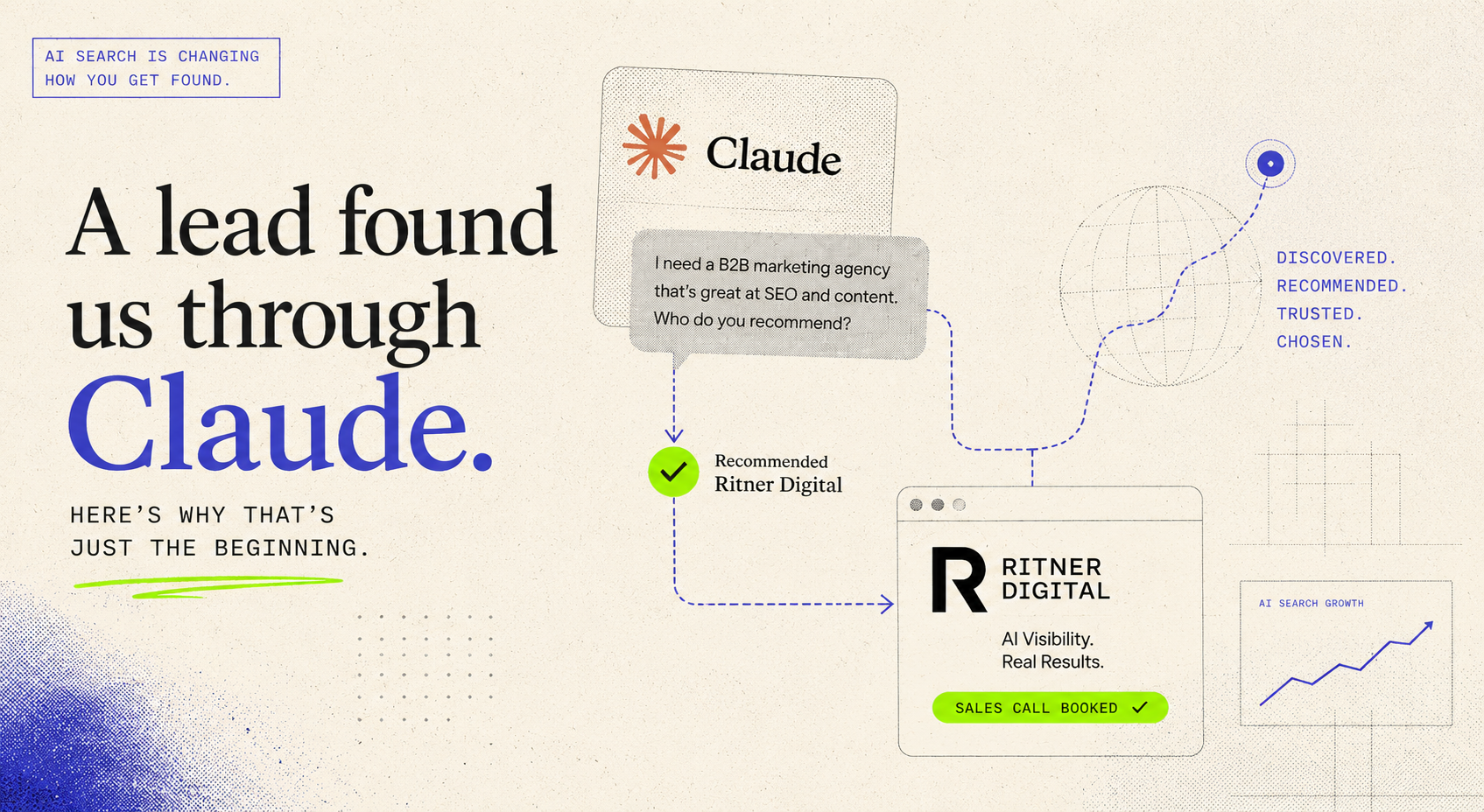
Yesterday we had a sales call with a company that came in through an inbound inquiry. Nothing unusual about that — inbound is how we prefer to grow, and we invest in content and SEO specifically because we want the right businesses to find us when they're looking for what we do.
What was unusual was the first thing they said when we asked how they found us.
"We found you through Claude."
Not Google. Not a referral. Not a LinkedIn post or a newsletter or a directory listing. Claude. The AI assistant made by Anthropic — the same one a significant and growing number of people now use the way they used to use Google, except instead of getting a list of links to evaluate, they get an answer that points them somewhere specific.
They asked Claude who could help them with their digital marketing strategy. Claude recommended Ritner Digital. They booked a call.
We've been doing the work to show up in AI search for a while now. This was the first time a lead told us directly that's how they found us. It won't be the last. And if you run a business that depends on being found by the right people at the right time, the mechanics of how that just happened are worth understanding.
What Actually Happened on That Call
Before getting into the broader implications, it's worth being specific about the mechanics of this particular lead.
The company — we'll keep the details confidential — was in the early stages of evaluating digital marketing partners. They had a clear need, a defined budget range, and were doing what buyers do in 2026: researching before they reach out. Their research started not with a Google search but with a conversation. They described their situation to Claude, explained what they were looking for in an agency, and asked for recommendations.
Claude gave them a specific answer. Ritner Digital was in it.
They came to our website, read through our content, decided we looked like a fit, and submitted an inquiry. By the time we got on the call, they had a clear picture of what we do, how we think, and what working with us might look like — because that's what our content is designed to communicate. The AI recommendation got them to the door. The content let them make an informed decision about whether to knock.
That's the full funnel in 2026. And it's different enough from the traditional model that it's worth thinking through carefully.
Why AI Recommendations Work Differently Than Search Rankings
When someone finds you through Google, the journey typically looks like this: they search a query, they see a list of results, they make a judgment about which result looks most relevant based on the title and meta description, they click through, they evaluate the page, and they either stay or go back and try another result. The process is comparative and active — the searcher is doing the work of evaluating options against each other.
When someone finds you through an AI assistant, the journey looks different. They describe their situation in conversational language — often with more context and nuance than a search query allows. The AI synthesizes what it knows about their situation and what it knows about the available options, and it makes a recommendation. Sometimes one recommendation. Sometimes a short list. But the recommendation comes with a degree of implicit endorsement that a search result doesn't carry.
A link on page one of Google says: this page is relevant to your query. An AI recommendation says: given what you've told me about your situation, this is who I think you should talk to. The framing is fundamentally different, and the psychological effect on the person receiving it is meaningfully different too. There's a reason people trust recommendations from a knowledgeable advisor more than they trust a ranked list — and AI assistants, at their best, are functioning more like the former than the latter.
This changes the nature of the competition. In traditional search, you're competing for attention in a list. In AI search, you're competing to be the answer. Those are different games with different rules, and businesses that understand the distinction early have a real advantage.
Why This Is Going to Pick Up
One sales call from a Claude referral is an interesting data point. The reason we expect more of them — and why we think businesses across categories should be paying attention — is the underlying trend data.
AI-referred sessions currently represent approximately 1% of traffic but saw a 527% year-over-year increase. That number captures both the current scale and the trajectory. The absolute percentage is still small. The growth rate is not. The businesses that are building their AI visibility now are doing so at a point in the adoption curve where the competition for those recommendations is still relatively low — before the majority of their competitors have figured out that this is a game worth playing. CMSWire
Prospects now form opinions about brands through conversations with answer engines, not by scanning search results. And unlike SEO, which evolved over decades, AEO is developing on a compressed timeline. That compression matters. The window to establish a strong AI search presence before it becomes as competitive as traditional SEO is open right now, and it won't stay open indefinitely. HubSpot
HubSpot's own data shows organic traffic for its customers has fallen 27% year-over-year, driven by a structural shift in how people search — AI platforms are increasingly intercepting queries before users ever reach a company's website. That 27% isn't going back. The shift is structural, not cyclical. The traffic that used to flow through traditional search to individual websites is increasingly being intercepted, processed, and redirected by AI assistants that give answers rather than lists. Some of that redirected traffic ends up as direct referrals to specific businesses — the ones the AI recommends. PPC Land
The brands investing in AEO now will earn disproportionate attention, trust, and demand as AI search continues to grow. Disproportionate is the operative word. Early positioning in a channel that's growing this fast tends to compound. The businesses that establish AI visibility now are building something that gets harder for latecomers to displace — not because the channel is being gated, but because authority and citation patterns in AI systems tend to reinforce themselves over time. HubSpot
What Made Claude Recommend Us Specifically
This is the question worth sitting with, and we want to answer it honestly rather than just saying "great content" and moving on.
We don't have direct visibility into Claude's recommendation logic. No business does — and anyone claiming they've cracked the algorithm for AI recommendations is overstating what's currently knowable. What we do know is that AI recommendations are built on what the AI has learned from the content that exists about you, from you, and around you on the internet.
In our case, that means several things we've invested in deliberately.
We publish content that is specific, opinionated, and useful to a defined audience. Not generic digital marketing advice. Not content written to rank for high-volume keywords that don't connect to what we actually do. Content that communicates clearly what we think, how we approach our work, and what kind of client relationship we're built for. The agency transition series we've been publishing is a good example — it's detailed, specific, and written for a reader who is actively navigating a real decision, not a reader who is passively browsing.
We are consistent in how we describe what we do across every channel where we have a presence. Consistency matters in AI recommendations the same way it matters in traditional SEO — the more coherent and consistent the signal, the more confidently an AI system can characterize what a business does and who it serves.
We build content that answers the questions our target clients are actually asking. Not the questions that are easy to rank for. The questions that a business owner or marketing leader has when they're trying to solve a real problem. Those questions increasingly get asked directly to AI assistants rather than typed into a search bar — and the businesses that have built content around them are the ones that show up in the answers.
None of this is magic. It's the same discipline that has always made content marketing work — specificity, consistency, genuine usefulness to a defined audience — applied with an understanding that the audience increasingly encounters that content through an AI intermediary rather than directly through a search result.
What This Means If You're Thinking About Your Own Visibility
We're not telling this story to make a point about how good we are at marketing. We're telling it because the mechanics that produced this lead are replicable — and because most businesses are significantly behind on building the kind of presence that produces AI recommendations.
The first thing to understand is that AI visibility is not a separate strategy from content and SEO. It's an extension of the same fundamentals — clear, specific, consistent communication about what you do and who you do it for, published in formats and on channels that AI systems can find, process, and cite. If your content strategy is already strong, you're building AI visibility whether you're thinking about it in those terms or not. If your content strategy is weak — generic, inconsistent, or written without a clear picture of who it's for — you're invisible in AI search for the same reasons you're invisible in traditional search.
The second thing to understand is that the entity consistency across channels matters more than it used to. AI systems build their understanding of a business from multiple sources — your website, your social profiles, your mentions in third-party content, your reviews, your directory listings. The more coherent and consistent the picture across all of those sources, the more confidently an AI can characterize what you do and recommend you in the right context. Inconsistency — different descriptions of your services on different platforms, outdated information in some places and current information in others — creates noise that works against you.
The third thing to understand is that earning mentions and citations in authoritative third-party content is as important for AI visibility as it is for traditional SEO — arguably more so. AI systems are trained on content from across the internet, and the businesses that are mentioned, cited, and discussed in reputable publications, directories, and industry content build the kind of footprint that AI systems can draw on when constructing a recommendation. This is one of the reasons PR and digital authority building have become more strategically valuable, not less, as AI search has grown.
The Honest Caveat
We want to be honest about what we don't know as clearly as we've described what we do know.
We don't know exactly why Claude recommended us in this particular instance. We don't know how consistently we show up in AI recommendations across different query framings. We don't know how our AI visibility compares to that of competitors we haven't thought to monitor. And we don't know how the recommendation algorithms of Claude, ChatGPT, Gemini, and Perplexity will evolve over the next twelve months — because they're evolving constantly, and the citation and recommendation patterns that hold today may shift significantly as the models update.
What we do know is that one inbound lead told us directly that an AI assistant sent them. That the underlying trend data points clearly toward more of these referrals over time, not fewer. That the work required to build AI visibility is work worth doing regardless of the pace of adoption. And that the businesses paying attention to this now are establishing positions that will be worth significantly more as the channel matures.
We'll keep building. We'll keep publishing. And we'll keep telling you what we learn as we learn it — including when what we learn changes what we thought we knew.
Want to Know How Your Business Shows Up in AI Search?
This is exactly the kind of work we help businesses with at Ritner Digital. If you want to understand your current AI visibility, build a strategy for improving it, and stop leaving inbound leads on the table because AI assistants don't know enough about you to recommend you — let's talk.
Frequently Asked Questions
How do we know if our business is already showing up in AI search recommendations?
The most direct way is to ask. Open Claude, ChatGPT, Gemini, and Perplexity and type the queries your target customers would use when looking for a business like yours. Be specific — describe the situation the way a real buyer would describe it, not the way you would describe your own services. See what comes back. Are you mentioned? Are competitors mentioned instead of you? Is no specific business mentioned at all? That manual audit gives you a starting picture. For ongoing monitoring, HubSpot's AEO tracker and tools like Profound can automate this across a larger prompt set — though as we've written elsewhere, some of those tools have their own UX challenges. The manual audit is still the most honest starting point.
Is getting recommended by Claude the same as getting recommended by ChatGPT or Gemini?
Not exactly. Each AI platform has its own training data, its own retrieval mechanisms, and its own logic for constructing recommendations. A business that shows up prominently in Claude's responses may not show up as consistently in ChatGPT's, and vice versa. The foundational work — clear, consistent, specific content about what you do and who you serve, distributed across authoritative channels — tends to help across all platforms because they're all drawing from overlapping pools of internet content. But the weighting differs, and monitoring your visibility across multiple platforms rather than optimizing for just one is the more defensible approach.
How long does it take to build meaningful AI search visibility?
There's no precise answer because the variables are too many — your category, your current content footprint, your competitive landscape, and how quickly the AI platforms update their training data. What we can say is that AI visibility is built on the same foundations as traditional SEO authority, which means it compounds over time and the early investments tend to produce returns that accelerate. The businesses seeing meaningful AI referral traffic today generally started investing in specific, authoritative content two or three years ago — not because they were thinking about AI search specifically, but because they were building real content authority. Starting now puts you ahead of the majority of businesses in most categories who still haven't connected the dots.
Does this mean SEO is dead and we should shift our entire focus to AEO?
No, and anyone telling you to abandon traditional SEO entirely is getting ahead of the evidence. Traditional search still drives the overwhelming majority of organic discovery for most businesses, and that won't change overnight. What's changing is the marginal value of the two channels — traditional SEO is becoming more competitive and delivering declining returns for generic content, while AI search visibility is growing from a small base with relatively low competition. The right response is not to pivot entirely but to extend your content strategy to cover both — which, as we note in the post, is less of an addition than it sounds because the fundamentals overlap significantly.
What kind of content makes a business more likely to be recommended by AI assistants?
Content that is specific, authoritative, and genuinely useful to a defined audience tends to earn AI recommendations more reliably than generic content. Specificity matters because AI systems are better at characterizing businesses that communicate clearly about what they do, who they serve, and how they think about their work. Authority matters because AI systems weight content from sources that are well-cited, well-linked, and consistent across channels. Genuine usefulness matters because the questions AI users ask tend to be specific and situational — the businesses whose content addresses those specific situations in depth are the ones that show up in the answers. Original research, detailed case studies, and specific point-of-view content tend to outperform generic informational content in AI recommendations for the same reasons they outperform it in traditional search.
Should we be creating content specifically designed to get AI recommendations?
The framing we'd push back on slightly is "designed to get AI recommendations" as a goal in itself. The better framing is: create content that genuinely serves your target audience's real questions and needs, distributed consistently across authoritative channels, with clear and coherent messaging about what your business does and who it serves. That content earns AI recommendations as a byproduct of being genuinely useful and authoritative — the same way it earns traditional search rankings. Content created specifically to game AI recommendations, without genuine usefulness underneath it, tends to produce the same results as content created to game search rankings: short-term noise that doesn't compound into durable visibility.
How important are third-party mentions and citations for AI visibility?
Very. AI systems don't learn about businesses exclusively from those businesses' own websites — they learn from the full ecosystem of content that references, discusses, and cites those businesses. A company mentioned in a well-regarded industry publication, cited in authoritative blog posts, reviewed on credible platforms, and discussed in community forums builds a richer and more credible AI footprint than a company with excellent owned content but no third-party presence. This is why PR, digital authority building, and earning genuine mentions in relevant publications are increasingly strategic investments — they're not just good for brand awareness, they're building the kind of third-party signal that AI systems use to validate and characterize a business.
Is there a risk that AI recommendations create over-dependence on a channel we don't control?
Yes, and it's worth being honest about. AI recommendation algorithms are not transparent, they change without notice, and a model update can shift citation patterns in ways that affect your visibility overnight. This happened with traditional search too — businesses that built their entire growth strategy on Google rankings discovered how fragile that was when algorithm updates moved the goalposts. The lesson from that experience applies here: AI search visibility is worth building, but it should be one channel in a diversified acquisition strategy, not the entire foundation. The businesses most resilient to algorithm changes in any channel are the ones with strong brand recognition, direct audience relationships, and multiple discovery pathways — so that no single channel's shift is catastrophic.
What should we do this week to start improving our AI search visibility?
Start with the manual audit described in the first FAQ — search for your business across Claude, ChatGPT, Gemini, and Perplexity using the queries your buyers actually use. Document what comes back. Then audit your entity consistency — Google your business name and check that the description of what you do is coherent and current across your website, your Google Business Profile, your LinkedIn, and any major directory listings. Inconsistencies are the easiest thing to fix and have an immediate positive effect on how AI systems characterize you. Then look at your content and ask honestly: does it answer the specific questions a buyer in my category would ask an AI assistant? If the answer is mostly no, you have a content roadmap. Start with the questions your best clients asked before they became clients.
We don't have a big content team. Can a small business realistically build AI search visibility?
Yes — and in some ways a small business with a clear, specific point of view has an advantage over a large business producing generic content at scale. AI systems don't reward volume. They reward specificity, authority, and coherence. A small agency or professional services firm that publishes twenty deeply specific, genuinely useful pieces of content about a well-defined niche is more likely to earn AI recommendations in that niche than a large firm that publishes two hundred generic pieces covering every possible topic. The investment required is less about resources and more about discipline — being clear about who you serve, what you know, and what you have to say that nobody else is saying. That's a strategic choice more than a budget question. If you want help thinking through what that looks like for your business, start here →