Why People Accept Your LinkedIn Connection Request — But Ignore Your Newsletter Invite
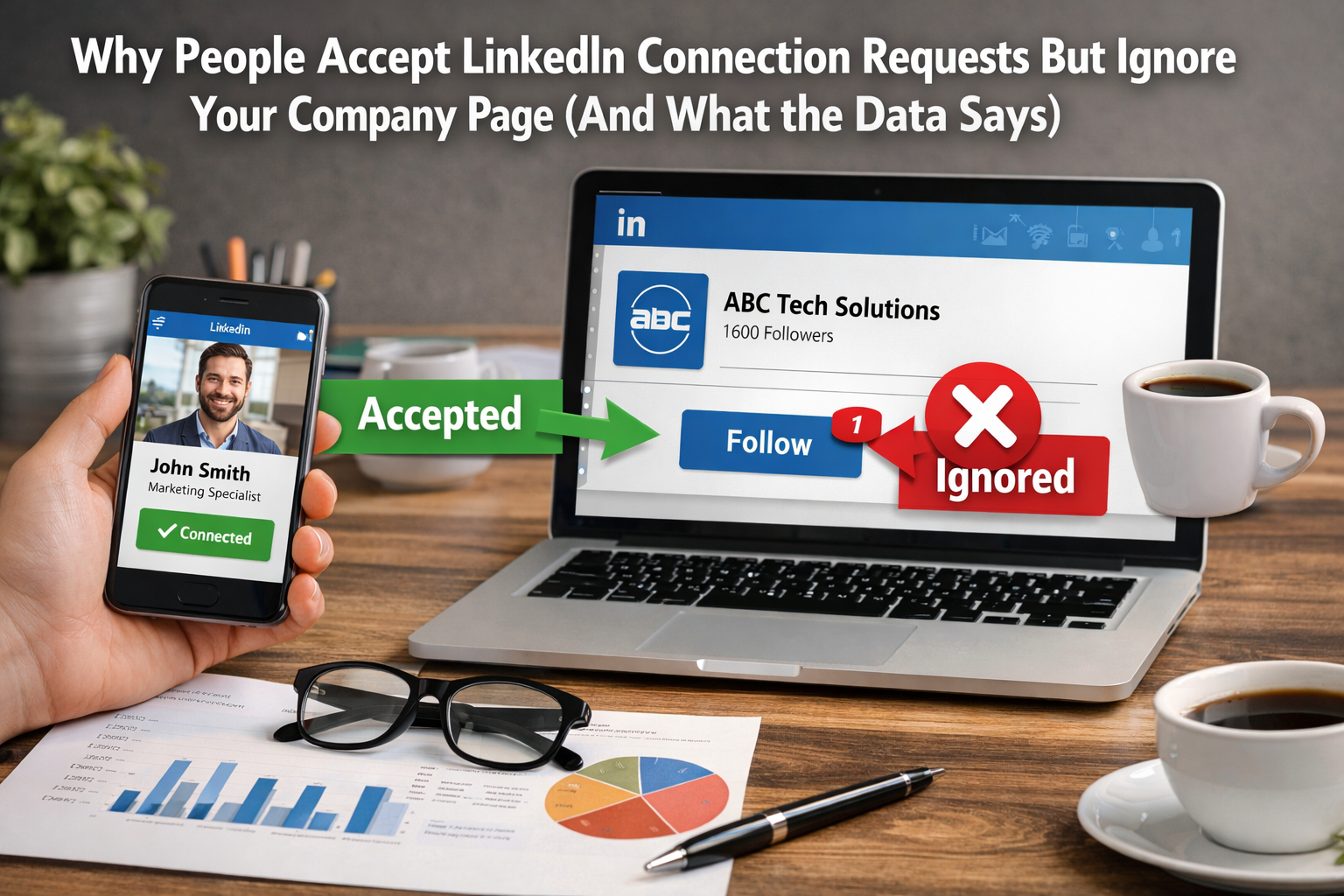
There's a pattern that nearly every marketer and business owner notices after spending time on LinkedIn, but rarely takes the time to fully understand. Someone accepts your personal connection request within hours. But when you invite that same person to follow your company page or subscribe to your newsletter, they ghost you. The invite sits there, unanswered.
This isn't a coincidence or bad luck. It's psychology — and the data backs it up completely. Understanding why this happens is the key to building a LinkedIn strategy that actually works.
The Numbers First: What We're Actually Dealing With
Let's start with what the research tells us.
In 2025, LinkedIn connection acceptance rates vary widely across industries and use cases, but small businesses and B2B teams should aim for 30–40% acceptance as a healthy benchmark. Alsona Some well-optimized campaigns do significantly better. Top performers using psychology-driven frameworks achieve 40–45% acceptance, and hyper-personalized strategies can reach as high as 72%. Gracker
Now contrast that with what happens on the company page side of the equation. Personal profiles outperform company pages by 83% in average engagement rate, and LinkedIn's algorithm deliberately favors human-to-human content over brand broadcasting. Linklulu When employees share company content, it receives 5–10 times more engagement than posts shared directly by the brand, while personal profiles tend to perform with engagement rates between 7–8%, compared to the 1–2% typical for company pages. Closely
The gap between how people respond to a person versus a brand isn't marginal. It's structural. And it runs straight through the psychology of how humans make snap decisions online.
The 3-to-7-Second Decision Window
Recipients typically decide whether to accept a connection request within just 3 to 7 seconds of seeing it. Closely That's not much time. So what is a person's brain actually doing in those few seconds?
When someone receives a personal connection request, their brain is running a quick mental profile check: Do I know this person? Do we have anything in common? Could this be useful to me? It's a peer-to-peer social evaluation — the same kind humans have been doing since long before the internet existed.
When someone receives an invitation to follow a company page or subscribe to a newsletter, a fundamentally different process kicks in. Now the question becomes: What is this brand going to send me? Am I going to get spammed? Do I care enough about this company to invite them into my feed? The default answer, absent a compelling reason, tends to be no.
LinkedIn taps into our quick judgments: a connection request says "we're peers," while a follow says "I admire your work from afar." Contentin And "we're peers" is a far more compelling proposition to the average professional scrolling their LinkedIn feed.
The Reciprocity Effect: Why Personal Connections Feel Obligatory
One of the most powerful psychological forces at play is reciprocity — the deeply human instinct to give back when something is given to you.
Reciprocity drives 67% of acceptance decisions on LinkedIn. When prospects see you've engaged with their content before requesting a connection, they feel obligated to reciprocate. Growleads This is why the "engagement-first" approach works so well in practice. First-message response rates can jump from about 8% to 14% when the connection request follows a prior engagement — nearly double the response rate — just from liking a post or leaving a comment on a prospect's content. Salesforge
A newsletter invite or a company page follow request triggers no such reciprocity loop. There's no human who liked your posts, no person who viewed your profile. It's a brand asking for attention — and attention is the one thing people are least willing to give freely in 2026.
Social Proof and Mutual Connections: The Trust Shortcut
LinkedIn's interface is deliberately designed to surface one piece of information above almost everything else when you receive a connection request: mutual connections.
Mutual connections build trust instantly. Seeing shared connections boosts your credibility because it creates what psychologists call "social proof" — when someone sees that you're connected to people they know and respect, you gain borrowed credibility. Closely
This is a mechanism that simply doesn't exist in the same way for company pages and newsletter invites. When a brand sends you a follow invitation, there are no mutual friends to borrow credibility from. There's no social graph to leverage. It's a cold ask from an entity, not a warm introduction from a peer.
The best-performing outreach strategies follow a warm-first approach by subtly showing up in a lead's LinkedIn orbit — viewing their profile, engaging with their posts — before ever sending a connection request. Expandi When they finally get the request, it doesn't feel cold. It feels like a natural next step. No such warm-up path exists for a company page or newsletter because there's no visible human doing the warming.
The Algorithm Is Actively Working Against You on Company Pages
Here's something most business owners don't realize: LinkedIn's algorithm isn't neutral. It explicitly favors person-to-person content and treats company pages as publishers rather than members.
Company page posts get shown to maybe 2–5% of followers initially. Unless they get immediate traction, they die there. When someone comments on a personal post, their entire network sees that activity. When someone comments on a company page post, that visibility is far more limited. Hrs
LinkedIn explicitly prioritizes "member-to-member" connections in its feed algorithm. Company pages are treated as publishers, not members, which limits their access to interest and social graph distribution channels. Digital Applied
This has a downstream effect on follow rates. People intuitively know — even if they can't articulate it — that following a company page means seeing less interesting content in their feed. Following a person means seeing conversation, perspective, and interaction. The decision to follow a company page carries a higher perceived cost in terms of feed quality, and people opt out.
The Content Experience Gap
There's also the matter of what people expect to receive after they say yes.
When someone accepts your personal connection request, they're not necessarily committing to much. They'll see your posts when you share them. You can message them. The relationship feels low-stakes and reversible.
When someone follows a company page or subscribes to a newsletter, there's a stronger sense of commitment. Now content is coming to them on a regular schedule. It feels more like a subscription than a relationship — and subscriptions require more trust upfront.
Despite having an average follower count 46% lower than a company page, individual employees averaged more than 2.75x the impressions and 5x the engagement per post, validating that people prefer to engage with people over brands. Refinelabs
The content experience on a personal profile also feels more authentic. Personal posts enter the feeds of direct connections and are eligible to surface to second and third-degree connections through engagement signals, while company page posts primarily reach followers and rarely extend beyond that base without high-engagement velocity in the first hour. Digital Applied
Personalization: The Variable That Changes Everything
The single biggest driver of connection acceptance rates — and the single biggest thing missing from most company page and newsletter invite strategies — is personalization.
Including a personalized message in a connection request significantly boosts the reply rate compared to sending no message at all, and AI-driven personalization outperforms non-personalized outreach across the board. BelkinsMentioning something specific about the recipient — like their background, a recent post, or a shared experience — shows you've done your homework, and a personalized note feels like the start of a genuine conversation rather than a mass outreach attempt. Closely
Company page follow invites and newsletter subscriptions almost never have this. They're typically triggered by a generic "Invite to follow" button, which carries zero personalization and zero sense that a human being thought about the recipient before clicking send.
The math bears this out: personalized requests outperform generic templates by 200%, while the industry average for personalized connection requests sits at 30% and generic requests with no customization get only 15% acceptance. Growleads
What This Means for Your LinkedIn Strategy
If your business is relying primarily on a company page or newsletter invites to grow your LinkedIn presence, the data is telling you to rethink the approach. This doesn't mean abandoning those channels — it means understanding their proper role in the funnel.
Personal profiles should do the heavy lifting. Posts from individuals convert at 2–5% of engaged users into marketing-qualified leads versus 0.5–1% for company posts, and employee advocacy can reduce sales cycles by accelerating trust-building before the first sales call. Meet Lea Your founders, executives, and sales team members are your most powerful distribution channels on LinkedIn — more powerful than any branded company page.
Use connections to warm people up to your brand. The connection is the door. Once someone is in your network through a personal relationship, they're far more receptive to being introduced to your company page, your newsletter, or your services. Leading with the brand and asking for the follow is the wrong order of operations for most businesses.
Think of company pages and newsletters as the second step, not the first. When you identify someone who fits your ideal customer profile and they've been engaging with your personal content, that's your signal to convert them further — they're already warm, so your acceptance rate on additional asks will be much higher. Cleverly
Engineer the reciprocity loop. Before you ask for anything — a connection, a follow, a newsletter sign-up — give first. Comment on their content. Share their posts. Engage with their ideas. The best-performing LinkedIn strategies follow a warm-first approach, subtly showing up in leads' orbits before ever making a direct ask. Expandi
The Bottom Line
People accept personal connection requests at a far higher rate than they follow company pages or subscribe to newsletters for one fundamental reason: people trust people, and they're skeptical of brands. LinkedIn's platform design, its algorithm, and basic human psychology all reinforce this reality.
The good news is that this gap is completely workable once you understand it. Your personal profile — and the personal profiles of your team — are your most valuable LinkedIn assets. Build connections as people first. Then convert those relationships into brand awareness, newsletter subscribers, and clients.
That's the order that works. And the data is unambiguous about it.
Ritner Digital helps businesses build LinkedIn strategies that lead with people and convert at every stage of the funnel. Want to talk about how this applies to your business? Let's connect.
Frequently Asked Questions
Why do people accept LinkedIn connection requests more than company page follows?
Because a connection request comes from a person, not a brand. LinkedIn users instinctively evaluate personal requests as peer-to-peer interactions — someone in their professional world reaching out. A company page follow invite feels more like a marketing ask, which triggers skepticism and a higher mental bar before saying yes.
What is the average LinkedIn connection acceptance rate?
For most outreach, the benchmark sits between 26–30% for cold connection requests. With strong personalization and warm-up strategies, well-optimized campaigns can reach 40–45%. Highly targeted, intent-based outreach with mutual connections in play can push that number even higher, into the 60–70%+ range.
Why does my company page get so little engagement compared to my personal profile?
LinkedIn's algorithm treats company pages as publishers and personal profiles as members. That distinction matters enormously — the algorithm actively distributes personal content to second and third-degree connections when it gains traction, while company page posts typically only reach 2–5% of followers initially and rarely travel beyond that unless engagement is immediate and strong.
Does adding a message to a connection request actually make a difference?
Yes, but perhaps not in the way you'd expect. Adding a message has almost no effect on whether someone accepts the request — acceptance rates are nearly identical with or without a note. The difference shows up in what happens after acceptance. A personalized message dramatically increases the chance the new connection actually responds and starts a conversation, which is where the real value is.
What makes someone decide to follow a company page or subscribe to a LinkedIn newsletter?
Almost always, it's because they already have some relationship with the brand through a person first. They've engaged with a founder's content, spoken with a salesperson, or had some human touchpoint that built trust. Cold invites to follow a page or subscribe to a newsletter — with no prior relationship — rarely convert because there's nothing personal driving the decision.
How should I use my personal profile and company page together?
Think of them as two different stages of the same funnel. Your personal profile builds relationships, earns trust, and gets attention. Your company page and newsletter then serve as deeper-dive destinations for people who are already warmed up. Leading with the brand and asking for the follow first is the wrong order — lead with people, then introduce the brand.
What is the reciprocity principle and how does it apply to LinkedIn?
Reciprocity is the psychological tendency to give back when someone has given to you first. On LinkedIn, this means engaging with a prospect's content — liking a post, leaving a thoughtful comment — before ever sending a connection request. When they recognize your name and see that you've shown genuine interest in their work, accepting your request feels natural. Company pages and newsletters can't easily trigger this loop because there's no visible human doing the engaging.
Does the size of my network affect my connection acceptance rate?
Indirectly, yes. A larger, active network means more mutual connections with the people you're reaching out to, and mutual connections are one of the strongest trust signals on LinkedIn. The more your network overlaps with your target audience's network, the more "warm" your cold outreach actually is.
Is it worth investing in growing a LinkedIn newsletter if acceptance rates are low?
Absolutely — but it requires a different strategy than cold invites. The most effective LinkedIn newsletters grow through personal profile content that consistently delivers value, which naturally drives people to subscribe on their own terms. Asking your existing connections to subscribe after they've already engaged with your ideas is far more effective than blasting invites to people who barely know you.
How often should we be posting from our company page vs. personal profiles?
Most of your content energy should go into personal profiles — founders, executives, and client-facing team members. For company pages, two to three posts per week is a solid baseline. But keep in mind that even a modest personal profile post from a well-connected team member will typically outperform a company page post on reach and engagement, so personal content should always be the priority.