Why Roswell Restaurants Need a Digital Strategy After the Bellini Osteria Fire (and What Every Canton Street Business Can Learn)
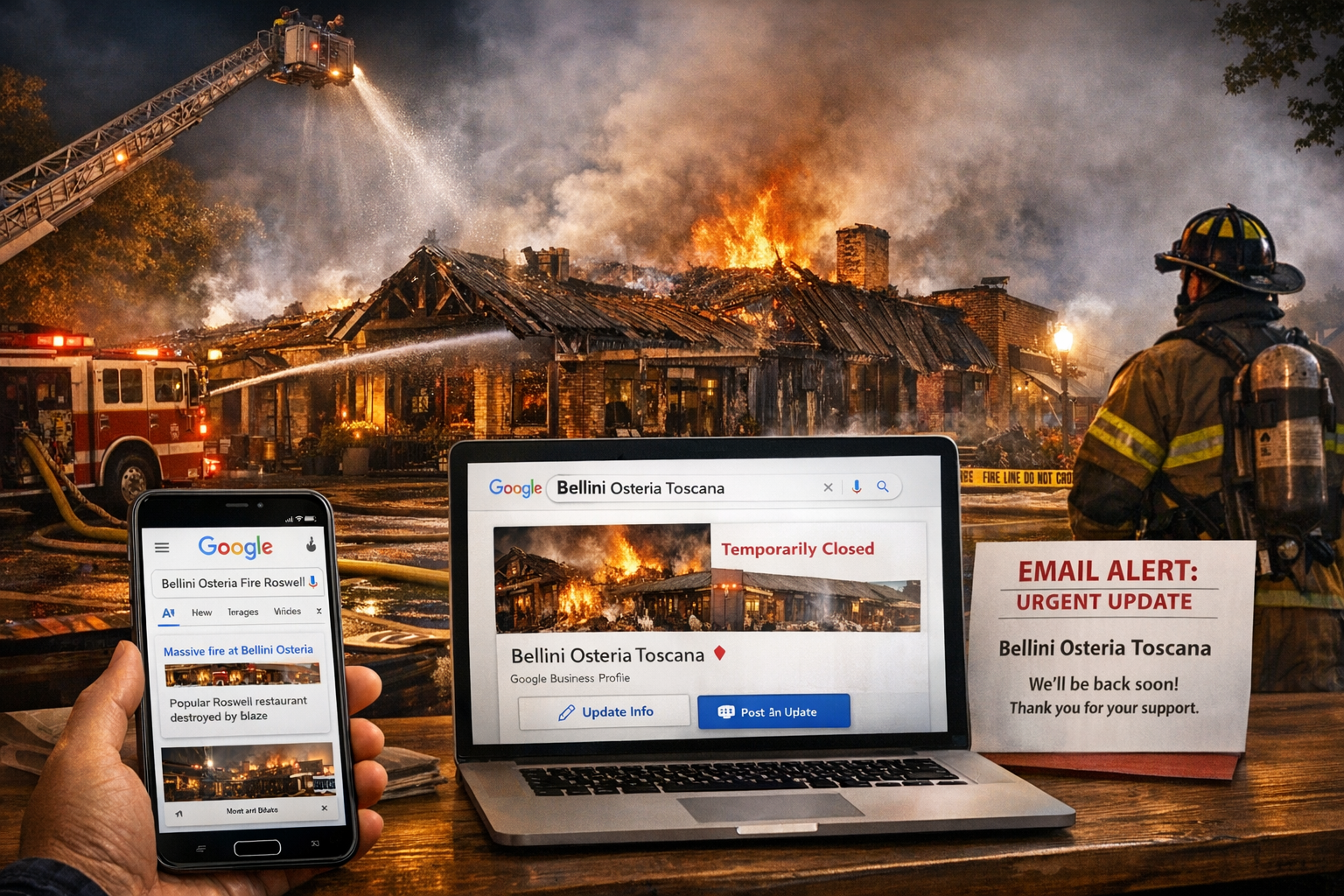
It was a Saturday night in Roswell. Diners were seated, wine was poured, and the kitchen at Bellini Osteria Toscana was in full swing. Then everything stopped.
On the evening of February 28, 2026, Roswell fire crews responded to a fire at Bellini Osteria Toscana on West Crossville Road. When they arrived, they found heavy smoke pouring from the roof and discovered the flames had spread through the walls and into the attic. FOX 5 Atlanta Fire departments from Milton and Alpharetta responded alongside Roswell crews Appen Media to battle the blaze. No injuries were reported, but firefighters remained on scene for an extended period monitoring hot spots. FOX 5 Atlanta
One OpenTable reviewer captured the surreal moment with striking brevity: they had been there for barely half a glass of wine and some focaccia bread before the fire started — and even in the middle of that chaos, they were impressed enough to say they planned to return.
That speaks to how beloved Bellini had become in the Roswell dining scene. The restaurant posted a message to its website acknowledging a fire in its pizza oven, noting it would be temporarily closed while repairs were completed and promising to keep customers updated. Belliniosteriatoscana
But here's the question no one in Roswell's business community is asking loudly enough after watching this unfold: When the lights go dark — for any reason — where do your customers go to find out what happened?
The answer, almost universally, is online. And if your digital presence isn't ready for that moment, you will lose those customers. Not because of the fire, the flood, the renovation, or the lease dispute — but because someone else showed up in the search results while you were silent.
This post is about what the Bellini fire reveals about digital preparedness, and what every restaurant, retailer, and service business on Canton Street and throughout Roswell needs to build before their own "dark period" arrives.
When Something Goes Wrong, Customers Go to Google First
Think about what happened in the hours after the Bellini fire. Loyal regulars who had a reservation that night — or who heard about it through a neighbor — did exactly what every modern consumer does: they searched.
They Googled "Bellini Osteria Toscana Roswell." They checked Instagram. They looked at the restaurant's Facebook page. They went to Google Maps and looked at the listing for updated hours. Some of them checked Yelp for recent reviews that might explain what was going on.
What they found determined whether they felt informed and loyal, or confused and forgotten.
This is the invisible crisis management battle that every Roswell business faces — and most don't realize it until it's too late. Your digital presence isn't just a marketing tool in normal times. It's your primary communication infrastructure when something unexpected happens. A fire. A temporary closure. A staffing issue. A flood. A remodel that runs two weeks long. A health code inspection that closes you for three days.
Email marketing generates engagement rates that are typically 5 to 10 times higher than social media marketing InboxAlly — and yet most Roswell small businesses have no email list at all. They've built their entire customer communication strategy on social media platforms they don't own, governed by algorithms they can't control, broadcasting to audiences they can't directly reach in a crisis.
That is an extraordinarily fragile position. And Bellini's situation, whatever the ultimate outcome, is a masterclass in why every local business needs to fix it right now.
The Problem With Social Media as Your Only Communication Channel
Let's address the elephant in the room before we go further: posting on Facebook or Instagram feels like reaching your customers. It isn't — not reliably.
Industry data paints a sobering picture of organic reach rates in 2026. On Instagram, fewer than 1 in 10 followers typically see a brand's update in their feed. ADdictive Facebook is even worse. Facebook organic reach has fallen to 2.6% on average, with some pages reporting engagement rates as low as 0.07% of total fans. Martech Zone
Run that math on a Roswell restaurant's typical social following. If you have 2,000 Instagram followers and you post that you're temporarily closed due to a fire, roughly 152 of those people will see it in their feed. The other 1,848 won't — unless the algorithm decides your post is worth amplifying. And in a crisis moment when you're dealing with insurance adjusters, contractors, and suppliers, you don't have time to engineer a viral post.
The reason is straightforward: social platforms make their money from advertising, and in order to push paid advertising, they limit the amount of reach businesses get organically. Most social media platforms now favor businesses that make a financial investment. ADdictive
This isn't a criticism of social media as a channel — it remains valuable for discovery, branding, and community building. But it cannot be your only line of communication to customers, especially in a crisis. It's rented land. The platform owns the relationship with your followers. You don't.
There are three digital assets every Roswell business needs to own outright: their Google Business Profile, their website, and their email list. These three — maintained properly — give you direct, algorithm-independent communication with your customers in any circumstance.
Your Google Business Profile Is Your Crisis Homepage
When something goes wrong with your business, your Google Business Profile becomes the first place the community looks for answers. Not your website. Not your Instagram. Google Maps.
This is where the practical lesson of the Bellini fire gets concrete. When customers searched for the restaurant after the fire, they landed on a Google Business Profile that showed regular operating hours. No update. No note explaining the temporary closure. Just business as usual — for a business that wasn't open.
That creates confusion and erodes trust, not because the owner was negligent, but because most local business owners don't think of their GBP as a crisis communication tool. It is.
Here's what your Google Business Profile should have in place before any disruption happens:
Claim and verify your listing now, not during the emergency. If you haven't claimed your GBP, you cannot update it quickly when you need to. The verification process takes time. Do it today.
Know how to update your hours instantly. Google Business Profile allows you to set special hours for specific dates — holiday closures, renovation periods, temporary shutdowns. Practice doing this on a non-urgent day so you're not figuring it out when you're already under pressure.
Use the Posts feature as a bulletin board. A GBP post saying "We experienced an unexpected closure and are working hard to reopen — stay tuned at [website/Instagram] for updates" takes five minutes to publish and reaches every person who searches for you on Google. It shows up directly in your listing. It's free.
Update your business description. A one-line addition — "Currently closed for repairs; reopening [date]" — in your business description signals to customers and to Google that you are an actively managed business, not an abandoned listing.
Respond to reviews quickly. When something unusual happens to a local Roswell business, reviews often reflect it in real time. Customers who show up to a dark building leave confused one-star reviews. Responding to those reviews promptly — acknowledging the situation and thanking people for their patience — is visible to every future customer who reads them.
Your Email List Is Your Most Valuable Business Asset
If you remember one thing from this blog post, make it this: your email list is the only customer communication channel you truly own.
Not your Instagram followers. Not your Facebook page likes. Not your Google reviews. Email addresses — collected with permission, stored in a platform you control — are a direct line to your customers that no algorithm can throttle, no platform can shadowban, and no server outage can misdirect.
Email marketing generates an average return of $36 to $42 for every dollar spent, consistently outperforming paid search, social media advertising, and display ads. InboxAlly 81% of SMBs rely on email as their primary customer acquisition channel. InboxAlly And yet the majority of Roswell restaurants and retail businesses have no email list at all, or have one they haven't touched in years.
Consider what an email list would have meant for Bellini in the days after the fire. A single email to 2,000 subscribers — people who had dined there, loved the food, and wanted to know what was happening — could have:
Informed loyal customers immediately, preventing frustration and unanswered Google searches. Expressed genuine gratitude for the community's support in a warm, personal way that a social media post cannot replicate. Created an opportunity to capture a waitlist of customers eager to be notified the moment the restaurant reopened. Turned a crisis moment into a loyalty-building touchpoint — one of the most powerful things a local business can do.
Transactional emails — messages sent in response to a specific event — have 8 times higher open rates compared to regular marketing emails. InboxAlly A "we're temporarily closed" email to a warm list isn't just damage control. It's one of the highest-engagement communications your business can send, precisely because it's real, timely, and personal.
Building your list doesn't require sophisticated technology. A simple sign-up sheet at the host stand, a QR code on the table tent, a "join our list for exclusive updates" prompt on your website, or a brief mention on your Instagram Stories directing followers to sign up — any of these, done consistently, builds a list over time. There are platforms designed specifically for small businesses — Mailchimp, Klaviyo, Constant Contact — that make it simple and affordable.
The Roswell restaurant that has 3,000 email subscribers will weather any disruption better than the one with 20,000 Instagram followers and no email list. Every time. No exceptions.
The "Dark Period" Digital Communications Playbook
Whether it's a fire, a flood, a forced renovation, a health inspection, a family emergency, or a staffing crisis — every Roswell business will face a dark period at some point. Here's a step-by-step digital communications playbook for when that happens:
Within the first hour: Update your Google Business Profile hours to reflect the closure. Post a GBP Update acknowledging the situation and directing customers to your social media and website for information. Change your website homepage or add a banner notification explaining the closure. If you have an email list, send a brief, warm, honest message telling subscribers what happened and what comes next.
Within the first 24 hours: Post on all active social media channels — even knowing your organic reach is limited, some customers will find you there. Reply to any comments, reviews, or direct messages from customers who are concerned. If you don't know your reopening timeline yet, say so honestly. "We don't have a date yet, but we'll reach out the moment we do" is far better than silence.
Throughout the closure: Maintain consistent, honest updates. Even a brief weekly social post — "Repairs are progressing, still no confirmed date but we'll let you know first" — keeps your loyal community from feeling abandoned. If you have email, send a mid-closure update when you have meaningful news to share.
Before reopening: Send an email announcement to your list before you post publicly anywhere else. Give your most loyal customers — the ones who trusted you enough to share their email — the first opportunity to make a reservation or walk through the door. This is a powerful loyalty signal. It says: "You matter most."
On reopening day: Send a reopening email with a warm, genuine message of gratitude. Offer something meaningful — a complimentary glass of wine, a discount on their first visit back, a priority reservation window. Create a reason for loyal customers to come back in the first week and help rebuild momentum.
What Canton Street Businesses Can Learn Right Now
The Bellini fire was specific to one restaurant. The lesson it teaches applies to every business in Roswell — from the boutiques on Canton Street to the service providers on Holcomb Bridge Road to the medical offices in the Crabapple corridor.
You don't get to choose when your dark period arrives. But you do get to choose whether you're ready for it.
The businesses that navigate disruption best in 2026 aren't the ones with the most Instagram followers. They're the ones with direct, owned lines of communication to their most loyal customers. Unlike social media followers, your email list is yours — you're not at the mercy of changing algorithms or ad costs. WebToffee
Start building that asset today. Claim your Google Business Profile if you haven't. Add an email sign-up to your website. Put a sign-up card at your checkout counter or host stand. Direct your Instagram followers to join your list. Tell them they'll get first access to specials, events, and important updates.
None of this is complicated. All of it is consequential.
The Bellini team is working hard to reopen and serve the Roswell community that clearly loves them. When they do, the businesses they'll compete with most effectively for that community's loyalty are the ones that stayed visible and connected while they were away. Make sure that's you.
Sources
Fox 5 Atlanta — Roswell Business Burns in Saturday Night Fire; Cause Still Unknown (March 1, 2026): fox5atlanta.com
WSB-TV Channel 2 Atlanta — Fire Damages Restaurant in Roswell (February 28, 2026): wsbtv.com
Appen Media — Area Fire Departments Aid in Battling Roswell Blaze (March 3, 2026): appenmedia.com
Bellini Osteria Toscana — Official website statement: belliniosteriatoscana.com
InboxAlly — The Ultimate List of Email Marketing Statistics for 2026: inboxally.com
SalesHandy — Email Marketing Statistics Updated for 2026: saleshandy.com
WebToffee — 20+ Email Marketing Statistics to Know in 2026: webtoffee.com
Addictive Digital — The Decline of Organic Reach on Social Media in 2026: addictivedigital.co.uk
Martech Zone — Organic Social Media Reach Is Dead: How To Grow Your Following in 2025: martech.zone
Google Business Profile Help: support.google.com
Don't wait for a crisis to find out your digital presence isn't ready.
A fire, a closure, a renovation — disruptions don't announce themselves. The Roswell businesses that weather them best are the ones that built their digital foundation before they needed it.
Let Ritner Digital audit your Google Business Profile, help you launch an email list, and build a communications strategy that protects your business when it matters most.
👉🏼 Get Your Free Digital Audit
Ritner Digital is a digital marketing agency serving restaurants, retailers, and local businesses in Roswell, GA and the greater North Fulton area.
Frequently Asked Questions
What should a Roswell restaurant do immediately after an unexpected closure?
The first hour matters more than most business owners realize. Update your Google Business Profile hours to reflect the closure, post a GBP Update directing customers to your social media for more information, add a banner or notice to your website, and — if you have an email list — send a brief, honest message to your subscribers explaining the situation. Customers aren't asking for perfection. They're asking to not feel ignored.
Why isn't posting on Instagram or Facebook enough to reach my customers during a crisis?
Because the algorithm decides who sees your posts — and in 2026, that number is shockingly small. Organic reach on Facebook averages around 2.6% of your followers, and Instagram is only slightly better at around 4%. If you have 2,000 followers and post about a temporary closure, fewer than 100 people are likely to see it in their feed without paid promotion. During a disruption, you can't afford to rely on a platform that throttles your message.
How do I build an email list for my Roswell restaurant or small business?
Start simple. Add a sign-up form to your website. Put a QR code on your tables, your checkout counter, or your receipt. Mention it in your Instagram Stories and tell followers they'll get first access to specials and important updates. Offer a small incentive — a free appetizer, a discount, early access to events — to encourage sign-ups. Consistency matters more than a perfect strategy. Ten new subscribers a week becomes a powerful list inside of a year.
What email platform should a small Roswell business use?
For most small businesses just getting started, Mailchimp and Constant Contact are user-friendly, affordable, and widely supported. If you're in restaurant-specific tech, platforms like Toast or OpenTable have built-in email tools tied to your reservation data, which is even more powerful. For growing businesses that want more automation and segmentation, Klaviyo is worth considering. The best platform is the one you'll actually use consistently — don't let the options paralyze you from starting.
How does a crisis affect my Google Business Profile ranking?
A sudden drop in activity — especially if your hours aren't updated and customers start leaving confused reviews — can negatively signal to Google that your business is inactive or unreliable. Unresponded reviews, outdated hours, and a lack of recent posts all work against your local ranking over time. Keeping your GBP updated during a closure, responding to reviews, and posting updates actively signals to Google that you're an engaged, trustworthy business — even when you're temporarily offline.
Should I respond to negative reviews left during my closure?
Absolutely — and do it quickly. When a business goes dark unexpectedly, confused customers often leave one-star reviews not out of malice but out of frustration at showing up to a closed location without warning. A warm, honest response — acknowledging the situation, thanking them for their patience, and inviting them to return — turns a public relations problem into a public relations win. Every prospective customer who reads that exchange sees how you handle adversity. That matters.
How long does it take to build a useful email list for a small business?
A useful list is smaller than most people think. Even 500 engaged, local subscribers who actually want to hear from you is more valuable than 10,000 cold contacts who've never stepped inside your business. Most Roswell restaurants and retailers can build a meaningful list of several hundred subscribers within the first few months simply by consistently asking at the point of sale and in social media bios. The key word is consistently — make it a habit, not a one-time push.
What's the difference between a Google Business Profile update and a regular post?
A GBP Update (also called a Google Post) is a short message that appears directly on your Google listing when someone searches for your business. It's separate from your business description and hours — think of it as a mini announcement that lives right inside Google Search and Maps. During a closure, a GBP Update is often the first thing a customer sees when they search for you. It costs nothing, takes minutes to publish, and reaches every person who looks you up on Google. It is one of the most underused tools available to Roswell small businesses.
Can a business actually grow its customer loyalty during a crisis?
Yes — and some of the strongest customer relationships are forged during disruptions. When a business communicates honestly, shows gratitude, and gives loyal customers a reason to feel like insiders — first to know, first to return — it creates an emotional bond that transactional interactions rarely build. A reopening email that says "because of your support during our closure, we'd like to offer you a complimentary glass of wine on your first visit back" does more for long-term loyalty than six months of promotional posts ever could.
How does this apply to non-restaurant businesses on Canton Street?
The principles are identical regardless of industry. A boutique that closes temporarily for a remodel, a salon that has to pause operations, a service business dealing with an equipment failure, a medical practice managing a staffing crisis — all of them face the same communication challenge. Customers default to Google. If your GBP is outdated and your only communication channel is a social media post that 97% of your followers won't see, you will lose people who would have happily waited. The businesses that build direct, owned communication channels now are the ones that protect their customer base when something unexpected happens.