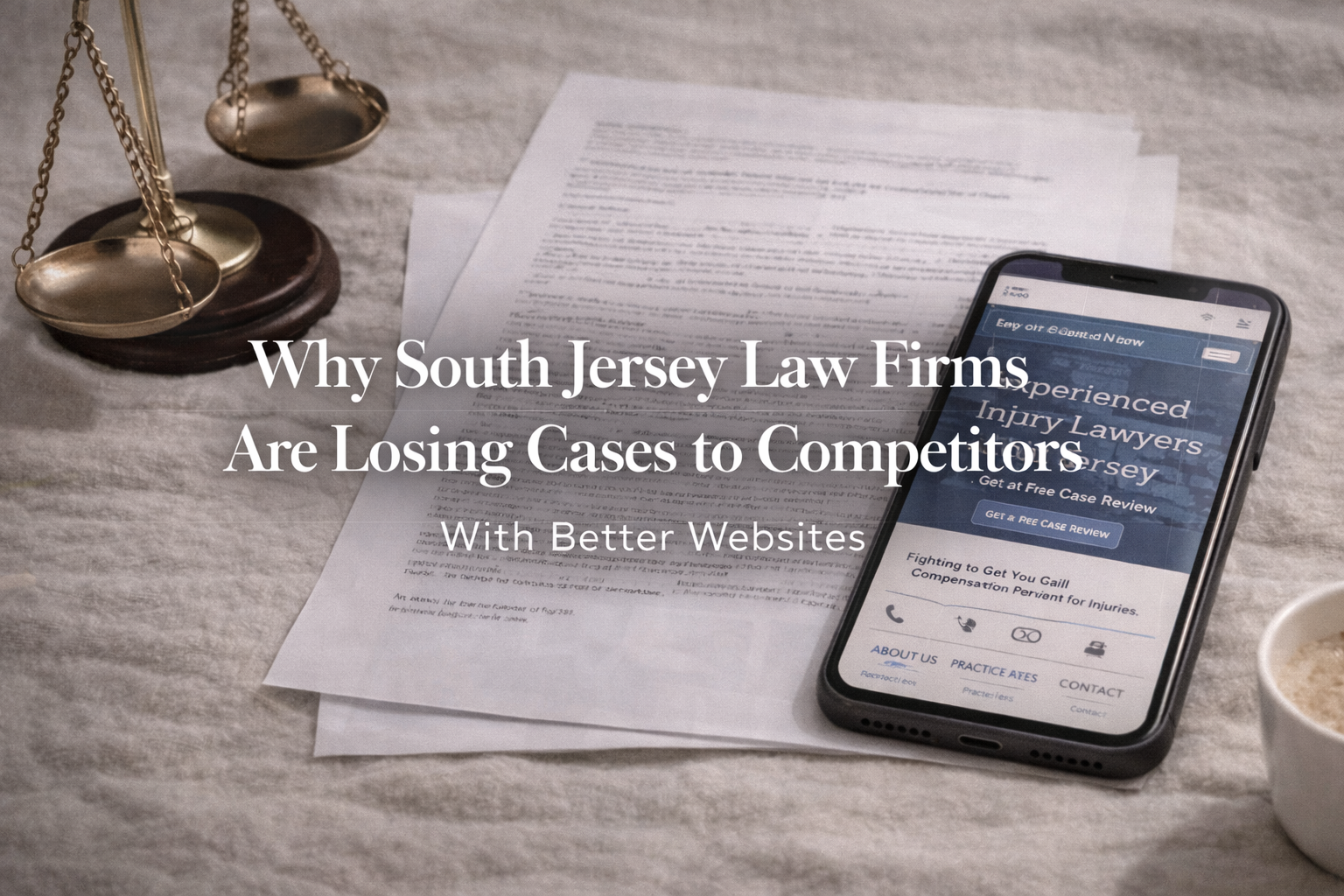
Why South Jersey Law Firms Are Losing Cases to Competitors With Better Websites
You’ve been practicing for 15 years.
You know the courts.
You know the judges.
You’ve won real cases.
And yet…
A newer firm — with less experience — keeps showing up ahead of you online and signing the cases you wanted.
It’s not luck.
It’s not always ad spend.
It’s usually their website.
In counties like Camden County, Burlington County, and Gloucester County, competition among law firms has intensified. And when prospects compare firms, your website is often the deciding factor.
Here’s why better websites are quietly winning more cases.
1. First Impressions Now Happen Online — Not in the Office
Before someone calls your firm, they’ve already:
Googled your name
Compared you to 2–5 other firms
Read reviews
Scanned your homepage
Evaluated credibility
In seconds.
If your site looks:
Outdated
Generic
Slow
Hard to navigate
You’ve already lost trust — before the phone rings.
Modern prospects equate website quality with firm competence. Fair or not, perception drives action.
2. Your Competitor’s Site Is Built to Convert — Not Just Inform
Many older law firm websites function like digital brochures:
“About us”
“Practice areas”
“Contact”
That’s not enough anymore.
High-performing law firm websites are built around:
Clear value propositions
Practice-area-specific messaging
Objection handling
Social proof
Strong, repeated calls to action
Mobile-first user experience
They guide visitors toward booking a consultation.
If your site simply provides information, while your competitor’s site drives decisions, guess who gets the call?
3. Mobile Experience Is Deciding Cases
More than half of legal searches happen on mobile devices.
If your site:
Loads slowly
Has tiny text
Requires pinching and zooming
Hides phone numbers
Has complicated forms
You’re losing high-intent prospects.
A modern, responsive site isn’t optional. It’s baseline.
Friction costs cases.
4. Clear Positioning Beats Generic Claims
“Experienced.”
“Dedicated.”
“Aggressive representation.”
Every firm says this.
The firms winning cases online do something different:
They clearly define:
Who they help
What makes them different
Why clients should choose them now
For example:
“Camden County car accident attorneys focused exclusively on serious injury claims.”
“Burlington County divorce lawyers with 20+ years of family court experience.”
Specificity builds authority.
Generic language blends into the noise.
5. Stronger Local Signals Improve Visibility
Websites influence search performance — especially when paired with:
Optimized content
Internal linking
Location pages
Structured data
Review integration
Search engines like Google reward relevance, clarity, and authority.
If your competitor’s site has:
Location-specific pages
Better internal structure
Stronger content depth
Faster load speeds
They’re more likely to rank — and ranking drives opportunity.
Visibility precedes selection.
6. They Make It Easy to Contact Them
It sounds simple.
But many law firm websites still:
Hide phone numbers in footers
Require long intake forms
Lack clear CTAs
Fail to offer immediate consultation prompts
The best-performing firms:
Place phone numbers prominently
Offer clear “Free Consultation” buttons
Use short, frictionless forms
Include click-to-call functionality
When urgency is high — especially in personal injury or criminal defense — simplicity wins.
7. Their Website Matches Their Reputation
If a firm has 150+ strong reviews but their website looks outdated, there’s a disconnect.
Conversely, when:
Reviews
Case results
Testimonials
Attorney bios
Visual design
All align, credibility compounds.
Trust isn’t one element. It’s consistency across signals.
The Hard Truth
You may be the better attorney.
But online, prospects can’t measure courtroom skill.
They measure:
Clarity
Authority
Professionalism
Ease
Trust
Your website communicates all of that — instantly.
In competitive South Jersey markets, small perception gaps create large case volume differences.
The 2026 Legal Marketing Reality
Clients compare firms more thoroughly than ever.
They:
Read reviews
Evaluate messaging
Compare websites side by side
Research attorneys before calling
If your website underperforms, every other marketing effort works harder.
Paid ads send traffic to it.
SEO rankings send traffic to it.
Referrals check it before calling.
Your website is the central trust asset of your firm.
If competitors with fewer years of experience are signing more cases, it may not be because they’re better lawyers.
It may be because they built a better digital first impression.
Wondering If Your Website Is Costing You Cases?
If you’re a South Jersey law firm and unsure whether your website is helping or hurting your growth, a performance-focused review can reveal the gaps.
👉🏼 Let’s evaluate your firm’s website strategy:
https://www.ritnerdigital.com/contact
FAQs
1. Can a website really impact how many cases a law firm signs?
Yes.
Before a prospect calls your office, they almost always:
Google your firm
Compare you to competitors
Read reviews
Visit multiple websites
If your website creates friction or lacks clarity, they move on.
In competitive counties like Camden County, Burlington County, and Gloucester County, small differences in online presentation can significantly impact consultation volume.
2. What makes a law firm website “high-converting”?
High-performing legal websites typically include:
Clear positioning and differentiation
Practice-area-specific messaging
Strong calls to action (“Free Consultation”)
Prominent phone numbers
Mobile-first design
Client testimonials and case results
Fast load speed
They guide visitors toward contacting the firm — not just reading about it.
3. Does website design affect SEO rankings?
Absolutely.
Search engines like Google evaluate:
Page speed
Mobile usability
Content structure
Internal linking
Relevance and depth
An outdated or poorly structured site can limit your visibility — even if your legal experience is strong.
Design and SEO are connected through user experience and technical performance.
4. How important is mobile optimization for law firms?
Critical.
A significant percentage of legal searches happen on mobile devices — especially for:
Personal injury
Criminal defense
Emergency-related services
If your site isn’t easy to navigate on a phone, you’re losing high-intent prospects in real time.
Mobile friction equals missed consultations.
5. Should smaller firms invest in their website, or is that just for larger firms?
Smaller firms often benefit more.
A strong website:
Levels the playing field
Enhances perceived authority
Builds trust quickly
Supports referrals
In local markets, clarity and positioning can outperform size.
6. How often should a law firm redesign its website?
Most firms should consider major updates every 3–5 years, depending on:
Branding changes
SEO performance
Technology improvements
Conversion rate trends
However, optimization should be ongoing. A website shouldn’t sit untouched for years.
7. What’s the biggest mistake South Jersey law firms make with their websites?
Common issues include:
Generic messaging
Thin practice area pages
Outdated design
Weak calls to action
Slow load times
Lack of local focus
Many firms assume experience alone will convert clients. Online, clarity and usability matter just as much.
8. Will a new website automatically increase cases?
Not automatically.
A website improves case volume when it enhances:
Visibility (SEO + local signals)
Trust (reviews + positioning)
Usability (mobile + navigation)
Conversion flow (clear CTAs + simple contact paths)
A redesign without strategy won’t move the needle.
Not Sure If Your Website Is Helping or Hurting?
If you suspect competitors with stronger digital presence are signing more cases, it may be time to evaluate your firm’s online performance.
Related Reads
〰️
Related Reads 〰️

Best Website Platforms for Philadelphia Law Firms in 2026 (And What Most Attorneys Get Wrong)
Philadelphia law firms in 2026 can’t afford generic websites. Your platform impacts SEO, AI search citations, lead conversion, and client trust. This guide breaks down the best website platforms — from WordPress to Webflow — and exposes the mistakes most attorneys make that quietly cost them cases and clients.
Local SEO for South Jersey Law Firms: How to Dominate the Map Pack in Camden, Burlington, and Gloucester Counties
If you’re a law firm in South Jersey, page-one rankings aren’t enough — you need to own the Map Pack. This guide breaks down how attorneys in Camden, Burlington, and Gloucester Counties can improve Google Business Profile visibility, generate reviews, and build local authority to attract more cases.
Why Most Dental Practice Websites Lose Patients Before the First Appointment
A potential patient finds your practice online, lands on your website, and leaves within 10 seconds. Not because the dentistry is bad — because the website is. Here's what's costing dental practices patients they'll never know they lost, and how to fix it.