Local SEO for South Jersey Law Firms: How to Dominate the Map Pack in Camden, Burlington, and Gloucester Counties
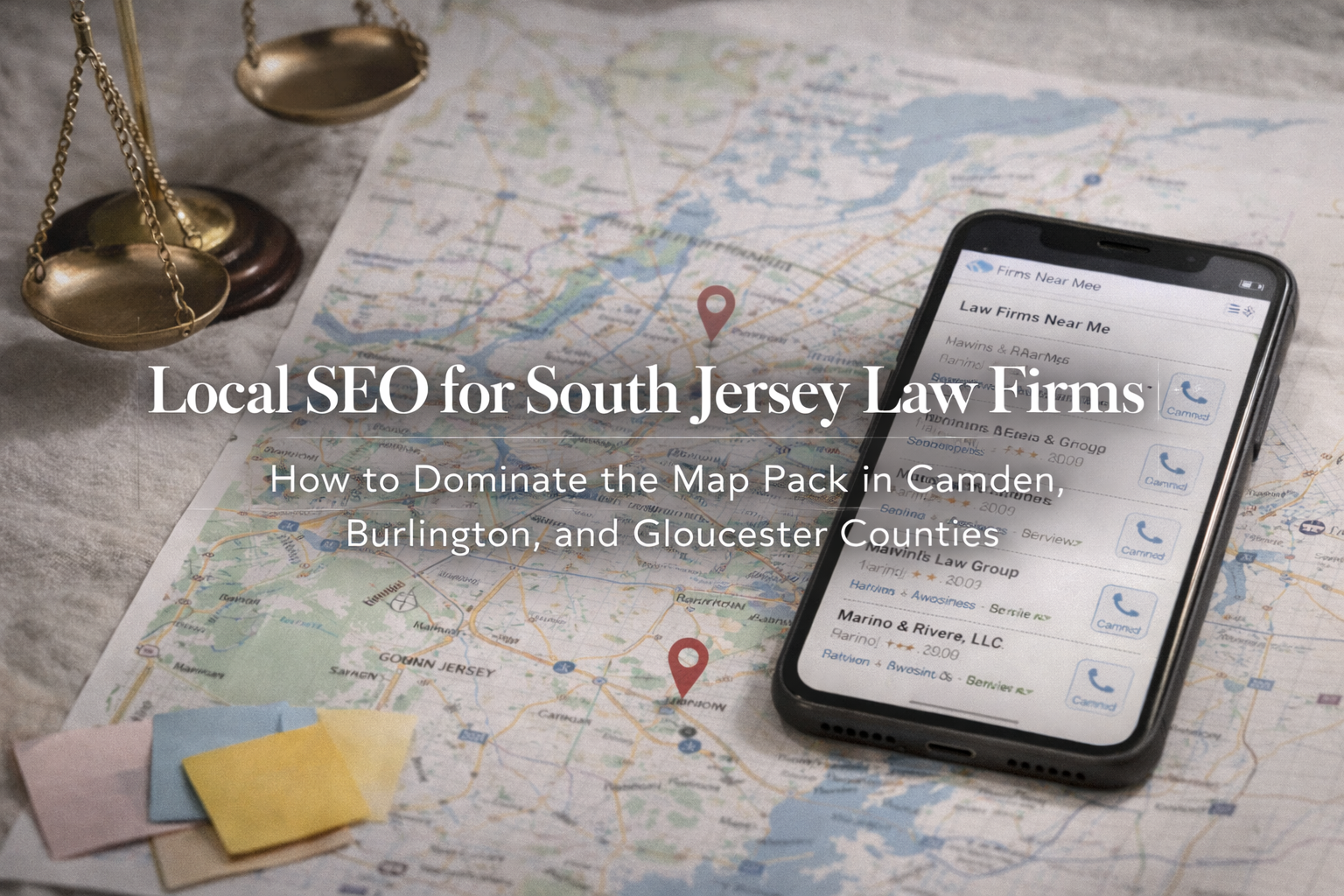
If you’re a law firm in South Jersey, ranking on page one isn’t enough anymore.
You need to be in the Map Pack.
Because when someone searches:
“personal injury lawyer near me”
“divorce attorney Camden NJ”
“DUI lawyer Gloucester County”
They’re not scrolling.
They’re clicking one of the top three local results.
And in counties like Camden County, Burlington County, and Gloucester County, competition is increasing every year.
Here’s how to win the Map Pack — strategically.
Step 1: Optimize Your Google Business Profile Like a Revenue Asset
Your Google Business Profile (GBP) is the foundation of Map Pack rankings.
Most law firms:
Claim it
Add a logo
Stop there
That’s not optimization.
To compete locally, your GBP must include:
Primary category (e.g., “Personal Injury Attorney”)
Secondary categories aligned to practice areas
Keyword-optimized business description
Service areas clearly defined (county + city level)
Regular posts
Updated hours
High-quality office photos
Consistent NAP (Name, Address, Phone)
Google rewards activity and completeness.
Dormant profiles drift. Active ones climb.
Step 2: Build Location-Specific Practice Pages
One “Practice Areas” page isn’t enough.
If you serve multiple counties, you need:
Personal Injury Lawyer in Camden County
Divorce Attorney in Burlington County
Criminal Defense Lawyer in Gloucester County
Each page should include:
County-specific language
References to local courts
Local case experience
Internal links
Schema markup
Google ranks relevance + proximity + authority.
If your content isn’t hyper-local, you’ll struggle to break into the top three.
Step 3: Reviews Are Your Ranking Multiplier
For law firms, reviews do three things:
Improve click-through rate
Increase conversion rate
Influence Map Pack rankings
A firm with 180 reviews and a 4.8 rating will almost always outperform one with 22 reviews and a 5.0.
Create a system:
Automated review requests after case milestones
Clear instructions for clients
Professional, compliant responses to every review
Reputation is local SEO fuel.
Step 4: Earn Local Authority Signals
Beyond your website and GBP, Google evaluates external signals.
In South Jersey, that means:
Local bar association listings
Chamber of Commerce memberships
Local news mentions
Sponsorships
Legal directories
Links and citations from locally relevant sources carry weight.
Generic directory spam doesn’t.
Authority is geographic.
Step 5: Technical & On-Page SEO Still Matter
Local SEO isn’t just your Google Business Profile.
Your website must:
Load fast
Be mobile-optimized
Have structured internal linking
Use clear H1/H2 structure
Include schema for legal services
Maintain consistent NAP across all pages
If your technical foundation is weak, your Map Pack visibility will be unstable.
Step 6: Understand the Competitive Landscape
In counties like Camden and Burlington:
Large multi-location firms compete aggressively
Personal injury keywords are highly competitive
Criminal defense and family law are saturated
That means:
You need niche positioning
You need strong reviews
You need hyper-local signals
You need consistent activity
Local SEO isn’t passive anymore.
It’s operational.
What Actually Moves You Into the Top 3?
Google’s local ranking factors generally revolve around:
Relevance (content + categories)
Distance (physical proximity)
Prominence (reviews + authority + links)
You can’t control distance.
You can control everything else.
The Biggest Mistake South Jersey Law Firms Make
They invest in:
Generic SEO retainers
Broad statewide targeting
Thin practice pages
Inconsistent review generation
And they wonder why they’re outranked by firms 10 minutes away.
Local SEO is not statewide SEO.
It’s neighborhood-level strategy.
The 2026 Reality for Law Firm Marketing
Clients research more.
Competition increases.
Map Pack real estate remains limited to three spots.
If you’re not consistently optimizing:
Your Google Business Profile
Your location-specific content
Your reviews
Your local authority signals
You’re losing visibility — even if your website looks great.
In legal services, visibility equals cases.
Cases equal revenue.
Want to See Where You Rank in South Jersey?
If you’re a law firm in Camden, Burlington, or Gloucester County and want to know exactly what’s holding you back from the Map Pack, we’ll audit your local presence.
👉🏼 Let’s evaluate your local SEO strategy:
https://www.ritnerdigital.com/contact
FAQs
1. How long does it take to rank in the Map Pack?
Local SEO is not instant.
In competitive counties like Camden County, Burlington County, and Gloucester County, most firms see measurable movement within 3–6 months — assuming consistent optimization.
Highly competitive practice areas (e.g., personal injury) may take longer.
Map Pack visibility compounds over time through reviews, authority, and content depth.
2. What factors influence Map Pack rankings the most?
Google’s local algorithm generally weighs:
Relevance (your categories and content)
Distance (proximity to the searcher)
Prominence (reviews, links, authority signals)
You can’t control proximity — but you can optimize the rest.
A well-optimized **Google Business Profile combined with strong local signals is critical.
3. Do I need separate pages for each county?
Yes — if you genuinely serve those areas.
For example:
“Personal Injury Lawyer in Camden County”
“Divorce Attorney in Burlington County”
Each page should include:
Unique, localized content
References to local courts or municipalities
Internal links
Clear calls to action
Generic statewide pages rarely dominate local results.
4. How many reviews does my firm need to compete?
There’s no universal number, but in competitive legal markets:
100+ reviews is common among top performers
Consistent review growth matters more than one-time spikes
Review recency impacts credibility
Quantity + quality + consistency = stronger local visibility.
5. Should law firms respond to every review?
Yes.
Responding:
Signals activity to Google
Builds trust with prospects
Demonstrates professionalism
Responses should remain compliant and avoid discussing confidential case details.
Engagement strengthens prominence.
6. Is local SEO different from traditional SEO?
Very.
Traditional SEO focuses on ranking webpages nationally or statewide.
Local SEO focuses on:
Google Business Profile optimization
Local citations
Geographic content relevance
Proximity-based search intent
For law firms serving specific counties, local SEO often drives higher-intent cases.
7. What’s the biggest mistake South Jersey law firms make with local SEO?
Common issues include:
One generic practice area page
Inconsistent NAP (Name, Address, Phone) across directories
Neglecting review generation
Treating Google Business Profile as “set it and forget it”
Targeting the entire state instead of focusing on local dominance
Local search rewards specificity.
8. Can a small firm outrank a larger firm locally?
Absolutely.
In local SEO, relevance and optimization often beat size.
A smaller firm with:
Better reviews
Stronger local signals
Hyper-local content
Active profile management
Can outrank larger firms that rely solely on brand recognition.
9. Is paid advertising necessary if we rank in the Map Pack?
Not necessarily — but it can amplify visibility.
Many successful firms combine:
Strong local SEO
Strategic paid search campaigns
Ranking organically lowers acquisition costs. Paid ads can expand coverage and protect brand searches.
Want to See How You Stack Up Locally?
If you’re a law firm serving South Jersey and unsure why competitors outrank you in the Map Pack, a local SEO audit can reveal the gaps.
Related Reads
〰️
Related Reads 〰️
Why South Jersey Law Firms Are Losing Cases to Competitors With Better Websites
Even experienced South Jersey law firms are losing cases to competitors with stronger websites. This article explains how design, positioning, mobile experience, and local SEO impact consultations — and why your website may be your biggest growth lever.

From Ritner Street to the Top of SERPs: Why Local Context Matters in Philly SEO
Philadelphia isn’t one market—it’s dozens. From South Philly to Center City, how people search (and choose businesses) changes block by block. That’s why generic SEO strategies fall flat here. In this post, we break down why local context matters, how Google decides who ranks, and what Philly businesses can do to climb the SERPs by leaning into where they actually operate.
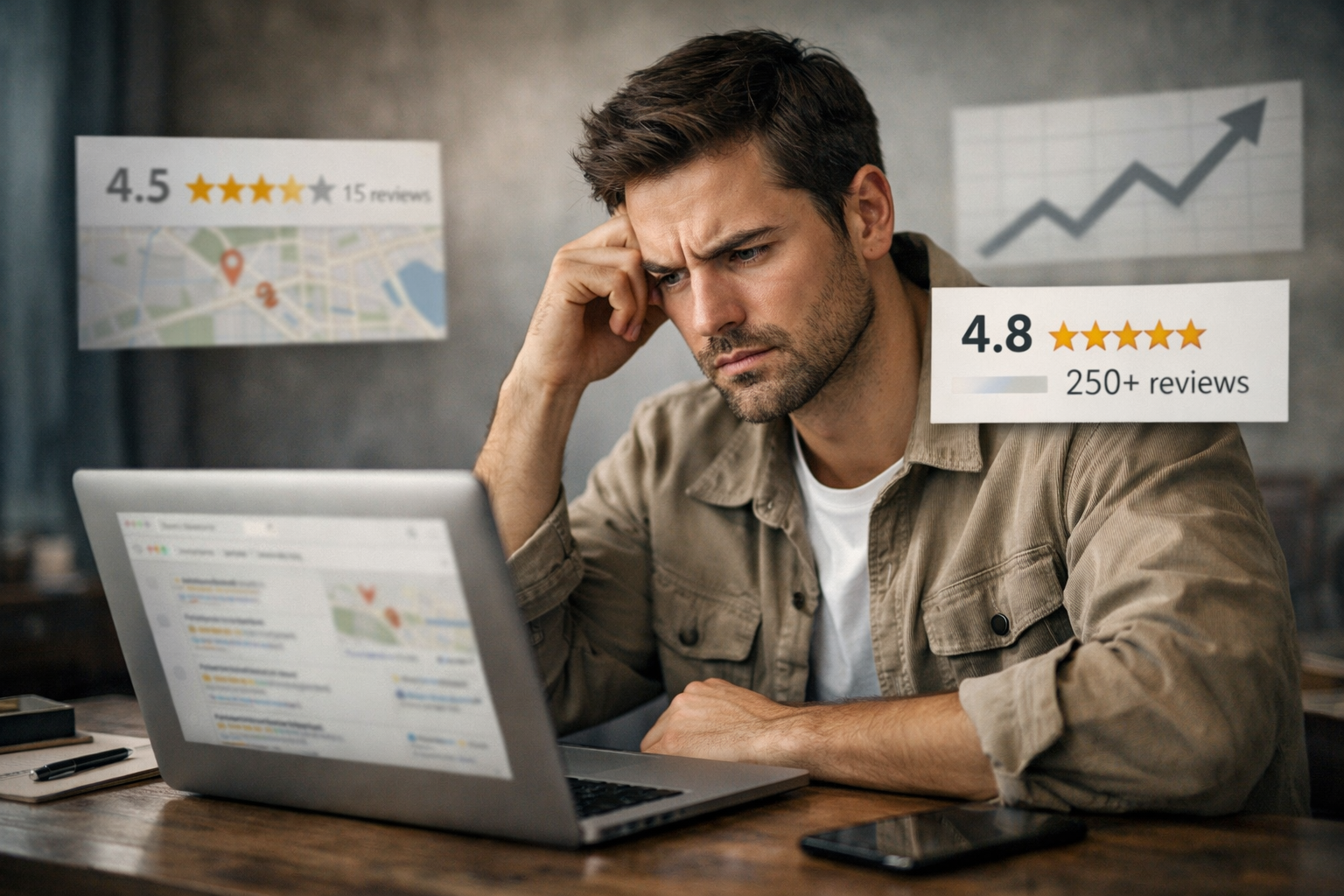
You Have 400 Reviews. They Have 50. They're Still Outranking You.
There's a special kind of frustration that hits when you Google your own company, your trade, and your town — and you're not at the top. You've got hundreds of reviews. The competitor above you has a fraction of that. So what gives? It comes down to how Google actually ranks local businesses, and review count alone isn't enough to win.