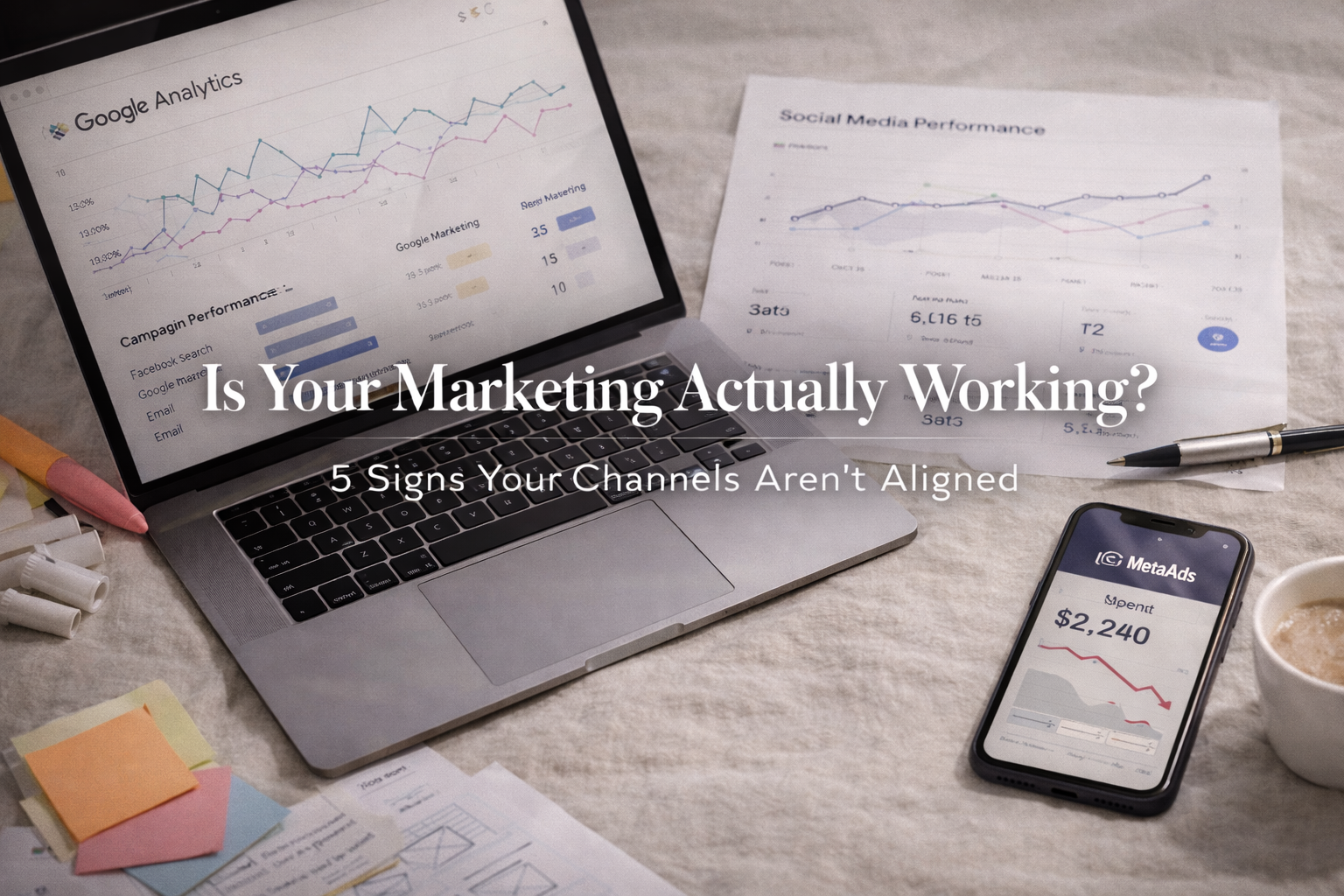
Is Your Marketing Actually Working? 5 Signs Your Channels Aren’t Aligned
Your ads are running.
Your emails are sending.
Your SEO is “doing something.”
Your social team is posting daily.
So… why does growth feel inconsistent?
Here’s the uncomfortable truth:
Most marketing doesn’t fail because of effort.
It fails because of misalignment.
When channels aren’t strategically connected, performance looks busy — not profitable.
Let’s break down five signs your marketing channels aren’t aligned (and what it’s costing you).
1. Each Channel Has a Different Message
Your paid ads say one thing.
Your website says another.
Your email tone shifts again.
This creates friction.
If your Google Ads headline promises “Fast, Affordable Service” but your homepage focuses on “Premium, White-Glove Experience,” you’ve introduced confusion.
Confusion kills conversion.
Aligned marketing means:
One core value proposition
Consistent positioning
Reinforced messaging across channels
Repetition builds trust. Variation builds doubt.
2. You Can’t Trace Revenue Back to a Channel
You know:
Cost per click
Cost per lead
Open rates
Traffic numbers
But can you confidently answer:
Which channel produces the most revenue?
If your CRM and ad platforms aren’t connected — whether that’s HubSpot, Salesforce, or another system — you’re optimizing based on surface metrics.
Leads ≠ revenue.
Traffic ≠ profit.
Without closed-loop reporting, alignment is impossible.
3. Paid Traffic Converts — Organic Doesn’t (Or Vice Versa)
This is a classic signal.
If:
Meta ads convert well
But organic social doesn’t
Or:
SEO traffic is strong
But paid campaigns struggle
You likely have:
Inconsistent messaging
Different audience targeting
Offer misalignment
Funnel disconnects
Strong marketing ecosystems support each other.
If one channel thrives while another underperforms, they aren’t working toward the same objective.
4. Sales Complains About Lead Quality
Marketing says leads are strong.
Sales says they’re weak.
This is rarely a volume problem.
It’s usually:
Targeting mismatch
Messaging misalignment
Qualification confusion
Funnel disconnect
When marketing and sales aren’t aligned on:
Ideal customer profile
Offer positioning
Qualification criteria
You get friction.
Alignment requires shared definitions — not separate dashboards.
5. Campaign Performance Is Inconsistent Month to Month
One month looks great.
The next looks unstable.
Without alignment:
Channels compete instead of complement
Messaging shifts constantly
Targeting changes too frequently
Attribution is unclear
Aligned marketing produces:
Predictable trends
Reinforced messaging
Compounding results
Misaligned marketing produces volatility.
What Aligned Marketing Actually Looks Like
When channels are aligned:
Ads drive traffic to conversion-optimized pages
Email reinforces ad messaging
SEO supports high-intent keywords
Retargeting supports both
CRM connects revenue back to source
Sales feedback informs targeting
It’s not separate tactics.
It’s one system.
The Hidden Cost of Misalignment
Let’s say:
You’re spending $20K/month on marketing
Close rates are slightly underperforming
Messaging varies by channel
Even a 10–15% efficiency loss compounds into tens of thousands of dollars annually.
Misalignment doesn’t look like failure.
It looks like “we’re doing okay.”
But okay is expensive.
The 2026 Marketing Reality
Attention is fragmented.
Buyers are researching across platforms.
Decision cycles are nonlinear.
If your channels aren’t reinforcing each other, you’re forcing prospects to reconnect the dots themselves.
And most won’t.
Aligned marketing reduces friction.
Reduced friction increases conversion.
Increased conversion lowers acquisition cost.
Alignment isn’t branding fluff.
It’s operational efficiency.
Not Sure If Your Channels Are Aligned?
If you’re investing in multiple channels but unsure how they’re working together — or whether they’re working at all — it’s time for a system-level audit.
👉🏼 Let’s assess your marketing alignment:
https://www.ritnerdigital.com/contact
FAQs
1. What does “marketing alignment” actually mean?
Marketing alignment means all of your channels — paid ads, SEO, email, social, and CRM — are working toward the same:
Core message
Target audience
Offer positioning
Conversion goal
It’s not just consistent branding. It’s strategic coordination from first click to closed deal.
When alignment exists, channels reinforce each other instead of competing for attention.
2. How can I tell if my marketing channels are misaligned?
Common warning signs:
Different messaging across platforms
Sales complaining about lead quality
Strong traffic but weak revenue
Paid campaigns converting but organic not (or vice versa)
No clear attribution from lead to closed deal
If performance feels inconsistent or unpredictable, misalignment is often the root cause.
3. Is this a marketing problem or a sales problem?
Usually, it’s both.
Misalignment happens when:
Marketing defines the audience one way
Sales defines it another way
CRM stages don’t reflect real buying behavior
Platforms like HubSpot or Salesforce can track performance — but they don’t fix alignment automatically.
The fix requires shared definitions and shared accountability.
4. How do paid ads and organic channels work together when aligned?
Aligned ecosystems typically look like this:
Google Search captures high-intent demand
Meta supports retargeting and awareness
SEO reinforces intent-based keywords
Email nurtures undecided prospects
CRM connects all activity back to revenue
When aligned, each channel supports the others instead of operating in isolation.
5. Does alignment really impact ROI that much?
Yes.
Even small inefficiencies compound.
For example:
Inconsistent messaging lowers conversion rate
Lower conversion increases cost per acquisition
Higher acquisition costs reduce margin
A 10% efficiency gain across channels can significantly increase revenue without increasing spend.
Alignment improves efficiency before you increase budget.
6. How often should we audit channel alignment?
At minimum, quarterly.
High-performing teams regularly review:
Messaging consistency
Conversion rates by channel
Lead-to-close performance
Revenue attribution
Sales feedback
Alignment isn’t a one-time fix. It’s an ongoing operational discipline.
7. Can small businesses benefit from alignment, or is this for larger companies?
Alignment matters at every level.
In fact, smaller budgets benefit more because:
There’s less room for inefficiency
Every dollar must compound
Fragmentation hurts faster
When resources are limited, alignment becomes leverage.
8. What’s the first step to improving marketing alignment?
Start with clarity:
Define your ideal customer profile
Clarify your primary value proposition
Align messaging across ads, website, and email
Ensure CRM tracks revenue by source
Create a feedback loop between marketing and sales
Alignment starts with shared definitions.
Want to See If Your Marketing Is Actually Working?
If your channels feel busy but revenue feels inconsistent, it may not be a performance issue — it may be a coordination issue.
Let’s evaluate your marketing as a system, not isolated tactics.
Related Reads
〰️
Related Reads 〰️

How to Tie Marketing Spend to Revenue
Marketing teams spend money. Finance wants proof. This guide breaks down how to tie marketing spend to real revenue using clean tracking, attribution models, and data your leadership team will actually trust.
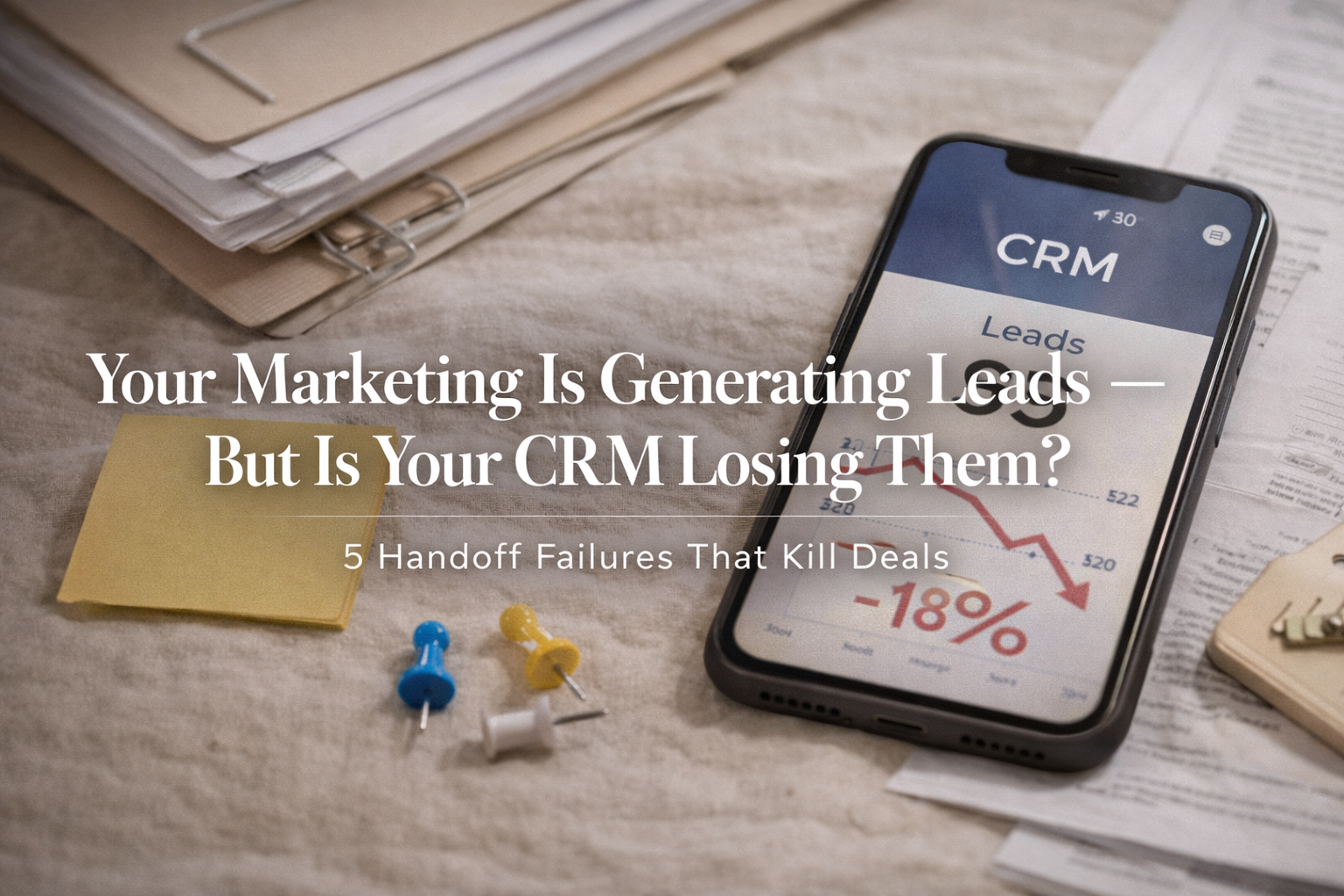
Your Marketing Is Generating Leads — But Is Your CRM Losing Them? 5 Handoff Failures That Kill Deals
If your ads and SEO are generating leads but revenue isn’t growing, the issue may not be marketing — it could be your CRM. This article breaks down five common handoff failures that quietly kill deals and lower close rates.

Agency Behind the Scenes: When the Specialist Leaves and Nobody Knows What You Were Getting
It happens more often than any agency will admit. A digital marketing specialist leaves, a new one steps in, and the account manager responsible for your relationship has no idea what was actually being done on your account. No documentation. No process. No continuity. And while they figure it out internally, your campaigns drift — and your money burns.