Your Semrush Competitor List Is Humbling — Here's What It Actually Means
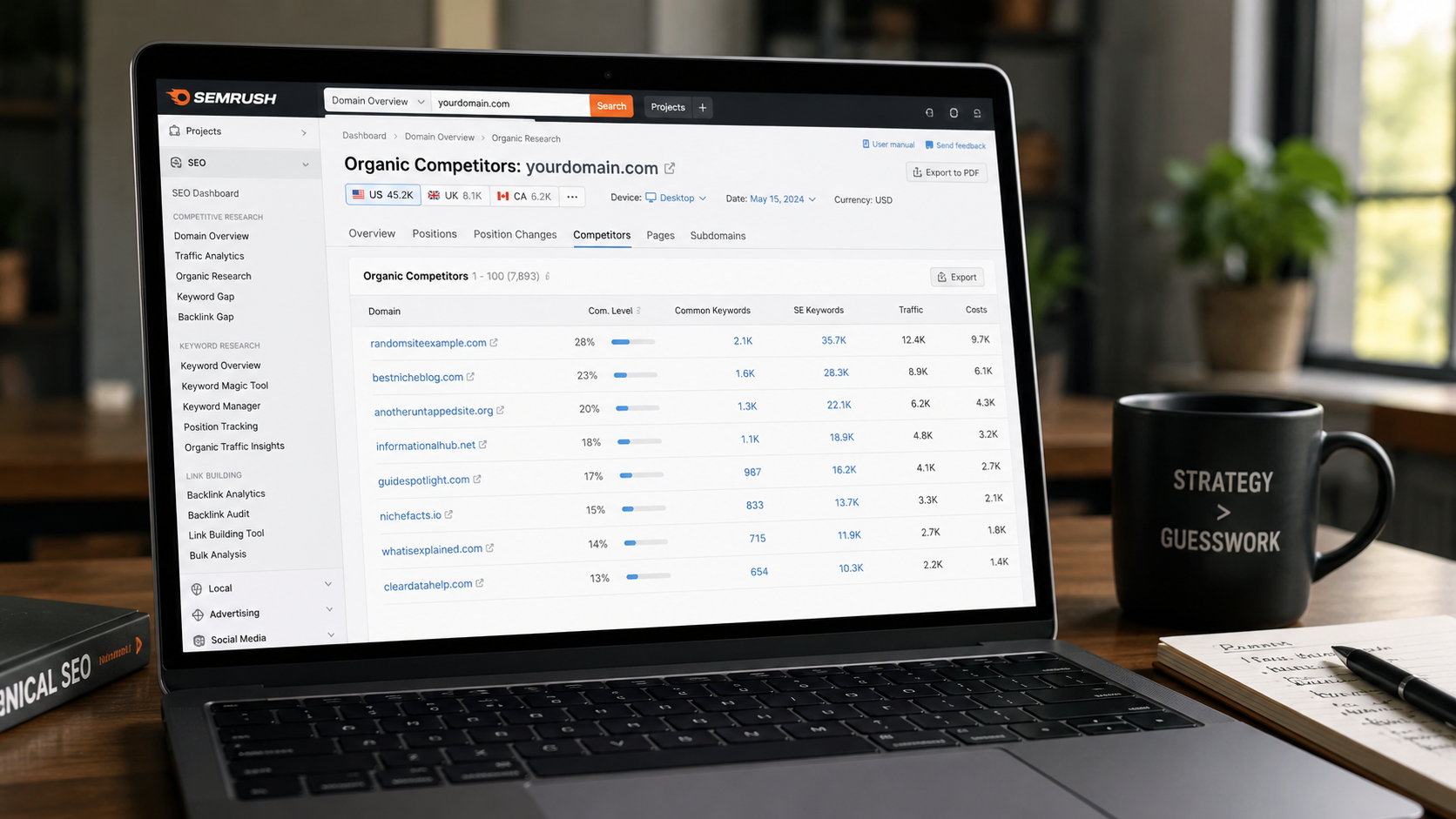
There's a specific kind of quiet that falls over a room when someone opens Semrush, pulls up their organic competitors report, and sees the list for the first time.
Not the competitors they expected. Not the agencies they benchmark against. Not the names they lose sleep over. Just a handful of domains they've never heard of — niche sites and small shops that happen to share a handful of the same keywords.
As of May 22, 2026, Semrush lists Ritner Digital's top organic competitors as bockol.com, gbgraphix.com, federalcontractingwebdesign.com, govconideators.com, and monarkk.com. The highest competition level score on the list is 3. The most SE keywords any of them holds is 108.
We're publishing this because we think there's something genuinely useful in being honest about where you are — and because the diagnosis this data reveals applies to a lot of growing agencies and service businesses who are looking at the same kind of list and not sure what to make of it.
What Semrush Is Actually Measuring Here
First, the methodology — because the report is widely misread.
Semrush identifies organic competitors based on keyword overlap. A domain appears on your competitor list not because it competes with your business in the real world, not because it targets your clients, and not because it poses any threat to your revenue. It appears because it ranks for some of the same keywords you rank for — even if that overlap is one or two terms.
This is why federalcontractingwebdesign.com is on the list. Ritner Digital has published content touching government contracting networking events, DC nonprofit web design, and related topics. That content overlaps with what a hyper-niche site built entirely around federal contracting web design ranks for. Semrush sees the keyword intersection and flags it as competition.
It is not competition in any meaningful business sense. It is content overlap. And understanding that distinction is the entire point of this piece.
What This List Is Actually Telling Us
When your top organic competitors have 81 keywords, 11 keywords, 108 keywords — when the competition level scores are 1s and a single 3 — the data is saying one thing clearly: the organic footprint is still early.
Semrush can only identify competitors based on what you're ranking for. A small keyword portfolio means the pool of domains that overlap with it is going to be small, niche, and often obscure. The report isn't saying bockol.com is a business rival. It's saying bockol.com is one of the few domains that shares enough ranking keywords to register as a data point at all.
Mature agencies with deep content programs don't find small regional design shops on their competitor list. They find HubSpot. They find established industry publications. They find the agencies that have spent years building topical authority across thousands of ranking keywords. Those names don't appear on our list yet — not because we're in a different market, but because the organic footprint hasn't grown large enough to overlap with theirs in measurable volume.
That's the honest read. And it's also the most useful thing the report tells us.
What They're Doing That We're Not Yet
Look at the domains that are showing up and a pattern emerges.
Federalcontractingwebdesign.com and govconideators.com are hyper-niche sites built entirely around one vertical. Every piece of content, every page, every keyword is concentrated around government contracting. They don't have more authority than Ritner Digital in any broad sense — they have more concentration. They've gone deep on one thing and the algorithm rewards that depth with consistent rankings in that niche.
That's the move we haven't fully made yet.
The content published so far has been deliberately broad — SEO pricing, social media management, AI search, web design, local marketing, government contracting, private school enrollment, med spa marketing, drupal development. The impressions are there. The Search Console data shows thousands of queries generating visibility across dozens of verticals. But broad topical coverage without depth in any single area produces exactly the competitor list you see above: overlap with niche sites in each vertical, but not yet enough concentration to rank alongside the serious players in any of them.
The sites on this competitor list aren't better. They're narrower. And in SEO, narrow often beats broad in the short term.
What We're Doing About It
This is the part that matters most — not the diagnosis, but the response.
Picking pillars and going deep. The content strategy is shifting toward fewer topics covered more comprehensively. Instead of one blog post touching government contracting and moving on, the approach is building a full content cluster: the definitive guide, the supporting FAQs, the specific service pages, the location pages, the comparison content — everything interconnected and pointing toward a single topical authority signal. Do that in three or four core areas and the competitor list starts looking very different inside of a year.
Treating the competitor list as a progress tracker. The domains on this list today are a benchmark. In six months the goal is for some of them to have dropped off and been replaced by names with larger keyword portfolios and higher competition level scores. In twelve months the goal is to see the first real agency competitor appear on the list — a company that actually competes for the same clients. That progression is one of the most honest measures of whether a content program is working.
Building content that earns overlap with the right competitors. The competitors we want on this list — established full-service agencies, major marketing publications, the authoritative voices in AI search and content strategy — are ranking for specific things. Detailed guides on SEO pricing. Comprehensive breakdowns of AI Overviews optimization. In-depth comparisons of marketing tools. That's the content we need to be producing at the same depth and consistency they do, not just touching those topics and moving on.
Compounding consistently. There is no version of this that works fast. A domain's organic footprint grows through consistent, high-quality content production over an extended period. The competitor list at month six reflects six months of that work. The list at month eighteen reflects eighteen. The only way to accelerate it is to increase production quality and volume — not to look for shortcuts that don't exist.
Why We're Publishing This
Most agencies don't show you their Semrush data. They show you their wins — the rankings they're proud of, the clients they've grown, the metrics that support the narrative they want to tell.
We're showing you this because the same diagnostic applies to a lot of businesses we talk to. You open the tool expecting to see your real competitors and instead you see a list of sites you've never heard of. That moment feels like failure when it's actually just an accurate reading of where you are in the process.
Knowing where you are is the prerequisite for getting somewhere else. This is where we are. This is what we're doing about it. And if your Semrush competitor list looks like ours does right now — full of small overlapping sites with thin keyword portfolios — you're probably earlier in your content program than you want to be, and the path forward is the same one we're on.
More depth. Fewer topics. Longer time horizon. Consistent execution.
The list changes when the work compounds.
If your organic presence looks like this and you want a clearer picture of what it would take to change it, that's exactly the kind of conversation Ritner Digital is built for.
Frequently Asked Questions
Why does Semrush show me competitors I've never heard of instead of the agencies I actually compete with?
Because Semrush isn't identifying your business competitors — it's identifying your keyword competitors. Any domain that ranks for one or more of the same terms you rank for can appear on that list, regardless of whether they're in your industry, your market, or even your country. When your keyword portfolio is still relatively small, the overlap tends to happen with niche or low-authority sites that happen to publish content in the same areas you've touched. The agencies you actually compete with for clients — the ones pitching against you in the same proposals — will start appearing on that list when your content program has grown large enough to generate meaningful keyword overlap with theirs.
Does a thin organic competitor list mean my SEO isn't working?
Not exactly, but it does mean your organic footprint is still early. The competitor list is a reflection of your current keyword portfolio — how many terms you rank for and how concentrated that ranking is in specific topic areas. If you're ranking for a relatively small number of keywords spread across many different verticals, the competitor overlap tends to be thin and obscure. It means the content program is producing some results but hasn't yet reached the depth in any specific area that generates overlap with established players. It's a stage indicator, not a failure indicator.
What does the competition level score actually mean in Semrush?
The competition level score reflects the intensity of keyword overlap between your domain and another. A score of 1 means minimal overlap — one or two shared keywords where you're both ranking. A score of 3, the highest on our current list, means slightly more overlap but still relatively thin. The higher the score, the more terms you share and the more similarly you're ranking for them. As your keyword portfolio grows and deepens in specific topic areas, you'll start seeing higher competition level scores with more authoritative domains — which is actually a sign of progress, not a problem.
Why are niche sites outranking us on specific topics even though they seem smaller overall?
Because Google rewards topical concentration. A site built entirely around one narrow subject — federal contracting web design, for example — sends extremely strong relevance signals to Google for every term in that niche. Every page, every internal link, every piece of content reinforces the same topical authority. A broader site that covers that topic in one or two posts, even if it has stronger overall domain authority, often loses to the niche specialist on those specific terms. The fix isn't to become a niche site — it's to build content clusters that create that same depth within specific pillars while maintaining the breadth of a full-service operation.
How long does it take for the right competitors to start appearing on the list?
Realistically, twelve to eighteen months of consistent, focused content production before you start seeing meaningfully larger competitors appear. The timeline depends on how aggressively you're publishing, how well the content is structured for topical authority, and how competitive the specific keyword spaces you're targeting are. The progression tends to go: obscure niche sites first, then small-to-mid agencies, then established players in your category. Each stage of that progression is a signal that your keyword portfolio has grown enough to generate overlap with a larger pool of domains. It's one of the more honest progress metrics available in SEO.
Should we be trying to outrank the sites currently on our competitor list?
Some of them, yes — strategically. If a niche site is ranking for terms that represent real buyer intent in a category you serve, beating them on those terms is worth pursuing. But the list itself shouldn't be the strategic target. The goal is to build content depth in the areas where your actual clients are searching, which will naturally produce competitive overlap with the right domains over time. Chasing the sites currently on the list without a broader topical strategy is optimizing for the wrong outcome — you'd win rankings that don't move your business and still not appear alongside the competitors that matter.
Is there a faster way to grow the keyword portfolio and change what the list looks like?
The honest answer is that the fundamentals don't have shortcuts, but you can accelerate the timeline with more focused effort. Publishing more frequently in concentrated topic areas rather than spreading across many subjects moves the needle faster. Building proper content clusters — a pillar page supported by multiple related posts, all internally linked — compounds authority faster than isolated posts. Earning backlinks from authoritative sources in your niche accelerates domain trust. And auditing existing content to improve, consolidate, or redirect underperforming pages prevents your portfolio from being diluted by content that isn't pulling its weight. None of this is fast in absolute terms, but the gap between a disciplined program and an undisciplined one shows up clearly in how quickly the competitor list evolves.
What should we look for to know the content program is actually working?
Watch a few signals in parallel. In Semrush, track whether the total number of ranking keywords is growing month over month and whether the competition level scores on the competitor list are gradually increasing. In Search Console, look for growth in impressions and clicks for the topic areas you're prioritizing, and watch whether the queries generating that traffic are becoming more commercially relevant over time. And qualitatively, notice when you start seeing familiar names in your competitor list — agencies and publications you actually respect. That moment is one of the clearest signs that the content program has crossed a meaningful threshold.
Want a straight read on where your organic presence stands right now and what a realistic path forward looks like? That's the conversation Ritner Digital is set up to have.