
What a Dog Friendly Co. email campaign reveals about attention-grabbing marketing, customer trust, and the increasingly blurry line between promotional and transactional messages.
On November 8, 2026, I received an unexpected notification from Apple Wallet.
It said an order from Dog Friendly Co. was processing.
There was even an order number.
The problem was simple.
I hadn't ordered anything.
Now, under normal circumstances, maybe I would have assumed it was a mistake.
But I have young kids, and I've already experienced what happens when a toddler figures out how to buy something online.
My two-year-old daughter once managed to order a hat through TikTok Shop. I had to cancel the purchase.
So when my phone indicated that another order was processing, I had a legitimate reason to be concerned.
I immediately wondered whether one of my children had somehow placed another order.
I went to my email to investigate.
There was a message from Dog Friendly Co., a company I'd purchased from previously.
Its subject line read:
#170528 Your Dog Friendly Co. Order Is Ready
The Apple Wallet order card showed the same number, #170528, with the status:
Order Processing
At first glance, it looked like a genuine order update.
But when I opened the email, the body began with a surprise.
“Just kidding.”
The message explained that I had to place an order first.
Then it presented a marketing offer: $10.21 in store credit with a promotional code, valid on orders over $79 and expiring at 11:59 PM Pacific Time that day.
There wasn't a new order.
There wasn't a package being processed.
And thankfully, there wasn't another accidental purchase made by my daughter.
It was a promotional email designed to get attention.
That alone would have made an interesting marketing case study.
But after looking at the message again, I noticed something else.
The email came from support@dogfriendlyco.com.
Not marketing@.
Not promotions@.
Not an obviously promotional sender name or address.
It came from an address that a customer could reasonably associate with help, order questions, and customer service.
And when I looked at the company's website, that same address was publicly listed as a support contact.
That made me look at the entire campaign differently.
An order-style subject line.
A numerical order reference.
An established customer relationship.
A sender address associated with support.
And an Apple Wallet order-processing alert.
Each detail might seem relatively ordinary on its own.
But together, they created an experience that looked far more like a transaction notification than an advertisement.
I can't say whether Dog Friendly Co. intentionally tried to trigger Apple Wallet. But the support address makes the order-like presentation of the email even more noticeable.
And that's the central marketing question I want to explore.
When does attention-grabbing creative cross the line from clever marketing into a customer experience that feels misleading?
Because this campaign absolutely got my attention.
I opened the email.
I investigated the supposed order.
I remembered the message.
But instead of using the offer, I reported the order information as spam in Apple Wallet.
That's a very different outcome from the one marketers generally hope to create.
The Email That Started Everything
Before analyzing the strategy, let's establish exactly what happened.
I was an existing Dog Friendly Co. customer.
I'd placed an order with the brand before, which explains why I was on its email list.
This wasn't an unsolicited email from a company I'd never heard of.
That detail matters because I recognized the business.
A legitimate order confirmation from Dog Friendly Co. wouldn't have been unusual in itself.
What was unusual was receiving one when I hadn't purchased anything.
The message was sent on November 8, 2026.
The email displayed a subject line identifying an order and indicating it was ready.
The body immediately revealed the joke and redirected the recipient toward a promotional purchase.
The offer involved $10.21 in store credit, the code EBF10SC, a $79 minimum order, and an expiration deadline that evening.
The email also stated that the offer could be combined with eligible early Black Friday website savings, subject to its terms.
That's a recognizable ecommerce campaign.
The objective appears to have been encouraging another purchase during an early Black Friday promotion.
But the creative approach was unusual.
Instead of leading with the offer, the message initially presented itself as information about an order.
Screenshot 1: The Apple Wallet Order and Promotional Email
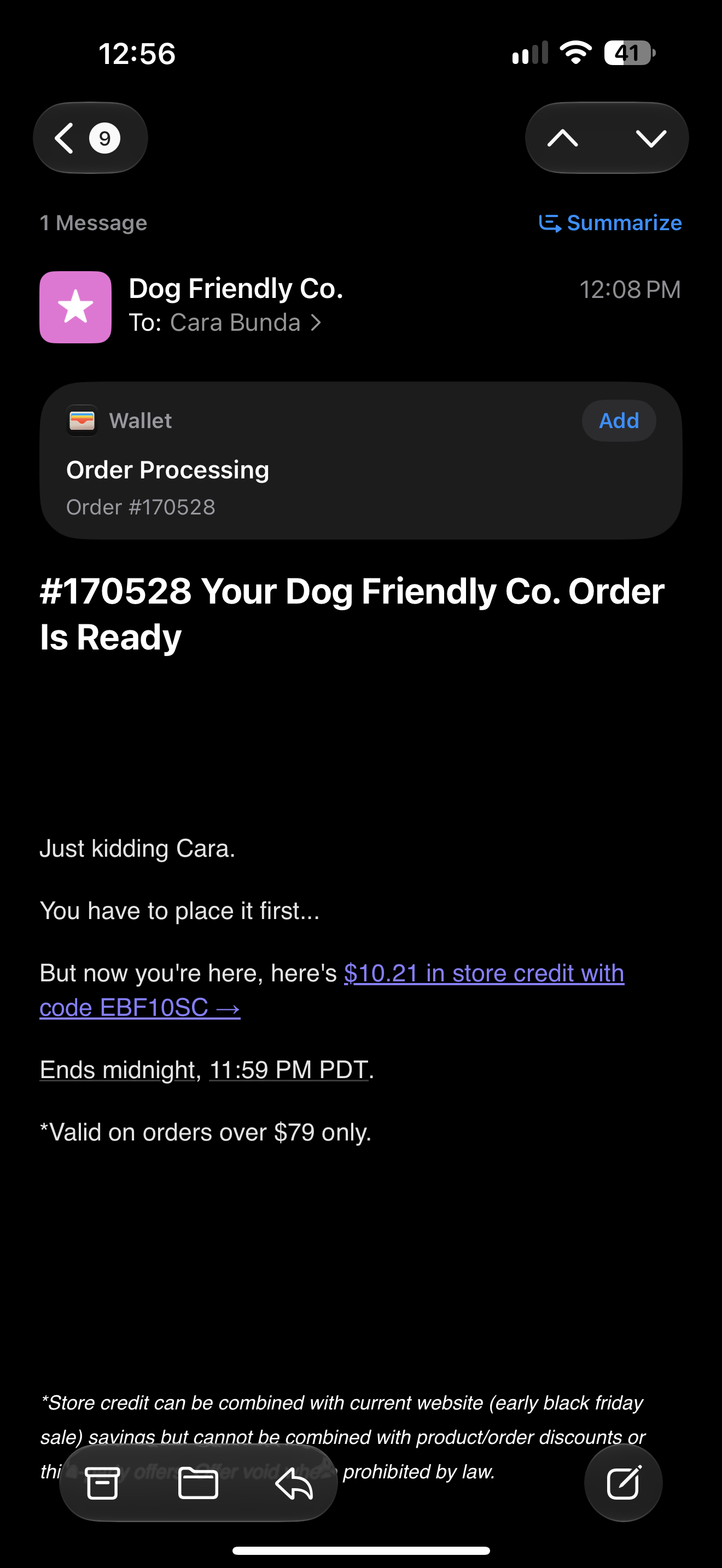
On November 8, 2026, Apple Wallet displayed an order-processing entry for Dog Friendly Co. using the same order number shown in a promotional email. The email revealed that no new order had actually been placed.
For me, the Apple Wallet element made the experience significantly more convincing.
I wasn't simply reading a strange subject line in my inbox.
I had already encountered the supposed order in a separate part of my phone associated with genuine purchases.
That meant I arrived at the email with a question I wanted answered.
What was this order, and who placed it?
The promotional offer wasn't the reason I opened the message.
Finding out whether something had been purchased was.
Then I Noticed the Sender Address
After the initial surprise, I looked more closely at the email details.
The visible sender was:
Dog Friendly Co. — support@dogfriendlyco.com
This is the detail that made me want to revisit the campaign analysis.
Many businesses use different email addresses or sending identities for different types of messages.
Promotional campaigns might come from addresses such as marketing@, offers@, or deals@.
Order confirmations might come from orders@.
Customer assistance may come from support@ or help@.
Those are examples, not universal rules.
There is no general requirement that marketing emails must be sent from an address beginning with marketing@.
Some legitimate companies use one sender address for several kinds of communication.
And a support address can be a perfectly legitimate sender.
But the context here matters.
This particular promotional email looked like an order notification.
It used an order number.
It claimed that an order was ready.
And it came from a sender address associated with customer support.
That combination is what stood out.
Screenshot 2: The Sender Address
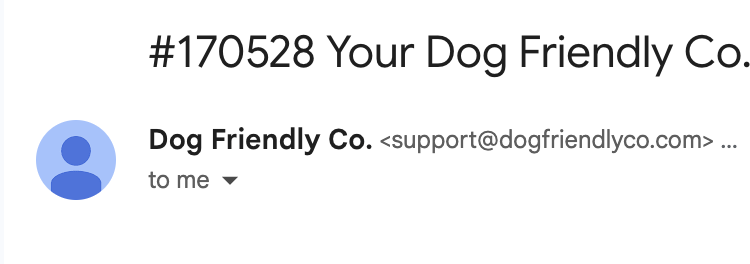
The promotional message displayed support@dogfriendlyco.com as its sender address, adding a customer-service cue to an email already designed to resemble an order notification.
I then checked whether that address was actually connected to the company's customer-support operation.
On Dog Friendly Co.'s official accessibility page, last updated October 15, 2026, the company directs people who need accessibility assistance to support@dogfriendlyco.com.
So this isn't merely an address that happens to contain the word “support.”
It's an address the company publicly identifies as a support contact.
That doesn't prove how its email system is configured.
It doesn't tell us whether the marketing team chose the address specifically for this campaign.
And it doesn't establish what address the company normally uses for promotions.
But it does make the sender's role relevant to the analysis.
A promotional email that pretends to be an order notification carries an additional credibility cue when it appears to come from the company's support address.
That's worth calling out.
Why the Support Address Changes How the Campaign Feels
Imagine receiving two different messages.
The first arrives from:
Its subject says:
“Your Early Black Friday Surprise Is Here.”
Before opening it, you already understand that it's marketing.
The second comes from:
Its subject says:
“#170528 Your Order Is Ready.”
That looks like something else entirely.
The combination suggests the company may be communicating about an existing transaction.
A customer could reasonably expect order details, a status update, or information requiring attention.
This is why the sender address matters psychologically.
Sender Identity Creates Expectations
Before opening an email, recipients often see the sender name, sender address, subject line, and preview text.
Those details help people decide whether the message is relevant, legitimate, and worth opening.
An address associated with customer support carries a different expectation from an address openly associated with promotions.
The address alone doesn't guarantee trust.
But it provides context.
And context changes how the subject line is interpreted.
Order Language Adds Another Layer
The subject line didn't simply say the brand had something to share.
It identified a numbered order and said it was ready.
That sounds factual.
It suggests that a transaction has already taken place.
For someone who recognizes the brand, the statement may seem plausible.
Existing Customer History Reinforces the Impression
Because I'd previously purchased from Dog Friendly Co., a legitimate order-related message wasn't inherently suspicious.
I already had a customer relationship with the business.
That's what made the email harder to dismiss.
If an unfamiliar company had sent the same message, I might have immediately suspected spam.
From a familiar retailer, I felt a stronger need to check.
Apple Wallet Made It Feel More Official
Then there was the order-processing entry.
That moved the experience beyond ordinary email marketing.
The information appeared in a digital wallet feature associated with purchases and order tracking.
Taken together, the elements created a convincing transactional impression.
Whether the company intended every part of that experience is a separate question.
But the resulting customer experience is observable.
What Google's Own Email Guidelines Say About Sender Addresses
This is where the analysis gets especially interesting.
Google publishes email sender guidelines for Gmail.
Among its sending-practice recommendations, Google advises senders to maintain consistent “From” addresses for messages in the same category.
Its examples distinguish between sales receipts, promotional messages, and account notifications.
For an illustrative business, Google uses addresses such as:
sales@example.com for receipts.
deals@example.com for promotions.
alert@example.com for account notifications.
Google also recommends avoiding the mixing of promotional content with receipt-related messages and describes ways to separate different kinds of sending traffic.
These are sender best practices, not a law requiring every retailer to use exactly those prefixes.
So I wouldn't claim that using support@ for marketing automatically violates Google's rules.
That's not what the guidance says.
But it does support the broader idea that different email categories should be recognizable and consistently managed.
And that makes the Dog Friendly Co. example worth examining.
The promotional email didn't merely use the support address.
It also adopted the appearance of an order confirmation.
Google's recommendations provide a practical reason for businesses to think carefully about that combination.
Why Separate Message Types?
Transactional messages are important.
A customer may need an order confirmation, a shipping update, or a password-related notice.
Promotional messages serve a different purpose.
They encourage purchases, announce offers, or build marketing engagement.
Keeping those categories clear helps customers understand what they're receiving.
It can also support more consistent sending practices.
The important distinction isn't simply whether an address says support@ or deals@.
It's whether the overall communication accurately reflects its purpose.
Would marketing@ Have Prevented the Problem?
Not necessarily.
An email from marketing@dogfriendlyco.com with the same fake order subject line could still create confusion.
The subject line itself was a major part of the issue.
But an obviously promotional sender might have provided an additional clue that the message was advertising rather than an actual order.
It could have changed how I interpreted the notification.
That's why I think the address deserves attention even though we can't prove why it was selected.
Was the Support Address an Intentional Part of the Strategy?
This is where it's important to distinguish observation from interpretation.
The screenshot establishes that the email displayed support@dogfriendlyco.com.
The company's website establishes that the same address is publicly used for support.
The subject line establishes that the message was framed as an order update.
The email body establishes that the message was actually promoting a purchase.
Those are observable facts.
What we don't have is Dog Friendly Co.'s internal campaign brief, sending configuration, or creative approval process.
We don't know whether a marketing employee deliberately selected the support address to make the email seem more transactional.
It may have been a default sender address.
It may be used across many kinds of company emails.
It may have been chosen for this campaign.
We simply don't know.
But it's reasonable to analyze the impression the combination creates.
To me, the support address makes the campaign feel less like an ordinary promotional joke and more like a message intentionally designed to resemble a real customer-service transaction.
That's my interpretation as the recipient.
It's not an allegation about the company's internal intent.
And there's an important difference between those two statements.
The campaign's actual design is fair to discuss.
Its effect on a customer is fair to document.
But speculation shouldn't be presented as proof.
The Apple Wallet Connection Makes This More Than a Typical Clickbait Email
If the message had simply appeared in my inbox, this would still be a case study about a potentially misleading subject line.
But the Apple Wallet experience adds an entirely different dimension.
Apple has expanded its order-tracking functionality.
In its 2025 developer presentation about Apple Pay updates, Apple explained that iOS 26 introduced automatic order tracking using Apple Intelligence.
The feature can recognize order-related emails in supported Mail experiences and present relevant order information in Apple Wallet.
Apple's Order Tracking FAQ, published in April 2026, explains that the system can extract details such as an organization name, order status, and order or tracking number.
The technology looks for common patterns associated with order and shipping emails.
That is particularly relevant here.
The promotional message included a company name and a numerical order reference, and its subject line suggested an existing order.
These are the kinds of details that can resemble legitimate transaction information.
Could the Email Have Been Interpreted as a Real Order?
It's plausible.
Apple's documentation confirms that its technology can recognize order-like information from emails.
The timing and matching order number in my screenshot make that explanation relevant.
However, Apple Wallet also supports other order-tracking pathways, including merchant integrations.
The screenshot does not establish which specific mechanism created the entry.
So the most accurate statement is that an order-style promotional email was associated with an Apple Wallet order-processing entry, and Apple's documented email-processing capabilities provide a plausible explanation.
Did the Company Know This Could Happen?
We can't determine that.
The fact that an email looked transactional doesn't prove its sender intended to manipulate Apple's order-tracking technology.
A creative team might have been thinking only about the inbox.
It may not have considered how other systems could interpret the message.
Alternatively, someone may have been aware of the technical behavior.
We don't have evidence either way.
Why Marketers Should Pay Attention Anyway
Even if the Wallet behavior was an unintended consequence, it demonstrates a broader risk.
Marketing emails don't exist only inside the inbox.
Their content may be processed by other applications.
A subject line resembling an order confirmation can potentially create confusion beyond the original marketing message.
The joke may not stay confined to the email where the punchline appears.
Software can encounter the setup without understanding the reveal the way a human reader eventually does.
That makes transaction-themed creative worth examining more carefully.
The Campaign Was Designed Around Attention, Not Immediate Clarity
At the center of this strategy is a familiar marketing idea.
Get someone to notice something unexpected.
Create curiosity.
Encourage them to open the message.
Then reveal the actual offer.
This approach can work well when the surprise is harmless and the recipient enjoys it.
But the psychological effect depends on the kind of uncertainty being created.
Curiosity Is Different From Concern
A subject line such as “We Have a Surprise for Your Dog” creates curiosity.
A subject line claiming an order is ready creates a different question.
What order?
That question can lead to concern about money, account activity, or accidental purchases.
For me, the possibility was especially believable because of my previous experience with my toddler.
The message wasn't simply intriguing.
It created a problem I thought I might need to solve.
The Brand Got the Open
From the perspective of a basic engagement metric, that looks promising.
The subject line caught my attention.
I opened the message.
But the reason matters.
I wasn't interested in shopping.
I was checking whether something had been purchased.
A marketing dashboard generally cannot tell those motivations apart.
The Reveal Changed the Emotion
Once I saw that there was no order, the immediate concern disappeared.
But that didn't mean I felt delighted.
Instead, I felt I'd been drawn into a promotion using a false transaction premise.
For another recipient, the joke might have landed differently.
That's part of the risk.
The Promotional Offer Came After the Trust Test
The message then offered a conditional store-credit incentive.
By that point, I had already interpreted the experience as misleading.
A promotion that might otherwise have been relevant now had to compete with the negative feeling created by the setup.
That's not necessarily the sequence a business wants.
How Different Customers Might React
A marketer may see a campaign like this and think it's funny.
And some recipients may agree.
But the customer experience isn't determined by the marketer's intended tone.
It's determined by how the message is received.
The Customer Who Laughs
One person might immediately recognize the joke.
They could appreciate the unexpected approach and use the promotional code.
For that person, the email may create a positive surprise.
The Customer Who Checks Their Bank Account
Another person might worry that a purchase occurred without their knowledge.
They may search through payment history or account activity before reading the message closely.
That customer has been given an unnecessary task.
The Parent of Young Children
Someone with children who occasionally use shared devices may reasonably wonder whether an accidental purchase occurred.
That's exactly why the message got my attention.
The email intersected with a real-life concern.
The Customer Who Has Experienced Fraud
A person who has dealt with unauthorized charges may take order-related notifications seriously.
The joke could create anxiety before the promotional intent becomes clear.
The Customer Who Ignores the Offer
Someone might open, see the reveal, and immediately close the message.
They may remember the brand without becoming more interested in buying.
The Customer Who Reports It
That was my response to the Wallet entry.
I reported the order information as spam in Apple Wallet.
This doesn't mean I can speak for everyone who received the campaign.
But it is a real customer reaction worth examining.
The same creative choice can generate very different outcomes depending on the recipient.
That makes attention-grabbing campaigns difficult to evaluate using one engagement metric.
The Difference Between a Marketing Email and a Transactional Email
Businesses send different kinds of emails for different reasons.
A genuine order confirmation provides information about a transaction that has already occurred.
A shipping update tells someone about an existing purchase.
A password reset helps a customer manage an account.
These messages serve operational purposes.
Marketing messages promote products, services, offers, or future purchases.
That distinction matters for both customer expectations and compliance.
What the FTC Says
The Federal Trade Commission's CAN-SPAM compliance guide explains that a message's primary purpose determines whether it's commercial or transactional.
The FTC also states that commercial email subject lines must accurately reflect the message's content and must not be deceptive.
A legitimate order confirmation can qualify as a transactional message.
An email encouraging the recipient to place a new order through a promotional code generally serves a commercial purpose.
Importantly, having an existing customer relationship doesn't automatically make a new promotional message transactional.
Why This Campaign Raises a Compliance Question
The email's subject line suggested an order existed.
The email body said the recipient needed to place an order first.
The actual purpose was promotional.
That raises a reasonable question about whether the subject accurately represented the content.
The sender address adds to the impression, but the subject line is especially relevant.
Does This Prove a Legal Violation?
No.
A definitive legal conclusion would require reviewing the complete email and relevant circumstances under applicable law.
This article isn't alleging that Dog Friendly Co. definitively violated CAN-SPAM.
It's identifying why transaction-style marketing messages deserve scrutiny under the FTC's published standards.
A campaign can raise a meaningful ethical or customer-experience concern without a writer making a formal legal accusation.
Why Using support@ for Marketing Deserves a Second Look
The support address isn't automatically wrong.
But it creates an opportunity to discuss an important email marketing practice.
Transactional Emails Need to Be Dependable
Customers should be able to recognize and trust messages about real orders, payments, shipping, and customer-support issues.
Those communications may require attention.
If a support-associated address regularly sends promotional messages that resemble transactions, customers may have difficulty distinguishing between genuine updates and advertising.
Marketing Messages Should Be Recognizable
A promotional email doesn't need a boring subject line.
It can be funny, surprising, personal, and creative.
But the overall presentation should not depend on an untrue transaction claim.
Google's sender guidelines offer practical examples of separating message types.
That doesn't establish that every company must use marketing@.
It does reinforce that message categorization and consistency deserve consideration.
Sender Reputation Is Also Relevant
Email providers use various signals to evaluate senders.
Google recommends authentication, appropriate sending practices, and maintaining low spam complaint rates.
If promotional content causes recipients to distrust an address used for important customer communications, that may create a business risk.
The exact consequences depend on sending infrastructure and recipient behavior.
We can't infer Dog Friendly Co.'s sender reputation from the screenshot.
But separating message purposes can make email operations easier to manage.
A High Open Rate Doesn't Mean Customers Appreciated the Campaign
This is one of the biggest lessons.
Marketers often evaluate email performance using metrics such as opens and clicks.
Those metrics can be useful.
But they don't explain why someone opened.
And they don't always tell you whether the experience improved the customer relationship.
Imagine a hypothetical campaign that generates unusually high engagement because its subject line looks like an unexpected charge.
Recipients open to investigate.
Some click through.
A few purchase.
Others unsubscribe or complain.
What does the campaign's open rate tell you?
Only part of the story.
The Motivation Behind an Open Matters
I opened because I was concerned about a possible accidental order.
Someone else might open because they're curious.
Another person might be excited about the discount.
All three actions could appear as an email open.
But they represent different customer experiences.
Purchase Data Matters More
If the business objective is repeat purchases, measure completed orders and actual revenue.
Even then, consider whether the campaign generated incremental purchases or simply captured sales that might have happened anyway.
Complaints Matter
Unsubscribes, spam reports, support inquiries, and customer feedback are relevant.
They can reveal costs that revenue reporting doesn't capture.
Trust Matters Over Time
A customer may stop engaging with a brand after an irritating experience.
That reaction may not be immediately visible in a single campaign report.
A short-term engagement spike can coexist with a longer-term relationship problem.
Did My Apple Wallet Spam Report Hurt Dog Friendly Co.'s Email Deliverability?
This question needs a careful answer.
I reported the order information as spam in Apple Wallet.
I did not provide evidence that I submitted the same complaint through Gmail.
Those are not necessarily equivalent actions.
Google's email sender guidance discusses spam complaints and sender reputation within its own email ecosystem.
Apple Wallet order reporting may operate differently.
We cannot assume that my Wallet action directly affected a Gmail spam-rate calculation or the company's email deliverability.
But the underlying customer response remains important.
A marketing campaign caused me to identify the resulting order information as something I didn't want associated with my legitimate purchase tracking.
That is a poor outcome from my perspective, regardless of whether it affected the sender's technical reputation.
The distinction between technical consequences and customer trust is important.
Not every negative experience produces a measurable deliverability event.
But it can still change how someone feels about the brand.
Could the Campaign Have Worked Without Pretending an Order Existed?
I think so.
The retailer already had several creative ingredients.
A recognizable brand.
An existing customer relationship.
An early Black Friday promotion.
An unusual $10.21 incentive.
A same-day deadline.
There were plenty of opportunities to write something attention-grabbing.
The email didn't need to claim that a purchase had already occurred.
Alternative Subject Line 1: Use the Strange Amount
Why $10.21? Here's Your Early Black Friday Surprise
The unusual number creates curiosity.
The customer understands that the message is promotional.
Alternative Subject Line 2: Make It About the Dog
Your Dog Has Excellent Taste. Here's $10.21 Toward It.
This uses personality and a playful brand voice.
It doesn't imply that a transaction happened.
Alternative Subject Line 3: Reward the Customer Relationship
A Little Thank-You for Shopping With Dog Friendly Co.
This acknowledges the existing relationship without borrowing the format of a real order update.
Alternative Subject Line 4: Lead With the Offer
$10.21 Toward Your Next $79+ Order—Today Only
This is straightforward.
It may not be as surprising, but it helps the recipient make an informed decision.
Alternative Subject Line 5: Create Honest Curiosity
We Have a Small Surprise for Your Next Dog-Friendly Adventure
This leaves room for the reveal without making a false claim about a completed purchase.
The point isn't that every promotional email must be completely literal.
It's that creativity should not depend on making customers worry about an order they didn't place.
If I Were Auditing This Campaign, Here's What I'd Look At
A proper email marketing analysis should go beyond the initial creative concept.
If I had access to the campaign's performance data, I would want to understand several things.
1. The Actual Email Goal
Was the campaign designed to generate immediate purchases?
Reactivate previous customers?
Promote early Black Friday shopping?
Increase site traffic?
Those goals require different success measures.
2. The Audience
Were recipients existing customers?
Recent purchasers?
People who hadn't ordered in months?
All subscribers?
The audience's relationship with the retailer could influence how the message was interpreted.
3. The Sender Configuration
Was support@dogfriendlyco.com the brand's normal promotional sender?
Was it used only for this campaign?
Was it the default address in its email platform?
Did the company have separate sending identities for transactional and promotional messages?
Those questions would help determine whether the sender choice was unusual operationally, not just visually.
4. The Subject-Line Testing
Did the team compare the fake-order subject line against a straightforward promotional version?
If so, what metrics did it evaluate?
A/B testing should consider more than immediate opens.
5. Customer Support Inquiries
Did recipients contact support asking whether an order had been placed?
Did anyone report seeing an unexpected Apple Wallet entry?
Those responses could reveal confusion that ordinary campaign analytics missed.
6. Completed Purchases
How many recipients used the promotion?
How much incremental revenue did the campaign generate?
Were the purchases profitable after the incentive and relevant costs?
7. Unsubscribes and Complaints
Did the message produce more negative feedback than comparable promotions?
How did the audience react after the reveal?
8. Long-Term Customer Behavior
Did customers continue engaging with future emails?
Did the campaign affect repeat purchasing?
A high-performing promotion should ideally support the relationship, not just one transaction.
9. Technical Testing
Did the team test the message in Apple Mail and other applications that might interpret transaction information?
Was any unexpected order-tracking behavior identified before launch?
These are questions I'd investigate, not claims about what the company did or didn't do.
A Better Campaign Would Keep the Humor and Remove the False Order
Here's how I would approach the same promotion.
The brand could still use a playful tone.
It could still make the offer feel unexpected.
It could still create urgency around the deadline.
But the message should remain recognizable as marketing.
Example Rewrite
Subject: Your Early Black Friday Surprise Is Here
Preheader: A little extra toward your next Dog Friendly Co. order.
“Your dog's wishlist might be getting a little longer.
So we thought we'd make your next shopping trip a bit more fun.
Here's $10.21 toward your next qualifying purchase with code EBF10SC.
Use it on orders over $79 before 11:59 PM PDT tonight.
The offer can be combined with eligible early Black Friday website savings, subject to the promotion's terms.
Shop the Early Black Friday Sale
Thanks for being part of the Dog Friendly Co. community.”
This illustrative rewrite would still require accurate full terms and appropriate commercial-email disclosures.
But the basic customer experience would be different.
I would immediately understand that I was receiving an offer.
There would be no imaginary order to investigate.
No fake transaction to explain.
And no reason for a software system or a customer to mistake the message for an actual purchase confirmation.
The Bigger Problem: Marketing Messages Can Now Be Interpreted by Software
One reason I find this case especially interesting is the broader technological shift it illustrates.
Marketers traditionally think about email as a message between a business and a customer.
But that relationship now involves additional systems.
Software may summarize an email.
It may classify messages into categories.
It may identify dates, shipping details, receipts, or order numbers.
It may surface information in a digital wallet.
Those systems don't necessarily interpret jokes the way humans do.
An email can claim an order exists in the subject line and reveal the joke in the body.
A human who opens the whole message can eventually understand the promotion.
But an order-tracking feature may focus on the information that resembles a purchase record.
Apple's documented order-tracking capabilities illustrate why marketers should consider this possibility.
The Context Can Change Before the Customer Opens the Email
The recipient may see a notification rather than the original campaign.
That notification can change the perceived meaning of the message.
In my case, I wasn't just scanning promotional emails.
I was investigating an order-processing alert.
A Subject Line Can Create Consequences Beyond the Open
The campaign may be memorable for reasons the marketing team didn't anticipate.
A customer might contact support.
They might search transaction history.
They might report the order information.
Even when no actual purchase has occurred, the appearance of one can create unnecessary concern.
Email Testing Needs to Evolve
Brands should consider how their messages appear across the devices and applications customers use.
A clever desktop email preview isn't enough.
If a campaign borrows language associated with payments, security, account changes, or order status, it deserves additional scrutiny.
This isn't a reason to stop being creative.
It's a reason to be more deliberate about the information being presented as fact.
What This Case Means for Brand Trust
Customer trust is often discussed in broad terms.
Businesses want to be authentic.
They want to build loyalty.
They want customers to feel connected to the brand.
But trust is also influenced by small, practical interactions.
An order confirmation should correspond to an order.
A shipping notification should concern a shipment.
A payment alert should reflect a real payment event.
A promotional email should not require a customer to investigate a nonexistent transaction just to discover the offer.
These expectations may sound basic.
But they're important because customers use this information to manage real life.
Existing Customers Are Not Automatically More Forgiving
Because I'd purchased from Dog Friendly Co. before, I recognized the sender.
That helped the message get my attention.
But familiarity also made the false order framing more convincing.
A brand's existing relationship with customers is an advantage.
It's also something worth protecting.
Attention Is Easy to Misinterpret
The fact that I'm writing about this campaign doesn't mean I consider the experience successful.
Memorability and positive perception are different outcomes.
A marketing stunt can be memorable because it was entertaining.
It can also be memorable because it was confusing or frustrating.
The Goal Should Be Trustworthy Attention
Businesses should aim for messages customers want to engage with.
That can mean relevance, humor, useful information, a compelling offer, or strong creative storytelling.
It doesn't require pretending that a financial transaction occurred.
The best email marketing earns attention without making customers question whether they can trust the information they're receiving.
What Other Businesses Can Learn From This Email
This isn't only relevant to ecommerce retailers.
It applies to any business that uses both promotional and operational email.
A salon sends appointment confirmations and marketing offers.
A restaurant sends reservation information and promotional newsletters.
A service provider sends invoices, scheduling updates, and sales messages.
A subscription company sends account notices and product announcements.
These businesses depend on customers understanding which messages require action.
The Dog Friendly Co. example offers several lessons.
Keep Message Purpose Clear
A promotion should be recognizable as a promotion.
A transaction notification should correspond to a real transaction.
Don't Assume the Sender Address Is Neutral
People interpret addresses like support@, billing@, and orders@ in context.
The sender identity contributes to the message's overall impression.
Consider the Entire Customer Journey
A campaign doesn't stop being part of the customer experience once someone opens it.
What happens next matters.
Evaluate Negative Reactions
Complaints, confusion, and support requests are meaningful feedback.
A campaign's performance cannot be fully understood through clicks alone.
Remember That Existing Customers Have Expectations
A previous purchase can make a message more credible.
Use that trust responsibly.
Test How Software Interprets the Message
Modern email experiences may involve order extraction and connected applications.
Transaction-style creative deserves extra technical testing.
Make Creativity Work With Accuracy
Playful marketing can be effective.
It just shouldn't depend on making a false factual claim about a purchase.
Frequently Asked Questions
1. Why did Dog Friendly Co. send a promotional email that looked like an order confirmation?
The visible campaign used an order-style subject line and fake order number before revealing a promotional offer. That strongly suggests the order framing was a creative device to attract attention. However, the company's internal strategy and approval process aren't available, so we cannot establish every intention behind the message.
2. Why does the support@dogfriendlyco.com address matter?
A support address is commonly associated with customer questions and transaction-related assistance. In this case, it appeared alongside an order-style subject line and fake order number. That combination made the message look more like a genuine customer-service communication. Dog Friendly Co. also publicly identifies the address as a support contact on its website.
3. Does using support@ for marketing prove that the campaign was intentionally misleading?
No. Businesses can use support addresses for legitimate promotional communications, and there is no universal requirement to send marketing from marketing@. The address alone doesn't establish intent. Its significance here is how it contributed to the overall impression created by the email.
4. Does Google recommend different email addresses for marketing and transactional messages?
Google's Gmail sender guidelines recommend consistent “From” addresses for messages of the same category and provide separate examples for receipts, promotions, and account notifications. These are best-practice recommendations, not a universal rule requiring specific address names.
5. Why did Apple Wallet show an order-processing entry?
Apple Wallet supports order tracking, including information extracted from supported emails through Apple Intelligence. The fake order-style subject line and order number provide a plausible explanation for how the message could have been interpreted as order-related. The screenshot does not prove the exact technical mechanism responsible for the entry.
6. Did Dog Friendly Co. intentionally trigger Apple Wallet?
There is no evidence confirming that intention. The company may have designed the email to resemble an order without anticipating Wallet's behavior. We can analyze the resulting experience, but we shouldn't assert that it deliberately manipulated Apple's systems.
7. Was the email a scam?
The supplied evidence shows a promotional email associated with a retailer the recipient had purchased from before. The body revealed that no new order had been placed and presented an offer. This article concerns misleading marketing presentation, not evidence of phishing or an actual unauthorized purchase.
8. Is a fake order confirmation subject line legal?
The FTC requires commercial email subject lines to accurately reflect their content and prohibits deceptive subject lines. Whether a particular campaign violates the law requires a full legal assessment. An order claim that turns out to be a promotion raises a legitimate compliance question.
9. Why might a fake order subject line increase email opens?
An unexpected order can create urgency, curiosity, or concern. Recipients may open the message to verify whether a transaction occurred. However, a higher open rate doesn't establish positive engagement or customer satisfaction.
10. Can a campaign generate sales and still damage trust?
Yes. A promotion could produce purchases while also frustrating some recipients. Revenue is important, but it doesn't capture every dimension of the customer experience. Complaints, unsubscribes, support inquiries, and future engagement may provide additional context.
11. Does reporting an Apple Wallet order as spam count as an email spam complaint?
Not necessarily. Apple Wallet and email providers may use different reporting systems. We cannot assume that reporting an order in Wallet automatically affects a sender's Gmail spam rate. The confirmed experience is that the recipient reported the unwanted order information in Wallet.
12. How could the retailer have made the email more transparent?
It could have used a promotional sender identity, an accurately descriptive subject line, and playful copy centered on the $10.21 offer rather than a nonexistent purchase. The campaign could still have been surprising without implying that an order had already been placed.
13. Should businesses stop using humor in email marketing?
No. Humor can be valuable when it fits the brand and audience. The issue isn't humor itself. It's whether the joke creates a materially misleading impression about something customers may need to take seriously.
14. How should marketers test unusual email subject lines?
Test the message with people unfamiliar with the creative concept. Review sender identity, subject line, preview text, and body content together. Consider how customers might interpret the message before opening it. For transaction-themed creative, also evaluate whether connected applications could misunderstand the content.
15. What metrics matter most for campaigns like this?
Completed purchases, incremental revenue, conversion rates, customer complaints, unsubscribes, support inquiries, and longer-term customer behavior are all useful. Opens and clicks provide engagement information but don't explain why someone interacted.
16. What is the biggest lesson from this case?
Attention and trust are different outcomes. An email can be successful at getting someone to open it while creating a negative customer experience. Strong marketing should make a relevant offer compelling without relying on an untrue transaction claim.
The Detail That Changed My View Wasn't Just the Fake Order. It Was Who Appeared to Send It.
When I first encountered the Dog Friendly Co. campaign, the most surprising element was Apple Wallet.
I hadn't placed an order.
Yet my phone showed an order-processing entry.
I checked my email because I wanted to find out what had happened.
Then I discovered the promotional joke.
That was already enough to make me question the strategy.
But after noticing that the email came from support@dogfriendlyco.com, the campaign seemed even more unusual.
A customer-support address.
An order number.
A subject line saying the order was ready.
A Wallet entry showing order processing.
And an email body revealing that the whole thing was a promotion.
I don't know whether the support address was selected specifically to make the message look transactional.
I don't know whether the company anticipated the Apple Wallet result.
And I don't know how the campaign performed with other recipients.
But I do know how the experience affected me.
It made me investigate an order that didn't exist.
It didn't make me want to purchase something.
And I reported the resulting order information as spam in Apple Wallet.
As a marketer, I can appreciate the effort to create a surprising subject line.
As a customer, I didn't appreciate being made to think an order had been placed.
Those two reactions can coexist.
And that's what makes this a useful case study.
A campaign can be clever in its construction and still create the wrong experience for the person receiving it.
For businesses, the lesson isn't to abandon creativity.
It's to think more carefully about the expectations created by your sender address, subject line, and message format.
Especially when those details resemble real transactions.
Because a brand's customer-support identity is built around helping people resolve genuine questions.
An order notification is supposed to tell someone about a real purchase.
And a promotional email shouldn't need to borrow the credibility of those communications to get attention.
The strongest marketing doesn't just make customers look.
It gives them a reason to keep trusting the business after they do.
Want Email Marketing That Gets Attention Without Sacrificing Trust?
At Ritner Digital, we believe effective marketing should be more than an impressive open rate or a clever subject line.
It should connect the right message with the right audience while protecting the relationship between a business and its customers.
That means understanding customer psychology, developing creative strategies, writing accurate and compelling campaigns, and measuring the results that matter beyond initial engagement.
Whether you're building an ecommerce email strategy, improving retention, refining your brand voice, or evaluating how customers respond to your campaigns, the goal should be meaningful engagement that supports long-term business growth.
You don't have to choose between creative marketing and trustworthy communication.
The strongest strategies make both possible.
Contact Ritner Digital to discuss an email marketing and digital strategy designed to capture attention, communicate clearly, and build stronger customer relationships.