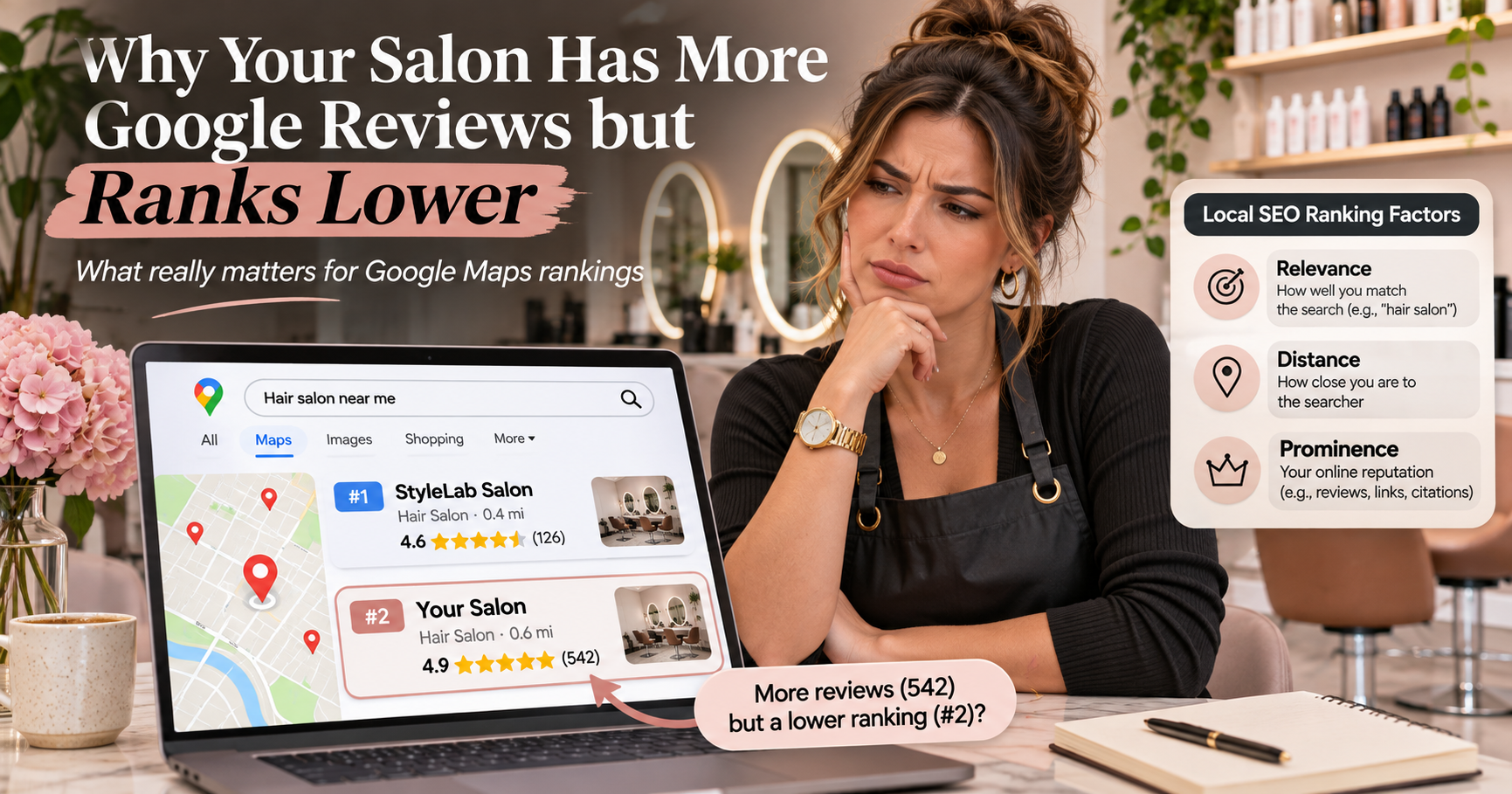
Your hair salon has worked hard to build a reputation.
You've spent years providing excellent services, developing relationships with clients, and creating an experience people genuinely appreciate.
You've encouraged satisfied customers to share their feedback on Google.
And the results are impressive.
Your salon has 200 Google reviews, a strong star rating, and plenty of happy customers who recommend your stylists.
But there's one problem.
When you search Google for “hair salon near me,” another salon keeps appearing above yours.
And that competitor has only 65 reviews.
You check again.
Same thing.
You try searching for “best hair salon in [city].”
They're still ahead.
You wonder whether you're doing something wrong. After all, you have more reviews, a larger customer base, and years of experience.
Shouldn't Google recognize that?
Here's what many salon owners don't realize:
Google reviews matter, but review count alone doesn't determine where your salon appears in local search results.
Having 200 reviews doesn't automatically make your business more relevant to every search than a competitor with 50.
A salon with fewer reviews might be closer to the person searching.
It might have a more relevant Google Business Profile category.
Its website might provide clearer information about the specific service the customer wants.
Or Google may have other signals suggesting that business is a better match for that particular search.
According to Google's official local ranking guidance, local search results are primarily influenced by three factors: relevance, distance, and prominence.
Reviews are part of the broader picture, particularly prominence.
But they aren't the whole equation.
That's why a salon can have an impressive reputation and still struggle to appear prominently for certain local searches.
The good news?
You don't necessarily need to collect another 200 reviews to improve your local search presence.
You may need a more complete local SEO strategy.
That means understanding how Google evaluates businesses, making sure your services are accurately represented, strengthening your website, and building an online presence that helps potential clients find and trust your salon.
Let's break down why a competitor with fewer reviews can rank above you—and what you can realistically do about it.
First, Google Doesn't Rank Hair Salons by Review Count Alone
Imagine two fictional salons in the same city.
Salon A has 212 Google reviews, a 4.8-star rating, and an established customer base.
Salon B has 67 Google reviews, a 4.7-star rating, and a smaller team.
At first glance, Salon A seems like the obvious winner.
But a customer searches for “curly haircut near me.”
Salon B appears first.
Why?
Perhaps Salon B has a highly relevant business category and a website with detailed information about curly hair services.
Perhaps it's considerably closer to the customer.
Perhaps the salon has stronger visibility for that particular service.
The exact reason cannot be determined just by looking at the two review counts.
Google doesn't publish every component or weight used in its local ranking systems.
But its official guidance makes one thing clear: multiple factors determine local visibility.
A business with fewer reviews can rank higher when the overall search context favors it.
What Reviews Actually Contribute
Google explicitly states that more reviews and positive ratings can help a business's local ranking.
That's important.
Reviews aren't irrelevant.
A strong review profile can contribute to prominence and help potential customers evaluate your business.
But Google doesn't say that the salon with the highest number of reviews must appear first.
It also doesn't publish a universal threshold that guarantees a top-three Google Maps position.
There is no official rule that says:
“Reach 100 reviews and enter the local pack.”
Or:
“Get 250 five-star reviews and outrank every nearby competitor.”
If someone promises you those results, be cautious.
The more useful question is whether your overall local search presence accurately communicates the services, location, and reputation of your salon.
The Three Google Ranking Factors Every Salon Owner Needs to Understand
Before spending more money on local SEO or asking customers for additional reviews, understand Google's three broad local ranking factors.
They explain much of the confusion surrounding Google Maps visibility.
1. Relevance: Does Google Understand What Your Salon Offers?
Relevance measures how closely your business matches what someone is searching for.
A person looking for a general hair salon may see different results from someone searching for a balayage specialist.
Likewise, searches for curly haircuts, hair extensions, bridal styling, or corrective color can produce different local results.
Google needs information about what your business actually offers.
That information can come from your Google Business Profile and other sources that help establish your business's identity and services.
Imagine your salon specializes in dimensional color.
But your Google profile lists only a generic business category, and your website contains a short paragraph saying you provide “cuts, color, and styling.”
A nearby competitor has detailed information about its color services, qualified stylists, and appointment options.
The second business may present a clearer match for certain service-specific searches.
That doesn't guarantee it will rank higher.
But relevance is an area where better business information can help.
2. Distance: How Close Is Your Salon to the Person Searching?
Distance is one of the most overlooked explanations for differences in Google Maps rankings.
When someone searches for a nearby salon, Google considers proximity to the location associated with that search.
If the person doesn't specify a location, Google uses available information to estimate where the search is taking place.
That means results can change depending on where the customer is located.
A salon might appear prominently when someone searches from a neighborhood close to the business.
The same salon could appear lower when the search happens several miles away.
This is particularly relevant in cities with many competing salons.
You might have 200 reviews and an excellent reputation.
But a business with 50 reviews may be substantially closer to a customer searching from another part of town.
You cannot collect enough reviews to make your salon physically closer to every potential customer.
That's why checking your rankings from one location doesn't tell the whole story.
3. Prominence: How Established Is Your Business Online?
Prominence reflects how well-known or established a business appears.
Google explains that this factor can include information such as links from other websites and the number and quality of reviews.
A salon's reputation matters here.
But online prominence extends beyond its Google review total.
For example, a business may have an established website that other reputable local organizations reference.
It might have meaningful coverage from local publications.
It may be recognized through relevant business relationships or community involvement.
These signals can contribute to the broader picture Google evaluates.
That doesn't mean every link, mention, or article automatically improves rankings.
It means local SEO shouldn't be reduced to accumulating reviews.
Your business's online identity and reputation deserve attention across multiple touchpoints.
Reason 1: Your Competitor May Be Closer to the Searcher
Let's start with one of the simplest explanations.
Imagine your salon is located on the west side of town.
Your competitor is located downtown.
A customer standing near the competitor searches “hair salon near me.”
Google may favor the closer salon because proximity is relevant to the search.
That can happen even if your business has significantly more reviews.
Now imagine someone searches from a location closer to your salon.
The results may change.
Why Checking Your Own Rankings Can Be Misleading
Salon owners often search for their business while sitting inside the salon.
They might use a desktop computer, personal Google account, or mobile phone.
Then they compare the results with what a friend sees somewhere else.
The rankings don't always match.
Differences in geographic context, query wording, and the current search environment can contribute to different results.
One screenshot doesn't establish your salon's ranking across the entire service area.
What You Can Do
Start by identifying the areas your salon realistically serves.
Consider where existing clients travel from.
Review whether potential customers in those areas can find your business.
Use consistent search terms and locations when evaluating changes over time.
Don't assume that appearing lower from one distant location means your entire local SEO strategy has failed.
And don't try to manipulate proximity through misleading addresses.
Google's Business Profile representation guidelines require accurate business information.
For a salon with a physical location, honesty about where the business operates is essential.
Reason 2: Your Google Business Profile Category May Be Too Broad or Incorrect
Your Google Business Profile category helps Google understand what your business is.
This can be especially important when customers search for specialized services.
Google's official category guidance states that business categories affect local ranking.
It also recommends choosing the most specific category that accurately describes the business.
For example, a nail-focused business shouldn't automatically select a broad category when a more accurate nail salon category is available.
For hair businesses, the relevant category should reflect the actual core operation.
Why Categories Matter
A business category describes the type of business you operate.
It isn't supposed to be a collection of every keyword you want to rank for.
A full-service salon, independent stylist, barber, and beauty studio may need different category selections based on the services and business structure involved.
An inappropriate category can make the business's identity less clear.
The Problem With Choosing Too Many Categories
Some salon owners try to add every vaguely related category they can find.
They assume that more categories create more opportunities to rank.
But Google's guidance recommends using as few categories as possible to describe the business accurately.
Additional categories should represent genuine aspects of the business.
Don't add categories for unrelated services simply because competitors use them.
What to Check
Review your primary category first.
Does it accurately describe your main business?
Then examine any additional categories.
Are they relevant?
Do they represent actual offerings?
If the current setup doesn't reflect your salon, correcting it may be a worthwhile part of your local SEO work.
But don't change categories repeatedly just to chase ranking fluctuations.
Make thoughtful updates based on the business's real identity.
Reason 3: Your Competitor's Services May Be Better Defined
Two salons can have similar review totals and very different service information.
One might display only broad offerings such as haircuts and color.
Another might clearly list specific services such as highlights, balayage, color consultations, blowouts, and other treatments it genuinely provides.
That difference matters when a customer searches for something specific.
Google Lets Businesses Add Service Details
Google's Business Profile service documentation explains that eligible businesses can add services, descriptions, and pricing information.
Depending on the business category, Google may display relevant services when customers search for those offerings.
This creates an opportunity to make your salon's services easier to understand.
Use Real Service Names
If your team offers color consultations, list them appropriately.
If you provide hair extensions, explain the available service types.
If your salon specializes in curly cuts, make that expertise visible in relevant website content and service information.
But avoid exaggeration.
Don't list services your team doesn't offer.
Don't describe every stylist as a specialist in every treatment.
Accurate information helps customers choose the right professional and reduces booking confusion.
Service Clarity Helps Customers, Too
This isn't only about rankings.
A potential client may discover your salon and then struggle to understand which appointment to choose.
Clear service descriptions can make the booking process easier.
A salon that provides better information can improve the customer journey even when rankings remain unchanged.
Reason 4: Your Website May Not Support the Services You Want to Rank For
Your Google Business Profile and website should work together.
A salon may have an impressive Google review profile but a website that doesn't fully explain its services.
Perhaps the website was built years ago.
Maybe it contains only a homepage, gallery, and contact form.
The business could be excellent, but potential clients still need relevant information.
Your Homepage Can't Explain Everything
A homepage generally introduces the salon.
It may describe the atmosphere, brand, and broad service categories.
But someone researching a specific service may need more detail.
For example, a person considering hair extensions may want to understand consultations, available methods, maintenance, and pricing expectations.
Someone looking for a curly haircut may want to see relevant work and learn about the stylist's experience.
These questions deserve useful answers.
Create Service Pages That Help Customers Decide
A well-developed service page should explain the offering in clear language.
It can describe the consultation process, relevant specialties, practical expectations, and how to book.
Include genuine examples of work where appropriate.
Connect the service to stylists who actually perform it.
Don't publish multiple nearly identical pages simply to target different keywords.
Google's people-first content guidance emphasizes useful, original information rather than content created primarily to manipulate search rankings.
Understand the Difference Between Maps and Organic Rankings
Your Google Maps position and your website's ranking in traditional organic search results are related parts of your visibility, but they're not identical.
Google Business Profile information supports local business discovery.
Your website can also appear as an organic result for relevant service searches.
Improving a service page doesn't guarantee that your Business Profile will move up in Google Maps.
But a stronger website can support service discovery, customer understanding, and the overall digital presence of your salon.
Reason 5: Your Competitor May Have Stronger Online Prominence Beyond Reviews
Google's local ranking guidance identifies prominence as a broader measure of how well-known a business is.
Reviews contribute to that assessment.
But so can links from other websites.
This is where salon owners sometimes overlook opportunities beyond Google Business Profile.
Local Relationships Can Create Real Visibility
A salon may participate in a local business association.
It could collaborate with an established bridal professional, participate in a community event, or receive legitimate coverage from a local publication.
Those activities may generate useful online references.
A relevant link can also help customers find the salon through another website.
But the relationship needs to be genuine.
Don't Buy Random Backlinks
Not every link helps.
Buying large quantities of low-quality links or participating in artificial linking schemes can create search-policy risks.
The goal should be authentic visibility and relevant references.
A meaningful local partnership is more valuable to customers than an arbitrary listing on a website nobody uses.
Keep Business Details Consistent
Your business name, address, phone number, and website information should accurately represent the salon.
If outdated directories or old business pages contain conflicting information, correct them where practical.
Google's Business Profile guidelines emphasize representing the real-world business consistently.
That doesn't mean every directory listing is a confirmed ranking factor.
It means inaccurate information can confuse customers and weaken the clarity of your online presence.
Reason 6: Your Reviews May Be Impressive but No Longer Reflect the Current Customer Experience
Here's an important distinction.
Review recency can influence consumer trust.
That doesn't mean Google has confirmed a specific ranking boost for every new review.
Those are separate claims.
Consider a salon with 200 reviews.
Many were written three or four years ago.
The business still has a strong overall rating, but there has been relatively little recent feedback.
Another salon has 80 reviews, with several describing experiences from the past few weeks.
Potential customers may view those profiles differently.
Customers Want Current Evidence
In the 2026 BrightLocal Local Consumer Review Survey, 74% of surveyed consumers said they looked for reviews written within the previous three months.
The same study found that 31% would only consider businesses with ratings of at least 4.5 stars.
These findings come from a survey of 1,002 U.S. adults across local business categories, not a salon-only sample.
They describe consumer preferences.
They don't establish a Google ranking formula.
Still, they demonstrate why a review strategy should continue after a business reaches an impressive total.
Your Salon's Team May Have Changed
A client reading reviews from several years ago might wonder whether the same stylists still work there.
They may want to know whether the business continues to provide the services described.
Recent, genuine reviews can provide a more current picture.
Don't Chase Artificial Review Velocity
Some marketing advice suggests that a salon must collect a precise number of reviews every week to improve rankings.
Google doesn't publish a universal review-frequency formula for local rankings.
Avoid treating an arbitrary weekly target as an algorithmic requirement.
Instead, create a consistent, honest process for inviting feedback from actual customers.
Reason 7: Review Quality and Rating Can Affect Customer Decisions
Two salons might each have 200 reviews.
But their overall ratings, written feedback, and customer experiences may differ.
A review count alone doesn't communicate that distinction.
Google explicitly states that positive ratings can help local ranking.
Customers also use review content to evaluate businesses.
What Potential Clients Look For
Someone researching a color specialist may be interested in whether customers felt listened to during consultations.
A client seeking a curly haircut may appreciate feedback from people who describe relevant experiences.
Someone considering a major transformation might want reassurance about communication and realistic expectations.
Detailed reviews can be useful because they provide context.
But that doesn't mean a salon should tell customers exactly what to write.
Never Script Your Customer Reviews
Google prohibits attempts to manipulate review content.
Its review policies prohibit fake engagement, incentives for reviews, selective solicitation of positive feedback, and pressuring customers to include particular content.
You can invite someone to share an honest experience.
You shouldn't require them to mention a particular keyword, stylist, or service.
The Difference Between Consumer Value and Ranking Factors
A genuine, detailed review can be useful to a prospective customer.
But it's important not to claim that putting “balayage” into five reviews will automatically improve your ranking for balayage searches.
Google does not publish a rule guaranteeing that outcome.
Useful customer feedback should remain authentic.
Your business information and service pages are more appropriate places to explain what you offer.
Reason 8: Your Business Information May Be Incomplete or Outdated
It's easy for a salon owner to focus on the review count while overlooking basic profile details.
Maybe the phone number changed.
Perhaps the business hours are outdated.
The website link might lead to an old page.
A new service may be missing.
Or Google may have applied an update to your business information without you noticing.
Google Can Update Profile Information
According to Google's Business Profile update documentation, Google may update business information using sources such as publicly available data and suggested edits.
That means your profile deserves periodic review.
Don't assume information remains accurate forever simply because you verified the business years ago.
Check the Basics
Confirm your real-world business name, address, phone number, website link, business category, and hours.
Review special holiday hours and other service information.
Make sure the details match your actual operation.
If the business has moved, changed names, or opened another location, follow Google's appropriate update procedures.
Accuracy Comes Before Optimization
Some salon owners want to jump directly into advanced SEO tactics.
But a broken website link or incorrect address can create an immediate customer problem.
Before trying to improve rankings, make sure people can reliably find, contact, and visit the business.
Reason 9: Your Competitor May Be Better Known for a Specific Specialty
A general full-service salon and a specialized salon may attract different kinds of searches.
Imagine your business provides haircuts, color, styling, and treatments.
A nearby studio focuses primarily on extensions.
For a broad search such as “hair salon,” your business may be highly relevant.
For “hair extension specialist,” the specialized studio may present a stronger match.
That doesn't mean your salon is worse.
It means search results are influenced by what the customer is asking for.
Identify the Searches That Matter to Your Business
Instead of chasing every beauty-related keyword, focus on the services you genuinely want to attract more customers for.
Maybe your salon wants more dimensional color appointments.
Perhaps you're expanding into extensions.
Or you have a stylist experienced with a particular cutting technique.
A focused strategy can make it easier to communicate those strengths.
Build Relevant Evidence
Use accurate service descriptions, stylist information, and genuine portfolios.
For example, a stylist offering curly haircuts can explain their approach and showcase appropriate work.
A color specialist might include before-and-after photographs that reflect real services.
Those details help customers determine whether the salon is a good match.
They also make the website more useful.
Reason 10: You're Comparing Rankings Without Considering the Search Context
A salon owner might search Google once, see a competitor above them, and conclude that something is seriously wrong.
But local results need to be evaluated over time and across relevant searches.
A single query from one device isn't enough to diagnose the cause.
Compare Similar Searches
“Hair salon near me” and “balayage in [city]” aren't identical searches.
A competitor may appear above you for one and below you for another.
The differences can reflect relevance and location.
Track the specific searches that matter to your business.
Avoid Obsessing Over One Position
Moving from fourth to third in a particular local result can be exciting.
But the business question is whether more suitable customers are finding and booking your salon.
A ranking improvement that doesn't lead to relevant inquiries may have limited business value.
Use Performance Data
Google's Business Profile performance reporting can show available metrics such as profile views, searches, and customer interactions.
Google Search Console can also help website owners understand search queries and organic website performance.
Use the information to identify patterns rather than relying on occasional manual searches.
Do Review Responses Help Your Salon Rank Higher?
Responding to reviews is good reputation management.
But it shouldn't be described as a guaranteed shortcut to better rankings.
Google encourages businesses to reply to customer feedback and notes that responses demonstrate that the business values its customers.
Its review management guidance explains how verified businesses can respond publicly.
What Google doesn't provide is a published rule saying that replying to a specific percentage of reviews produces a particular ranking increase.
The more dependable benefit is communication.
A Thoughtful Reply Shows You're Paying Attention
When someone leaves a positive review, a brief, genuine response can acknowledge the experience.
For example:
“Thank you for visiting us! We're glad you enjoyed your appointment and appreciate you taking the time to share your feedback.”
That response is more useful than forcing several SEO keywords into the reply.
Respond Professionally to Negative Reviews
A negative review can be uncomfortable.
But the public response is an opportunity to demonstrate professionalism.
Acknowledge the concern.
Avoid arguing.
Offer an appropriate way to discuss the issue privately.
Don't disclose private appointment details, contact information, or personal circumstances.
Avoid Copy-and-Paste Responses Everywhere
Repeated generic replies can feel impersonal.
You don't need to write a lengthy essay for each review.
A short response reflecting the actual feedback is often enough.
And don't turn the response into an advertisement.
The purpose is to communicate with customers, not to stuff additional keywords into Google Maps.
Should You Keep Asking for Reviews After Reaching 200?
Yes—when you're inviting genuine, voluntary feedback in a compliant way.
An impressive review total isn't a reason to stop listening to customers.
Your business continues to serve people.
New stylists join.
Services evolve.
Customer experiences change.
Recent reviews can help potential clients understand what the salon is like today.
Use Google's Review Link or QR Code
Google provides tools for requesting reviews from customers.
Its review link and QR code guidance explains how businesses can share a direct review link through receipts, thank-you emails, and other appropriate channels.
The goal is convenience.
Customers should be able to leave feedback without searching for your business manually.
Ask for Honest Feedback
A simple request is enough:
“Thank you for visiting us. If you'd like to share your experience, we'd appreciate your honest feedback on Google.”
Don't promise a discount in return.
Don't request only five-star reviews.
Don't ask employees to write reviews as though they're independent customers.
Avoid Review Gating
Review gating means selectively directing happy customers to public review platforms while discouraging dissatisfied customers from leaving feedback.
Google's policies prohibit selectively soliciting positive reviews.
A review request process should be fair and not conditioned on whether the client seems likely to leave praise.
Don't Pressure Customers at Checkout
Asking for feedback is different from standing over someone while they write a review.
Give customers the opportunity to share their experience voluntarily.
Your reputation should reflect actual customer experiences.
Fake Reviews and Shortcuts Can Create Bigger Problems
When a salon with fewer reviews outranks you, it's tempting to assume the competitor must be doing something questionable.
Sometimes businesses do violate Google's policies.
But a higher ranking isn't evidence of wrongdoing.
Before making accusations, distinguish between legitimate optimization and actual policy violations.
Keyword-Stuffed Business Names
Some listings include long strings of services and locations in the business name.
For example, a hypothetical listing might read:
“Bella Salon Best Balayage Highlights Hair Extensions Downtown.”
If the real-world business name is simply “Bella Salon,” those extra words may violate Google's naming rules.
Google requires the profile name to reflect the actual business name, not a collection of search keywords.
But don't copy that tactic because a competitor appears to benefit from it.
It can create policy and suspension risks.
Fake Locations
A business might claim an address it doesn't actually operate from.
Google has eligibility and representation rules for physical locations, service-area businesses, and individual practitioners.
A legitimate salon should follow those guidelines rather than create extra profiles simply to reach additional neighborhoods.
Duplicate Profiles
Creating several Google Business Profiles for the same business can also create problems.
Google's duplicate profile guidance explains that generally only one profile is allowed for each business.
Distinct eligible businesses at the same address may qualify separately, subject to Google's requirements.
Don't assume every stylist or salon suite automatically deserves its own profile without evaluating eligibility.
Buying Reviews
This is especially risky.
Google prohibits paying for reviews or offering discounts and free services in exchange for them.
The Federal Trade Commission's Consumer Reviews and Testimonials Rule also addresses fake reviews, deceptive incentives, and review suppression.
The FTC's rules and Google's platform policies aren't identical.
Conduct that might be evaluated one way under federal law can still violate Google's stricter platform requirements.
A legitimate reputation strategy should satisfy both.
Reporting Actual Violations
If you have credible evidence that a listing violates Google's rules, use its official reporting procedures.
Google's business reporting guidance explains how to flag inaccurate information or potentially fraudulent business conduct.
Don't file complaints simply because a competitor ranks above you.
Focus on verifiable violations rather than assumptions.
Reviews Are Also a Conversion Tool, Not Just an SEO Signal
There's another reason not to obsess over the exact ranking position.
Even when someone finds your salon through Google, they may not book immediately.
They might compare photographs.
They may read several reviews.
They could visit your website, browse individual stylist profiles, or check Instagram.
Your reputation influences that evaluation.
What the 2026 Consumer Research Shows
According to the 2026 BrightLocal Local Consumer Review Survey, 97% of surveyed U.S. consumers read online reviews for local businesses.
The research also found that 66% continued researching a business after reading positive reviews, while 54% were likely to visit the business's website.
These are broad local-consumer findings, not proof that every salon customer behaves identically.
But they highlight an important connection.
A positive Google review may encourage someone to investigate further.
What they find next matters.
Your Website Needs to Support the Reputation
Imagine a potential client sees your salon has 200 excellent reviews.
They're interested.
They click your website.
But the service menu is outdated, stylist information is missing, and the booking button leads to an unfamiliar platform with confusing options.
The positive reviews helped build confidence.
The website introduced new uncertainty.
That's why local SEO and conversion optimization need to work together.
Getting found is the beginning. Helping someone confidently book is the business outcome.
The 200-Review Salon Audit: What to Check Before Asking for More Reviews
If your salon already has a substantial number of reviews but isn't appearing where you'd expect, start with a structured audit.
Don't immediately purchase new SEO software or launch a large review campaign.
First, identify what's actually missing.
1. Verify That Your Google Business Profile Is Accurate
Check the real-world business name, address, phone number, website, and hours.
Review any suggested or Google-applied updates.
2. Review Your Primary Category
Does it accurately represent your salon's core business?
Avoid choosing categories based exclusively on keywords.
3. Check Your Listed Services
Make sure important services are represented accurately.
Explain specialized offerings when the platform supports additional details.
4. Examine Your Website
Can potential customers find information about your main services?
Are relevant stylist profiles and portfolios available?
Is the website readable on mobile?
5. Review Your Booking Journey
Can someone easily select the right service and stylist?
Are prices and important policies understandable?
Does the booking process work correctly?
6. Examine Your Review Profile
Look beyond the total count.
Are the reviews genuine?
Do they reflect recent customer experiences?
Are responses professional and appropriate?
7. Assess Your Online Presence Beyond Google
Does your salon have accurate information on important relevant websites?
Are there legitimate local organizations or partners that reference your business?
8. Compare Relevant Search Queries
Don't focus on one generic keyword.
Investigate the specific services your salon wants to be found for.
9. Review Real Geographic Context
Consider where customers are searching from.
Don't assume your ranking is identical across the entire area.
10. Measure Actual Customer Actions
Track appropriate website visits, calls, inquiries, and completed bookings where reliable data is available.
The audit should end with a clear set of priorities, not simply a report showing that competitors have different review counts.
A 30-Day Local SEO Improvement Plan for Hair Salons
You don't need to change everything at once.
A manageable process can help identify problems and make meaningful improvements.
Week 1: Review Google Business Profile
Confirm your business information.
Check categories, services, hours, photographs, and booking links.
Review recent customer feedback.
Correct inaccurate details.
Document your current performance as a baseline.
Week 2: Improve Service Relevance
Choose the services you most want to attract customers for.
Review whether your website explains those offerings clearly.
Update relevant service descriptions.
Add accurate stylist information and genuine portfolios.
Avoid creating repetitive pages solely to target additional keywords.
Week 3: Strengthen Trust and Reputation
Establish a compliant process for inviting honest customer reviews.
Respond thoughtfully to relevant feedback.
Check important local business references for accuracy.
Make sure prospective customers can easily find practical information about your salon.
Week 4: Evaluate Search and Booking Performance
Review Google Business Profile performance and website search data.
Test the booking process.
Check whether customers can move easily from discovering a service to scheduling it.
Document any improvements in relevant inquiries and completed appointments.
Remember that rankings may not change immediately.
The purpose of the first month is to strengthen the foundation and establish a better measurement process.
How to Tell Whether Your Local SEO Is Actually Improving
Rankings matter because they affect visibility.
But the goal isn't merely to move one position higher in Google Maps.
It's to attract relevant customers.
Google Business Profile Interactions
Google's Business Profile performance tools can provide information about how people view and interact with your listing.
Available metrics may include searches, calls, website clicks, and other actions.
Not all metrics are available for every business.
Some reports may also include interactions associated with advertising.
Interpret the data according to its actual definitions.
Search Console Performance
Google Search Console can show which queries lead people to your website through organic search.
This can help distinguish people searching your brand name from people discovering you through service-related searches.
Both have value, but they may represent different stages of awareness.
Qualified New-Client Inquiries
Review how many people contact your salon about relevant services.
Someone requesting a color consultation may represent a meaningful lead.
But an inquiry isn't the same as a completed booking.
Confirmed Appointments
Where practical, connect your marketing measurement to the scheduling system.
Monitor whether new clients complete appointments, not simply whether they click a button.
Returning Customer Relationships
A new client who returns may contribute more long-term business value than someone who books only once.
Evaluate retention using actual customer history rather than assuming every first-time visitor will become a regular.
Seven Local SEO Myths That Can Distract Salon Owners
Myth 1: The Salon With the Most Reviews Always Wins
False.
Review count is one consideration among several local ranking factors.
Myth 2: Responding to Every Review Guarantees Higher Rankings
Google encourages useful review responses, but it doesn't publish a guaranteed ranking improvement for replying to a specific percentage.
Myth 3: Posting Every Day on Google Business Profile Guarantees Better Rankings
Business Profile posts can communicate useful information, but a guaranteed direct ranking boost from posting frequency isn't established by Google's published guidance.
Myth 4: Adding Keywords to Your Business Name Is a Smart SEO Trick
If those words aren't part of the real-world business name, they may violate Google's rules.
Myth 5: Your Salon Needs an Exact Number of New Reviews Every Week
Google doesn't publish a universal weekly review target that guarantees local ranking improvements.
Myth 6: Every Nearby Competitor With a Better Ranking Must Be Cheating
A competitor may simply be more relevant to the query, closer to the searcher, or stronger on other prominence signals.
Myth 7: Ranking First Means Your Website Is Generating Customers
Not necessarily.
Visibility needs to connect to trust, appropriate services, availability, and completed appointments.
Frequently Asked Questions
1. Why does a salon with fewer Google reviews rank higher than mine?
Google local rankings depend primarily on relevance, distance, and prominence. Reviews contribute to prominence, but they don't determine every result. A competitor may be closer to the searcher, have more relevant business information, or possess other signals that Google considers useful for the query.
2. Do Google reviews affect local SEO rankings?
Yes. Google's official guidance states that more reviews and positive ratings can help local ranking. However, it doesn't publish an exact formula or guarantee a ranking position based on review count. Reviews should be part of a broader local SEO strategy.
3. How many Google reviews does a hair salon need to rank in the top three?
There is no official minimum. A salon can have hundreds of reviews and still rank below another business for certain searches. Google evaluates multiple factors, including geographic proximity and relevance. Focus on accurate information, a trustworthy reputation, and useful service content rather than an arbitrary target.
4. Does a 5-star rating guarantee better Google Maps rankings?
No. A strong rating may support prominence and customer trust, but it doesn't guarantee placement above competitors. A business with a slightly lower rating may still appear higher because other local ranking factors favor it for that search.
5. Do recent Google reviews help salons rank higher?
Recent reviews can help prospective customers assess the business's current experience, but Google hasn't published a simple ranking formula guaranteeing a boost based on review recency. Consumer research shows that freshness matters to many customers. Keep inviting genuine feedback without treating recency as a guaranteed ranking shortcut.
6. Should salon owners respond to every Google review?
Responding thoughtfully can demonstrate that the business values feedback. You don't need to force lengthy or repetitive replies. Focus on being professional, relevant, and respectful, especially when addressing concerns. Google doesn't guarantee a specific ranking improvement for responding to every review.
7. Can the wrong Google Business Profile category hurt salon visibility?
An inaccurate category can make it harder for Google and customers to understand the business. Google confirms that business categories affect local ranking. Choose the most specific category accurately describing your main operation and use additional categories only when genuinely relevant.
8. Can adding more services to Google Business Profile improve rankings?
Accurate service information can help Google better understand what your business offers and help customers evaluate it. However, simply adding a long list of services doesn't guarantee higher rankings. Include only services you actually provide and describe them clearly.
9. Does my salon website affect Google Maps rankings?
Google's prominence guidance includes information from the wider web, such as links, while your website also supports organic search visibility and customer evaluation. Website improvements may strengthen your digital presence, but a particular website change doesn't guarantee a higher Maps ranking.
10. Why do my Google Maps rankings change depending on where I search?
Distance is a primary local ranking factor. Searches from different locations can produce different results. Query wording and search context can also matter. Evaluate visibility across relevant locations and services rather than relying on a single manual search.
11. Can buying Google reviews help a salon rank higher?
Buying reviews violates Google's policies and can create serious business and legal risks. Fake or incentivized reviews may be removed, and businesses may face platform restrictions or other consequences. Build your reputation through genuine client experiences and compliant review requests.
12. Can I offer a discount for a five-star Google review?
No. Google's policies prohibit offering discounts, free services, or other incentives in exchange for reviews, whether the review is positive or negative. The FTC also regulates certain deceptive and incentivized review practices. Ask customers for honest feedback without tying rewards to reviews.
13. What's the difference between Google Business Profile SEO and website SEO?
Google Business Profile optimization focuses on accurate information and visibility within Google's local business experiences. Website SEO focuses on helping website pages become discoverable and useful in organic search. The strategies overlap, but they aren't identical. Both can support a salon's broader digital presence.
14. Should hair salons create location pages for nearby towns?
Only when those pages provide genuinely useful, accurate information. Don't create dozens of repetitive pages that simply replace one city name with another. A salon should represent its real location honestly and create content that helps customers understand its services and geographic relevance.
15. Do photos help a hair salon's local SEO?
Google recommends adding relevant, high-quality photos to Business Profiles. Images can help customers evaluate services and better understand a business. However, uploading a certain number of photographs doesn't guarantee higher rankings. Use genuine work and avoid misleading edits.
16. How can a salon safely ask customers for Google reviews?
Use Google's review link or QR code and invite customers to share their honest experiences. Requests can be included in appropriate follow-up communications or made available at checkout. Don't offer incentives, selectively solicit only positive reviews, or pressure customers to leave particular ratings.
17. What should I do if a competitor is keyword stuffing its Google business name?
If you have credible evidence that a business is violating Google's naming guidelines, use its official reporting process. Don't imitate the tactic or submit false complaints. A competitor's ranking alone isn't proof of a policy violation.
18. How long does it take to improve salon Google Maps rankings?
There is no guaranteed timeframe. Some business information corrections may be reflected relatively quickly, while broader improvements can take longer. Competition, distance, profile relevance, and other signals all affect visibility. Evaluate progress consistently without expecting an immediate result from every change.
19. Is local SEO worth investing in if my salon already has 200 reviews?
It may be. A strong review profile is valuable, but local SEO can involve categories, services, website content, geographic visibility, technical improvements, and booking usability. An audit can help determine which areas genuinely need attention before you invest.
20. Can a salon rank well on Google without hundreds of reviews?
Yes. Google doesn't require every business to reach a specific review total. Relevance, distance, and prominence all matter. A smaller salon can build meaningful visibility by providing accurate information, serving customers well, and developing a legitimate local online presence.
Your 200 Reviews Aren't the Problem. They're Only One Part of the Picture.
If your salon has collected 200 genuine Google reviews, you've already built something valuable.
Those reviews represent real customer experiences.
They can help potential clients understand your reputation and feel more comfortable considering your business.
But they don't automatically make your salon the most relevant result for every search.
Google evaluates more than popularity.
It considers what someone is searching for, where they're located, and how the business is represented across the local search ecosystem.
That's why another salon can appear above you without having more reviews.
And that's why the solution isn't necessarily to launch another campaign asking everyone for five-star ratings.
The better approach is to understand where your local SEO strategy may be incomplete.
Are your categories accurate?
Do your services match the searches you want to appear for?
Does your website explain your specialties?
Can customers find relevant stylist information?
Are your business details consistent?
And when someone does discover your salon, can they easily book?
Reviews help establish trust. Local SEO helps connect that trust with the searches customers are making.
Both matter.
Your salon doesn't need to obsess over every competitor with a higher position.
It needs to focus on becoming easier for the right customers to find, evaluate, and choose.
Because the ultimate goal isn't simply to have more Google reviews than the salon down the street.
It's to turn local visibility into meaningful customer relationships and real appointments.
Have Plenty of Google Reviews but Still Struggling to Get Found?
At Ritner Digital, we believe local SEO should go beyond collecting reviews or chasing a single Google Maps ranking.
A strong digital presence connects accurate business information, service relevance, website content, reputation, and a customer experience that makes booking straightforward.
If your salon has built a great reputation but isn't attracting the local search visibility you expect, the next step may be identifying what's missing from the overall strategy.
From Google Business Profile optimization and local SEO to website improvements and conversion-focused content, Ritner Digital helps businesses create a more connected path from search visibility to customer action.
You don't need another generic promise about getting to number one.
You need a strategy grounded in your business, your services, and the customers you're trying to reach.
Contact Ritner Digital to discuss your salon's local SEO, Google Business Profile, and opportunities to turn more relevant searches into qualified inquiries and booked appointments.
Because 200 reviews should be something to build on—not the only part of your marketing you're measuring.