AI Image Generation Prompts That Actually Work: A Visual Vocabulary Guide for Small Business Owners
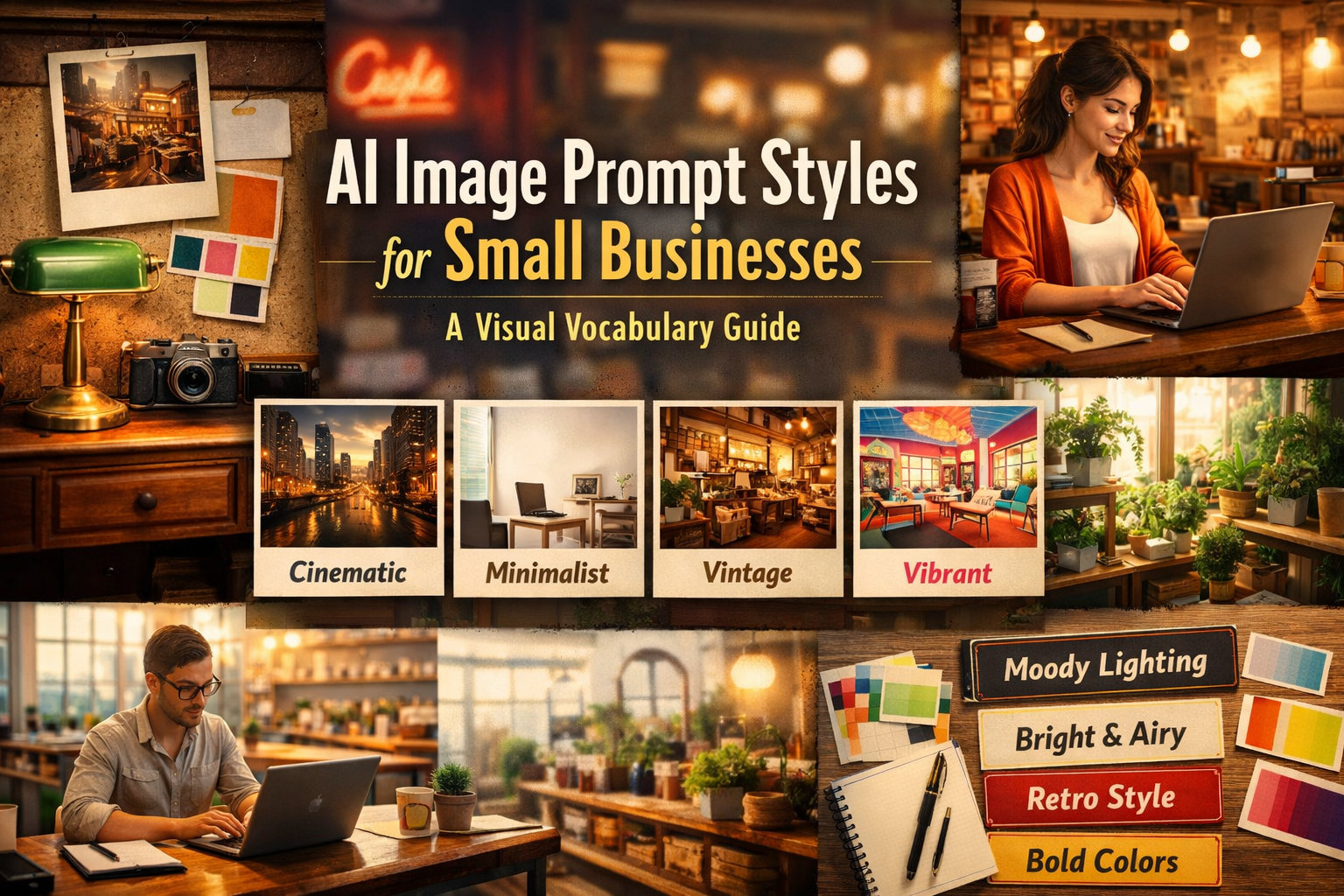
How to Describe the Look You Want — Without Knowing Anything About Photography
You've opened an AI image generator. You typed something like "professional photo of my product" and got something that looks fine but also looks like literally every other AI-generated product photo on the internet.
The problem isn't the tool. It's the prompt. Most people describe what they want in an image — the subject, the object, the scene. But what separates a forgettable AI image from one that actually fits your brand is describing how it should look. The lighting. The mood. The color palette. The era. The feel.
Professional photographers and art directors have a vocabulary for this. They talk about "golden hour warmth" and "editorial negative space" and "high-key minimalism" and "film grain texture." Once you learn that vocabulary and apply it to AI prompts, your outputs change dramatically.
This guide teaches you that vocabulary — organized by aesthetic style — and shows how small business owners in real categories can put it to work.
How AI Image Prompts Actually Work
Before the styles, a quick framework for how to build a prompt that produces consistent, professional-looking results.
A well-built AI image prompt has four layers:
Subject: What's in the image. A coffee cup. A woman in a linen dress. A renovated kitchen. A small storefront.
Setting: Where it exists. On a marble countertop. In a sun-drenched studio. Against a white seamless backdrop. In an outdoor urban environment.
Style: How it looks aesthetically — the mood, the era, the visual language. This is what most people skip and where the most improvement happens.
Technical modifiers: Camera, lens, and lighting language that signals quality and specificity to the AI. Words like "shot on 35mm film," "f/1.8 depth of field," "soft diffused natural light," "medium format photography."
A weak prompt: "photo of a candle"
A strong prompt: "close-up product photograph of a hand-poured soy candle in an amber glass vessel, styled on aged white oak, soft window light from the left casting gentle shadows, warm tonal palette, shallow depth of field, editorial lifestyle aesthetic, shot on medium format film"
Same subject. Completely different image.
The rest of this guide gives you the aesthetic vocabulary to fill that third layer — by visual style, with ready-to-use descriptors and real small business applications for each.
The Aesthetic Styles — and How to Describe Them
1. Clean Minimalist
The look: White or neutral backgrounds, generous negative space, single subject in frame, no visual clutter. Objects feel considered and intentional. Shadows are soft or absent. Colors are muted or monochromatic.
Prompt vocabulary to use:
"white seamless background"
"minimalist product photography"
"generous negative space"
"soft diffused studio lighting"
"monochromatic neutral palette"
"high-key lighting"
"clean editorial composition"
"Scandinavian aesthetic"
"flat lay with breathing room"
Example prompt: "Minimalist product photograph of a single white ceramic mug on a pale grey stone surface, soft diffused overhead lighting, generous negative space, monochromatic tonal palette, no props, clean Scandinavian aesthetic, editorial composition, shot on medium format"
Best for: E-commerce product shots, skincare and beauty brands, professional services, anything you want to feel premium and uncluttered.
2. Warm Lifestyle
The look: Natural light, warm golden or amber tones, real environments rather than studio setups, people living their lives with the product present. Feels candid and approachable, like a weekend morning. Think Sunday cooking content, linen and wood textures, farmers market vibes.
Prompt vocabulary to use:
"warm golden hour light"
"soft natural window light"
"lifestyle photography"
"candid and authentic feel"
"warm amber tones"
"wooden textures, linen fabrics"
"lived-in environment"
"shot on film, slight grain"
"loose and relaxed composition"
"35mm film aesthetic"
Example prompt: "Lifestyle photograph of a handmade ceramic bowl filled with fresh fruit on a wooden kitchen table, warm morning sunlight streaming through a window, golden tones, soft film grain, authentic candid feel, linen napkin in frame, slightly overexposed highlights, shot on 35mm film"
Best for: Food businesses, home goods, wellness brands, restaurants, boutique retail, anything that benefits from feeling human and approachable.
3. Dark and Moody
The look: Low-key lighting, deep shadows, rich jewel-tone or near-black backgrounds, dramatic contrast. Feels luxurious, atmospheric, and slightly mysterious. Think candlelit restaurant tables, dark leather and whiskey, high-end beauty.
Prompt vocabulary to use:
"low-key dramatic lighting"
"deep shadow areas"
"chiaroscuro lighting"
"rich jewel tones"
"dark atmospheric mood"
"candlelit ambiance"
"high contrast, single light source"
"matte dark backgrounds"
"luxury editorial aesthetic"
"Rembrandt lighting"
Example prompt: "Dark moody product photograph of a luxury whiskey glass on a black walnut surface, single dramatic side light source, deep shadow areas, chiaroscuro lighting, rich amber tones in the liquid, dark atmospheric background, high contrast, editorial luxury aesthetic, shot on 85mm lens"
Best for: Restaurants and bars, wine and spirits, luxury retail, high-end grooming or beauty, any brand that wants to feel sophisticated and premium.
4. Bright and Airy
The look: The opposite of moody — everything is light, open, and almost overexposed. White or pastel backgrounds, soft diffused natural light, very few deep shadows. Feels fresh, clean, and summery. Popular with bridal, wellness, and boutique businesses.
Prompt vocabulary to use:
"bright and airy aesthetic"
"overexposed highlights"
"soft pastel tones"
"white and blush palette"
"light-flooded environment"
"ethereal and dreamy feel"
"blown-out whites"
"soft bokeh background"
"feminine editorial style"
"clean and fresh composition"
Example prompt: "Bright and airy flat lay of a bouquet of white peonies and eucalyptus on a white linen surface, soft natural window light, slightly overexposed highlights, blush and white palette, ethereal dreamy aesthetic, shallow depth of field, soft bokeh, clean feminine editorial style"
Best for: Wedding vendors, florists, boutique fashion, beauty and wellness, anything targeting a female demographic that values softness and elegance.
5. Urban Editorial
The look: Real city environments, architectural elements, concrete and steel, asymmetric compositions, a slightly raw or documentary feel. Subjects feel confident and intentional in an urban landscape. Colors can be desaturated or high-contrast.
Prompt vocabulary to use:
"urban editorial photography"
"architectural backdrop"
"street-level perspective"
"gritty urban texture"
"documentary style"
"desaturated tones"
"asymmetric composition"
"natural city light"
"cinematic framing"
"street photography aesthetic"
Example prompt: "Urban editorial portrait of a person in a tailored navy suit standing in front of a textured concrete wall, natural city light from above, slightly desaturated tones with deep blacks, asymmetric composition with negative space, documentary-style photography, cinematic framing, shot on 50mm"
Best for: Professional services, B2B brands, fashion retailers, creative agencies, anyone whose brand feels confident and modern rather than soft and approachable.
6. Nostalgic Film
The look: Intentional imperfection — grain, slightly faded colors, light leaks, cross-processing effects, the warmth and unpredictability of actual film photography from the 1970s through early 2000s. Feels authentic, personal, and emotionally resonant.
Prompt vocabulary to use:
"shot on expired 35mm film"
"analog film grain"
"light leak effect"
"cross-processed tones"
"faded vintage colors"
"Kodak Portra aesthetic"
"Fujifilm color science"
"lo-fi photography"
"polaroid aesthetic"
"nostalgic 1990s visual style"
Example prompt: "Candid photograph of a group of friends at an outdoor summer gathering, shot on expired 35mm Kodak film, visible grain, light leak in the upper corner, warm faded tones, slightly soft focus, authentic candid moment, nostalgic 1990s visual aesthetic, imperfect and genuine feel"
Best for: Food and hospitality brands, music and entertainment, fashion, any business building a brand around authenticity and emotional connection rather than polish.
7. Flat Lay Editorial
The look: Subjects arranged from directly above on a flat surface, precisely styled, often with complementary props. Color-coordinated and considered. Very popular for product photography, recipe content, and "unboxing" style brand imagery.
Prompt vocabulary to use:
"overhead flat lay composition"
"bird's-eye-view perspective"
"precisely styled props"
"coordinated color palette"
"product styling photography"
"editorial still life"
"soft even lighting from above"
"negative space border"
"symmetrical or diagonal arrangement"
Example prompt: "Overhead flat lay product photograph of a skincare routine set — cleanser, serum, and moisturizer — arranged diagonally on a pale sage green background, complementary eucalyptus sprigs and white pebbles as props, soft even lighting with no harsh shadows, coordinated muted green and cream palette, clean editorial still life styling"
Best for: E-commerce brands, beauty and skincare, food content creators, subscription box businesses, any product that benefits from careful styling and color coordination.
8. Documentary / Authentic
The look: Real moments, real people, real environments — nothing feels staged. Subjects are caught mid-action or mid-conversation, slightly imperfect, entirely believable. No perfect lighting setups, no posed smiles. This aesthetic has grown significantly as consumers have become suspicious of overly polished imagery.
Prompt vocabulary to use:
"documentary photography style"
"candid and unposed"
"photojournalism aesthetic"
"real moment captured"
"available light only"
"imperfect and authentic"
"slice-of-life composition"
"raw and unfiltered"
"natural expressions"
"reportage style"
Example prompt: "Documentary-style photograph of a chef in a working restaurant kitchen, mid-motion plating a dish, available light from overhead kitchen fixtures, candid unposed moment, photojournalism aesthetic, natural expressions, slight motion blur, raw and authentic feel, reportage style"
Best for: Restaurants, artisan food producers, service businesses that want to show their process, any brand building trust through transparency and realness.
9. High-Concept Studio
The look: Controlled studio environment taken to an artistic extreme — bold color backgrounds, dramatic lighting rigs, subjects styled with strong creative intent. This is the aesthetic of high-fashion magazines and art-directed advertising. It's bold, intentional, and unmistakably "produced."
Prompt vocabulary to use:
"high-concept studio photography"
"bold saturated color backdrop"
"dramatic lighting rig"
"fashion editorial aesthetic"
"art-directed composition"
"strong graphic elements"
"saturated color palette"
"high production value"
"commercial advertising style"
"striking visual contrast"
Example prompt: "High-concept studio product photograph of a perfume bottle against a deep cobalt blue seamless background, dramatic single spotlight from above creating a precise shadow, bold saturated color, art-directed composition with strong graphic quality, high production value commercial advertising aesthetic, perfectly lit product"
Best for: Fashion and beauty, luxury products, brands launching something new that needs to stop the scroll, any campaign where you want the visual to be unmistakably intentional.
10. Architectural and Interior
The look: Rooms and spaces photographed with precision — straight verticals, careful attention to light, wide angles that convey the full environment. The style emphasizes geometry, proportion, and the quality of light through a space.
Prompt vocabulary to use:
"architectural interior photography"
"straight verticals, no distortion"
"wide angle lens perspective"
"natural light flooding interior"
"precise geometric composition"
"golden hour light through windows"
"ambient and artificial light blend"
"residential interior styling"
"commercial interior photography"
"real estate photography aesthetic"
Example prompt: "Architectural interior photograph of a renovated open-plan kitchen, natural afternoon light streaming through large windows, straight verticals and precise geometric composition, warm ambient light blending with natural light, wide angle perspective showing full room, residential interior styling, clean and aspirational aesthetic, professional real estate photography style"
Best for: Real estate agents, interior designers, home renovators, architects, hospitality businesses, anyone whose product is a physical space.
Building Your Own Prompt: A Template
Here's a repeatable template you can fill in for any image you need to create:
"[Style descriptor] photograph of [subject and setting], [lighting description], [color palette description], [mood or feel], [props or context if relevant], shot on [camera/lens/film type], [composition notes]"
For example, a South Jersey landscaping company that wants to show a completed backyard installation:
"Warm lifestyle photograph of a newly landscaped backyard with a stone patio and native plantings, golden late-afternoon sunlight, warm amber and green tones, candid authentic feel, slight film grain, shot on 35mm, wide composition showing full garden space, professional residential landscaping photography"
Or a Philadelphia restaurant that wants to capture the atmosphere of their dining room:
"Dark moody interior photograph of an intimate restaurant dining room, warm candlelight and low pendant lights, chiaroscuro quality to the lighting, rich deep tones with warm amber accents, cinematic atmosphere, slight soft focus in background, high-end hospitality photography aesthetic, 35mm lens"
Quick Reference: Style Vocabulary by Business Type
Restaurants and food businesses: warm lifestyle, dark and moody, documentary, nostalgic film, flat lay editorial
Retail and e-commerce: clean minimalist, flat lay editorial, high-concept studio, bright and airy
Home services and contractors: warm lifestyle, architectural and interior, documentary, urban editorial
Beauty, wellness, and health: bright and airy, clean minimalist, warm lifestyle, flat lay editorial
Professional services (legal, financial, consulting): urban editorial, clean minimalist, documentary
Hospitality (hotels, venues, event spaces): dark and moody, architectural and interior, warm lifestyle, documentary
Fashion and apparel: urban editorial, nostalgic film, high-concept studio, dark and moody
Artisan food and craft producers: nostalgic film, documentary, warm lifestyle, flat lay editorial
A Few Technical Modifiers Worth Knowing
Beyond aesthetic style, these technical terms reliably improve AI image quality and consistency:
Camera and format: "shot on 35mm film," "medium format photography," "large format film," "DSLR photography," "analog photography"
Lens descriptors: "50mm lens," "85mm portrait lens," "wide angle 24mm," "f/1.4 shallow depth of field," "telephoto compression"
Lighting terms: "soft diffused window light," "golden hour," "chiaroscuro," "Rembrandt lighting," "hard directional light," "soft box studio lighting," "available light only"
Quality signals: "professional photography," "high resolution," "editorial quality," "commercial photography," "award-winning photography," "shot by a professional photographer"
Film stocks (for nostalgic looks): "Kodak Portra 400," "Fujifilm Pro 400H," "Ilford HP5 black and white," "Kodak Gold 200"
The Bigger Point: Visual Consistency Is Brand Equity
The reason this matters for your small business isn't just making prettier images. It's about consistency. Every piece of visual content you put into the world either reinforces a coherent brand identity or adds noise that makes your brand harder to recognize and remember.
When your Google Business Profile photos, your website imagery, your social media content, and your marketing materials all share a consistent aesthetic language — the same warmth, the same tones, the same mood — your brand becomes recognizable even before someone reads your name. That recognition builds trust. That trust converts.
AI image generation makes it faster and cheaper than ever to create consistent, professional-looking visual content. The only missing ingredient, for most small business owners, is the vocabulary to describe what they want. Now you have it.
Ritner Digital helps small businesses across South Jersey and the Philadelphia area build digital presences that attract real clients. If you want help thinking through how your visual brand fits into your broader marketing strategy, let's talk.
Frequently Asked Questions
Can I use AI-generated images commercially for my business?
It depends on the platform. Most major AI image generators — Midjourney, DALL-E, Adobe Firefly, and others — allow commercial use of outputs under their terms, but the specifics vary and change frequently. Always check the current terms of service for the specific tool you're using before publishing AI-generated images in paid advertising or using them commercially. Adobe Firefly is built on licensed training data and is generally considered the safest option for commercial use.
How do I keep visual style consistent across multiple AI-generated images?
Save your best-performing prompts and reuse the style vocabulary portion across different subjects. If you generated a product image with "warm lifestyle, 35mm film grain, golden hour light, wooden textures, amber tones" and it worked well, those descriptors become your template. Some platforms also allow you to reference a previous image as a style input. Building a short document of your "brand prompt vocabulary" — the five to ten style terms that consistently produce images that feel right for your brand — is a worthwhile 30-minute investment.
What's the best free AI image generator for small businesses?
Adobe Firefly (available through Adobe Express, which has a free tier) is the most commercially safe option with high output quality. Microsoft Designer (powered by DALL-E) is free and well-integrated with Microsoft 365 tools. Canva's AI image generator is included in their free plan and is very accessible for non-designers. For more advanced outputs, Midjourney produces the highest quality results but requires a paid subscription and a learning curve.
How specific do my prompts need to be?
More specific is almost always better. Generic prompts produce generic outputs. The more detail you include — subject, setting, lighting, mood, color palette, technical modifiers — the more likely you are to get an image that actually fits your brand and your use case. That said, it's worth experimenting. Sometimes a prompt that feels incomplete produces an interesting result you wouldn't have thought to describe. The vocabulary in this guide gives you the tools to describe what you liked about that result and reproduce it intentionally.
What if I try a style and the output still doesn't look right?
Iterate on the style vocabulary rather than the subject. If the image feels too dark, add "soft diffused lighting" or "brighter ambient light." If it feels too flat, add "dramatic directional light" or "strong shadows." If the tones feel off, name the palette more specifically: "warm amber and terracotta tones" rather than just "warm." AI image generation responds to vocabulary precision — the more accurately you describe the look you want, the more accurately it delivers it.