How Do Small Businesses in Philadelphia Find Clients Online Without a Big Budget?
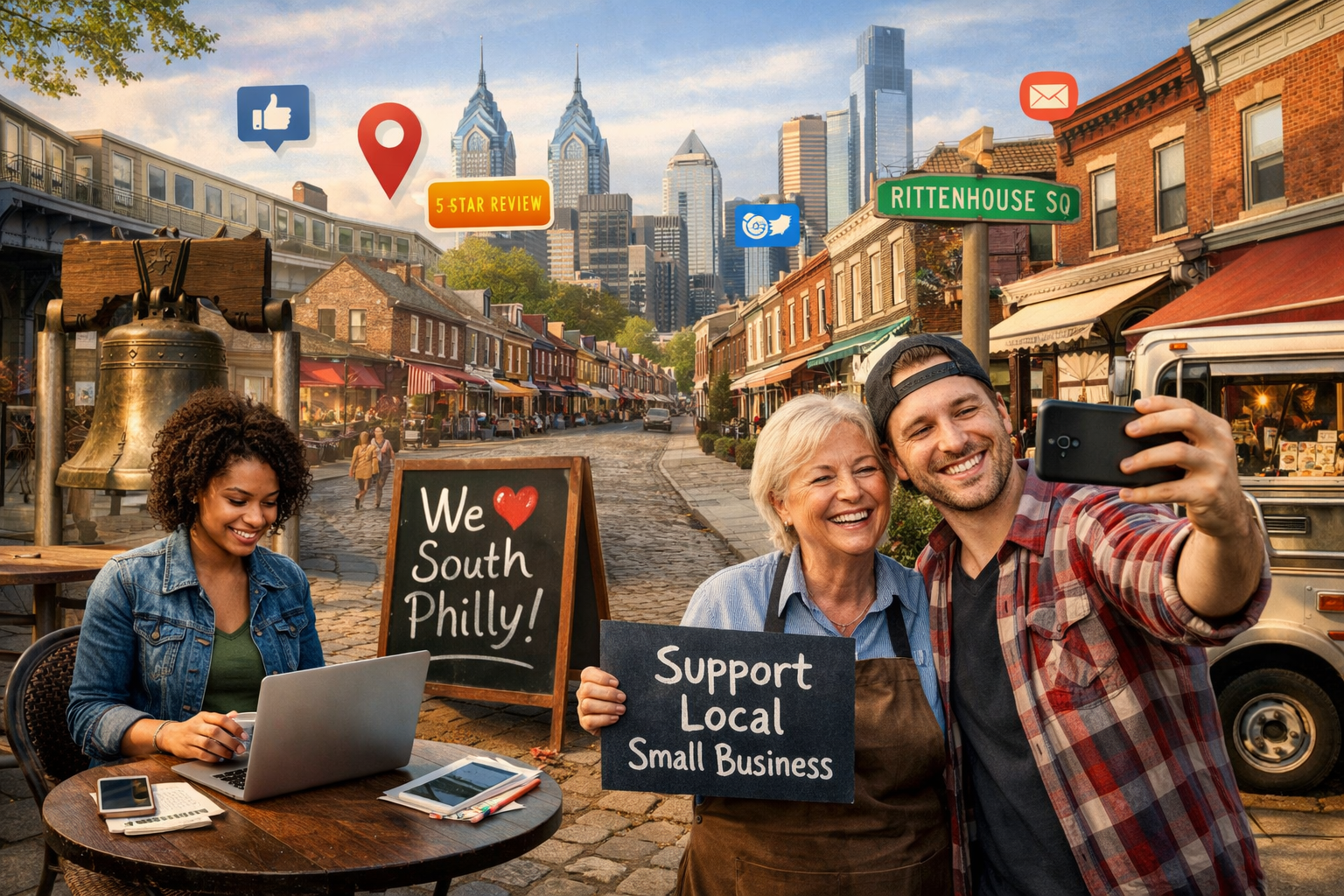
A Neighborhood-by-Neighborhood Digital Playbook for Philly Business Owners
Philadelphia is not one city. It's Fishtown and Frankford, Rittenhouse Square and Roxborough, South Philly and the Northeast, Manayunk and Germantown — dozens of neighborhoods with distinct identities, distinct customer bases, and distinct competitive landscapes. What works for a coffee shop on East Passyunk is not the same strategy a contractor needs in Chestnut Hill.
That's the first thing generic marketing guides get wrong about Philadelphia. The second thing they get wrong is assuming you need a big budget to get found online in a city this size.
You don't. You need the right moves — and you need them executed with Philly-specific awareness of how people here actually find and trust local businesses.
This guide gives you exactly that.
Why Philadelphia Is a Unique Digital Marketing Environment
Philadelphia is one of the most neighborhood-loyal cities in the country. Residents have strong identities tied to where they live, strong opinions about local businesses, and a genuine preference for supporting businesses that feel like part of their community. That cultural reality is your biggest marketing asset — if you know how to activate it.
The Philadelphia market has distinctive traits compared to other major metropolitan areas, including strong neighborhood identities and community pride that can be leveraged in targeted campaigns. Philadelphia users show higher engagement rates with content related to local sports teams, food culture, historical sites, and community events compared to national averages. myshyft
That neighborhood pride translates into a search behavior that matters for your local SEO strategy. People in Philadelphia search specifically. Not "plumber" — "plumber Manayunk." Not "restaurant" — "restaurant Fishtown." Not "dentist" — "dentist South Philly." When a resident in University City searches for a dentist, a plumber in South Philadelphia needs directions, or a homeowner in Germantown seeks a trusted contractor, the local signals must reflect proximity, relevance, and trust. Philadelphia SEO
The implication for your digital marketing is this: the more specifically your online presence reflects the neighborhood or neighborhoods you serve, the more effectively you compete for exactly the customers you want — without spending a dollar competing for searches from people across the city who will never hire you anyway.
Step 1: Claim and Fully Optimize Your Google Business Profile
Everything starts here. Your Google Business Profile (GBP) is the single highest-return, zero-cost marketing asset available to any Philadelphia small business — and most local businesses are using it at a fraction of its potential.
Getting into Google's Map Pack — the top three businesses shown for local searches — is like having a billboard on Broad Street. These "near me" searches are made by people ready to act, directly translating into foot traffic and leads. FZP Digital
That Map Pack placement is where you want to be. When someone in Bella Vista searches "electrician near me" or someone in Mount Airy searches "house cleaner Germantown," the businesses in those top three listings get the calls. Everyone else gets the scraps.
Here's what a fully optimized GBP looks like in Philadelphia specifically:
Your business name, address, and phone number exactly match what's on your website and every directory listing. You've chosen the most specific category available — not just "contractor" but "roofing contractor" or "plumbing contractor." Your business description naturally references the Philadelphia neighborhoods you serve — Kensington, Bridesburg, Mayfair, wherever your customers actually are. You've uploaded at least 15 real photos — your work, your team, your storefront, your recent projects. You're posting weekly updates: a promotion, a recently completed job, a local event you're participating in, a seasonal tip. You're responding to every review within 24 hours — every positive one and every difficult one.
Ask clients to leave reviews for your service and location. A review that reads "Great HVAC service in Point Breeze — fast and professional!" does double duty: it builds social proof and it signals to Google exactly where you work. ThinkDMG
The setup takes a few hours. The ongoing maintenance is 20 to 30 minutes per week. The payoff — consistent inbound calls from people who were already searching for exactly what you offer — is hard to beat with any paid strategy at equivalent cost.
Step 2: Make Your Website Speak Philly's Language
Most small business websites in Philadelphia have the same foundational problem: they exist, but they're invisible. They load slowly on mobile, they don't mention the neighborhoods they serve, and there's no clear reason for a visitor to pick up the phone.
Use city-specific keywords like "Philadelphia," "Philly," or specific neighborhood names in your website's title tags, meta descriptions, headers, and content. Create location-specific landing pages if you serve multiple neighborhoods. A page on your site that speaks directly to customers in Chestnut Hill, complete with local testimonials, is incredibly effective. POP THE PIXEL
In practice, this means your website should naturally mention the Philadelphia neighborhoods you serve. If you're a landscaper covering Northeast Philly, your website should reference Mayfair, Rhawnhurst, Fox Chase, and Bustleton by name — not as keywords shoved awkwardly into a paragraph, but woven naturally into descriptions of your service area, your testimonials, and your content.
If you have a business with multiple locations or service areas, create dedicated pages for each neighborhood. A chain restaurant with spots in Center City, Old City, and Fishtown should have a unique page for each location, with distinct content that speaks to each neighborhood's character and customer base. VISTA.Today
Every page on your site should also answer three questions a first-time visitor needs answered in under five seconds: What do you do? Where do you serve? How do I reach you? A phone number prominently displayed at the top, a clear service area description, and a contact form that's short and visible are the basics that too many Philly small business sites still get wrong.
Mobile matters enormously in this city. Over 72% of Philadelphia social media users access platforms via mobile devices. myshyft The percentage searching for local businesses on phones is at least as high. If your site is hard to read or navigate on a phone, you're losing people before they've had a chance to consider hiring you.
Step 3: Get Your Business Information Consistent Across the Web
This is called NAP consistency — Name, Address, Phone number — and it's one of the most overlooked local SEO fundamentals, particularly in a city with as many business directories and community platforms as Philadelphia.
Google verifies your business's legitimacy partly by cross-referencing your information across the web. When your address appears as "South Street" on your website, "S. St." on Yelp, and something slightly different on a third directory, Google loses confidence in your listing and your rankings suffer.
The directories that matter most for Philadelphia businesses: Google Business Profile, Yelp, Facebook Business Page, Apple Maps, Bing Places for Business, the Better Business Bureau, and any industry-specific directories relevant to your field — HomeAdvisor or Angi for contractors, Zocdoc for healthcare providers, OpenTable for restaurants, Avvo or Justia for attorneys.
Run a free audit on your own citations by searching your business name in Google and checking what comes up. Fix every discrepancy you find. It's not exciting work, but it compounds quietly over months, building the consistency signals that lift your local rankings.
Step 4: Build Your Google Review Volume — Systematically
In Philadelphia, reputation is everything. The city has a culture of passionate loyalty to the businesses it trusts — and intense skepticism of anyone who hasn't earned that trust yet. Reviews are how that trust gets established online.
Philadelphia has over 15,000 registered small businesses competing for attention. Without proper local visibility, you're invisible to the 82% of local consumers who use Google to find businesses like yours. 97% of consumers search online before visiting a local business, and 76% of people who search for something nearby visit a business within 24 hours. Digitalmarketingservpro
If your competitor has 60 Google reviews and you have eight, that gap is costing you customers every day — customers who looked at both profiles, made a judgment, and picked them.
The most effective review-building system is the simplest one: ask every satisfied customer, right after you've delivered value. In the moment, when they just thanked you and you know they're happy. Have your Google review link saved as a text message template on your phone. Send it within the hour. Or hand the customer your phone, pulled up to your profile, and let them write it right there.
Don't offer incentives — Google prohibits it, and reviews written for a discount rarely sound genuine. What you want is real Philadelphians writing real things: "Fixed my burst pipe in Port Richmond on a Saturday morning — showed up in an hour and had it done by noon." That specificity — the neighborhood, the detail, the outcome — builds credibility that generic praise never will.
Respond to every review. Thank the five-star reviews specifically, by referencing what was done. For critical reviews, respond professionally, acknowledge the concern, and offer to make it right offline. Potential customers in Philly read how you handle negative reviews as carefully as they read the reviews themselves.
Step 5: Show Up in Philadelphia's Neighborhood Facebook Groups
Local Facebook groups are the new town square. They're where people ask for recommendations for a plumber, a great new restaurant, or a trustworthy mechanic. If you're not there, you're missing out on some of the most powerful word-of-mouth marketing available today. Localview
Philadelphia has an exceptionally active ecosystem of neighborhood Facebook groups — "Fishtown Community," "I Love Brewerytown," "South Philly Neighbors," "What's Happening in Chestnut Hill," "Kensington Action Now," groups for Germantown, Manayunk, the Northeast, Port Richmond, and virtually every neighborhood in the city, each with thousands of engaged, local members.
These aren't spaces for promotional posts. They're spaces for community. And that means the strategy for showing up in them is specific.
The wrong approach is posting "Check out my business!" promotions. These get removed, generate resentment, and actively damage your local reputation. The right approach is genuine, consistent presence.
Answer questions in your area of expertise. If someone in the Fishtown group asks whether they need a permit for a deck addition, and you're a contractor, answer helpfully — with real information, no pitch. Be the person who shows up with useful knowledge. People remember. They save your comments. They reach out three months later when they're ready to hire. They tag you when a friend asks for a recommendation.
By joining and being an active member, you become a familiar face in the community. People see your name, your profile, and your business attached to helpful, valuable comments. This passive exposure builds awareness without a single sales pitch. The golden rule of Facebook groups is to add value first. Answer questions, offer advice, and share helpful tips without an immediate sales agenda. Think of it as a long-term investment in your community. Localview
When someone does post "Does anyone know a good [whatever you do]?" in a group where you've been a genuine contributor, the recommendations will come organically — from people who recognized your name from all those helpful comments. That's the compounding effect of community-first presence, and no paid ad can replicate it.
Step 6: Create Philadelphia-Specific Content That Earns Organic Search Traffic
Here's an advantage a small business in Manayunk has over a national competitor: they can write content that is genuinely, specifically useful to people in Manayunk — and Google rewards that specificity in local search results.
For local content strategy, go through your keywords and select good descriptors of your business, then make a list of the neighborhoods you service. For each combination, write a somewhat unique post — 500 to 1,000 words — that helps potential clients learn or do something they didn't know they could. If you write quality posts for these keywords, you'll be raising your prominence in local search results. ProStrategix
In practice, this means writing one useful piece of content per month that answers a real question your Philadelphia customers are asking — and grounding it specifically in the city. A few examples by business type:
A roofing company in Northeast Philly: "What Philly Homeowners Need to Know About Roof Damage After a Major Rainstorm Season." A family law attorney in Center City: "How Child Custody Works in Philadelphia County When Parents Live in Different Neighborhoods." A HVAC contractor in South Philly: "When Should You Switch From Heat to Air Conditioning in Philadelphia's Climate?" A restaurant in Northern Liberties: "Why We Source Our Produce From Local Farms — and Where to Find Them." A personal trainer in Rittenhouse Square: "The Best Outdoor Workout Spots in Philadelphia for When You're Tired of the Gym."
Each of these answers something Philadelphians are actually searching for. Each builds your authority with Google as a local expert in your field. Each generates organic traffic long after publication — without ongoing spend. And each is something your business is uniquely qualified to write, because you actually serve this city.
You don't need to be a writer. Speak your answer out loud, record it, and clean up the transcript. Or just write the way you'd explain it to a customer sitting across from you. Genuineness and specificity matter more than polish.
Step 7: Earn Local Backlinks Through Philly Community Connections
Quality local backlinks from Philadelphia news sites, local chambers of commerce, and industry publications boost your domain authority and signal to Google that your business is a trusted, embedded part of the local community. These are the links that move local rankings meaningfully. Digitalmarketingservpro
The good news: these backlinks come from relationships, not money.
Getting listed in your local chamber. The Greater Philadelphia Chamber of Commerce, the Philadelphia Chamber of Commerce, and dozens of neighborhood business associations — BNI chapters, the Old City District, the East Passyunk Avenue BID, the Fishtown Neighborhood Business Association — many include member directory listings that function as valuable local backlinks. Membership fees are often modest, and the links carry real weight.
Sponsoring local events. Philadelphia has hundreds of community events annually — neighborhood block parties, 5Ks, school fundraisers, Little League programs, cultural festivals. Many of these programs feature sponsors on their websites, and a sponsor link from an established neighborhood organization or school is a highly credible local citation.
Partnering with complementary local businesses. A caterer and a wedding venue. A physical therapist and a yoga studio. A contractor and a local real estate agent. These relationships, when reflected in genuine mentions and links on each other's websites, build mutual local authority for both businesses.
Getting covered in local media. The Philadelphia Inquirer, Billy Penn, Broad + Liberty, Philadelphia Business Journal, and neighborhood outlets like the Fishtown Neighbor and the Germantown Dispatch all cover local business stories. When you do something genuinely newsworthy — significant growth, community contribution, interesting story — reach out to the local business reporter. A single mention from the Inquirer or Billy Penn is worth dozens of directory listings.
Step 8: Use Email to Stay Top of Mind With Customers You've Already Earned
This is the most consistently underused marketing channel among Philadelphia small businesses — and it's nearly free.
Your existing customers have already hired you, trusted you with their home or health or money, and formed an opinion about you. A simple monthly email keeps you in their mind when they need you again, and positions you perfectly for the referral they might otherwise forget to make.
Email marketing delivers an average return of $36 for every dollar invested — making it one of the highest-ROI channels in all of digital marketing. Emailmonday For a small Philly business with a growing customer base and a limited marketing budget, that return is hard to ignore.
The system is simple. Collect email addresses at every customer interaction — "May I grab your email for our records?" A free Mailchimp account handles up to 1,000 contacts and monthly sends at no cost. Write a monthly email that sounds like a real person from your business: a seasonal tip, a recent project highlight, a neighborhood event you're involved in, a referral offer. Keep it short, keep it genuine, don't try to sound corporate.
The businesses in Philadelphia that do this consistently build a base of customers who think of them first — not because they advertised, but because they showed up in the inbox once a month with something useful. That's the difference between a one-time customer and a loyal one who tells their neighbors about you.
Step 9: Claim Your Nextdoor Business Page
Nextdoor is an online word-of-mouth platform. If you're not plugged into the conversation on Nextdoor, you're missing an opportunity to get your customers engaged with each other. None of my other social media has had the positive business impact of Nextdoor. Not even close. Nextdoor
Nextdoor is a neighborhood-specific social network where Philadelphia residents ask each other for recommendations, discuss local issues, and post about community events. It's particularly powerful for home services businesses, healthcare providers, childcare, restaurants, and retail — categories where neighbors regularly ask "Does anyone have a good [category] in [neighborhood]?"
Claiming a free business page on Nextdoor takes under an hour. Once it's live, you can post neighborhood-specific content, respond when residents mention or ask about businesses in your category, and receive recommendations that appear organically when your neighbors search.
Home services businesses report strong performance on Facebook and Nextdoor, particularly when targeting established neighborhoods with homeowners. myshyft In a city with as many distinct residential neighborhoods as Philadelphia — from the rowhouse blocks of Passyunk Square to the craftsman homes of Germantown — the hyperlocal targeting of Nextdoor connects you with exactly the neighbors who are most likely to become your customers.
Step 10: Choose the Right Social Platform for Your Philly Audience
Not every platform is the right fit for every Philadelphia business. Spreading thin across five social channels produces mediocre results on all of them. The better move is picking one or two platforms where your actual customers spend time — and showing up consistently.
Restaurants, retail, and arts organizations in Philadelphia typically see the strongest results from Instagram and Facebook, where visual content drives engagement with Philly's active foodie and cultural communities. Professional service providers like lawyers, financial advisors, and B2B companies generally find LinkedIn and Facebook most effective for reaching Philadelphia's professional audience. Home services businesses report strong performance on Facebook and Nextdoor, particularly when targeting established neighborhoods with homeowners. For businesses targeting younger demographics, including Philadelphia's substantial student population near Drexel, Temple, Penn, and Jefferson, Instagram and TikTok generate stronger engagement. myshyft
A practical guide by Philly business type:
Restaurants, bars, and food businesses: Instagram for visual content, Facebook for events and community engagement, and TikTok if you have a younger target demographic — Fishtown and South Street businesses do especially well here. Home services (contractors, HVAC, plumbers, cleaners): Facebook and Nextdoor. Your customers are homeowners who live in specific neighborhoods and trust neighbor recommendations. Professional services (law, accounting, financial, consulting): LinkedIn and Facebook. Your clients research before they call, and they want to see professional credibility. Health and wellness (gyms, physical therapy, yoga, med spas): Instagram for visual results and transformations, Facebook for promotions and community. Retail and boutique: Instagram and Facebook. Product photos, behind-the-scenes content, local story angles.
Whatever platform you choose, consistency is more important than frequency. For most local businesses, three to four high-quality posts per week, combined with daily Stories, is the sweet spot. Stories keep you at the top of the app, while feed posts act as your permanent portfolio. If you can only commit to twice a week, do that reliably rather than posting five times one week and zero the next. Small Business Expo
Step 11: Start Paid Advertising Small and Local When You're Ready
Everything above costs time but minimal money. When you're ready to invest some budget in paid advertising, even a modest amount can accelerate meaningful results — particularly for service businesses where each new customer is worth hundreds or thousands of dollars.
The lowest-risk entry point is Google Ads with tight geographic targeting. Rather than running campaigns across the entire Philadelphia metro, target the specific zip codes where you work. Set a clear daily budget. Write ad copy that mentions the specific Philly neighborhoods you serve. Send clicks to a simple, fast-loading page with a phone number and clear call to action.
For small businesses in Philadelphia, social media advertising budgets typically range from $500–$2,500 monthly. Many successful businesses start with $750–$1,000 monthly, allocating approximately 60% to Facebook and Instagram, 25% to a secondary platform, and 15% for testing new approaches. myshyft You don't have to start that high — a $10 to $20 daily Google Ads budget targeting two or three Philadelphia zip codes is enough to generate meaningful early data about what works.
The discipline that matters most on a small budget: track everything. Know your cost per lead. Know your cost per new customer. Know which neighborhoods and which ad types generate the best results. Don't just spend and wait — read the data weekly and adjust.
The Philly Advantage: This City Rewards Authentic Community Presence
Here's the underlying truth that no generic marketing guide captures: Philadelphia has a uniquely powerful local business culture. Philly residents are passionate about their neighborhoods. They want to support local. They will go out of their way for a business they trust and talk about it to everyone they know. And they will also tell everyone when a business lets them down.
Philadelphia small businesses have the opportunity to connect with a strong online community through social media — a low-cost, extremely effective marketing tool when used efficiently. Social media is all about contributing to a larger conversation. The more you stay on top of local events and engage with what's happening in your specific Philly neighborhood, the more relevant and timely your presence becomes. Philadelphia Business Services
The businesses winning in Philadelphia right now — getting consistent leads, consistent referrals, consistent reviews — aren't necessarily outspending their competitors. They're out-caring them. They're more present in neighborhood conversations. More responsive online. More genuinely useful when someone has a question. More visible when someone is ready to hire.
Every genuine interaction compounds. The customer you went out of your way for. The Facebook comment that actually helped someone solve a problem. The Google review you earned by showing up on time and doing excellent work. The sponsorship that got your name on a sign at a community event in Fairmount or Kensington or the Great Northeast.
That's what a digital reputation in Philadelphia is built from. And the tools to build it are available right now — most of them free, all of them accessible to any business owner willing to put in consistent, community-first effort.
Ritner Digital works with businesses across the Philadelphia metro area — including South Jersey, the Main Line, and the surrounding suburbs — who want to grow their online presence without wasting money on strategies that don't fit their market. If you'd like an honest conversation about what would actually move the needle for your business, let's talk.
Frequently Asked Questions
How long does it take for a Philadelphia small business to start getting leads from local SEO?
For businesses starting from a well-optimized Google Business Profile with a consistent NAP, solid photos, and at least 10 genuine reviews, early results — direct calls and profile views from Google Maps — are typically visible within 30 to 60 days. Ranking more broadly in organic search results for competitive neighborhood-specific keywords takes longer, typically four to nine months of consistent effort. The foundational work costs nothing to maintain once it's in place, and it compounds — every review earned, every citation fixed, every piece of local content published makes the next result easier to achieve.
Which Philadelphia neighborhoods are most competitive for local SEO?
Center City, Rittenhouse Square, Fishtown, Northern Liberties, and South Philly along East Passyunk Avenue tend to have the highest concentration of businesses competing for local search visibility — particularly in restaurants, retail, and personal services. If your business is in these neighborhoods, the competition for map pack placement is real, and the quality of your Google Business Profile, review volume, and local content all matter more. Businesses in less digitally saturated neighborhoods like parts of the Northeast, Germantown, or Kensington often find it faster to rank because fewer local competitors have optimized aggressively.
Is it worth advertising on social media as a very small Philly business with almost no budget?
If your budget is very tight, prioritize free tools first — Google Business Profile, reviews, local Facebook group presence, and Nextdoor — before spending on paid social. Once your free foundation is generating some leads, even a $5 to $10 daily Facebook or Instagram campaign targeting your specific Philly neighborhoods can meaningfully increase local awareness. For restaurants and retail, Facebook and Instagram's visual ad formats at modest daily budgets have consistently strong returns in Philadelphia's engaged local market. For home services, that same budget on Google Ads (targeting specific zip codes with high-intent search terms) tends to produce better-quality leads.
Should I try to show up across all of Philadelphia or just focus on my specific neighborhood?
Start hyper-local and expand from there. A contractor in Roxborough should dominate Roxborough, Manayunk, and Wissahickon before worrying about Center City. A restaurant in Kensington should own its block before trying to pull customers from across the city. Hyper-local specificity in your GBP categories, your review language, your website content, and your social presence makes you far more competitive for the searchers who are most likely to convert — the ones who are actually near you and ready to act. As you build authority in your immediate area, Google rewards that with broader visibility over time.
What's the most important thing a Philadelphia small business can do online if they can only do one thing?
Claim, complete, and actively maintain your Google Business Profile. Add real photos. Collect at least 10 to 15 genuine reviews from real customers. Respond to every review. Post a weekly update. If you only have time for one thing, this is the one that directly drives phone calls, map visits, and new customers — often within weeks of getting it right.