AI Search Is Coming for "Near Me" — What Local NJ Businesses Need to Know About GEO in 2026
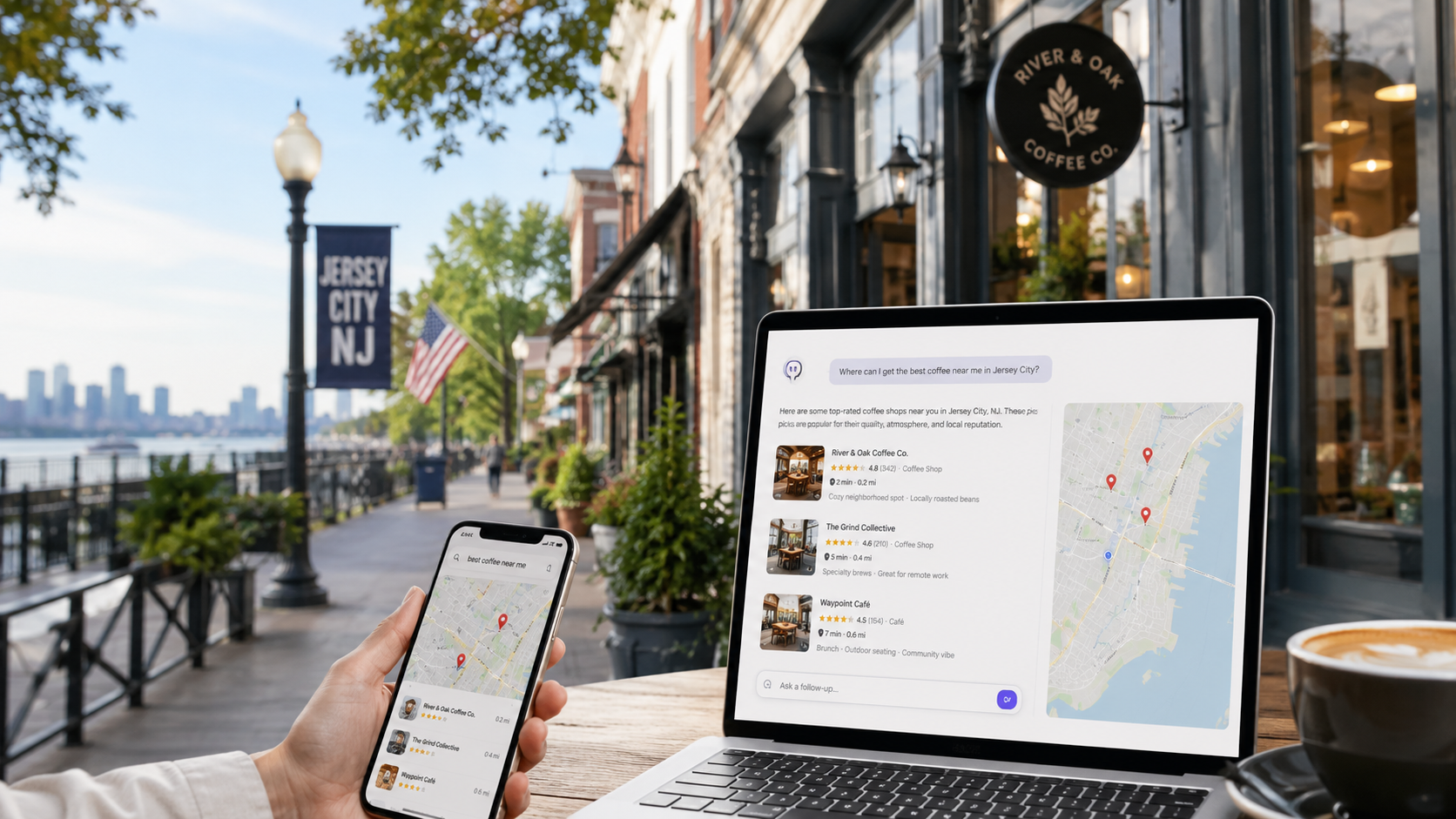
For fifteen years, local business marketing in New Jersey ran on a two-word ritual: "near me."
Plumber near me. Used trucks near me. Divorce lawyer near me. Tacos near me. Nearly half of consumers — 46% by recent survey data — say they "always" or "often" append those two words to their local searches. The entire local SEO industry, the map pack, the review economy, your Google Business Profile — all of it exists to win the "near me" moment.
That moment is now being quietly rerouted. A growing share of your future customers aren't typing "near me" into a search box at all. They're asking — ChatGPT, Google's AI Mode, Gemini, Perplexity — in full sentences, with context: "I need an HVAC company in Gloucester County that can come out this week and won't charge me for the estimate." And instead of ten blue links and a map, they get an answer. Two or three names, stated with confidence.
The discipline of making sure one of those names is yours has an acronym now: GEO — Generative Engine Optimization. This article is the plain-language briefing for New Jersey business owners: what's actually changed, how big it really is (with the honest counterweights), what drives visibility in AI answers, what to do about it — and the popular advice you can safely ignore.
What GEO Actually Is (Cutting Through the Acronym Soup)
You'll see GEO, AEO (Answer Engine Optimization), AI SEO, and LLM optimization used almost interchangeably. They all point at the same job: making your business visible, accurate, and recommendable inside AI-generated answers— the responses produced by ChatGPT, Google's AI Overviews and AI Mode, Gemini, Perplexity, and Copilot.
Classic SEO optimizes for a ranking system: you compete for positions on a results page, and position determines clicks. GEO optimizes for a synthesis system: the engine reads broadly across the web — your site, your reviews, directories, forums, local press — and composes an answer that names a small number of businesses. There is no position four. There's mentioned, or there's absent.
If that sounds like SEO's job description with new vocabulary, you're half right — and the half that's different is the half that decides who wins the next five years of local discovery in this state.
How Much of "Near Me" Has Actually Moved? (The Honest Numbers)
Let's do this with data instead of vibes, because the AI marketing space is drowning in hype.
The adoption curve is the steepest local search has ever seen. BrightLocal's 2026 Local Consumer Review Surveyfound that 45% of consumers used AI tools to find local business recommendations in the past year — up from 6% the year before. A 7.5x jump in twelve months made AI the #3 local discovery channel, behind only Google and Facebook and already ahead of Yelp and TripAdvisor. The heaviest users are consumers aged 30–44 (64% have asked AI for a business recommendation) — peak years for buying homes, hiring lawyers, and replacing HVAC systems.
And the shift isn't only happening in chatbots — it's inside Google itself. Per Whitespark's 2026 local search analysis, AI Overviews now appear on 68% of local business-type queries — versus 39% for the traditional local pack. Read that twice: on local searches, Google's own AI answer now shows up more often than the map pack. Even the customer who never opens ChatGPT is increasingly reading an AI-composed answer about businesses like yours.
Now the honest counterweight. Traditional search is still the bigger river: Bain's research finds 56% of consumers still mostly or always start with a search engine, versus 16% with a chatbot. Nobody serious is telling you to abandon Google — the map pack still pays your bills today. The correct read is two rails running in parallel: the mature one you must keep winning, and the young one compounding at a rate local search has never produced — while, per industry tracking, roughly 88% of local businesses have no AI search strategy whatsoever. In a state with the small-business density of New Jersey, that 88% is not a warning. It's a window.
Why AI Answers Are a Different Game Than the Map Pack
Three structural differences change how you compete:
1. Radical selectivity. SOCi's 2026 Local Visibility Index measured it: for the same set of businesses, 35.9% achieved visibility in Google's local 3-pack — while ChatGPT recommended just 1.2% of locations. AI answers are roughly 30x more selective than Google. The map pack has a third place and a "more places" link; an AI answer has two or three names and silence. Winner-take-most becomes winner-take-nearly-all.
2. Context-rich questions. "Near me" was two words plus GPS. AI queries arrive loaded: budget, urgency, situation, preferences — "family lawyer in Camden County, custody case, needs payment plans." The engine matches that context against everything it can read about local businesses. A business whose web presence actually answers those contextual questions — plainly, specifically — becomes recommendable in scenarios where a thin brochure site is invisible.
3. It answers even when you never asked it to. Your customer Googles a normal question; an AI Overview composes the response. The behavior shift doesn't require your customers to adopt anything. Google adopted it for them.
What Actually Drives GEO Visibility (Per the 2026 Research)
The encouraging headline from Whitespark's 2026 work: local search signals and AI search signals have effectively merged — the same fundamental inputs now drive visibility across Google, Maps, ChatGPT, and Perplexity. You don't need a secret parallel strategy. You need the fundamentals executed at a level most NJ businesses aren't executing them, plus a few AI-specific emphases:
Your off-page reputation is the main course. Analysis of 23,000+ citations in AI answers found that roughly 77% of the sources AI cites about brands are off-page — reviews, directories, forums, articles — not the brand's own website. An AI assistant behaves like a diligent researcher with thirty seconds: it reads what everyone else says about you and synthesizes. Review volume, review recency (74% of consumers specifically want reviews from the last three months — and the engines mirror that preference), and third-party mentions are the raw material of recommendations.
Freshness is weighted harder than you're used to. Ahrefs' analysis of 17 million AI citations found AI-cited content averages 25.7% fresher than what ranks in classic organic results — with ChatGPT showing the strongest recency preference of any engine. A site that last published in 2023 is quietly aging out of the conversation even while its Google rankings hold.
Consistency errors are punished harder. Per the SOCi data, AI engines penalize name/address/phone and hours inaccuracies more severely than the 3-pack does. The boring directory-cleanup work your last agency skipped is now load-bearing.
Quotable beats clever. Engines recommend what they can understand and restate. "Serving all your automotive needs since 1987" is unquotable mush. "We sell used commercial trucks — F-350s to F-750s — with in-house financing, in Greensburg-style plain English" is an answer waiting to be assembled. Every core page should survive the test: could a stranger accurately describe this business in two sentences after thirty seconds here?
The NJ Playbook: Six Moves in Priority Order
For the owner who wants the to-do list — much of it genuinely DIY-able:
Run the visibility check first. Before optimizing anything, find out where you stand — we published the exact 5-minute protocol for checking whether your business shows up in ChatGPT, including how to grade the result. Diagnosis before treatment, always.
Turn reviews into a weekly system. Not a poster by the register — a system: every completed job or sale triggers an ask. Volume, recency, and detail. This single habit feeds Google, the AI engines, and human trust simultaneously.
Fix your data everywhere. Identical NAP, hours, and business description across your site, Google Business Profile, and every directory. One afternoon, disproportionate payoff, harshly punished when wrong.
Rewrite your money pages to be quotable. One page per service, plain language, real specifics, real geography — Vineland is not "the greater tri-state area." Add an FAQ section that answers the questions customers actually ask, in the words they ask them.
Publish something genuinely useful every month. The freshness signal compounds with everything above — and it's the same engine that builds classic rankings, so the effort pays on both rails.
Log the check monthly. Re-run the prompts, note who gets named, watch your analytics for referrals from chatgpt.com, gemini, claude.ai, and perplexity. You can't manage a channel you never look at.
What to Ignore (The GEO Snake Oil Section)
A gold rush attracts shovel salesmen, so file these under skip:
"Guaranteed AI placement." There is no ad unit inside organic ChatGPT recommendations and no way to guarantee inclusion. Anyone guaranteeing it fails the seven questions we tell every business to ask before hiring marketing help.
Schema markup as a magic AI bullet. This one deserves its own line because it's the most common upsell: Ahrefs tested it across 1,885 tracked pages and found adding JSON-LD schema produced no measurable change in AI citations — and none of the five major AI systems even read JSON-LD when fetching pages live. Schema has legitimate classic-SEO uses; as a GEO tactic, the 2026 evidence says it's a placebo being sold at consulting rates.
Panic, in either direction. "Google is dead" is as wrong as "AI search is hype." Two rails. Run both.
On what this should cost: the market has already repriced — GoodFirms' 2026 agency survey found 54% of agencies raised prices this cycle, with 37% citing GEO/AEO work as the reason, often packaged as add-ons of $900+/month. Our position, consistent with our published pricing: the work is real, but because the signals have merged, much of GEO belongs inside a competent local search program, not bolted on as a mystery surcharge — and any provider doing it should show you evidence, starting with their own AI referral traffic. (Ours arrives monthly from ChatGPT, Gemini, and Claude, and we got a dealership client its first AI-assistant referrals within 60 days. Receipts or it didn't happen.)
Frequently Asked Questions
What does GEO stand for, and is it different from AEO?
GEO is Generative Engine Optimization; AEO is Answer Engine Optimization. In practice they describe the same discipline — earning visibility inside AI-generated answers from ChatGPT, Google AI Overviews/AI Mode, Gemini, and Perplexity — and the terms are used interchangeably. What matters isn't the acronym; it's whether the provider using it can show evidence of actual AI-driven visibility.
Are people in New Jersey really using AI instead of "near me" searches?
Both, and increasingly the AI layer intercepts the "near me" behavior itself: 45% of consumers used AI tools for local business recommendations in the past year (up from 6%), and AI Overviews now appear on 68% of local-type Google queries — more often than the traditional map pack. Traditional search remains the larger channel today, which is exactly why the correct strategy is both rails, not a swap.
Does ranking well on Google mean I'll show up in ChatGPT?
Not automatically. SOCi's 2026 data found 35.9% of businesses visible in Google's 3-pack while ChatGPT recommended only 1.2% of the same set. The underlying signals overlap heavily — reviews, consistency, clear content — but AI engines weight freshness and off-page reputation differently and are drastically more selective. Treat your Google position as a head start, not a transfer.
What's the single most important thing a small NJ business can do for AI visibility?
Reviews — volume, recency, and detail, generated systematically. Roughly 77% of what AI engines cite about businesses is off-page, and recent reviews are the richest slice of it. Second place: rewriting your core pages so a stranger (human or machine) can accurately describe what you do, for whom, and where in two sentences.
Do I need to add schema markup for AI search?
Per Ahrefs' 2026 testing: no measurable effect on AI citations, and the major AI systems don't read JSON-LD on live fetches. Schema retains legitimate uses in classic search, but if someone is selling it to you specifically as the key to ChatGPT visibility, that's a red flag. Spend the budget on reviews, content, and consistency instead.
How do I know if any of this is working?
Three instruments: the monthly prompt check (who do the engines name for your money questions), referral traffic in your analytics from AI domains (chatgpt.com, gemini.google.com, claude.ai, perplexity.ai), and — ultimately — inquiries that mention "I asked ChatGPT." Log all three. A channel this new rewards the businesses that measure it while everyone else guesses.
Claim Your Spot on the New Rail
Somewhere in New Jersey right now, someone is asking an AI assistant for exactly what you sell — and it's answering with somebody's name. The window where 88% of your competitors have no strategy is the best market condition you will ever be offered, and it will not stay open.
If you want to know where your business stands — the full multi-engine audit, the accuracy check on what the assistants believe about you, and the prioritized plan — that's an hour of our time and a straight answer, even if the answer is "you're in better shape than you think."
Find out where you stand → Contact Ritner Digital
Ritner Digital is a South Jersey digital marketing practice specializing in SEO and AI search optimization for dealerships, law firms, contractors, and local service businesses across New Jersey and the Philadelphia metro.