Does Your Philadelphia Business Show Up in ChatGPT? Here's How to Check in 5 Minutes
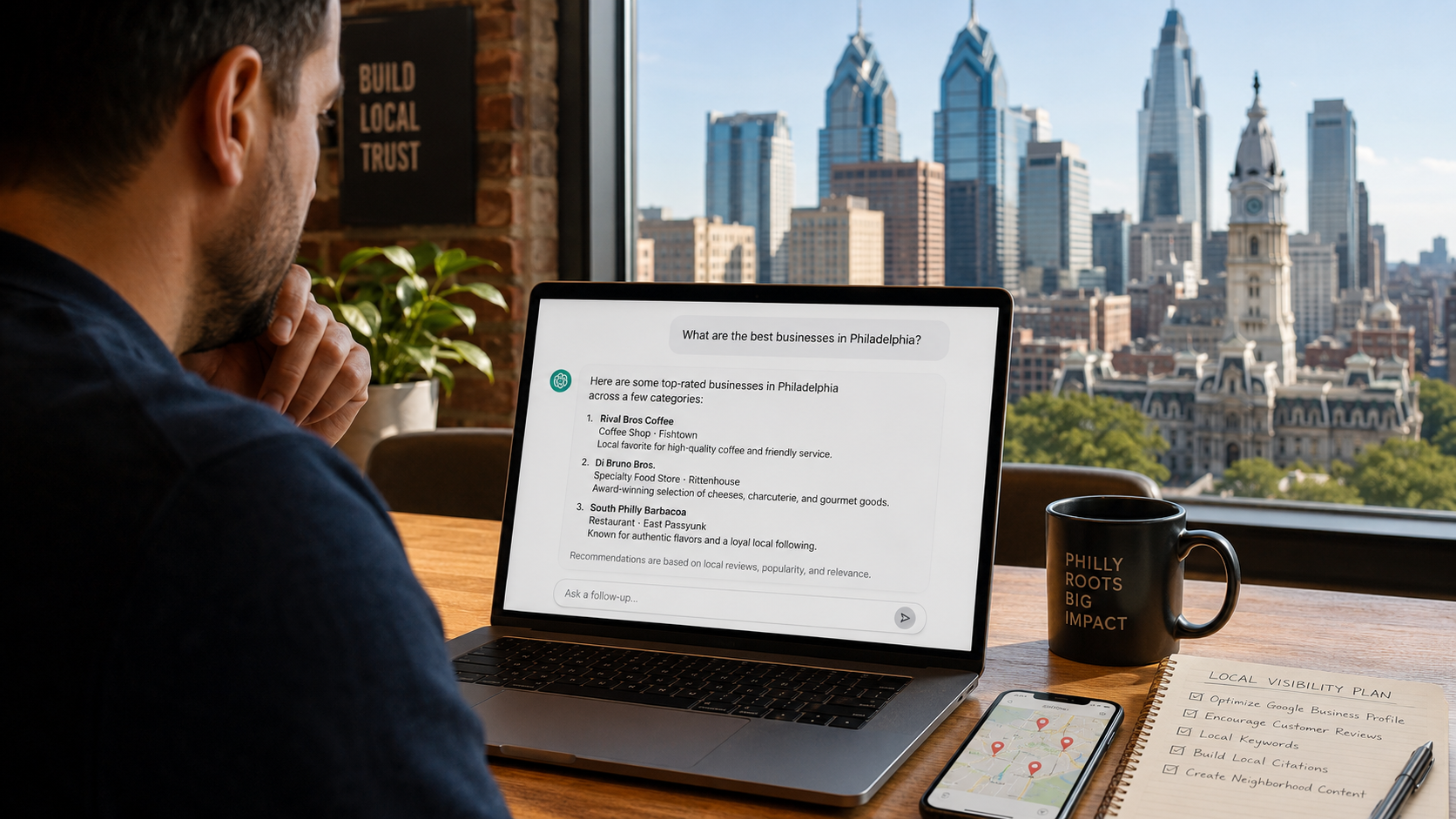
Try this right now: open ChatGPT and ask it for the best business in your category in your area. "Best family law firm in Philadelphia." "Best HVAC company in South Jersey." "Best used truck dealer near Cherry Hill."
It will answer. Confidently. With names.
Now the only question that matters: is one of those names yours?
For most Philadelphia-area businesses, the honest answer is no — and most owners have never checked, because nobody told them this was now a place customers look. But the data says they very much do: according to BrightLocal's 2026 Local Consumer Review Survey, 45% of consumers used AI tools like ChatGPT to find local business recommendations in the past year — up from just 6% the year before. That's not a trend line; that's a step change. AI is now the third most-used local discovery channel in America, behind only Google and Facebook — already ahead of Yelp and TripAdvisor.
And here's the stat that should genuinely concern you: per SOCi's 2026 Local Visibility Index, ChatGPT recommends only about 1.2% of local business locations — versus 35.9% of the same businesses appearing somewhere in Google's local 3-pack. AI answers are roughly 30x more selective than Google. There's no page two in a ChatGPT answer. You're either one of the two or three names the assistant says out loud, or you don't exist.
The good news: finding out where you stand takes five minutes and costs nothing. Below is the exact check we run for clients — the same one we run on ourselves — followed by what each result means and what to do about it.
Why This Matters Right Now (The 60-Second Version)
Three numbers frame the moment:
ChatGPT crossed roughly a billion weekly users in 2026 — it's not a niche tool; it's a mainstream behavior, and 44% of US adults have used it.
The people using AI for business recommendations are your best customers. BrightLocal's data shows 64% of consumers aged 30–44 — peak homeowning, peak hiring-a-lawyer, peak buying-a-work-truck age — have asked AI for a business recommendation. Adoption is highest in exactly the high-consideration categories that dominate this region's small business economy: legal, healthcare, home services, automotive.
They trust what it tells them. Among active AI users, 63% trust AI recommendations, and 64% trust ChatGPT's picks as much as customer reviews. When the assistant names two plumbers, a meaningful share of askers simply calls one of the two.
We're not speculating from the sidelines here — we watch this traffic arrive. Our own site receives visitors referred directly from ChatGPT, Gemini, and Claude every month, and we generated a local dealership client's first-ever AI-assistant referrals within 60 days of starting work. The channel is real, it's measurable, and in the Philadelphia market it is still mostly unclaimed. Which brings us to the check.
The 5-Minute Check: Step by Step
Grab your phone or laptop. You'll rotate through a handful of prompts and note what comes back. Two ground rules first:
Rule 1: Test clean. If you use ChatGPT regularly, it may have memory of you and your business, which contaminates the test. Use a logged-out session, a temporary chat, or ask a friend or family member to run the prompts from their account. You want to see what a stranger sees.
Rule 2: Ask more than once. AI answers aren't fixed like search rankings — the same question can return different names on different days. Run each prompt two or three times. You're checking whether you appear consistently, sometimes, or never.
Minute 1: The money question
Ask the question your next customer asks:
"What's the best [your category] in [your town]?" "Who should I use for [your service] in Philadelphia?""Best [category] near [neighborhood/suburb]"
Use your real service area — "best contractor in Northeast Philly," "best dentist in Cherry Hill," "best commercial truck dealer in South Jersey." Note every business named, in order.
Minute 2: The buyer-scenario questions
Real customers rarely ask the generic version. They ask with context:
"I need a lawyer for a custody case in Camden County — who do you recommend?" "Where can I buy a used F-350 with financing near Philadelphia?" "Affordable [service] in [town] that can come out this week"
These conversational, specific prompts are where AI assistants do their most recommendation-like work — and where being the business whose website actually answers those questions pays off.
Minute 3: The direct lookup
Now ask about you by name:
"Tell me about [Your Business Name] in [Town]." "Is [Your Business Name] a good [category]? What do people say?"
Three things to grade: Does it know you exist? Is what it says accurate (services, location, hours, positioning)? And is it current — or is it describing the business you were three years ago, the old address, the service you discontinued?
Minute 4: The comparison
"[Your Business] vs. [Your Main Competitor] — which is better for [service]?"
This reveals what the assistant believes your relative strengths are, and whose narrative is winning. If it fluently describes your competitor's advantages and hedges vaguely about yours, that's the information environment your prospects are deciding inside.
Minute 5: Check the other engines — and your own analytics
Run your best two prompts through Google's AI Overviews / AI Mode (just Google the question — AI Overviews now appear on the majority of local business-type queries) and, if you're thorough, Gemini or Perplexity. Different engines, different answers, same stakes.
Then the receipts check: open your website analytics and look at your referral sources for chatgpt.com, gemini.google.com, claude.ai, perplexity.ai, or copilot.microsoft.com. Any sessions from those domains are actual humans who asked an AI and clicked through to you. Zero isn't necessarily bad (assistants often answer without linking) — but a nonzero and growing number is direct evidence the channel is already feeding you.
Scoring Your Result: The Four Outcomes
Outcome A — You're recommended, consistently. Congratulations, you're in the 1.2%. Your job is defense: keep the signals fresh (AI systems measurably prefer recent content and recent reviews), keep your information consistent everywhere, and start tracking AI referrals monthly so you notice if you slip.
Outcome B — Known, but not recommended. The assistant can describe you when asked directly but never volunteers you for the money question. This is the most common result for established businesses, and it's actually the best starting position — the entity exists; it just lacks the reputation and citation mass to make the shortlist. The gap between B and A is closeable, and it's where optimization work earns its keep.
Outcome C — Known, but wrong. It names you, then gets your services, location, or story wrong — sometimes badly. This is urgent in a way B isn't: prospects are receiving misinformation about you at the exact moment of decision. The fix runs through the sources AI systems learn from: your website's clarity, your Google Business Profile, directories, and the third-party web's description of you.
Outcome D — Invisible. Direct lookups draw a blank or a hallucinated guess. Common for newer businesses, businesses with thin websites, and businesses whose only web presence is social media (assistants lean heavily on the open web, and content locked inside Facebook is largely dark to them). You're starting from zero on this channel — while 45% of consumers are asking.
Why Businesses Do (and Don't) Get Recommended
Nobody outside the AI labs knows the exact recipe, but the research converging in 2026 points at a consistent picture:
It's mostly about what the rest of the internet says about you. Analysis of tens of thousands of AI answer citations found that roughly 77% of the sources cited about brands are off-page — reviews, directories, forums, articles — not the brand's own website. Assistants behave like a very fast researcher: they read your reviews, the local roundups, the directory entries, the forum threads, and synthesize a recommendation. A business with 200 recent, detailed reviews and mentions across the local web gives that researcher material. A business with a 6-page website and 11 reviews gives it nothing to say.
Clarity and consistency are entity fuel. Assistants recommend businesses they can understand: what you do, exactly, for whom, where. Vague brochure-speak ("solutions for all your needs!") is unquotable. Specific, structured, plainly-written content — service pages that say the thing, FAQ sections that answer real questions — is what gets synthesized into answers. Inconsistent name/address/phone data across the web is punished harder by AI engines than by Google.
Freshness matters more than in classic SEO. Ahrefs' analysis of 17 million AI citations found AI-cited content runs meaningfully fresher than what ranks in classic search — with ChatGPT showing the strongest recency preference. A site that hasn't published since 2023 is fading from the conversation even if its Google rankings are holding.
And your Google work transfers only partially. The SOCi data above is blunt: winning the 3-pack does not mean appearing in ChatGPT. They're parallel rails sharing some inputs. Which is why "we already do SEO" isn't an answer to the AI question — a distinction we've made in our pricing breakdown and in the questions we tell every business to ask providers: what are you doing to get me recommended by AI, and can you show evidence?
What to Do With Your Result (Without Hiring Anyone)
The genuinely DIY-able moves, in priority order — consistent with our standing policy of telling you what you can do yourself:
Run the reviews play hard. Recent, detailed reviews are the single richest food source for AI recommendations — and 74% of consumers specifically look for reviews from the last three months. Ask every happy customer, every week, forever.
Rewrite your core pages to be quotable. One page per service, in plain language, that literally answers "who is this business, what do they do, for whom, where, and why them." If a smart stranger couldn't summarize you from your homepage in two sentences, neither can an assistant.
Fix your consistency. Same name, address, phone, and description on your site, Google Business Profile, and every directory that mentions you. Boring, unglamorous, disproportionately punished when wrong.
Publish recent, genuinely useful content in your niche — the freshness signal compounds with everything above.
Re-run the 5-minute check monthly and keep a simple log. You cannot manage a channel you never look at — the same discipline we preach about every other dashboard.
The deeper work — entity building, citation strategy, structured content programs, tracking recommendation share against competitors — is where it stops being a weekend project. That's the layer the industry now prices separately, and the layer where we spend most of our time.
Frequently Asked Questions
How do I check if my business shows up in ChatGPT?
Ask it the questions your customers ask — "best [category] in [your town]," specific buyer scenarios, and a direct lookup of your business by name — from a clean, logged-out session, several times over a few days. Grade yourself on the four outcomes: consistently recommended, known-but-not-recommended, known-but-wrong, or invisible. Then check your analytics for referral traffic from chatgpt.com and other AI domains.
Why does ChatGPT recommend my competitor and not me?
Most often because the open web gives it more, and more recent, material about them: review volume and recency, directory presence, third-party mentions, and clearer website content. Roughly three-quarters of what AI answers cite about brands comes from off-page sources — so the fix is usually reputation and citation work, not website tinkering alone.
Can I pay to appear in ChatGPT's recommendations?
No. There's currently no ad placement inside organic ChatGPT recommendations — which is precisely why the channel is valuable and why early movers get an outsized advantage. Visibility is earned through the signals above, not bought. (Be skeptical of anyone selling "guaranteed AI placement"; the honest version of this work is optimization, never guarantees.)
Is AI search optimization different from regular SEO?
Overlapping but distinct. The same foundations help both — clear content, reviews, consistent data — but the SOCi data shows Google visibility doesn't transfer automatically (35.9% 3-pack visibility vs. 1.2% ChatGPT recommendation rate for the same businesses), AI engines weight freshness and off-page reputation differently, and measurement is completely different. It's the fastest-moving part of search, and it's the main reason agencies repriced their services this cycle.
How long does it take to start showing up in AI answers?
Honest answer: it varies more than classic SEO, because assistants blend live retrieval with trained knowledge. Improvements to reviews, consistency, and quotable content can surface in retrieval-backed answers within weeks; becoming a stable, repeatedly-recommended entity is a months-scale project. We saw first AI-assistant referral traffic for a local client within 60 days — real, but the beginning of a curve, not the end.
Does this matter yet for a small Philadelphia business, or is it hype?
The adoption numbers answer that: 6% to 45% in one year, concentrated in 30–44-year-old buyers, in high-consideration local categories. It's smaller than Google today and compounding faster than anything in local search history. The practical read: keep winning Google — and claim your spot on the new rail while 88% of local businesses still have no AI strategy at all.
Or Send Us Your Business Name and We'll Run the Full Version
The 5-minute check tells you where you stand. The full version — every major AI engine, buyer-scenario prompts for your actual services, a competitor comparison, an accuracy audit of what the assistants believe about you, and the prioritized fix list — takes us about an hour, and for Philadelphia and South Jersey businesses we'll tell you plainly what we find, including "you're already fine."
Get your AI visibility checked → Contact Ritner Digital
Ritner Digital is a South Jersey digital marketing practice specializing in SEO and AI search optimization for dealerships, law firms, contractors, and local service businesses across the Philadelphia metro, Gloucester, Camden, and Burlington counties.