Backlink Audit: Wade's Care First
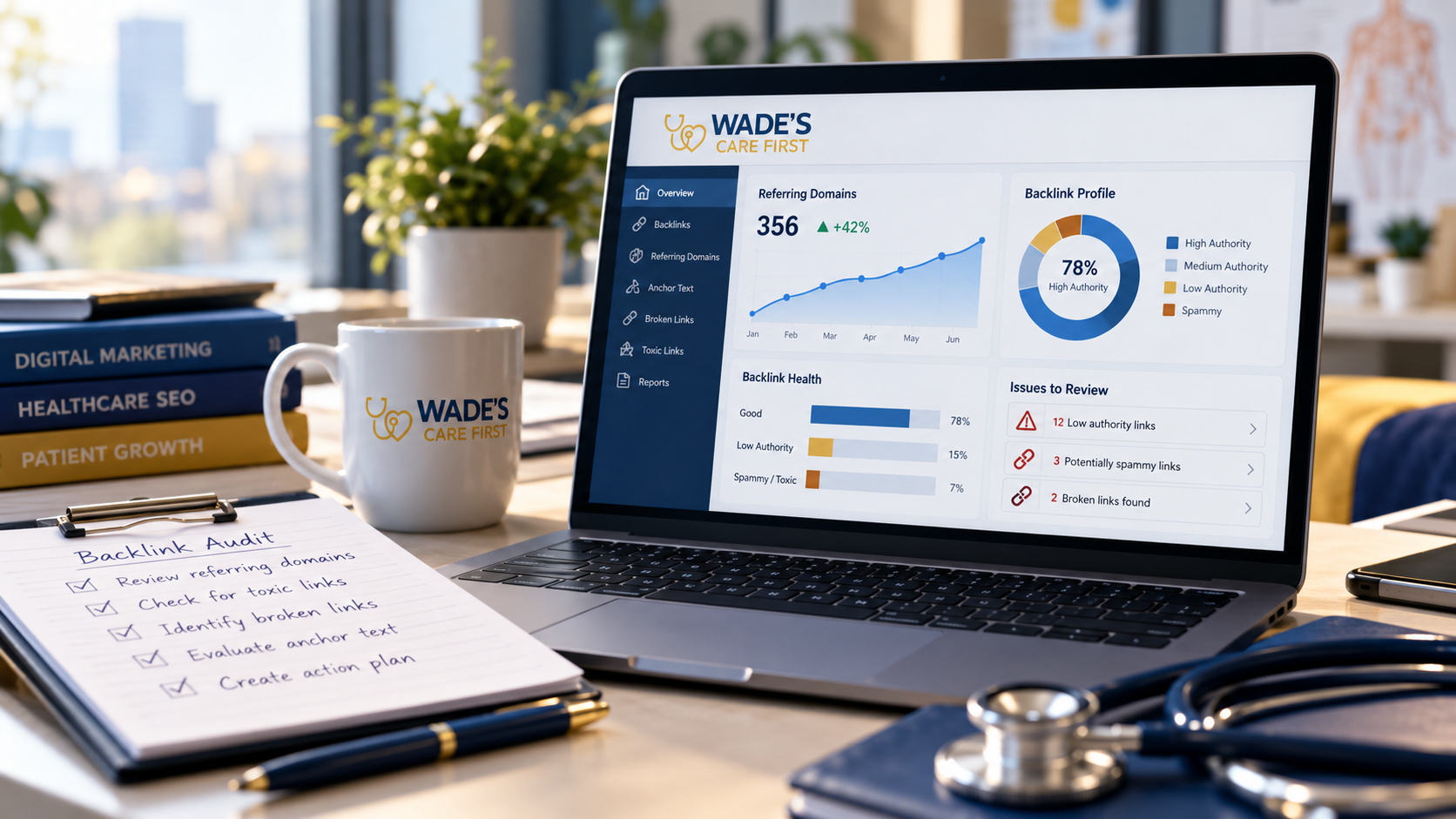
135 five-star reviews on Klarity. One organic visit a month to the practice's own website. That gap is the audit.
Prepared for: Wade's Care First — wadescarefirst.com
Provider: Charles E. Wade, FNP-BC · Wade's Care First Nurse Practitioner Services LLC
Model: Telehealth, Indianapolis-based, serving patients in nine states
Platform: WordPress (Elementor) · Athena patient portal
Data: Semrush backlink and organic overviews, pulled September 26, 2026 · third-party profiles verified individually the same day
Prepared by: Ritner Digital
Charles Wade has built something most small practices never manage: a large, loyal patient base that writes reviews. Klarity shows 135 reviews at 4.99 stars. Birdeye shows 47 at 5.0. The review text says the same thing over and over, that he listens and doesn't rush.
Almost none of that reaches wadescarefirst.com. Semrush estimates one organic search visit a month. AI visibility is zero. And the profiles where all those reviews live send patients to the booking platforms, not to the practice's own site.
This audit covers what's linking to the site, what isn't, and why the second list matters far more than the first. Like every audit we publish, it's the same work a new client's first month starts with, done in the open.
Part 1: The headline numbers
Semrush's read on wadescarefirst.com as of September 26, 2026:
Read quickly, the trend column looks encouraging. Referring domains more than doubled, backlinks grew by almost a third, and ranking keywords grew by nearly three-quarters.
Read properly, it says something else. A site that just more than doubled its linking domains should have gained authority. This one sits at an Authority Score of 6. It ranks for 285 keywords and gets an estimated one visit a month from them, and that one visit comes from someone searching "dr wades." ChatGPT, Gemini and Google's AI results aren't mentioning the practice at all.
For calibration: Victory SK, a four-truck freight carrier with almost no web presence, sat at an Authority Score of 2 when we audited it in August. Mount Holly Nissan, a franchise dealership with a decade of history, sat at 25. At 6, Wade's Care First is much closer to the carrier than the dealership, despite having 183 linking domains to the carrier's handful.
The reason is simple, and it's the thread through this whole audit. The links the site has are mostly noise. The links it should have are pointing somewhere else.
Part 2: Where the 183 referring domains come from
Break the linking domains down by their own authority and the picture gets clear fast.
Eighty-six percent of the sites linking to Wade's Care First have an Authority Score of 10 or below. Only three score above 30. There are no links from .gov or .edu domains, and none from a hospital, health system, medical association or health publisher that we could see in the overview.
The other breakdowns point the same way:
Top-level domains. Just 59% of linking domains are .com. Another 8% are .link domains and 7% are .shop domains. Neither is where medical referrals come from.
Countries. The U.S. and Moldova are tied as the top source of linking domains, at 16 each. A telehealth practice licensed in nine U.S. states has no reason to be earning links from Moldova.
Similar profiles. Semrush compares the site's backlink profile with others that share the same linking domains. The closest match, at 52%, is ckwellnessllc.com. The rest of the top five include a designer-shoe domain, an Indian site, a "billionaire" studio and an AI-branded site. Those are sites that happen to sit in the same link networks, not peers in healthcare.
Categories. Where Semrush could categorize the linking sites, the biggest groups are online services (18), IT (4) and advertising and marketing (4). Health doesn't appear in the top five.
This is the same pattern we documented in the Mount Holly Nissan audit: a layer of low-quality, often foreign directory and scraper domains that inflate the referring-domain count without adding authority. The recent jump — referring domains up 110% — is almost certainly more of that layer arriving, not a wave of real endorsements.
Two caveats, stated plainly. First, this doesn't mean anyone bought these links. Sites get pulled into scraper and spam networks all the time without the owner knowing, and a new site with a blog is an easy target. Second, Google is generally good at ignoring junk links rather than punishing a site for them. The practical cost is that the 183 figure is meaningless as a measure of trust. Only 26 of the 183 domains score above 10, so the number doing real work for the site is likely under 30. The full referring-domain export would confirm the exact count.
The healthier signs are real, but small. About 69% of links are followed rather than nofollowed, which is a natural ratio. The site is linked from 191 distinct IPs across 142 subnets, which means the noise isn't coming from one server farm. And the site's designer, DesignHornet, features it in a portfolio post that links to the homepage — a legitimate, editorial link, even if it isn't a medical one.
Part 3: Where the links land
Semrush's top-pages report shows which URLs the linking domains point to:
Three things stand out.
Almost all the equity sits on two versions of the homepage. Forty-five linking domains point at the homepage, split between the www and non-www addresses. That split is normal. What isn't normal is that Semrush recorded a 404 on the non-www address the last time it crawled it. When we checked it today it loaded the homepage, so the problem may already be fixed or intermittent. It's worth confirming that the non-www address returns a single, permanent 301 redirect to the www homepage every time, because 16 domains' worth of link equity depends on it.
One linked page is dead. The /blogs/ address earns links from three domains and returns a 404. Whatever blog index used to live there has moved, and nothing is catching the traffic. One redirect to the current blog page fixes it.
The content barely earns links. The site publishes long, well-sourced health articles. The eczema-versus-psoriasis post runs close to 3,000 words and cites the National Institute of Arthritis and Musculoskeletal and Skin Diseases and MedlinePlus. It has three linking domains. The ADHD post has two. No other article makes the top five linked pages. That's not a writing problem. As Part 5 explains, it's mostly a credibility problem that starts with the name at the top of each article.
The best links, annotated
Semrush's backlink list, sorted by the authority of the linking page, is short enough to walk through. Here is the top of it:
Each source links to the live page. We've deliberately left the three spam pages unlinked, as we did in the Mount Holly Nissan audit: sending readers or crawlers to link-seller pages helps no one.
Three patterns come out of that list.
The legitimate top of the profile is thin. The best link the site has is a review page with an Authority Score of 13. There's no insurer, no association, no hospital, no health publisher and no local news. Everything above the spam line is a directory, a bookmark, a coupon listing or a self-posted article.
Much of it looks like a low-cost off-site SEO package. Social bookmarks, articles posted to self-publishing sites under a practice account, general web directories and a coupon listing, most first seen between September and December 2025, are the classic ingredients of cheap link-building. That work has a short shelf life, which the data shows: the Yoomark link is already gone, and the two posted articles point at a blog URL that no longer exists. If a vendor was paid for this, the practice got very little lasting value from it.
The newest links are pure spam. Three pages first seen between September 10 and 20, 2026, sit on domains like casinopopular.online and bestonlinecasinogamescanada.online. Their titles advertise "premium PBN network" and "niche edit" backlinks, and their anchor text uses wadescarefirst.com itself, as in "Expert Niche Edit Links for wadescarefirst.com." Each page carries thousands of outbound links. We're deliberately not linking to them. They're the visible edge of the recent referring-domain jump, and they're the kind of link that belongs in a documented disavow review. The practice probably didn't order them. Spam networks put real domain names on their sales pages to look credible.
Part 4: The profiles that matter don't link home
Here's the finding that matters most. Charles Wade's reputation online is strong. It just lives almost entirely on other people's websites, and those websites send patients everywhere except wadescarefirst.com.
The three strongest profiles by review volume — Klarity, Birdeye and TherapyDen — all point their website field at Klarity. That's 182 reviews' worth of trust, sitting on pages that send every interested patient to a booking marketplace instead of the practice's own site. For search, it means the most credible endorsements of this provider pass nothing to his domain. For the practice, it means patients who might book directly are being routed through a platform.
We want to be fair to the setup. Klarity is a real source of patients, and there may be good business reasons to send people there. But a website field can hold only one link, and today it's never the practice's own. Where a profile has any other place to add a website — a bio, a practice description, a secondary link — wadescarefirst.com belongs in it.
The record doesn't agree with itself
The profiles also describe the practice in ways that don't match each other or the website:
Two Indianapolis addresses. Birdeye lists 7116 Waldemar Drive (46268). rater8 lists 6101 North Keystone, Suite 100 #1084 (46220). For a telehealth-only practice, the right move may be to show a service area rather than a street address at all, but whichever address is used should be the same everywhere.
Several phone numbers. The website lists (317) 765-0603 as the main line, plus separate text lines for Florida, New York, Arizona and Indiana. TherapyDen shows (219) 224-5805, which doesn't appear on the site.
Different state lists. The website says the practice serves nine states: Arizona, Florida, Illinois, Indiana, Kentucky, Michigan, Nevada, New York and Texas. Klarity lists six. TherapyDen says Indiana. A patient in Kentucky, Nevada or Texas checking a profile could reasonably conclude they aren't eligible.
Different prices. The website lists a $100 first visit and $50 follow-ups for mental health. TherapyDen shows $191–$224 a session.
Different names. "Charles Wade," "Charles E. Wade," "Charles Wade, FNP-BC," "Wade's Care First" and "Wade's Care First Nurse Practitioner Services LLC" all appear.
None of these is serious alone. Together, they're why search engines and AI tools can't confidently connect "the highly rated nurse practitioner on Klarity" with "the practice at wadescarefirst.com." It's also a big part of why AI visibility is zero. An AI engine recommends a provider when independent sources agree on who they are, where they practice and what they treat. Right now the sources describe what could be three or four different practices.
Two dead listings are still in Google
The Zocdoc practice page and the rater8 practice page both still appear in Google's results for "Wade's Care First," and both return 404s. A patient searching the practice's name can land on a dead page from a trusted brand. The fix is to either reactivate the listings or ask each platform to remove the old URL so Google drops it. The Psychology Today profile deserves a check too. The profile address Google indexes now opens the general Indianapolis directory, which usually means the profile is inactive.
Part 5: The content problem is a credibility problem
Wade's Care First publishes a lot of health content, and the keyword data shows it. Of the site's 285 U.S. ranking keywords, 278 — 94% — are informational: questions about acne scars, rashes, bronchitis, hair loss, Wellbutrin and menopause. The acne scars guide alone ranks for 84 keywords, and the Wellbutrin article for 25.
Almost none of those rankings are close enough to page one to matter:
Positions in the 40s through 80s mean page five through page nine. That's why 285 keywords produce one visit.
Two things are holding the content back, and neither is the writing.
Health content without a clinician's name on it
Google holds health and medical pages to its highest standard. Its quality guidelines call them "Your Money or Your Life" topics, and the question it asks is whether the page reflects real medical experience and expertise. The site has exactly the right answer: a board-certified family nurse practitioner who treats these conditions every day.
But the articles don't say so. The eczema-versus-psoriasis guide and the August Wellbutrin article are both bylined "bilal," with no credentials, no link to a bio, and no statement that a clinician reviewed them. To a search engine, and to a patient, these read as general web content written by someone unnamed. Charles Wade's credentials are the single strongest signal the site could send, and they're missing from the pages that need them most.
This is also why the content earns so few links. Health publishers, patient-education sites and local media link to content they can attribute to a credentialed source. "Bilal" gives them nothing to cite.
AI answers the question before anyone reaches the page
Semrush tracks which search features appear for the site's keywords. Of the 285, 272 show a Google AI Overview. People Also Ask shows on 280, and videos on 276. Wade's Care First isn't cited in any of them.
That's the environment for health questions in 2026. For "how do you get rid of acne marks," Google writes an answer at the top of the page, and a patient may never scroll to the results at all. The sources AI answers cite for health questions tend to be ones with clear medical authorship and institutional trust. General health explainers without a clinician's name on them are competing with the Cleveland Clinic and the Mayo Clinic, and they usually lose.
The fix isn't to stop publishing. It's to publish what only this practice can: a named clinician's view on questions he actually answers for patients, tied to the services he offers. Content like "When is it safe to start Wellbutrin through a telehealth visit?" or "What a $100 mental health visit actually includes," written or reviewed by Charles Wade and linked to booking, is something the big health sites can't write.
Part 6: Why the usual backlink playbook is wrong here
A generalist SEO looking at an Authority Score of 6 would sell a link-building package: guest posts, directory submissions, a monthly quota. For this practice, that makes things worse.
The profile already has too much low-quality volume. 157 of 183 linking domains are near-zero authority. Adding more of the same won't raise authority. It makes the profile look more like a link scheme, and health sites are judged more strictly than most.
Health links have to come from health, or from the community. The links that would move this site are from sources a patient or a clinician would trust: professional associations, insurers, telehealth directories, local organizations, health publications. None of them are for sale.
The biggest wins aren't new links at all. They're changing a website field on three profiles, fixing a redirect, and putting a clinician's name on the content. That's free, and it's worth more than a year of outreach.
Part 7: The roadmap, in priority order
Tier 1 — Point the record home (weeks 1–4, near-zero cost)
Add wadescarefirst.com to every profile that allows it. Start with Birdeye and TherapyDen, which currently point to Klarity. On Klarity, add the practice site wherever the profile allows it. If a profile allows only one website, decide deliberately which destination matters more for that platform's patients.
Choose one canonical record and use it everywhere. One practice name, one main phone number, one address or service-area setup, one list of states and one set of prices. Then update Birdeye, TherapyDen, rater8, Psychology Today, Doximity, US News, Klarity, Facebook, LinkedIn and Google Business Profile to match.
Fix the state list. If the practice serves nine states, every profile should say so. If some licenses are new or pending, the website should be accurate about which states are live.
Deal with the dead listings. Reactivate or remove the Zocdoc and rater8 practice pages. Check whether the Psychology Today profile is active.
Fix the two broken link targets. 301 /blogs/ to the current blog page. Confirm the non-www homepage returns a single 301 to the www homepage every time.
Pull the full referring-domain export, tag every link as followed or nofollowed, and separate the real links from the noise before building anything new.
Tier 2 — Put the clinician on the page (months 1–2)
Build a proper provider page for Charles E. Wade, FNP-BC. Credentials, board certification, NPI number, states licensed, years in practice, what he treats, and links to his Klarity, Doximity and US News profiles, so every source points to the same person.
Re-byline the health content. Articles written by staff should carry a "Medically reviewed by Charles E. Wade, FNP-BC" line with a review date, linked to the provider page. New articles should be written or reviewed by him from the start.
Add structured data. MedicalBusiness or MedicalClinic schema for the practice, Person schema for the provider with his credentials, and article schema that names him as author or reviewer. This is how search engines and AI tools connect the practice, the clinician and the content.
Tier 3 — Earn links from sources patients trust (months 2–6)
Insurer provider directories. The site lists Anthem, UnitedHealthcare, Aetna, Humana, Cigna, TriCare, Ambetter, Wellcare, MHS and Indiana Medicaid plans. Confirm the practice is listed in each insurer's directory with the right details, and with the website where the directory allows it.
Professional associations. National and state nurse practitioner associations and telehealth associations often keep member directories. They're relevant, trusted and rarely pursued.
Telehealth and mental health directories. Psychology Today (once reactivated), TherapyDen and similar platforms should all carry the website link.
Indianapolis community links. A local chamber membership, a community health event or a sponsorship produces links that tie the practice to a real place.
Tier 4 — Content that earns links on its own (months 3–12)
The practice has one asset most healthcare sites don't: published prices. A clear page explaining what a telehealth visit costs, with and without insurance, state by state, is exactly what local reporters and patient-advocacy sites link to. Pair it with guides only a telehealth nurse practitioner can write: which conditions are right for a video visit and which aren't, how ADHD evaluations work online, and what to expect from a medical weight-loss program. Each should be bylined or reviewed by Charles Wade.
Tier 5 — Clean up the noise, carefully (ongoing)
Once the export is reviewed, document the obvious spam domains, including the .link, .shop and Moldovan clusters. Monitor them, and file a disavow only if a manual review finds clearly manipulative links. Most of it can simply be ignored.
Part 8: What we would not do
No link packages or bulk directory submissions. The profile already has too much of both.
No purchased guest posts on health sites. In a medical niche, they carry real risk and little benefit.
No aggressive disavowing before the export has been reviewed by hand.
No new health content without a clinician's name on it. It's the single change that makes everything else work.
No moving patients off Klarity. It's clearly working for bookings. The goal is to make the practice's own site the hub the profiles point back to, not to pull the practice off a platform its patients use.
What success looks like, and when
Days 1–60. Profiles pointing home, one canonical record everywhere, dead listings handled, redirects fixed, provider page live and the health content re-bylined with a medical review line. Expect the site to start showing up for Charles Wade's name and the practice name more consistently. Don't expect much new traffic yet.
Days 60–180. Insurer and association listings in place, the first community links earned, and the first clinician-authored articles published. Expect Authority Score to move off 6, referring domains from real sources to grow even if the total count doesn't, and informational rankings to start climbing out of positions 40–90.
Days 180–365. Compounding. The goal is for search engines and AI tools to treat wadescarefirst.com, the Klarity profile and the reviews as one provider, and to name him when a patient in Indiana, Florida or New York asks for a telehealth nurse practitioner who takes their insurance.
Track four things: referring domains from real health and local sources (not the total), the number of profiles that link to the practice site, non-branded search impressions in Search Console, and appointments booked directly through the site rather than through a platform.
The short version
Wade's Care First doesn't have a link-count problem. It has 183 linking domains, and most of them are noise. What it's missing is the link between the practice's strong reputation and its own website.
The reviews are on Klarity and Birdeye. Those profiles send patients to Klarity. The health articles are signed by "bilal," not by the board-certified nurse practitioner who treats these conditions. And the profiles disagree about the address, the phone number, the price and even which states the practice serves.
Point the profiles home. Make the record agree. Put Charles Wade's name and credentials on the content. Then earn a small number of links from the places patients already trust: insurers, professional associations, telehealth directories and the Indianapolis community. That's how a practice with 135 five-star reviews stops getting one visit a month.
Frequently Asked Questions
Why is the Authority Score only 6 when the site has 183 linking domains?
Because 157 of those domains have an Authority Score of 10 or less, and many are directories, bookmarking sites, coupon pages and link-seller spam. Only 26 score above 10, and the best link on the site comes from a review page scoring 13. Authority comes from trusted sources vouching for you, not from the number of sites that mention your URL.
Are the spam links hurting the practice?
Probably not directly. Google is generally good at ignoring junk links rather than penalizing the site they point to. But they make the profile look worse than it is, and three brand-new link-seller pages carrying the practice's domain name belong in a documented disavow review.
Why don't the reviews on Klarity help the website?
Because Klarity, Birdeye and TherapyDen all point their website link to Klarity, not to wadescarefirst.com. The trust those 182 reviews represent stays on the platforms. Adding the practice site wherever the profiles allow it is the fastest win in this audit.
Does it matter who's named as the author of a health article?
Yes, more than almost anything else on a medical site. Google holds health content to its highest standard and looks for real medical expertise. An article signed by a board-certified nurse practitioner, or reviewed by one, carries far more weight than the same article signed with a first name and no credentials.
Why does the practice rank for so many keywords but get almost no traffic?
Because most of those 285 keywords rank on pages five through nine, and 272 of them show a Google AI Overview that answers the question before anyone scrolls. Rankings that deep produce impressions, not visits.
Should the practice stop using Klarity?
No. Klarity is clearly working for bookings, with 135 reviews to show for it. The goal is to make the practice's own website the hub that all the profiles point back to, so search engines and AI tools can connect the reviews to the practice.
How long will it take to see results?
Profile fixes and bylines register within weeks. Real authority from insurer, association and community links builds over two to three quarters. Expect meaningful movement in search and AI answers in six to twelve months.
What do you need to go deeper?
The full Semrush referring-domain export, access to Google Search Console and Analytics, and access to the Google Business Profile and the main provider profiles. That's enough to separate every real link from the noise and turn this into a single prioritized plan.
Questions, or ready to move forward?
This audit was built from Semrush's backlink and organic overviews, the practice's own site, and every provider profile we could verify individually. Everything in Tier 1 is actionable as written, and it's yours to run whether or not we work together.
If you'd like us to pull the full link export and build out the twelve-month plan, get in touch.
Sources verified
Semrush backlink overview, backlink list and organic overview for wadescarefirst.com, pulled September 26, 2026
Wade's Care First — What is the difference between eczema and psoriasis?
Wade's Care First — /blogs/ (returns 404)
rater8 practice page and Zocdoc practice page (both return 404)
Psychology Today profile URL (opens the Indianapolis directory)
Earlier Ritner Digital audits referenced: Mount Holly Nissan backlink audit (August 13, 2026); Victory SK backlink audit (August 31, 2026)