Can One Cleveland Business Rank in Multiple Suburbs?
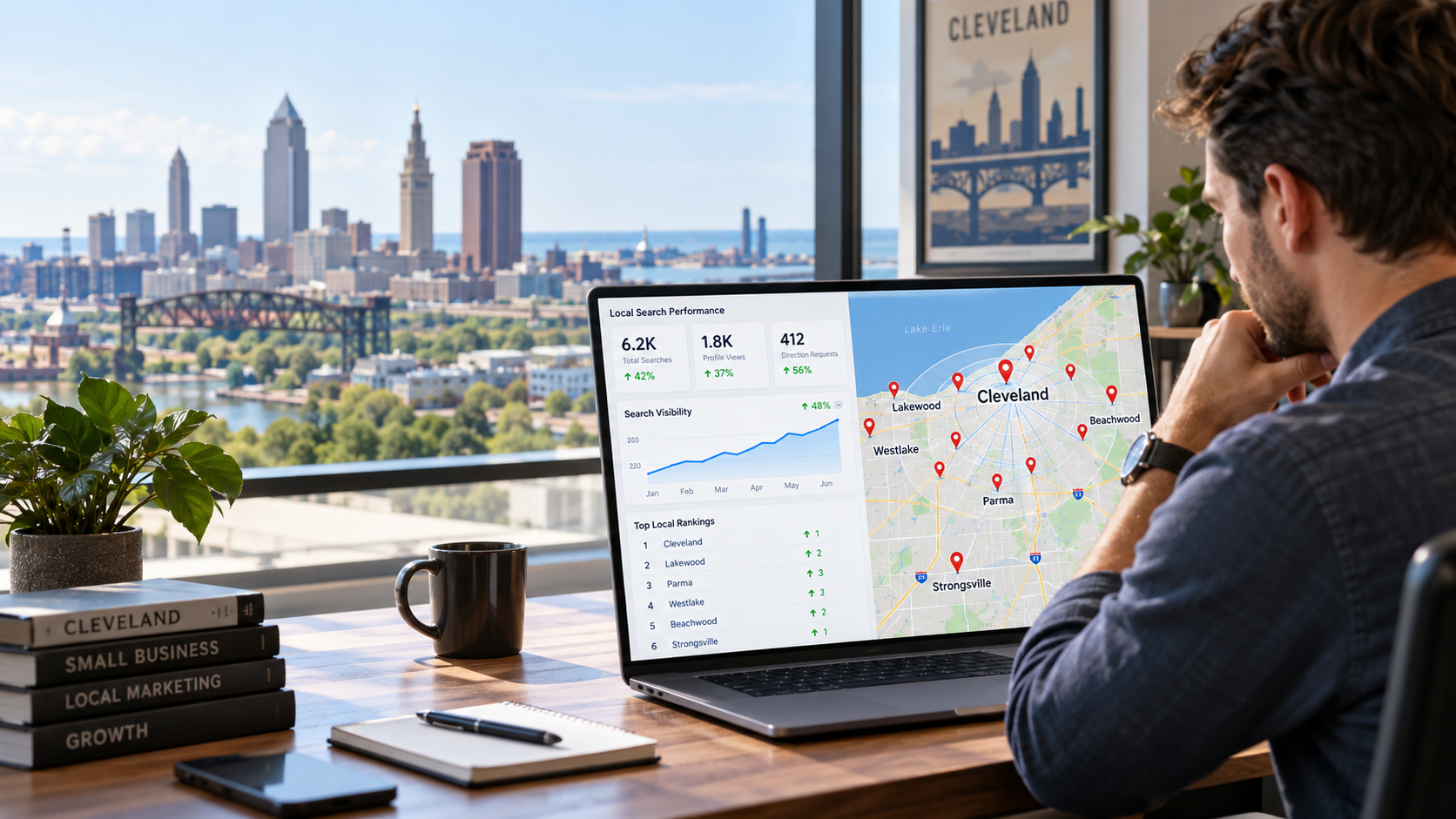
A Cleveland business may start with one simple SEO goal:
Rank in Cleveland.
Then the company grows.
Customers start coming from:
Lakewood
Parma
Westlake
Rocky River
Cleveland Heights
Beachwood
Strongsville
North Olmsted
Independence
Solon
Suddenly the question becomes more complicated:
Can one Cleveland business rank in multiple suburbs without having an office in every suburb?
Yes—but there is an important distinction.
A business can potentially build organic search visibility across many Cleveland-area suburbs from one legitimate location.
Google Maps is different.
Google explicitly says local results are primarily based on relevance, distance, and prominence. Distance refers to how far the business is from the person performing the search.
That means a roofing company based near Cleveland may rank strongly in Google Maps near its location but appear differently when the same search is performed from Westlake, Parma, Beachwood, or Strongsville.
No SEO strategy can remove physical distance from Google's local-ranking system.
But that does not mean a company must accept visibility only within a few miles of its office.
A strong geographic SEO strategy can combine:
Google Business Profile optimization
Service-area settings
Dedicated service pages
Useful suburb pages
Local organic SEO
Reviews
Local links
Project and case-study content
Internal linking
Geographic rank tracking
Conversion tracking
to build visibility across a much larger portion of Northeast Ohio.
The key is understanding what can realistically expand—and what cannot.
The Short Answer: Yes, but Google Maps and Organic SEO Behave Differently
Imagine a plumbing company physically based in Cleveland.
It wants customers from:
Cleveland
Lakewood
Parma
Westlake
Rocky River
Cleveland Heights
Can it rank in all six?
Potentially.
But it probably will not rank identically in every search environment.
Consider two types of results.
This distinction matters because businesses often use the phrase:
“Rank in Parma.”
But that could mean several different things.
Do you want:
A Google Maps listing visible to someone physically standing in Parma?
An organic page ranking for “plumber Parma Ohio”?
Your business recommended in AI search for Parma-area plumbing?
Visibility when someone in Cleveland types “plumber Parma”?
Those are different search scenarios.
Why Google Maps Rankings Change From Suburb to Suburb
Google states that local results are mainly determined by:
Relevance
Distance
Prominence
Distance is the critical geographic limitation.
If someone searches:
plumber near me
from Lakewood, Google's understanding of that person's location matters.
If another person performs the same search from Beachwood, the competitive set may change dramatically.
Your company has not moved.
The searcher has.
That is why local rankings can look completely different only a few miles apart.
A #1 Google Maps Ranking Is Not a City-Wide Ranking
One of the most misleading ways to measure local SEO is:
Search your keyword from your office.
See yourself near the top.
Assume everyone across Greater Cleveland sees the same thing.
They may not.
A Cleveland HVAC company could appear strongly around its physical location but fade as the search point moves farther away.
That is not necessarily an SEO failure.
It may be the normal effect of Google's distance factor.
Whitespark's 2026 Local Search Ranking Factors survey—a third-party expert survey rather than Google's official ranking formula—ranked proximity of the business address to the searcher's location as one of the strongest perceived Local Pack/Maps factors. It also ranked having a physical address in the city of search highly.
Google's official explanation is simpler:
Distance matters.
Can a Service-Area Business List Multiple Cleveland Suburbs?
Yes.
Eligible service-area and hybrid businesses can define service areas in their Google Business Profile.
Google says service areas can be based on:
Cities
Postal codes
Other defined areas
and currently allows businesses to specify up to 20 service areas. Google also recommends keeping the overall service-area boundary to roughly two hours of driving time from the business's base, although some businesses may appropriately serve larger areas.
A Cleveland contractor might legitimately list areas such as:
Cleveland
Lakewood
Parma
Westlake
Strongsville
Rocky River
North Olmsted
if it genuinely serves customers there.
But this setting is often misunderstood.
Adding a Service Area Does Not Create a New Location
Suppose your plumbing company is based in Cleveland.
You add:
Westlake
to the service-area section of your Google Business Profile.
You have now told customers:
We serve Westlake.
You have not created:
a Westlake office.
Google's Business Profile guidelines make clear that service-area businesses generally have one profile for their central office or location. Businesses with distinct locations can have separate profiles when those locations are legitimate and separately staffed.
Do not assume that adding 20 service areas makes your physical location equally competitive in Google Maps across all 20 areas.
Service Areas Are Not a Substitute for Proximity
This is one of the most important concepts in Cleveland geographic SEO.
Suppose a roofing business is located near Downtown Cleveland.
Its Business Profile lists:
Cleveland
Parma
Westlake
Beachwood
Strongsville
That accurately communicates where it works.
But the physical business is still located where it is located.
Adding Westlake as a service area does not make the company geographically located in Westlake.
The 2026 Whitespark survey is useful context here: contributors viewed proximity as extremely influential for Local Pack visibility while assigning relatively little ranking influence to simply setting service areas in a Google Business Profile. Again, that is industry survey data—not Google's published algorithm.
The takeaway is practical:
Use service areas accurately, but do not treat them as a Maps-ranking shortcut.
Do Not Create Fake Offices in Every Cleveland Suburb
A common attempt at geographic expansion looks like this:
Need to rank in Westlake? Rent a mailbox.
Need to rank in Parma? Use a virtual office.
Need Beachwood? Add another coworking address.
That creates serious Business Profile eligibility problems.
Google says businesses should create profiles for their actual real-world locations. Virtual offices are not eligible unless the location meets Google's requirements, and coworking offices generally need clear signage, customer access during business hours, and staffing by the company's own team during those hours.
A service-area business without a storefront should not manufacture fake locations to manipulate Maps visibility.
Build the legitimate business footprint.
Do not invent one.
When Can a Business Have Multiple Google Business Profiles?
Multiple profiles can be appropriate when the business truly has multiple locations.
Google says service businesses with distinct locations may have separate profiles when the locations have separate service areas and separate staff.
For example, suppose a Cleveland HVAC company expands and opens a legitimate second operation in Westlake with:
Permanent business operations
Appropriate staffing
A real business presence
Separate service territory
That is different from renting an address solely for Google Maps.
The question is not:
“Can I get another address?”
It is:
“Did my business actually open another legitimate location?”
Organic SEO Gives Businesses More Geographic Flexibility
Google Maps is strongly affected by physical geography.
Traditional organic search gives businesses more flexibility.
A contractor based in Cleveland can potentially rank an organic page for:
roof repair Westlake
even if its primary office is not in Westlake—assuming it legitimately provides the service there and creates a useful page that deserves to rank.
That page has to compete based on factors such as:
Search intent
Content quality
Website authority
Internal linking
External links
Geographic relevance
Competition
This is where location pages can become useful.
What Is a Location Page?
A location page is a page focused on serving customers in a particular geographic area.
For example:
/locations/lakewood/
/locations/parma/
/locations/westlake/
/locations/cleveland-heights/
A strong location page explains more than:
We serve Westlake.
It should help a Westlake-area customer decide whether the company is a good fit.
What Should a Cleveland Suburb Page Include?
A useful suburb page might contain:
Clear Geographic Heading
Example:
Plumbing Services in Lakewood, Ohio
Services Available
Explain which services are genuinely offered there.
Relevant Local Experience
Mention real work the company has performed in that market when applicable.
Customer Problems
Explain the common reasons someone might need the service.
Project Examples
Real projects can provide meaningful local specificity.
Reviews
When appropriate, include legitimate testimonials from customers in or near the service area.
Service Process
Explain how scheduling and service work.
Geographic Coverage
Clarify surrounding communities or neighborhoods served.
FAQs
Answer actual questions local customers have.
CTA
Make it easy to call, request a quote, schedule an appointment, or contact the business.
What Makes a Location Page Worth Creating?
Do not create a page simply because a suburb exists.
A location page makes more sense when the business can answer “yes” to several questions:
This prevents geographic SEO from becoming an exercise in mass-producing city names.
The Biggest Location-Page Mistake: Copy, Paste, Replace the City
Consider these pages:
Plumber in Lakewood
We are your trusted plumber serving Lakewood. Call today for plumbing services in Lakewood.
Plumber in Parma
We are your trusted plumber serving Parma. Call today for plumbing services in Parma.
Plumber in Westlake
We are your trusted plumber serving Westlake. Call today for plumbing services in Westlake.
If the only meaningful difference is the city name, you have not built useful local content.
You have built templates.
Google's spam policies specifically address doorway abuse, including pages targeted at specific regions or cities that funnel users toward the same destination and substantially similar pages created primarily to capture search queries.
Google also defines scaled content abuse as creating many pages primarily to manipulate rankings rather than help users, particularly when those pages provide little original value.
The lesson is straightforward:
Do not build 100 suburb pages just because software makes it easy.
Useful Location Pages Should Earn Their Existence
Ask:
Would this page still be useful if Google did not exist?
That is a powerful test.
Would someone in Lakewood genuinely benefit from the Lakewood page?
Does it tell them:
Whether you serve them
Which services are available
How quickly you typically reach the area
What kinds of work you perform there
What local customers say
What the process looks like
If yes, the page has a purpose.
If its only purpose is repeating:
“keyword + Lakewood”
20 times, reconsider it.
Google's current people-first content guidance emphasizes original, substantial content that helps visitors accomplish a real goal rather than pages created primarily to attract search traffic.
Service Pages and Location Pages Do Different Jobs
A strong multi-suburb SEO strategy usually needs both concepts.
A service page explains:
What do you do?
A location page explains:
Where do you do it?
For example:
Service Pages
/roof-repair/
/roof-replacement/
/commercial-roofing/
Location Pages
/locations/cleveland/
/locations/lakewood/
/locations/westlake/
The pages can support each other through internal links.
Do You Need a Separate Service × City Page for Every Combination?
Usually not.
Imagine:
10 services
multiplied by:
15 suburbs
That produces:
150 pages.
Could all 150 pages be legitimately useful?
Possibly—but for many businesses, probably not.
A better starting architecture might be:
Strong main service pages
Strong primary location pages
Select service-location pages only where demand and unique content justify them
For example, a roofing company may have:
/roof-repair/
/roof-replacement/
/locations/westlake/
Then, if data shows exceptional demand and the company has substantial Westlake-specific experience with roof repair, it might eventually justify:
/westlake-roof-repair/
But the page should exist because it provides unique value—not because an SEO spreadsheet found another keyword permutation.
Can the Homepage Rank Across Multiple Suburbs?
Sometimes.
An authoritative homepage can appear for searches outside the company's immediate city.
But forcing the homepage to target:
Cleveland plumber
Lakewood plumber
Parma plumber
Westlake plumber
Beachwood plumber
Strongsville plumber
all at once usually creates awkward content.
The homepage should provide a strong overview of:
Business
Core services
Primary market
Broader service area
Trust signals
Calls to action
Then detailed service and geographic pages can handle more specific intent.
How Should You Choose Which Cleveland Suburbs to Target First?
Do not pick suburbs based only on size.
Start with business data.
Look at:
Existing customers
Revenue by ZIP code
Lead quality
Average job value
Travel time
Closing rate
Competition
Search demand
Profitability
A suburb with fewer searches may be dramatically more valuable if:
Jobs are larger
Customers close more often
Travel is efficient
Competition is weaker
Revenue Geography Is More Important Than Vanity Geography
Suppose a basement-waterproofing company gets leads from:
The company should not prioritize markets purely by lead count.
The better questions are:
Which markets close?
Which produce profitable jobs?
Which have affordable acquisition costs?
Which fit operational capacity?
SEO should support the business—not merely increase the number of ranking reports.
Start With Existing Geographic Momentum
Google Search Console can help reveal queries and pages already earning impressions.
You might discover the website already appears for:
roofer Lakewood
roof replacement Westlake
storm damage Parma
without dedicated geographic pages.
That can indicate existing relevance.
Then evaluate:
Is the current page the right destination?
If not, a stronger location page may be justified.
Google Maps Expansion Should Be Measured Geographically
Searching from one device is not enough.
Imagine a business physically located in Cleveland.
A single search from the office might show:
Position 2
That does not mean the business ranks #2 throughout Greater Cleveland.
A better local SEO measurement system uses multiple geographic search points.
For example:
The exact pattern will depend on the business, competitors, category, and searcher's location.
The point is:
local visibility forms a geographic footprint.
It is not one ranking number.
Build a Local Ranking Grid
A geographic rank grid can measure the same keyword from multiple points.
For example:
HVAC company
could be checked throughout:
Cleveland
Lakewood
Parma
Westlake
Cleveland Heights
This helps answer:
Where are we visible?
Where does visibility decline?
Where did the campaign improve?
Where does distance appear to dominate?
Grid tracking is especially useful for Google Maps because Google officially acknowledges distance as part of local ranking.
Do Not Expect a Perfect Green Grid Across Northeast Ohio
Geographic rank tracking can become addictive.
Businesses may see weaker rankings farther away and immediately demand:
“Make every grid point #1.”
That may be unrealistic.
If competitors are physically closer to searchers and equally relevant/prominent, distance may work against you.
The goal should not necessarily be:
#1 everywhere.
It should be:
profitable visibility across the markets that matter.
Reviews Can Support Geographic Expansion
Reviews help customers evaluate businesses, and Google says review quantity and positive ratings can contribute to local prominence.
For geographic expansion, reviews can also naturally demonstrate service reach.
For example, legitimate reviews may say things such as:
They repaired our furnace in Lakewood.
or:
We hired them for a roof replacement in Westlake.
Do not coach customers to stuff keywords into reviews.
Ask for genuine feedback.
Real customer experiences can naturally reinforce where and how your company works.
Reviews Also Affect Whether Searchers Choose You
Ranking is only one stage.
BrightLocal's July 2026 consumer research found that local searchers evaluate factors including:
Proximity
Star ratings
Review quantity
Complete business information
Pricing
Photos
Service category
Only 6% of surveyed consumers said they simply selected the top result.
That matters for suburb expansion.
A business ranking third in Westlake with:
Excellent reviews
Strong photos
Clear services
Good information
may still earn meaningful leads.
Ranking is visibility.
Conversion depends on what customers see after finding you.
Build Local Proof, Not Just Local Keywords
Want to strengthen relevance in a suburb?
Do not simply repeat the suburb name.
Build proof.
Examples include:
Completed projects
Case studies
Before-and-after photos
Customer testimonials
Local partnerships
Local sponsorships
Local media mentions
Community involvement
Helpful area-specific information
Imagine a roofing company creating:
Westlake Roof Replacement Case Study
with:
Actual project photos
Roof type
Problem discovered
Materials used
Work performed
Outcome
That provides considerably more geographic evidence than inserting “Westlake” 18 times into generic copy.
Local Links Can Strengthen Geographic Authority
A business expanding across Northeast Ohio should look for legitimate relationships in its target markets.
Potential sources include:
Chambers of commerce
Industry associations
Local organizations
Sponsorships
Suppliers
Community groups
Local publications
Whitespark's 2026 survey ranked geographic relevance and authoritative inbound links highly among perceived local-organic factors.
Again, the study reflects expert opinion rather than Google's official ranking formula.
But the strategic principle is useful:
Real involvement creates real local signals.
Build Separate Content Only When There Is Something Local to Say
Different suburbs can produce genuinely different content opportunities.
For home-service companies, that might include:
Housing types
Common property issues
Local project examples
Service logistics
Common customer questions
But be careful.
Do not invent “local facts” merely to make pages appear unique.
If the company's actual service is identical in Lakewood and Parma, it is okay to say so.
Uniqueness should come from real usefulness—not fabricated geographic trivia.
Multi-Location Businesses Need a Different Strategy
Suppose a company genuinely operates locations in:
Cleveland
Westlake
Beachwood
Each legitimate location can have its own:
Location page
Business Profile, when eligible
Address
Hours
Phone information
LocalBusiness structured data
Google's structured-data documentation recommends defining each actual local business location as a LocalBusiness entity and using the most specific applicable business subtype.
That is a very different situation from a one-location service-area business.
Do not confuse:
areas served
with:
business locations.
Structured Data Does Not Create Locations
Schema markup is helpful for communicating structured business information.
It is not a loophole.
If your business has one physical location, adding fake LocalBusiness schema for:
Lakewood office
Parma office
Westlake office
does not make those locations real.
Structured data should represent actual business information.
Google's documentation specifically treats LocalBusiness markup as information about a physical business location.
Keep markup consistent with reality.
Can a Cleveland Service-Area Business Hide Its Address?
Yes.
Google says service-area businesses that do not serve customers at their business address should remove or hide that address from customers and configure the profile as a service-area business.
For example, a plumber operating from a residential home should not present that residence as a customer-facing storefront if customers are not served there.
Accurate eligibility matters more than trying to game proximity.
Does Hiding the Address Mean Google Does Not Know Where the Business Is?
No.
The underlying verified business still has a real geographic basis.
Hiding an address from customers does not turn the company into a locationless business.
This is another reason why listing additional service areas should not be viewed as a way to relocate the business algorithmically.
Should You Put Every Suburb in the Footer?
You have probably seen websites with footers containing:
Cleveland | Lakewood | Parma | Westlake | Strongsville | Solon | Beachwood | Rocky River | Avon | Mentor | Euclid | Independence | North Olmsted...
A short service-area list can help users.
But hundreds of keyword-heavy city links can become cluttered.
If you have meaningful location pages, organize them within a real site hierarchy.
For example:
Locations
→ Cleveland
→ Lakewood
→ Parma
→ Westlake
→ Strongsville
This is easier for users and easier to maintain.
Internal Linking Helps Connect Geography and Services
Suppose you have:
Roof Replacement
and:
Westlake
pages.
The roof-replacement page might naturally mention:
We provide roof replacement throughout Cleveland's western suburbs, including Westlake.
That can link to the Westlake location page.
The Westlake page can then link to:
Roof repair
Roof replacement
Storm damage
This creates a clear relationship between:
what you do
and:
where you do it.
Should Every Suburb Page Link to Every Service?
Not necessarily.
Link based on usefulness.
If the business offers every service in the suburb, linking to major services can make sense.
But avoid enormous blocks containing dozens of mechanically inserted keyword links.
Build navigation for customers.
How Many Suburbs Should You Target?
There is no ideal number.
A local medical office might primarily target a relatively tight radius because patients strongly value proximity.
A specialized commercial contractor might work throughout Northeast Ohio.
BrightLocal's 2026 consumer research found that proximity mattered strongly in local decision-making overall, though its importance varied by industry.
Your geographic SEO footprint should follow:
where customers will realistically buy from you.
Not:
every city keyword an SEO tool can generate.
A Practical Cleveland Geographic Expansion Model
A useful expansion strategy can occur in phases.
Phase 1: Win the Core Market
Strengthen:
Main Cleveland visibility
Google Business Profile
Core service pages
Reviews
Technical SEO
Conversion tracking
Phase 2: Expand Into Adjacent High-Value Suburbs
Choose markets based on:
Existing customers
Revenue
Travel efficiency
Search opportunity
For example:
Lakewood
Parma
Cleveland Heights
Phase 3: Build Regional Depth
Expand into strategically important communities such as:
Westlake
Strongsville
Beachwood
Solon
depending on the business.
Phase 4: Measure Profitability
Track:
Rankings
Maps coverage
Traffic
Calls
Forms
Qualified leads
Customers
Revenue
Phase 5: Expand or Consolidate
Invest more where geography produces business.
Do not maintain pages that provide no strategic value simply because they exist.
Prioritize Suburbs With a Scorecard
A Cleveland company could use a model like this:
This shifts the conversation from:
“Which cities can we rank for?”
to:
“Which cities are worth ranking for?”
That is a much better business question.
Organic Expansion Can Sometimes Reach Farther Than Maps
Imagine a contractor 15 miles from a target suburb.
Google Maps visibility may weaken because nearby competitors have a proximity advantage.
But a well-built organic page may still rank for:
roofing company [suburb]
because traditional organic results are not identical to the Local Pack.
This is why businesses trying to expand geographically should not build their entire strategy around the Maps three-pack.
Use both:
Google Maps
and:
organic SEO.
Your Website Becomes More Important as Geography Expands
The farther you expand beyond the immediate area surrounding your Business Profile, the more valuable your website can become.
A strong website gives you room to explain:
Services
Locations
Projects
Expertise
Customer questions
Pricing
Case studies
That can create organic entry points in markets where Maps visibility is harder.
It may also matter as local discovery expands into AI-assisted experiences.
What About AI Search Across Different Suburbs?
AI-assisted local search is developing quickly.
BrightLocal's September 2026 Local AI Visibility Study analyzed more than 200,000 localized prompts and found that results varied when the same prompt was run from different geographic points—even within the same city. It also found that business websites represented a substantial share of cited sources in its dataset.
That suggests geographic visibility is not becoming less important as search evolves.
It is becoming more fragmented.
Your business may need to be understandable across:
Google Maps
Organic Google results
AI Mode
ChatGPT
Other AI-assisted discovery tools
Clear location and service information helps establish where the company operates.
Google Still Matters for Local Discovery
Despite rapid growth in AI search, Google's ecosystem remains central to local business discovery.
BrightLocal's July 2026 consumer study reported that 52% of respondents started their most recent local-business search on Google Search and another 9% started with Google Maps. It also found that 75% used more than one channel during the journey.
That means Cleveland businesses should not abandon traditional local SEO.
They should broaden it.
Common Geographic SEO Mistakes
Creating Fake Google Business Profiles
Do not manufacture locations to increase Maps reach.
Creating 100 Duplicate City Pages
Location pages should provide unique value.
Adding Every Possible Service Area
Only list areas you genuinely serve.
Assuming Service Areas Override Distance
They do not turn one location into 20 locations.
Tracking Rankings From One Computer
Local rankings change geographically.
Ignoring Organic Search
Maps is only one search surface.
Ignoring Conversion
Ranking in a suburb is pointless if the leads are unprofitable.
Expanding Too Quickly
Win strategically important markets before spreading resources thin.
Ignoring Real Customer Geography
Your CRM may reveal better opportunities than keyword tools.
Frequently Asked Questions
Can one Cleveland business rank in multiple suburbs?
Yes.
A Cleveland-area business can potentially build organic visibility across many suburbs.
Google Maps visibility may vary significantly because Google uses distance as one of its primary local-ranking factors.
Can I rank in Lakewood if my business is in Cleveland?
Potentially.
Organic pages can rank outside your physical city if they are relevant, useful, and competitive.
Google Maps rankings may be more difficult because distance affects local results.
Can I rank in Parma without a Parma address?
Organic visibility is possible without a physical Parma office.
Google Maps visibility may vary depending on the searcher's location, competing businesses, relevance, and prominence.
Do not create a fake Parma address solely for SEO.
Does adding a suburb to my Google Business Profile service area help me rank there?
A service area tells customers where you provide services.
Google currently allows eligible businesses to specify up to 20 service areas.
However, adding an area does not create a physical location in that city or eliminate Google's distance factor.
How many service areas can I add to Google Business Profile?
Google currently allows eligible service-area and hybrid businesses to add up to 20 service areas.
Only add areas you genuinely serve.
Should I create a page for every Cleveland suburb?
No.
Create location pages where:
You genuinely serve the area
There is business value
Search demand exists
You can provide useful local information
Avoid mass-producing near-identical city pages.
Are duplicate city pages bad for SEO?
Substantially similar pages created primarily to capture geographic searches can become a problem.
Google's spam policies specifically identify doorway pages targeting regions or cities and scaled low-value page creation as abusive practices.
What makes a good suburb page?
Useful location pages can include:
Services available
Real project examples
Testimonials
Area-specific information
Service process
FAQs
Contact information
The page should genuinely help someone in that market.
Should I create separate service and location pages?
Often, yes.
Service pages explain what you do.
Location pages explain where you do it.
They can support one another through internal linking.
Should I create a service page for every suburb?
Not automatically.
Avoid creating every possible service × suburb combination unless each page has real demand and enough unique value to justify its existence.
Can my Google Maps ranking be different in Cleveland and Westlake?
Absolutely.
Google explicitly uses distance when determining local rankings, so the same business can appear differently when searches are performed from different locations.
How should I track suburban Google Maps rankings?
Use geographic rank tracking from multiple points rather than checking one search from your office.
Measure visibility throughout the actual markets you want to serve.
Can reviews help me expand into suburbs?
Reviews can support prominence and conversion.
Google says more reviews and positive ratings can help local ranking.
Genuine reviews may also naturally demonstrate that you serve customers throughout your market.
Should reviews mention city names?
Do not script keyword-stuffed reviews.
Ask customers for genuine feedback.
If customers naturally mention where they live or where work occurred, that is authentic.
Can local backlinks help?
Legitimate local links and mentions can strengthen the website's authority and local presence.
Prioritize real relationships rather than manufactured link schemes.
Can I open another Google Business Profile to rank in another suburb?
Only when another profile is legitimately eligible.
Google permits separate profiles for qualifying distinct locations, but virtual offices and fake addresses generally do not qualify.
Does LocalBusiness schema help me rank in multiple suburbs?
Structured data helps search engines understand factual business information.
It does not create additional physical locations.
Use LocalBusiness markup to accurately represent legitimate business locations.
Can service-area businesses hide their address?
Yes.
Google says businesses that travel to customers and do not serve customers at their business address should remove the address from public display and use service-area settings.
Should I target Cleveland first before suburbs?
For many businesses, strengthening the core market first makes sense.
Then expand based on actual customer and revenue data.
But the best order depends on where your profitable customers already come from.
Which Cleveland suburbs should I target?
Prioritize suburbs using:
Existing customers
Revenue
Lead quality
Search demand
Profitability
Travel efficiency
Competition
Geographic feasibility
Do not prioritize solely by population.
Is it easier to rank organically or in Maps outside my city?
It depends on competition, but organic SEO often provides more geographic flexibility because Maps is explicitly affected by physical distance.
A strong organic location page may reach customers where your Maps visibility is weaker.
Can one website rank for Cleveland, Lakewood, Parma, Westlake, and other suburbs?
Yes.
One authoritative website can contain distinct service and location pages targeting different legitimate customer intents.
The goal is not to create separate domains for every city.
Build one coherent regional website.
One Cleveland Business Can Build a Regional Search Footprint
A company does not need an office in every Cleveland suburb to build meaningful regional search visibility.
But geographic SEO has limits.
You cannot simply type:
Lakewood
Parma
Westlake
Beachwood
into your Google Business Profile and expect to rank equally everywhere.
Distance still matters.
Your real location still matters.
Competitors still matter.
The better strategy is to separate the problem into two parts.
For Google Maps, strengthen:
Business Profile relevance
Reviews
Prominence
Complete business information
Accurate service areas
Local authority
while accepting that distance can constrain visibility.
For organic SEO, build:
Strong service pages
Useful suburb pages
Internal links
Local project content
Reviews
Case studies
Local backlinks
Clear website architecture
Then track performance geographically.
Do not ask only:
“Do we rank?”
Ask:
“Where do we rank?”
“For which service?”
“From which search location?”
“Which suburb generates qualified leads?”
“Which suburb produces revenue?”
That is how Cleveland businesses move from local SEO to regional market expansion.
The goal is not to cover a map with city-name pages.
The goal is to build a real search presence wherever the company's best customers are located.
Sources
Google Business Profile Help — Improve Your Local Ranking. Google's official documentation explaining that local results are mainly based on relevance, distance, and prominence.
Google Business Profile Help — Manage Service Areas. Google's current guidance for service-area and hybrid businesses, including its 20-area limit and recommendations for defining realistic service territories.
Google Business Profile Help — Guidelines for Representing Your Business. Official policies covering service-area businesses, multiple locations, virtual offices, coworking spaces, addresses, and location eligibility.
Google Business Profile Help — Service Businesses Overview. Google's current description of service-area and hybrid businesses and how their profiles appear in Search and Maps.
Google Search Central — Spam Policies. Google's current policies on doorway abuse and scaled content abuse, including substantially similar geographic pages created primarily to capture search traffic.
Google Search Central — Creating Helpful, Reliable, People-First Content. Google's guidance emphasizing original, substantial content created to help users rather than primarily manipulate search rankings.
Google Search Central — LocalBusiness Structured Data. Official guidance for accurately representing real local business locations with structured data.
Whitespark — 2026 Local Search Ranking Factors. Third-party expert survey covering perceived Local Pack, local-organic, and AI-search factors, including proximity, physical city location, geographic relevance, dedicated service pages, internal linking, and local authority.
BrightLocal — Consumer Search Behavior 2026. Research published July 2026 examining how consumers use Google Search, Google Maps, mobile devices, AI tools, and multiple discovery channels to find local businesses.
BrightLocal — Local Business Decision Research 2026. Research published July 2026 examining proximity, reviews, complete business information, pricing, photos, and other factors consumers consider when choosing local businesses.
BrightLocal — Local AI Visibility Study 2026. September 2026 study analyzing more than 200,000 localized AI prompts and geographic variation in local business recommendations.
Expand Your Cleveland SEO Footprint Strategically
Ritner Digital helps Cleveland businesses expand local search visibility across Northeast Ohio using Google Maps optimization, suburb and location pages, service-page SEO, local authority building, review strategy, geographic rank tracking, and lead attribution.
If your company already performs work in Lakewood, Parma, Westlake, Cleveland Heights, Beachwood, Strongsville, or other surrounding communities but is not consistently being found there, we can identify which markets offer the strongest opportunities and build a geographic SEO strategy around qualified leads and revenue—not just city-name rankings.