
The Podcast
Ritner Digital Podcast
Marketing, Business & Beyond · Hosted by Cara Bunda
Short, honest conversations about why people notice, trust, and choose a business. AI search, SEO case studies, celebrity brands, South Philly bakeries, and the lessons hiding in all of it.
- 10Episodes
- ~10Minutes each
- 2Ways to listen
Latest Episode · Ep. 10
Meghan Markle’s As Ever: Celebrity Hype vs. Customer Loyalty
A $12 jar of raspberry spread. A celebrity founder. A first collection that reportedly sold out in less than an hour. But what does a sellout actually prove?
All Episodes
Start anywhere
-
 11:15
Meghan Markle’s As Ever Brand AnalysisCelebrity hype vs. customer loyalty.
A $12 jar of raspberry spread sold out in under an hour. Cara breaks down how As Ever built a lifestyle brand around emotion, exclusivity, and everyday luxury, what a sellout actually proves, and five branding lessons any business can use.
Read the blog postAs Ever Brand Analysis: How Meghan Markle Built a Lifestyle Brand Around Emotion, Exclusivity, and Everyday LuxuryRead the transcript1,595 words · about 7 min read
A jar of jam is not particularly revolutionary. You can buy one at a grocery store, or make one in your own kitchen. And yet, in the spring of twenty twenty-five, a twelve dollar jar of raspberry spread became the center of a global conversation about celebrity, exclusivity, and what people are really buying when they buy a brand. The first collection sold out in under an hour. So what was in the jar? And what happens when the spotlight moves on?
Welcome to the Ritner Digital Podcast. I'm Cara Bunda, and this is episode ten. Last time, we went to a home party. This time, we're standing in front of a pantry shelf. A few notes first. This episode is based on a post from our blog, called As Ever Brand Analysis. It's a marketing case study. It's not a product review, and it's not advice about whether to buy from the brand. We're not endorsing or criticizing the company or its founder. We're looking at strategy. Let's get into it.
First, what is As Ever? It's a lifestyle brand founded by Meghan, Duchess of Sussex, built around cooking, entertaining, home, and gifting. The public story starts in March of twenty twenty-four, with a concept called American Riviera Orchard, named for Santa Barbara and its relaxed coastal feeling. A few friends and public figures received jars of preserves, and the social posts did the rest. In February twenty twenty-five, she announced a new name, because the old one felt too tied to one place for everything she had in mind.
Then the timeline moves fast. In March, her Netflix series premiered. On April second, the first products went on sale: raspberry spread, honey, teas, and baking mixes. Netflix said the collection sold out in less than an hour. By fall, there was wine and candles. In March of twenty twenty-six, Netflix and As Ever ended their consumer products partnership, framing it as a move toward independent growth. By November, the line included porcelain, linens, and a signature basket on Oprah's Favorite Things list. A jam brand had become a home brand.
Let's start with positioning, the space a brand tries to occupy in your mind. The post sums up As Ever's version like this: thoughtfully designed products that bring beauty, warmth, and meaning to everyday rituals. Notice what that doesn't say. It doesn't say best-tasting. It doesn't say cheapest. It's an emotional promise, not a functional one. Picture two messages for the same raspberry spread. One talks about fruit content. The other invites you to turn an ordinary breakfast into a moment worth savoring. Both can sell the jar, but they appeal to very different motivations. And that only works if the experience feels elevated beyond the marketing.
Now, the rebrand. The post argues it was more than a name change. A place name is hard to stretch over candles, tablecloths, and teapots. As Ever sounds personal and enduring, and it can sit on almost anything. But it brought friction. Fast Company reported that other businesses already used the name, and the logo drew comparisons to the coat of arms of a town in Mallorca, Spain. The post is clear that this doesn't prove infringement or copying. The lesson: judge a name by flexibility, distinctiveness, and legal clearance. A broader name can support growth, but it still has to be distinctive enough to own.
Then there's the look. Cream and ivory backgrounds, gold details, delicate script lettering. The post places it in the quiet luxury movement, where restraint replaces loud logos. A cream-and-gold jar tells you something before you taste a thing. It suggests quality, occasion, and value. It also photographs beautifully, so every jar on a breakfast table is a tiny free ad. But the post adds a caution. Packaging sets the expectation. It can't permanently replace satisfaction.
Next, the psychology. First, aspiration. You don't need a Montecito estate to buy a beautiful jar of preserves, so the jar becomes an accessible piece of a much larger dream. Second, ritual. Tea isn't just a drink, it's a reason to slow down. Third, gifting, where the buyer wants the recipient to enjoy it, but also wants to say something about their own care. And fourth, the founder. For some shoppers her name creates interest. For others, it creates hesitation. It cuts both ways.
So who is buying? The post is upfront that As Ever hasn't published its customer demographics, so these are hypotheses, not data. It sees four likely groups. The lifestyle enthusiast. The premium gift buyer. The supporter, drawn in by the founder. And the curious first-time buyer, who arrived through press or a gift guide. Each needs something different. One wants a hosting tutorial. Another wants a gorgeous holiday collection. Another just wants a straight answer on whether it's worth it. No single campaign serves them all.
Now, pricing. The post lists examples from the website in November twenty twenty-six. Raspberry spread, twelve dollars. Herbal teas, fourteen. A gift box, forty-two. Candles, sixty-four. A porcelain teapot, ninety-eight. And an embroidered linen tablecloth, three hundred ninety-eight. Look at that as a ladder. A twelve dollar jar is a low-risk way in, and the candle and eventually the tablecloth feel like natural next steps. But there's a risk. Customers accept a link between preserves and tea. Preserves, premium linens, and a plush dog toy shaped like the jar take a more persuasive story. Every new category either reinforces the promise, or waters it down.
Now, the Netflix piece. The post calls it entertainment as a marketing channel. Instead of starting with an ad for a jar, the series started with an experience, and the products lived inside a world viewers had already spent hours in. Then, scarcity. The sellout was the headline. But the post asks a sharp question: what does a sellout actually prove? It proves the inventory ran out. It doesn't tell you how big the inventory was, how much revenue it made, or whether demand will last. And for things people eat and drink, repeated unavailability can push shoppers elsewhere.
Public relations is where As Ever had a head start. A famous name guarantees coverage, and seeding jars to friends turned recipients into a distribution channel. But the post draws a line between attention and trust. Independent validation matters, like a Good Housekeeping taste test, or the Oprah placement, which reached shoppers thinking about gifting, not royal news. And social attention is borrowed. An email list is a relationship you own.
Who does As Ever compete with? For preserves and gifting, the post points to established names like Bonne Maman and Stonewall Kitchen, where the difference isn't a new kind of fruit spread, it's the founder, the packaging, and the story. For brand architecture, it compares As Ever to Goop, another founder-led company that expanded across categories. And there was criticism too, over the name, the logo, and a tone some read as an inaccessible version of domestic luxury. The post says polish and authenticity can coexist, but only if the experience is believable.
The post also offers a SWOT, and it's careful to call it an independent assessment, not company data. Strengths: recognition, a cohesive look, and gifting appeal. Weaknesses: heavy dependence on the founder, a widening product range, and little public information on retention or finances. The central observation is that the biggest strength and the biggest vulnerability are the same thing. So what must As Ever prove? Repeat purchase rate. Customer acquisition cost. Lifetime value. And the most telling test: can customers explain what it stands for without naming its founder?
Here's the caveat, because this show has a reputation to uphold. This is a marketing analysis, not an audit. The strengths, weaknesses, and audiences are the author's interpretations. The prices and dates come from the post and could change, and we haven't independently verified every detail. It also doesn't tell us how the business is actually performing, because those numbers aren't public. And whatever you think of the founder, this episode isn't meant to settle that.
So what can any business take from this? Lesson one: build the story before you ask for the sale. Lesson two: sell a meaningful benefit, not just an object. A local bakery sells a birthday tradition. A repair company sells peace of mind. Lesson three: keep your visual identity consistent. Don't copy the cream and gold. Copy the discipline. Lesson four: make sure attention leads somewhere useful. And lesson five: measure loyalty, not just launch excitement. Impressions show visibility. They don't show value.
Here's your thirty-day experiment. Step one: write one sentence describing the feeling a customer has after using your product, not the features. Step two: look at your last ten pieces of marketing and check whether they feel like the same brand. Step three: pick one moment of attention you earned, and trace where those people went next. Step four: after thirty days, count how many of them came back a second time. That one number says more than any launch ever will.
The post ends with a line worth repeating. The real test isn't whether one famous person can sell a jar of jam. It's whether people keep buying because they believe in the products and the brand itself. If you'd like to talk about how your brand gets found, trusted, and remembered, in search, in AI answers, and where your customers already look, Ritner Digital can help. Find us at ritnerdigital.com.
I'm Cara Bunda. Thanks for listening to episode ten. The real test comes after the sellout.
-
 10:02
Are Home Parties Still a Thing in 2026?Tupperware, direct sales, and millennial moms.
From Tupperware’s 2024 bankruptcy to Scentsy and Pampered Chef still running parties today, Cara looks at why the home party model worked, what broke it, and why millennial moms, who want connection but not a sales pitch, might be its next chapter.
Read the blog postAre Home Parties Still a Thing in 2026? The Rise, Fall, and Quietly Complicated Present of the Direct Sales ModelRead the transcript1,442 words · about 6 min read
It's a Tuesday night, and a dozen women are crowded around a kitchen table, passing around a scented candle and a mixing bowl. One of them is hosting from her phone, scheduled in advance so she can still do bath time. This was supposed to be over. Tupperware went bankrupt. Avon went bankrupt. And yet the parties keep happening. So who's still showing up? And why might the generation that swore it off be the one that saves it?
Welcome to the Ritner Digital Podcast. I'm Cara Bunda, and this is episode nine. Last time, we went car shopping. This time, we're going to a party. A few notes first. This episode is based on a post from our blog, called Are Home Parties Still a Thing in Twenty Twenty-Six? It's a story about a sales model and a culture. It's not an audit, and it's not advice about buying from, or joining, any company. The brands we mention are part of the history, and we're not endorsing or criticizing any of them. Let's get into it.
Start with a plastic bowl. In the early nineteen fifties, Earl Tupper had built airtight containers that kept food fresh in a way kitchens had never seen. The problem was that nobody could sell them. On a store shelf, a Tupperware lid looks like any other lid. You had to feel the seal catch to understand it. Enter Brownie Wise, who figured out that the demonstration was the sale, and that the best place to demonstrate was a living room, among friends, with a host who vouched for the product.
The post calls the model architectural, and that's a good word for it. The home gave you a trusted environment. The host gave you social proof. The group gave you a little fear of missing out. And the incentives, free products for the host, commissions for the seller, rewards for recruiting the next seller, built a growth engine that needed almost no advertising. At its peak, brands like Tupperware, Avon, Mary Kay, Longaberger, and Pampered Chef weren't only selling products. They were selling community, income, and identity. The container was the vehicle. The experience was the point.
So what happened? The usual answer: the internet, more women working with less time for Tuesday nights, and a younger generation suspicious of anything that smells like a pyramid. The post says all of that is true, and none of it is complete. Its deeper explanation is what it calls the educated sale. The party was the perfect mechanism when the product needed explaining. Trouble started when companies decided the mechanism was powerful enough to sell anything. Longaberger, the post says, pushed consultants toward hand cream and jewelry that didn't carry the basket story and didn't need a party to be understood.
Then came the reckoning. The post reports that Tupperware filed for Chapter eleven in September twenty twenty-four, with roughly eight hundred eighteen million dollars in debt, and was later acquired by its lenders. One detail stands out. At the time of the filing, only thirteen percent of its products were listed on its own website. Avon filed that same year. LuLaRoe became a documentary and a cautionary tale about consultants stuck with unsold inventory. And the cultural permission the model relied on took a serious hit.
And yet. Scentsy has over a hundred thousand active consultants worldwide, according to the post, and still hosts in-person parties, online parties, and Facebook events. Pampered Chef, owned by Berkshire Hathaway since two thousand two, still runs over a million cooking shows a year in the United States. Mary Kay, Arbonne, Traveling Vineyard, and Thirty-One Gifts all still operate. None is at its two-thousands peak. The model hasn't disappeared. It has contracted.
Contracted to where, exactly? Look at what the survivors sell. Fragrance you have to smell. Kitchen tools you have to use. Wine you have to taste. Jewelry you have to try on. Products where the consultant's story and the product's story can't be pulled apart, and where a living room does something a product page can't. The post puts it neatly: the home party hasn't lost its power. It just stopped pretending to have power in categories where it never belonged. The party became specific.
Now the twist the post is really after. The millennial mom, roughly thirty to forty-five, with kids, work, and never enough hours, was never the target of the classic home party. She grew up while the internet hollowed the model out, and she has radar for the difference between a real recommendation and a commission pitch. And yet, the post argues, she's exactly the customer this model was built for. She's overwhelmed by choice and values trusted recommendations above advertising. She's in Facebook groups trading honest reviews of baby gear and kitchen products with an intensity any nineteen sixty-five Tupperware hostess would recognize. Affiliate links are structurally the consultant model: a trusted person recommends, and gets paid when you buy. It just runs through a platform instead of a living room.
She also craves in-person time. The post cites Pinterest data showing searches for Galentine's party aesthetics up twelve hundred eighty-five percent year over year. She's looking for reasons to gather in someone's home. She just doesn't want to be sold to while she does. That's the crux, the post says. She isn't hostile to the home party. She's hostile to the pretense that it's social when it's actually commercial. She'll happily go to a cooking night at a friend's house and buy a ninety dollar baking stone, if it solves a real problem. She'll recoil from the identical evening if she senses she was invited to hit a monthly target.
So what does a revival look like? The post describes four versions quietly working. One, the experience-first party, where the activity is the point and the order sheet is incidental. The moment a customer feels sold to, you've lost her. The moment she feels served, you've won. Two, the micro-influencer as the new consultant: eight thousand followers, a reputation for honest reviews, and a phone camera for a living room. Three, the hybrid party, which starts in a kitchen and extends to a Facebook event for friends in other time zones. And four, the product that genuinely earns the party, something demonstrably better in a room than on a screen.
The post's conclusion is that the millennial mom isn't the obstacle. She's the opportunity. She doesn't need to host in her living room. She'll host in an Instagram story, a private group, a wine bar, or a text thread with her six closest friends. What she needs is a product worth talking about, honest pay for talking about it, and a company that understands the transaction is the last thing that happens in the relationship, not the first. The party isn't over, the post concludes. It has just moved somewhere new.
Now the honest caveat, because this show has a reputation to uphold. This is a trend and opinion piece, not a study. The figures we've quoted come from the post, and we haven't independently re-verified each one. A revival is a prediction, not a fact. And plenty of people have had genuinely bad experiences in direct sales, which this episode isn't meant to wave away. Treat it as a way of looking at the model, not a verdict on any company.
So what can any business take from this? Lesson one: ask honestly whether your product needs to be understood in person. If a web page can explain it, a party won't add much. Lesson two: trust is the real distribution channel, so who does the recommending matters more than the platform. Lesson three: don't let the mechanism outrun the product. Lesson four: let customers buy where they already are. And lesson five: make the sale the last thing that happens, not the first.
Here's your thirty-day experiment. Step one: write down the five people whose recommendations you trust most when you buy something, and why. Step two: ask where a customer could meet your product in person or in a small group, even virtually. Step three: invite one real customer who loves what you do to share it their own way, with no script and no quota. Step four: after thirty days, compare how those referrals behave against your regular advertising.
If you'd like to talk about how your brand gets found, trusted, and talked about, in search, in AI answers, and in the places your customers already gather, Ritner Digital can help. Find us at ritnerdigital.com.
I'm Cara Bunda. Thanks for listening to episode nine. The party isn't over.
-
 11:28
AI Knows Mount Holly NissanWhy recognition isn’t recommendation.
We ran ten real car-buyer questions through ChatGPT, Claude, and Gemini. Mount Holly Nissan scored 18 out of 30: twelve for twelve on who it is and where it is, zero for nine on what it sells and where it competes. Cara breaks down why being known by AI isn’t the same as being recommended by it.
Read the blog postAI Knows Exactly Who Mount Holly Nissan IsRead the transcript1,660 words · about 7 min read
Eighteen out of thirty. That's the best score we've ever published in one of these AI audits. And it's still a warning. Because this car dealership went twelve for twelve on every question about who it is, where it is, who owns it, and what it used to be called. And zero for nine on every question about what it sells and where it competes. The engines know exactly who this dealer is. That turns out to be the problem.
Welcome to the Ritner Digital Podcast. I'm Cara Bunda, and this is episode eight. Last time, we went to the movies. This time, we're going car shopping, sort of. A few notes first. This episode is based on an audit we published on our blog, called AI Knows Exactly Who Mount Holly Nissan Is. It's about visibility, meaning who shows up when a buyer asks an AI a question. It's not a review of any dealership's cars, service, or prices, and it's not shopping advice. Mount Holly Nissan is a Nissan dealership in Hainesport, New Jersey. Let's get into it.
This is part three of a series. Part one audited the dealership's backlink profile. Part two compared five South Jersey Nissan stores head to head. Both relied on third-party data. This time, we asked the engines themselves. We wrote ten prompts a South Jersey car buyer might type, four local, three regional, three industry, and ran each through ChatGPT, Gemini, and Claude, in fresh sessions, in August twenty twenty-six. One point each time an engine named Mount Holly Nissan. Thirty possible points. One note on location. We tested from South Jersey, as a genuinely in-market buyer, so unlike our earlier Indiana dealership test, the location effect here works in the dealership's favor. That makes the absences more damning.
Eighteen out of thirty, comfortably ahead of the eleven that True Blue Autos scored in Indiana. But the shape is what matters. Every identity question, who are you, where are you, who owns you, what were you called before, scored twelve for twelve. Every category and territory question, used cars in your own county, best reviews near Philadelphia, work trucks in South Jersey, scored zero for nine. And here's the twist. In our earlier audits, we saw zeros when the engines answered from memory. Not here. Retrieval fired on essentially every prompt, including every zero. The engines looked. They found a perfectly resolved entity. And the entity they found is narrow: a Nissan dealer, in Hainesport, owned by Woodbury, formerly Classic Cars Nissan. And nothing else.
Local tier first, nine out of twelve. Prompt one: what are the best Nissan dealerships near Mount Holly? A clean sweep, and a unanimous number one. ChatGPT called it its first stop, citing a four point eight star rating across nine hundred twenty-two verified CARFAX reviews. Gemini sourced it from Nissan's own dealer locator. Prompt two: where should I buy a used car in Burlington County? Zero for three. Gemini built its answer around Route 38, the dealership's own road, and named a Chevy dealer a few blocks away. ChatGPT's strategy was franchise and certified dealers first, a description that fits Mount Holly Nissan exactly, and it named three other franchise stores. All three engines searched. This wasn't a memory failure. It was a category failure. The engines know a Nissan dealer near Mount Holly. They don't know a used-car destination in Burlington County.
Prompts three and four went perfectly. Asked for the address and phone number, all three engines got both right. None confused the dealership with Mount Holly, Vermont, and none remembered it by its old name. That's consistent name, address, and phone number, the least glamorous work in local search, and this is what it buys. Asked whether Mount Holly Nissan is the same dealership as Woodbury Nissan, all three resolved it correctly: separate stores, same ownership. That relationship is barely documented on either dealership's main pages. When your own site won't tell your story, the review platforms tell it for you, and less controllably.
Regional tier, four out of nine. Prompt five: best Nissan dealer in South Jersey? Three engines, three different winners. ChatGPT ranked Mount Holly first. Claude, curating by proximity from a Gloucester County location, listed four other stores and dropped it entirely. Gemini named it, but at the wrong address, in the wrong town, a street number and a municipality that were both wrong, as if the name pulled the building into Mount Holly. Nobody owns that query yet. Prompt six: I'm near Cherry Hill and want a new Nissan Rogue. ChatGPT called Mount Holly the best leverage play, because its site showed roughly a hundred fifty-four new Rogues in stock. Claude named it last of four. Gemini skipped it and recommended a Pennsylvania dealer forty minutes away instead of a franchise store twelve miles up the road. When retrieval reads your lot, your inventory sells itself. When it doesn't, the map ends at Hainesport.
Prompt seven: which car dealerships near Philadelphia have the best customer reviews? Zero for three, and not just for Mount Holly. All three engines searched, and all three built their lists entirely on the Pennsylvania side of the river. Northeast Philly's used-car row, Bensalem, the Main Line. Not one South Jersey dealer of any kind appeared, even though the dealership's own tagline calls it your Cherry Hill and Philadelphia Nissan dealer. This is a different mechanism from our earlier memory zeros. Reviews are a retrieval asset, but retrieval is geographically scoped, and Mount Holly's scope ends at the Delaware. The territory a dealership claims in its copy, and the territory the engines recognize, are two different maps. And the recognized map is the only one buyers see.
Industry tier, five out of nine. Prompt eight asked which New Jersey Nissan dealers participate in the Charge Up New Jersey EV incentive. ChatGPT and Claude both read the state's official eligible-dealerships page and named Mount Holly straight off it. Gemini insisted no such list exists, while citing a competitor, Hilltop Nissan, whose own Charge Up content earned the citation. A hallucinated absence, delivered while the other two engines were reading the page. The lesson cuts both ways. An authoritative government listing gets you named by the engines that find it. And a page on your own domain catches the engine that doesn't. The dealership is on the state list, but has no Charge Up content on its own site.
Prompt nine asked for a work truck or commercial vehicle in South Jersey. Zero for three. Nineteen dealers were named across the engines, Ford, Chevy, Isuzu, RAM, Hino, Kenworth, and not one Nissan store anywhere in New Jersey. Part of that is a brand headwind, since Nissan exited the US commercial van business in twenty twenty-one. But that's what makes it the highest-leverage finding. The lane isn't lost. It's unclaimed. Prompt ten closed strong: what happened to Classic Cars Nissan? Three for three. All three engines returned the correct succession, sold around late twenty sixteen, rebranded, same address, now under Woodbury's ownership. A legacy under-new-ownership page is still doing its one job ten years later, and ChatGPT even traced the same phone number before and after the rebrand.
So what did this audit prove? We've now seen three ways a business fails in AI search. True Blue Autos failed by geography: dominant at home, invisible elsewhere. Troncalli, another dealership we audited, failed by memory: strong when the model looked them up, absent when it worked from recall. Mount Holly Nissan fails by category. It's perfectly known and tightly caged. Consistent details built the identity. Nothing has built the associations: used cars, Burlington County, Philadelphia, commercial. The fix isn't more mentions of your name. It's content and citations that bind your name to the categories and places you want to win.
Now the honest caveat, because this show has a reputation to uphold. Each prompt ran once per engine, and AI outputs aren't deterministic, so re-running them will give different wording, maybe different results. We're claiming a diagnostic pattern, not statistical rigor. Location matters too, and the engines differed from each other: ChatGPT scored seven out of ten, Claude six, Gemini five. Treating AI as one monolith would hide that.
So what can any local business take from this? Lesson one: identity and category are two different tests. Most businesses only check whether AI knows their name. Test what happens when a customer describes a need and a place without naming you. Lesson two: write the service area you want machines to recognize, with real pages and real proof for each county, city, and category, not a tagline. Lesson three: enroll in the authoritative sources, then build the page on your own site. Either alone wins some engines. Both wins all of them. Lesson four: look for the lane nobody owns. And lesson five: tell your own story, because if a review site explains your history for you, you've left control on the table.
Here's your thirty-day experiment. Step one: write ten prompts. Four about identity, using your name. Four about category and territory, describing what you sell and where, without your name. Two industry questions. Run them through ChatGPT, Claude, and Gemini, and score one point per mention. Step two: for every zero, look at who the engines named instead, and what page made their case. Step three: build one page that binds your name to one category or place you want to win, with real proof. Step four: run the same ten prompts again in ninety days.
If you'd like to find out what AI says about your business, Ritner Digital runs this exact kind of audit. We write ten prompts for your industry and markets, run them across ChatGPT, Gemini, and Claude, and send you the transcripts, a scorecard, and a plain-English read on what to fix first. Find us at ritnerdigital.com.
I'm Cara Bunda. Thanks for listening to episode eight. Go widen your map.
-
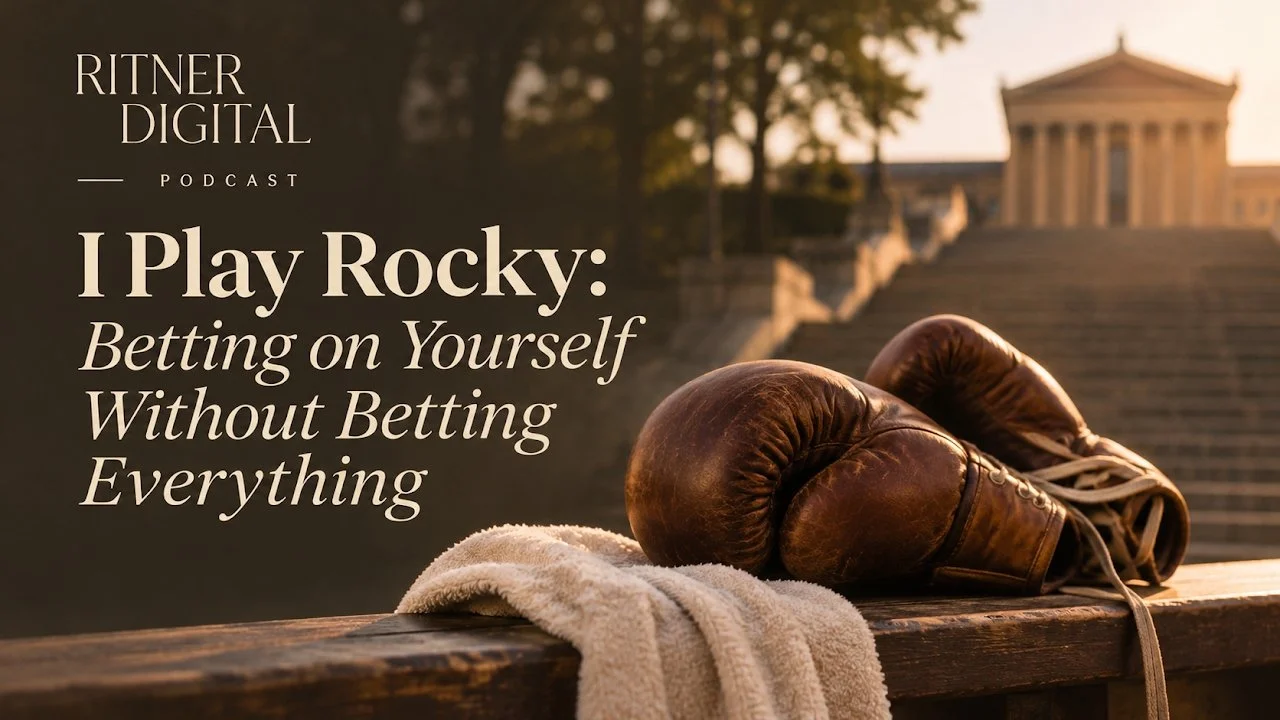 10:01
I Play RockyBetting on yourself without betting everything.
Fifty years ago, Sylvester Stallone refused to sell his Rocky screenplay unless he could star in it. With the new film I Play Rocky out for the 50th anniversary, Cara looks at what that bet really teaches about creative ownership, knowing what’s non-negotiable, and why Philadelphia still loves an underdog.
Read the blog postI Play Rocky, Betting It All, and the Most Philadelphia Business Plan EverRead the transcript1,408 words · about 6 min read
A struggling actor has a screenplay Hollywood wants to buy. There's one condition: he gets to star in it. Hollywood says no. He says no right back. Today's question is a marketing one, and it comes from a very Philadelphia story: when everyone around you is offering the safe deal, how do you know which part of your idea is worth protecting?
Welcome to the Ritner Digital Podcast. I'm Cara Bunda, and this is episode seven. Last time, we were holding a piece of paper. This time, we're going to the movies, sort of. The film is I Play Rocky, the new Peter Farrelly picture about how the original Rocky got made. Two notes first. We haven't screened it, so this isn't a review. We're talking about its documented premise, its production history, and early coverage. And a disclosure: Ritner Digital is named after Ritner Street in Philadelphia, so yes, we have a soft spot here. We're not affiliated with Amazon MGM Studios, the filmmakers, or the Rocky franchise. Let's get into it.
First, what is this movie? I Play Rocky is a twenty twenty-six biographical drama about the making of the original nineteen seventy-six Rocky. Anthony Ippolito plays a young Sylvester Stallone, with a cast that includes Matt Dillon and AnnaSophia Robb. It premiered at the Toronto International Film Festival in September, opened in limited theaters in November, and goes wider on November twentieth, one day before the original film's fiftieth anniversary. Here's what makes it interesting. The underdog at the center isn't the boxer. It's the writer. And it's a dramatization, not a documentary, so some events and conversations are adapted for the story.
Now the real history, which is the part that's well documented. In the mid nineteen seventies, Stallone was not a bankable leading man. He was struggling financially. The often-repeated story is that he wrote the Rocky screenplay in about three and a half days, inspired in part by the nineteen seventy-five fight between Muhammad Ali and Chuck Wepner, an underdog who lasted nearly fifteen rounds. Producers Irwin Winkler and Robert Chartoff saw potential. But the studio wanted a recognizable star, and names like Burt Reynolds, James Caan, and Ryan O'Neal reportedly came up. Honestly, that's not a crazy position. An unknown lead is a risk, and studios are in the business of managing risk.
Stallone disagreed. He was offered real money for the script, with six-figure amounts reported, though the exact numbers vary from retelling to retelling, so don't treat any single figure as verified. The part that is well documented is the negotiation itself: he could sell the screenplay without starring, and he insisted on playing Rocky Balboa. Eventually, the producers agreed. Picture it as a marketing meeting. The strategy team says replace the founder with a famous spokesperson. The founder says no. The team says, are you sure? The founder says, still no. He wasn't only selling words. He was trying to keep the idea and the person behind it together.
Here's the trap, though. We know how this ended. The film cost roughly one million dollars, shot in about twenty-eight days, and earned around two hundred twenty-five million dollars worldwide, according to The Numbers. That's gross revenue, not profit. It won three Academy Awards, including Best Picture, and Stallone was nominated for acting and for the screenplay. With that ending, holding out looks obvious. But in the moment, it wasn't. The producers could have walked. He could have passed on the money and never gotten the breakthrough. A successful gamble is still a gamble, and we tend to remember the people who held out and won, not the ones who held out and didn't. Imagine a consultant reviewing the plan in nineteen seventy-six. Founder risk tolerance: concerning. Founder conviction: extremely high. Revenue forecast: impossible to responsibly guarantee. Founder response: I'm playing Rocky. That audit is parody, but the lesson isn't.
Now to the part I care about. Philadelphia. Rocky could have been set anywhere, but the city became part of the character: working class, a little rough around the edges, sincere, stubborn, and determined to keep going. Then there are the Museum of Art steps. Plenty of visitors run up them without ever stepping into a gallery. They just know that Rocky ran up here, and now they have to. Nobody bought that campaign. This year, Visit Philadelphia is running Rocky Season, from September twenty-ninth through December third, with tours, fitness events, and celebrations. Fifty years later, a story is still driving people to a city. For a place-branding campaign, that's extraordinary staying power, and it came from emotion and meaning, not from repetition.
And the new film went back to the actual steps. According to The Philadelphia Inquirer, production closed the steps in November twenty twenty-five so Ippolito could re-create the run, and the Rocky statue had to be moved to make room. A movie about the making of the movie that made the steps famous, moving the statue inspired by the original movie. It's cultural recursion, and you'd need a diagram. Here's another lovely detail. According to the Associated Press, Ippolito didn't wait to be handed the part. He made an unsolicited audition tape and sent it to the filmmakers, and Peter Farrelly was impressed. The actor playing the guy who bet on himself got the job by betting on himself.
So what can a business take from this? Lesson one: know your non-negotiable. Betting on yourself doesn't mean betting everything. You don't need to risk your mortgage to prove you're serious. Look at what Stallone actually protected: the starring role. Everything else flexed, including budget, scale, and polish. So decide which part of your idea is the reason you started, and which parts can bend. Maybe it's controlling your brand, owning your customer relationships, or refusing to sell something you can't deliver well. And notice he wasn't betting on a hunch. He had a finished script and real interest from buyers. Being determined isn't the same as being right. Evidence matters. And please, nobody quit their job to launch a luxury pickleball apparel brand because of this episode.
Lesson two: ask what you're giving away. Who owns your website, your brand files, your content? What reuse rights come with work someone made for you? What happens to the intellectual property if a partnership takes off? Creating something famous doesn't automatically mean you keep every right attached to it. Film rights involve contracts, licensing, and profit participation, and small businesses face their own versions. Sometimes the biggest decision isn't how much you earn today. It's what you agree to hand over, so get proper professional advice. Lesson three: let the work make the case. Ippolito's audition tape, a sample project, a useful article, a pilot program. A demonstration often persuades better than a promise, and a smaller first version can still carry the whole idea.
Now, the honest caveat, because this show has a reputation to uphold. Reviews of the film are mixed to positive. Critics have praised Ippolito's performance and the crowd-pleasing energy, while others say it leans on nostalgia and familiar Hollywood mythology. Reuters reports that Stallone approved the script and the casting, spoke with Ippolito, and responded positively after a private screening, though he wasn't directly involved in the production. And remember that a dramatization compresses events and builds conflict. We can enjoy the story and still separate the record from the retelling. One more thing. Rocky doesn't need to win the fight. He needs to go the distance. For a business, that can mean a pitch that didn't land but sharpened your message. Progress doesn't always look like the big prize.
Here's your thirty-day experiment. Step one: write down the one thing about your business you would refuse to trade away. Your Stallone line. Step two: list what you could flex on without losing it, like timeline, polish, launch size, or budget. Step three: check your ownership. Who holds the rights to your site, your brand assets, and your content? If you don't know, find out this month. Step four: make something that demonstrates your value, and put it where decision-makers can find it. Then adjust, and try again.
If you'd like help building marketing that communicates clearly and earns trust, Ritner Digital works on SEO, AI search visibility, content strategy, and digital PR. Find us at ritnerdigital.com.
I'm Cara Bunda. Thanks for listening to episode seven. Now go find your own steps.
-
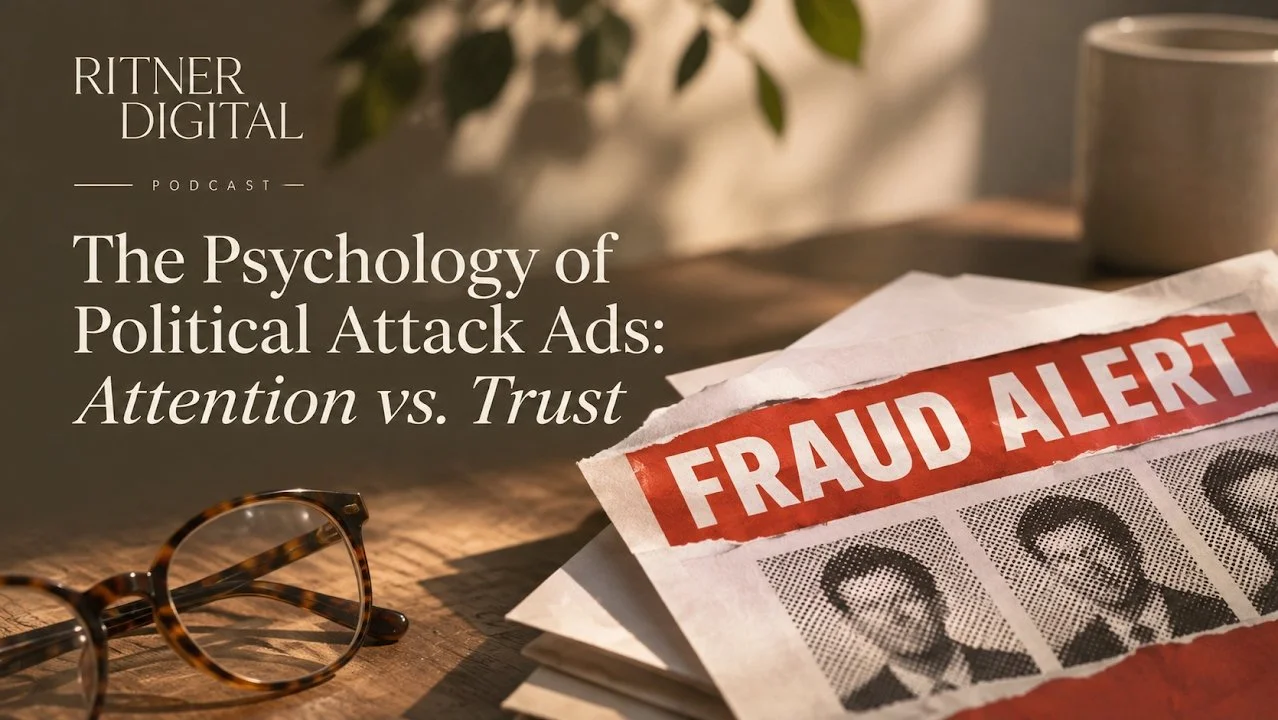 10:39
The Psychology of Political Attack AdsAttention vs. trust.
A “Fraud Alert” campaign mailer showed up in a Gloucester County mailbox. Cara breaks down the advertising behind it, from warning-style design and grouped accusations to what research says about whether attack ads actually work, and what any business can learn about the gap between attention and trust.
Read the blog postNegative Political Advertising: What a Gloucester County “Fraud Alert” Mailer Reveals About Marketing, Psychology, and TrustRead the transcript1,469 words · about 6 min read
Imagine opening your mailbox to two giant yellow words: Fraud Alert. Below them, three faces. No policy. No plan. Just an emergency. Today's question is a marketing one, about a very political piece of mail: when a message is designed to be impossible to ignore, what happens to everything it hopes you'll skip?
Welcome to the Ritner Digital Podcast. I'm Cara Bunda, and this is episode six. Last time, we talked about LeBron James and some very large numbers. This time, we're holding a piece of paper. In October, our team received a political mailer in Gloucester County, New Jersey, and we did what marketers do: we stopped reading the politics and started reading the advertising. One note first. This is a media literacy episode, not an endorsement of any candidate or party, and not a verdict on anyone's fitness for office. Claims on the mailer are claims, and we'll treat them that way. Let's get into it.
First, what actually arrived. The front has a dark background, enormous yellow lettering that says Fraud Alert, and red warning graphics, with photographs of three Gloucester County commissioner candidates underneath. Inside is a section called the case file, with four parts: a historical insurance-related case, a bankruptcy filing, alleged late property tax payments, and lawsuits or debt judgments. The back adds words like con, irresponsible, and extreme, plus two QR codes. And in much smaller type, the disclosure: paid for by the New Jersey Democratic State Committee. That's the object. Now, the design decisions.
Decision one: the headline. Fraud Alert borrows the language of consumer warnings and breaking news. Yellow on dark with red accents, the colors of hazard tape. As design, it works. You read the warning first, and everything else becomes secondary. That's the problem. The emotional frame lands before the evidence does. Fraud is a serious accusation, and when it sits above photographs of three people, a reader may attach it to all three. But the details involve different people and different circumstances. A bankruptcy isn't automatically a crime. A lawsuit isn't proof of wrongdoing. A late tax payment isn't a fraud conviction. The design asks you to feel first and sort later.
Decision two: the grouping. Three candidates, one headline. Media literacy researchers call this guilt by association, extending a negative impression of one person to others without showing it applies to them. The Annenberg Public Policy Center lists it as a recognizable technique. To be fair, candidates who run as a slate can reasonably be judged together on shared policies. The concern is different: when separate allegations about separate people are bundled under one alarming label, responsibility blurs. A more transparent version names each person, the record, the date, and the outcome.
Decision three: the case file. That phrase sounds official. It suggests investigators and evidence, and the mailer adds stamps resembling labels for fraud, bankruptcy, and delinquency. But a document that looks like evidence isn't evidence. To its credit, the mailer does cite newspaper reporting and court or tax records in small print. The question is whether an ordinary person could find and check them. A good citation names the document, the date, the person, what the source actually established, and whether it was an allegation, a filing, a judgment, or a resolved case. A citation should be a pathway to evidence, not decoration.
Let's slow down on vocabulary, because emotional advertising gets slippery here. Being sued means someone brought a claim, not that the claim was right. What matters is the outcome: dismissed, settled, or a judgment. Bankruptcy is a legal process for dealing with debt, and a filing doesn't establish fraud. Late property taxes may matter, but how are they counted, and were they paid? A big number can't answer that. The historical criminal matter is different, because there is independent reporting. In June twenty twenty-six, the New Jersey Globe reported that one candidate admitted to theft by deception over a vehicle insurance claim about twenty years earlier, with restitution and a Pre-Trial Intervention program. That gives context to one claim. It doesn't verify every other claim on the page.
Why do campaigns, and brands, reach for fear? Negative information grabs attention. Words like fraud, con, and extreme carry emotional weight, and emotional weight is memorable. But memorable isn't believed. And if every message is an emergency, urgency stops meaning anything. Does it work? The research is mixed. A two thousand seven meta-analysis in the Journal of Politics found negative campaigning tends to be more memorable, but didn't consistently show it wins votes, or reliably suppresses turnout. Even when an attack works, that doesn't settle whether it was fair. Effectiveness and ethics are separate questions.
Now, a careful point, because there's a lazy version of this conversation where all criticism is mudslinging. It isn't. Candidates should face scrutiny about their records, and a campaign pointing at a documented controversy isn't unethical just because it's uncomfortable. The useful questions are about evidence and presentation. Was it stated accurately? Was context left out? Could a reader verify it? Those apply no matter who's paying. And notice what the mailer doesn't spend space on: what a county commissioner actually does, or what any slate would change. Character can be fair game. It's just not the whole job description.
Now the fine print, literally. The disclosure is real, and New Jersey requires covered political communications to say who paid. We're not making any finding on whether this mailer meets every requirement. But legal disclosure and effective transparency aren't the same thing. The sponsor line is tiny, and the headline is enormous. A reader can remember the accusation and forget who delivered it. Then the QR codes, a classic offline-to-online funnel. But a QR code is navigation, not a fact-check. A campaign site will make the campaign's case, which isn't independent verification. And the Federal Trade Commission warns that QR codes can hide harmful links, so check the destination first.
Here's where this lands in our world. Once someone scans a code, searches the names, or asks an AI assistant to summarize, a piece of paper joins the digital information environment. Results mix court records, news, campaign sites, and social posts, very different kinds of sources. An AI summary can drop context, like a lawsuit without its outcome. That's a possible failure mode, not a finding about any system. But search visibility and factual reliability are separate qualities, and the same goes for your business. Keep accurate information up, and make credible sources easy to find.
So what can a business learn from an attack mailer? Lesson one: don't confuse attention with trust. A dramatic headline buys curiosity, but its value depends on what people find next. If the page doesn't support the headline, you haven't won attention. You've borrowed it, and the interest comes due.
Lesson two: be specific, and make your sources useful. Don't turn one narrow fact into a sweeping conclusion. If your site cites research, link the original, note the date and limits, and separate what the source found from what you think it means. A source link should help a skeptic check you.
Lesson three: be clear about who's talking, and don't build a brand only on criticizing someone else. Customers should know when they're reading advertising. Comparison is fine, but if all you say is why the other guys are bad, you've said little about why you're good.
Here's your thirty-day experiment. Step one: take the five boldest claims in your own marketing. Next to each, write the source, the date, and what that source actually proves. If you can't fill in all three, that's a flag. Step two: when you meet a loud piece of advertising from anyone, ask who paid for it, which claim belongs to which person, and whether it's an allegation or an outcome. Step three: once a week, check one headline you wrote against its evidence. If the message is louder than the proof, turn it down. Adjust, and try again.
Now, the honest caveat, because this show has a reputation to uphold. None of this means the mailer's criticism is wrong. Some of it may rest on solid public records, and at least one underlying matter has been independently reported. It means a claim can be accurate and still be packaged to overstate what it shows. We haven't verified every allegation, and we're not investigating anyone. We analyzed the advertising. I'll leave conclusions about candidates to voters and the documents. What I'll say is this: attention starts the conversation. Evidence earns the trust.
If you'd like help building marketing that communicates clearly and earns trust, Ritner Digital works on SEO, AI search visibility, content strategy, and digital PR. Find us at ritnerdigital.com.
I'm Cara Bunda. Thanks for listening to episode six. Now go check the footnotes.
-
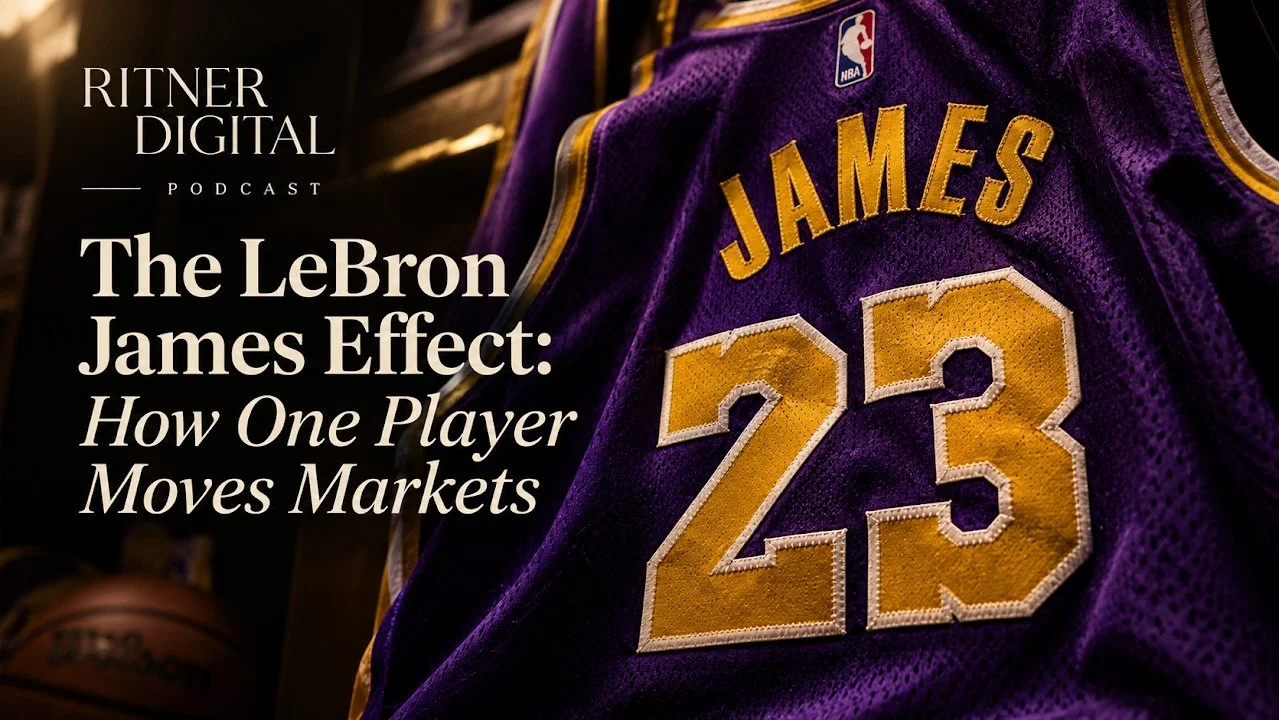 9:38
The LeBron James EffectHow one player moves markets.
LeBron James joined the 76ers and broke a Fanatics jersey record in 48 hours. Cara follows the money through Cleveland, Miami, Los Angeles, and Philadelphia: franchise valuations, attendance, a $500 million forecast economists doubted, and why big numbers need clear definitions.
Read the blog postThe LeBron James Effect: How One Basketball Player Changed the Economies of Cleveland, Miami, Los Angeles, and PhiladelphiaRead the transcript1,347 words · about 6 min read
Somewhere in Philadelphia, a sporting goods store manager is having a very strange day. The phone won't stop ringing. Everyone wants a jersey with the number twenty-three. And the cause of all this chaos is that a forty-one-year-old man changed employers. Today, we're asking what that's actually worth.
Welcome to the Ritner Digital Podcast. I'm Cara Bunda, and this is episode five. Last time, we went to a bakery. This time, we're talking about LeBron James, and one expensive question: how much money can one basketball player actually move? The numbers are enormous, and they're real. But they don't all measure the same thing. This is an analysis episode built from published reporting, not a client result. And yes, there are three marketing lessons hiding in here. Let's get into it.
Let's start in the present. In July twenty twenty-six, LeBron announced he was joining the Philadelphia 76ers. Within hours, merchandise was selling out. According to CBS Philadelphia, Fanatics said his jersey set its record for the most jerseys sold by an athlete joining a new team, across all sports, in the first forty-eight hours. The previous record belonged to Shohei Ohtani. Fanatics also said more LeBron merchandise sold in the first day than in the entire first week after he joined the Lakers in twenty eighteen. Most marketing departments spend six months preparing a product launch. LeBron changed teams and the jerseys sold out by lunch. Then there's the big number. A forecast attributed to the Boyd Company, reported by NBC10 Philadelphia, estimated two hundred fifty to four hundred thirty million dollars in annual economic activity. Remember the word forecast. We'll come back to it.
Philadelphia isn't the first city to run this experiment. In twenty ten, LeBron announced on ESPN that he was leaving Cleveland for the Miami Heat. An average of nine point nine million people watched, according to Nielsen. And the financial reaction was fast. Forbes estimated the Cavaliers' value fell about twenty-six percent, while the Heat's rose seventeen. In Miami, home attendance climbed by almost eighty-four thousand in a single season. The Heat's estimated value went from three hundred sixty-four million dollars in twenty ten to seven hundred seventy million in twenty fourteen. Then he came home. After his return, Cavaliers attendance rose by about one hundred thirty-two thousand, the team reported a forty-five percent jump in revenue, and Forbes put the franchise at nine hundred fifteen million dollars, up from five hundred fifteen. In twenty sixteen, Game Seven of the Finals averaged about thirty-one million viewers. By any measure, this man moves markets. But here's the catch.
Those valuation jumps happened while the whole league was getting richer. Average NBA franchise values rose about seventy-two percent during Miami's stretch, and about seventy-four percent in the year Cleveland jumped seventy-eight. So LeBron was clearly part of the story. He just wasn't the entire story. Then there's the number everyone loves to quote. When he returned to Cleveland, county officials presented a regional impact figure of about five hundred million dollars a year. Economists were skeptical, and the reason is a word worth learning: substitution. If a resident spends two hundred dollars at a Cavaliers game, that may be two hundred dollars they would have spent at another Cleveland restaurant or venue. The spending is real. It just isn't necessarily new. Wharton experts told Penn Today much the same about Philadelphia: the arena has room for about two thousand more fans a game, but the net effect on the whole city may be positive and still fairly modest.
So is there rigorous evidence of a real local effect? Yes, and it's my favorite part of the story. Economists Daniel Shoag and Stan Veuger studied LeBron's moves between Cleveland and Miami in a paper called Taking My Talents to South Beach, and Back. They looked at actual businesses near the arenas. Their estimates: about thirteen percent more restaurants, bars, and other eating-and-drinking establishments within a mile of the arena, and about twenty-three point five percent higher employment at those places. And the effect faded quickly with distance. Not the whole state. Not the whole metro area. The blocks around the building. A real effect, and a surprisingly local one. Los Angeles, by contrast, offers big headline numbers. The Lakers went from three point three billion dollars in twenty eighteen to ten billion in twenty twenty-five. But the league's economics were booming, and a five-year local impact figure of about three hundred ninety-seven million dollars was exactly that: a projection.
So here's lesson one: know what your number actually measures. In this one story, we've met valuations, attendance, television audiences, merchandise records, forecasts, and one academic estimate of nearby jobs. Every one is legitimate, and none is the same thing. A valuation is what analysts think a business is worth. A forecast is a guess with a spreadsheet. Gross spending is not net new spending. You can't add them all up and announce that one man generated fourteen point seven billion dollars. That would be an exciting spreadsheet, and an indefensible one. Your business does the same thing. Traffic, rankings, leads, and revenue all sound related, but they aren't interchangeable. So before you celebrate a number, ask the dull question: what exactly is this measuring?
Lesson two: attention is not revenue. Nearly ten million people watched The Decision. About thirty-one million watched Game Seven. That's extraordinary exposure. But thirty-one million viewers did not produce thirty-one million hotel bookings. Most were on their couches. Attention creates an opportunity, but you still need a business that can catch it. A viral post isn't a profitable campaign. An AI mention isn't automatically a recommendation. A website visit isn't a customer. Track the step after the attention: the phone call, the booking, the quote request.
Lesson three: demand is local, and it fades with distance. The extra restaurants and jobs showed up within a mile of the arena, not across the state. The furniture store across town barely noticed. If you run a local business, that's useful. You don't need the biggest possible audience. You need to be unmistakably present where demand already is: the right neighborhood, the right search, the right moment. Make sure your Google business profile, website, and reviews all say clearly where you are and what you do. The restaurant next to the arena didn't need to go viral. It needed to be open, findable, and ready.
Now, the honest caveat, because this show has a reputation to uphold. None of this means the LeBron effect is fake. The merchandise records are real, the audiences are real, and the nearby-business research is real. It just means the biggest headline numbers shouldn't be taken at face value. And Philadelphia's chapter is still early. We have a record-breaking merchandise launch, some forecasts, and some cautious economists. What we don't have yet is an independently measured picture of the net impact. That takes time. I'm a marketer, not an economist, so I'll leave the verdict to them. But if someone asks how much LeBron added to the economy, the responsible answer is: it depends what you count. And be a little suspicious of anyone who gives you just one number.
Here's your thirty-day experiment. Step one: list the five numbers you report most often. Traffic, rankings, followers, leads, whatever they are. Next to each, write one sentence: what does this actually measure? Step two: circle the numbers closest to money. Calls, bookings, quote requests, sales. If nothing is circled, that's your first finding. Step three: track one circled number weekly for a month, alongside one thing you changed. A page you improved, a story you published, a profile you cleaned up. If a number goes up and nothing else does, that's not a win. That's a very confident spreadsheet. Adjust, and try again.
If you'd like help making your expertise easier to find, Ritner Digital works on SEO, AI search visibility, content strategy, and digital PR. Find us at ritnerdigital.com.
I'm Cara Bunda. Thanks for listening to episode five. Now go find out what your numbers actually mean.
-
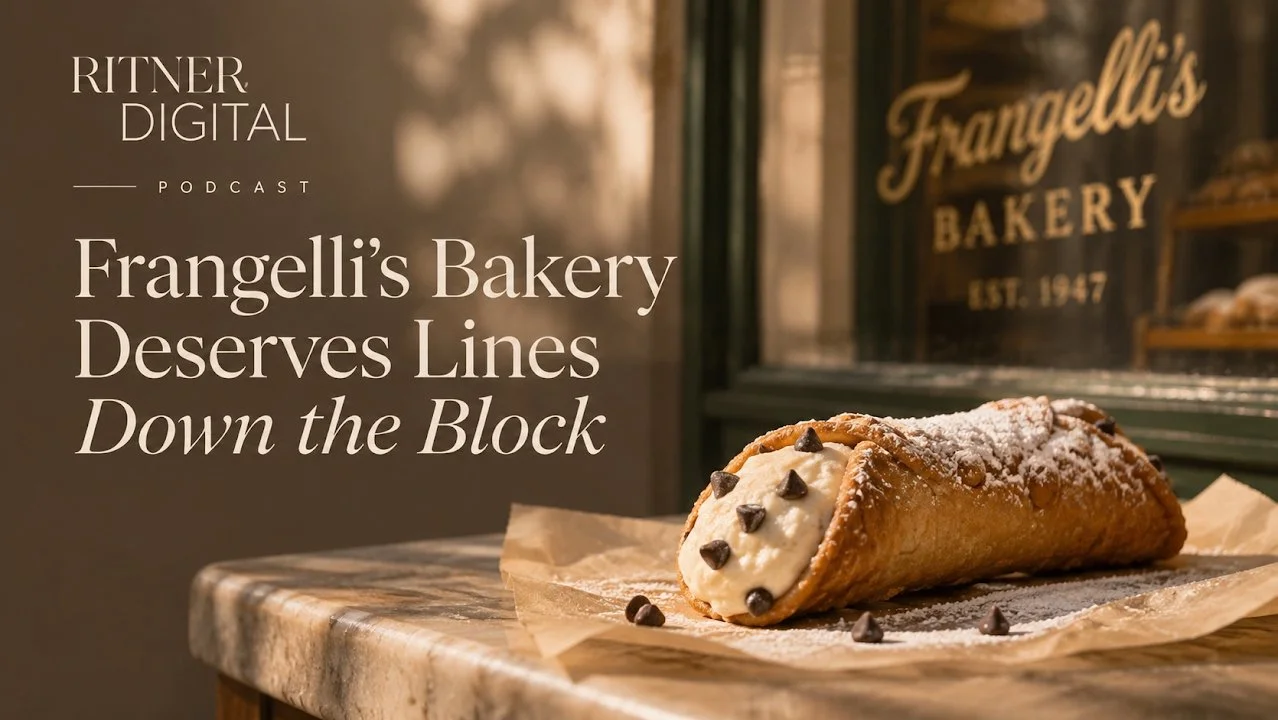 10:10
Frangelli’s Bakery Deserves Lines Down the BlockSouth Philly’s famous franolli.
Frangelli’s has been baking in South Philly since 1947, and its Franolli, a doughnut filled with cannoli cream, has been on national TV. So why isn’t there a line around the block? Cara’s love letter to the bakery at Ninth and Ritner, with three lessons on differentiators, discoverability, and real stories.
Read the blog postFrangelli’s Bakery Deserves Lines Down the Block in 2027. I Am Prepared to Make This Everyone’s Problem.Read the transcript1,444 words · about 6 min read
There's a bakery in South Philadelphia that has been open since 1947. The Inquirer has written about it. So has Philadelphia Magazine. So has The Infatuation. And somehow, it still isn't mobbed by tourists. Today, we're asking why.
Welcome to the Ritner Digital Podcast. I'm Cara Bunda, and this is episode four. Today is a different kind of episode. Episode three was a client case study, with numbers and a fake mustache. This one is a love letter to Frangelli's Bakery, at Ninth and Ritner in South Philadelphia. It's an opinion piece with real sourcing. It is not a client result, and nobody paid for it. The only compensation I'm expecting is a doughnut. And yes, there are three marketing lessons hiding in here. Let's get into it.
First, let's establish that this place is real. Frangelli's traces its founding to 1947, when Joseph Frangelli opened a bakery at Ninth and Jackson Streets. In 1994, it moved a few blocks south to its current spot on West Ritner Street. In 2010, a baker named John Colosi took ownership. And here's the part I love: Colosi grew up in the neighborhood. A 2011 Philadelphia Inquirer profile described how he visited the bakery with his father as a child, and eventually ended up running it. Frangelli's predates TikTok. It predates Instagram. It predates the very concept of a content calendar. It did not open last Thursday with a brand identity designed by someone who charges fourteen thousand dollars to pick a shade of beige. And here's the marketing truth in that story: you cannot buy decades of community relationships with a paid social campaign. Frangelli's didn't have to invent those connections. It was simply there, doughnut after doughnut, year after year.
Now, the Franolli. A Franolli is a hand-cut yeast doughnut, split open and filled with sweet ricotta cannoli cream and miniature chocolate chips. Two foods that were already doing perfectly well on their own, and then someone suggested a collaboration. For once, the meeting produced something useful. The origin story is wonderful. In a 2016 Inquirer interview, Colosi explained that he was making cannoli filling, broke off a piece of doughnut, tasted the two together, and realized he had something. That's it. No innovation summit. No focus group of four hundred consumers. No slide deck titled Disrupting the Cannoli. A baker was hungry, and he combined two delicious things. Word spread, and the Franolli eventually drew attention from food writers and television, including The Chew, The Steve Harvey Show, and The Harry Connick Junior Show. Which raises a fair question: how is there not a nationwide Franolli awareness campaign? At one point, people were buying digital pictures of cartoon apes. We have the resources.
So here's lesson one: have a real differentiator. Look at why the Franolli works. You can describe it in a single sentence. You can photograph it. It has a name, and it has a documented history. And here's the sneaky part. Someone can tell a friend about a good glazed doughnut. But someone telling a friend about a Franolli has to explain what a Franolli is, and that explanation becomes the start of another conversation. Conversations are how local reputations travel. The most effective differentiator is usually something genuinely distinctive about the business, not something a marketing department invented to describe it. So ask yourself: what do you do that you can explain in one sentence, that someone could photograph, and that actually exists outside a slide deck? If you can answer that, you've found your Franolli. If you can't, start looking. It's probably already there.
But please don't mistake Frangelli's for a one-doughnut bakery. A famous signature product can turn the rest of the menu into supporting characters in its own family business. Consider the regular doughnuts: glazed, chocolate-frosted, buttercream, Italian cream, and jelly. Colosi described the jelly doughnuts as especially popular, made with seedless black raspberry jelly. Not raspberry-flavored essence. An actual jelly doughnut. Sometimes the innovation isn't adding seven ingredients. Sometimes it's refusing to make a perfectly good doughnut worse. Then there are the ice cream doughnuts, a revived neighborhood tradition. Somewhere, a consultant is billing by the hour to design an immersive, multi-textural summer dessert. Frangelli's has been putting ice cream in a doughnut. There are also cookies, cannoli cake, and a proper Italian rum cake, which that 2011 Inquirer profile named among the scratch-made offerings. Around March nineteenth, you'll find seasonal Saint Joseph's cakes, too. One practical note: availability changes, so if you're making a special trip for a cake, call ahead. I would hate for you to plan an afternoon around a cake that isn't in the display case. Although I would understand the impulse.
Lesson two: being excellent and being discoverable are different jobs. Look at the press file. The Inquirer covered Frangelli's in 2011, 2014, and 2016. Philadelphia Magazine gave it a Best of Philly nod in 2014. PhillyVoice mentioned the Franolli in 2015. Visit Philadelphia includes it in a guide to the city's best doughnuts. Billy Penn featured it in 2026, and The Infatuation this past October. That is not an undiscovered bakery. It's a bakery that has been discovered repeatedly. So the phrase hidden gem doesn't quite fit. What's more accurate is that Frangelli's may be better known in its community than among the wider audience who would love it. That's a different problem, and a more interesting one. It already has credibility. It needs someone to keep telling the story. And here's why that matters for you. Google's guidance on local search names three main factors: relevance, distance, and prominence. How well you match the search, how close you are, and how established you appear. In plain language: a customer can't recommend a business they've never heard of. Being good is the foundation. Being findable is the second job.
Lesson three: real stories beat manufactured ones. Frangelli's story has real substance. A founding year. A neighborhood. A documented handoff between owners. Preserved recipes. A signature product with an unusual origin. That's the opposite of generic content. Google's guidance on helpful content encourages original information and genuine usefulness, rather than writing to chase rankings. So instead of publishing the nine hundredth article called Five Reasons Quality Matters, a bakery could document how it makes a traditional filling. It could explain a family recipe, or tell the story of a holiday cake. And if you don't run a bakery, the idea still applies. Show the real process. Tell the real origin. Explain the thing you know that your customers don't. And if a marketing agency ever proposes replacing all that with inspirational stock photos captioned Rise and Grind, I'd encourage you to end the meeting immediately.
Now, the honest caveat, because this show has a reputation to uphold. I've spent this episode saying Frangelli's deserves more attention. But visibility should serve a business, not pressure it. Not every beloved small business wants to become a national chain, or a backdrop for viral videos. Some value consistency over expansion. They'd rather serve a loyal customer base than become a tourist attraction. Those are legitimate decisions, and I don't know what Frangelli's wants. That's their call. So here's how I think about the eightieth anniversary in 2027: it's an opportunity, not an obligation. A newspaper could revisit the history. A neighborhood group could recognize the milestone. Customers could share their memories. And if lines do form, let's be good neighbors. Keep them orderly. Don't block doors. South Philadelphia is a neighborhood where people live, not a pastry-themed amusement park.
Here's your thirty-day experiment. Step one: write down the three most distinctive true things about your business. True is the important word. Not what you wish were true, and not what every competitor also says. Step two: check whether your website and your Google business profile say those things clearly, near the top, in plain language. If a stranger looked at both for thirty seconds, would they know what makes you different? Step three: add one real story. A recipe. A founder moment. A customer memory. It doesn't have to be long. It has to be real. Then wait a month, and look again. Did anyone mention that story? Are more of the right people finding you? And if nothing changes, don't just repeat the same thing forever. You remember what that's called. That's not determination. That's an unread dashboard. Adjust, and try again.
If you'd like help making your expertise easier to find, Ritner Digital works on SEO, AI search visibility, content strategy, and digital PR. Find us at ritnerdigital.com.
I'm Cara Bunda. Thanks for listening to episode four. Now go get a Franolli.
-
 10:03
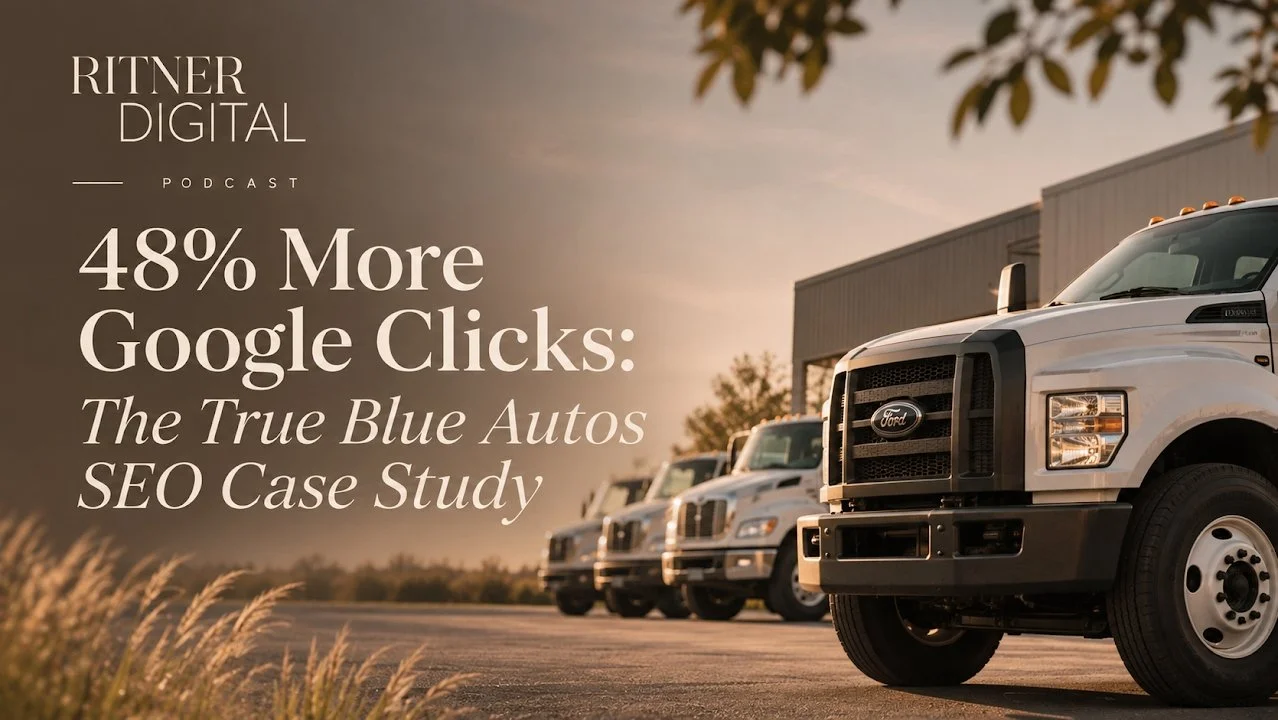
48% More Google ClicksThe True Blue Autos SEO case study.
A commercial truck dealership in Greensburg, Indiana grew Google clicks 48% and impressions 93% by answering the questions truck buyers ask before they know a dealer’s name. Cara walks through the content strategy, the page that led the way, why click-through rate fell, and what the numbers don’t prove.
Read the blog postCommercial Truck Dealership SEO Case Study: How True Blue Autos Increased Google Clicks 48% and Search Impressions 93%Read the transcript1,328 words · about 6 min read
A truck dealership in Indiana nearly doubled how often Google showed its website. And its click-through rate went down. Both of those things are good news. Let me explain.
Welcome to the Ritner Digital Podcast. I'm Cara Bunda, and this is episode three. Today: a real client. True Blue Autos, a commercial truck dealership in Greensburg, Indiana. Fair warning, this is an honest case study. So we'll cover what the numbers prove and, just as importantly, what they don't.
Start with the customer. What does a contractor do before buying a commercial truck? They research. A lot. They compare towing capacity. They check payload ratings. They wonder whether a Ford F-550 is enough truck, or whether they need an F-750. Gas or diesel? Flatbed or service body? And if the right truck happens to be several states away, they start wondering what shipping will cost. Every one of those questions is a chance to meet a buyer before they've chosen a dealership.
Now, there are two kinds of searches. A branded search includes your name: "True Blue Autos." A non-branded search describes a need: "Ford F-550 versus F-750." The first reaches people who already know you. The second introduces you to people who don't. Ritner Digital calls that goal owned search demand: attracting interested visitors to your own website, instead of waiting for them to arrive already knowing your name. It does not mean you control Google. Nobody controls Google. On some days, not even Google.
So what did the strategy look like? Five content pillars. One: model comparisons, the F-250 through the F-750, explained by what each truck is actually for, not just a spec sheet. Two: work-ready configurations. Flatbeds, service bodies, cab-and-chassis setups, because a contractor hauling lumber and an electrician organizing tools have very different problems. Three: engines and operating costs. Four: buying and shipping. And five: geographic relevance, for buyers in Indiana and Ohio. Then everything gets tied together in one central resource: a complete guide to buying and shipping a commercial work truck. Think of it as a front door to a very specific hallway.
Now, the numbers. The report compares two equal thirty-day windows. The engagement began in July, but the Search Console data starts July twenty-second, so this is observed growth, not a clean before-and-after. Fine print, delivered. In the first window: 418 Google clicks. In the last: 619. That's up 48.1 percent. Impressions, the number of times Google showed the site, went from 27,001 to 52,153. Up 93.2 percent. And average position improved from 10.2 to 7.0, which is the kind of movement that makes a marketer quietly leave the room to celebrate.
The star of the show was a comparison article: Ford F-550 versus F-750, which commercial truck is right for the job. Over three months, it earned 101 clicks, 21,648 impressions, and an average position of 4.41. Notice what that page is. Not an announcement. Not "we're proud to serve the Greensburg area." It's a page that answers a question a buyer was already asking. One caution: average position is a Search Console metric. It does not mean the page appeared fourth for every single search. Position varies by query, by location, by the mood of the algorithm that morning.
The supporting cast mattered too. The F-350 versus F-450 comparison earned 83 clicks and 20,820 impressions. Together, the two comparison pages produced 184 clicks. Not 184 buyers. Two pages, 184 clicks. The F-550 flatbed buyer's guide earned 51. The article on what it costs to ship a truck across the country: 37. And my personal favorite, the guide to the best service trucks for electricians: 27 clicks. That one isn't about trucks in general. It's about one profession, with one set of storage problems, finding an answer written for them.
Was this just one lucky week? Not according to the data. Across three consecutive complete weeks in October, Google clicks went from 116, to 141, to 174. That's fifty percent growth. And here's a measurement principle worth stealing: it's easy to make analytics look impressive by comparing a full month against a partial one. This report uses completed, equally sized windows, and treats the latest twenty-four hours as preliminary. Boring? Slightly. Trustworthy? Considerably.
So, back to our puzzle. Click-through rate fell, from 1.55 percent to 1.19. How? Impressions grew faster than clicks. When your site starts appearing for far more searches, some of those appearances are earlier-stage, or less relevant, or sitting next to stronger competitors. More appearances, a smaller share clicked. But total clicks still rose forty-eight percent. So this isn't a failure. It's a puzzle worth investigating. And look at the two big comparison pages. Each has around twenty thousand impressions, but a click-through rate under half a percent. That's the opportunity. The answer isn't fifty more articles. It's improving the pages that already show up. Rewrite the title for what the searcher actually wants. Tighten the description. Put the answer higher on the page. Impressions are the audience arriving. Click-through rate is whether the sign on the door makes sense.
Now, the honesty section. Fifty thousand impressions are not fifty thousand customers. A visitor reading an article is not automatically a qualified lead. The Clarity data recorded 176 "submit form" events, 25 "contact us" events, and 2 "request quote" events. Tempting to add those up and announce two hundred leads. Don't. A button click and a completed, relevant, sales-ready inquiry are not the same thing, and the report is careful to say so. The next step is real tracking: confirmed form submissions, call records, and customer data that can answer a better question. Which article did this person read first, and did they eventually buy a truck?
Next, tools. SEMrush estimated about 528 organic visits. Google itself recorded 1,621 clicks over the reporting period. Different tools, different methods, different windows. They shouldn't be swapped, and the estimate shouldn't replace the real number. The same goes for the backlink count, which grew to about a thousand. More links are not automatically more authority. Quality and variety matter more than the total. And the report doesn't establish how many trucks were sold because of SEO, or that the dealership spends less on third-party leads. A report that claims hundreds of leads without verification is a flattering statistic wearing a fake mustache. Reporting that admits its limits is far more useful to a business owner.
Three lessons you can use. One: answer the questions customers ask before they know your name, and be specific. A detailed comparison of two trucks beats five vague posts about excellence. The same idea works whether you sell trucks, write contracts, treat patients, or build decks. Explain the decision your customer is actually facing. Two: check your mobile experience. 68.2 percent of True Blue's Google clicks came from phones. Someone is reading your article on a jobsite, with one thumb, probably squinting. Can they read your comparison table? Can they find your phone number? Can they tell how to ask about a vehicle? Three: give every article a next step. Someone finishes the F-550 comparison, and the natural question is, "Do you have one in stock?" Make that easy to ask. Not a pushy sales banner. A relevant link, placed where the question forms.
Here's a thirty-day experiment you can run on your own site. Find the page with the most search impressions. Rewrite its title for the person actually searching. Add one clear link to the next step: your inventory, your contact page, your quote request. Then wait two weeks, and look at the numbers. Did clicks move? Did anyone take the next step? Adjust, and try again. And if nothing changes, don't just repeat the same thing forever. That's not determination. That's an unread dashboard.
If you'd like help making your expertise easier to find, Ritner Digital works on SEO, AI search visibility, content strategy, and digital PR. Find us at ritnerdigital.com.
I'm Cara Bunda. Thanks for listening to episode three.
-
 10:23
The Audacity TheoryYour next client can’t find you if you’re hiding.
Great work can’t speak for itself if nobody can find it. Cara takes Case Kenny’s line, “life meets you at your level of audacity,” and turns it into marketing: being specific, sharing an opinion, showing your work, asking for the bigger project, plus a 30-day experiment to stop hiding.
Read the blog postThe Audacity Theory of Marketing: Everything You Want Can’t Find You If You’re HidingRead the transcript1,360 words · about 6 min read
Picture this. A business owner has built an absolutely extraordinary company. The work is excellent. The clients are delighted. The competitors, frankly, are not operating at the same level.
And yet this person has one unfortunate habit. They are hiding. They attend meetings, answer emails, and occasionally post on LinkedIn, usually after forty-five minutes deciding whether the first sentence sounds too confident.
They do have a website. Technically. It has been "undergoing updates" for nineteen months.
Meanwhile, a potential client with a real budget and an urgent problem is searching for exactly this expertise, and cannot find it.
Welcome to the Ritner Digital Podcast. I'm Cara Bunda, and this is episode two. Today: the Audacity Theory of marketing.
The idea comes from author Case Kenny, whose refrain is: "Life meets you at your level of audacity." Now, that's a motivational idea, not a scientific law. Nobody has found evidence that the universe maintains a customer relationship management system for your ambitions. But it raises a useful question. Does your firm need to get better before it grows? Or does it need to get bolder about letting people know it exists?
Let's start with humility, because I respect humble people. But there's a difference between humility and being impossible to find. A hiding owner says, "We prefer to let the work speak for itself." Which sounds admirable. It also raises a practical question. Where, exactly, is the work speaking?
On the website? Six stock photographs and a paragraph about delivering excellence. In case studies? There aren't any. In search results? Potential clients are finding three competitors.
So yes, the work is speaking. But only to people who have already hired you. You can be humble about yourself and still be clear about what you offer.
Why do capable people hold back from asking? Part of it is a prediction problem. In 2008, researchers Francis Flynn and Vanessa Lake published a study called If You Need Help, Just Ask. In the first three studies, participants underestimated the likelihood of receiving help by as much as fifty percent.
A caveat, because this is an honest podcast. That research examined requests for help. It did not prove that a two-hundred-thousand-dollar proposal gets approved. Please do not send your next proposal with the subject line, "Psychology Says You Have to Hire Me."
The useful takeaway is smaller, and sturdier. Our expectations about rejection are not always accurate. Uncertainty is not the same thing as rejection. Sometimes the only way to find out is to ask. Politely, clearly, and without six follow-up emails before breakfast.
Next: the audacity to be specific. Many firms say they want better clients and more visibility. Which clients? Visible to whom? Without answers, growth becomes a vague request addressed to the entire economy. Dear Economy, please send prosperity. Sincerely, The Management Team.
Imagine a research firm whose website says, "We provide innovative research solutions that empower organizations to make data-driven decisions." Now imagine it says, "We help healthcare technology companies understand why hospitals adopt, or reject, new products." The second sentence connects a particular audience with a recognizable problem. It guarantees nothing. But it gives the right person a reason to keep reading.
That's audacity in practical form. Try to be relevant to everyone, and you tend to become memorable to no one. Of course, the expertise has to be real. You cannot become a cybersecurity specialist by buying a photograph of a glowing padlock.
Now, the mythical state of being ready. You'll feel prepared after the website redesign. And the new headshots. And once the logo is a slightly warmer shade of blue.
A year passes. Meanwhile, the competition has been out in the market, learning from prospects, making mistakes, and getting better. Preparation is valuable, but it can become a sophisticated form of avoidance. There's a difference between fixing a real deficiency and inventing improvements to postpone a hard action. You don't need a hundred testimonials before you ask a satisfied client for the first one.
Here's why timing matters. The 2026 6sense B2B Buyer Experience Report found that buyers first engaged sellers about fifty-nine percent of the way through their purchasing journey.
It also found that ninety-six percent of surveyed buyers kept up with their category between formal evaluations. A fair caveat: that covers formal B2B buying, not every purchase in the economy. But the decision may be half-made before you even hear there was an opportunity.
Which is why SEO is, strangely, romantic. Someone needs something. You may be able to provide it. Search helps the two of you find each other. Think of it as leaving the porch light on. Except the porch light needs a sensible URL structure, and somebody should check whether Google can crawl the front door.
AI search works the same way. Google says the SEO fundamentals still apply, and nothing guarantees inclusion. A page titled "Why We Are the Best Company in the World According to Artificial Intelligence" is not a strategy. It is a cry for help. But clear, accessible information about whom you serve and what you know gives you a chance to be considered.
Next, the audacity to have an opinion. Customer experience is important. Leadership requires communication. All true. All safe. And all completely invisible. The 2026 Edelman-LinkedIn Thought Leadership report points to original thinking and expert judgment. You don't need to be controversial. You need to contribute something: a mistake you've watched clients repeat, or an assumption your research challenges.
Then, show your work. Confidentiality is real, and it should be respected. But you can still explain your methodology, share approved testimonials, and present anonymized examples. Don't just announce expertise. Make it easier to evaluate.
And make a clear offer. Some firms publish a wonderful article that ends with, "Thank you for reading." Lovely. But what's the next step? The reader is apparently meant to intuit it through a sophisticated process of emotional interpretation. A clear call to action isn't pushy. It's helpful.
Finally, ask for the bigger project. Some barriers are real: procurement requirements, credentials, capacity. Evaluate those honestly. But don't reject yourself before the buyer has had a chance to evaluate you.
Before anyone treats this as permission to message seventeen thousand strangers on LinkedIn: audacity is not volume. In a June 2025 Gartner survey, seventy-three percent of surveyed B2B buyers said they actively avoided suppliers that sent irrelevant outreach.
An unsolicited message beginning, "I noticed you're a visionary leader driving transformation," is less promising. Especially if the recipient is a dentist, and you're selling enterprise procurement software. Audacity without relevance is just interruption.
So let's make this practical. Not a manifestation ritual. Not a vision board featuring a private jet. A thirty-day experiment, one action a week.
Week one: look at your website the way a stranger would. Can you tell what you do, and who you help, within a few seconds? Fix one obstacle. A vague headline, a thin service page, an overdue case study.
Week two: make one appropriate ask you've been avoiding. A referral, a testimonial, an introduction. Skip the three-paragraph apology. State the request, and respect the answer. A no is information, not a verdict on your worth.
Week three: publish something that proves what you know. Pick a question your ideal clients keep asking, and answer it with real substance.
Week four: introduce yourself to an audience that doesn't know you yet. A publication, an association, a conference. Don't demand attention. Earn it.
And if nobody responds? Visibility is not a guarantee of demand. Audacity should make you more willing to learn, not more resistant to evidence. Check the analytics, adjust the message, and try again. Repeating an ineffective approach forever isn't determination. It's usually evidence that nobody looked at the analytics.
If you'd like help making your expertise easier to find, Ritner Digital works on SEO, AI search visibility, content strategy, and digital PR. Find us at ritnerdigital.com.
Remember, your business cannot win opportunities it never gets to compete for. And the next person who needs exactly what you offer may already be searching.
I'm Cara Bunda. Thanks for listening to episode two. Go send the email.
-
 11:19
Your Reputation Isn’t a Growth StrategyB2B marketing beyond referrals.
A respected advisory firm grows on referrals, until its best-connected partner retires. Cara explains why reputation alone is a risky growth plan, what high-growth firms do differently, and a 90-day plan to make your expertise discoverable before the introduction happens.
Read the blog postWhy B2B Advisory Firms Need More Than Reputation and Executive Referrals to GrowRead the transcript1,486 words · about 6 min read
Somewhere in America, right now, a highly respected B2B advisory firm is holding its quarterly growth strategy meeting.
The managing partner is confident. The reputation is exceptional. The clients are delighted. Business is good, and the firm has no intention of wasting money on something as vulgar as marketing.
"We've always grown through relationships," says the managing partner. Everyone nods. "Our reputation speaks for itself." More nodding.
Someone gently asks about the website, which currently features a photograph of six executives in front of a glass building, and the words "Delivering Strategic Excellence Through Trusted Partnerships."
The managing partner considers this. "Richard knows a lot of people," he replies.
Excellent. The marketing strategy is complete.
Three months later, Richard retires. Another partner's biggest client gets acquired. And the firm discovers that its extraordinary reputation lives mostly inside the networks of five people who have all recently developed an interest in golf.
Richard, now enjoying retirement in Naples, Florida, declines to answer his phone.
Welcome to the Ritner Digital Podcast. I'm Cara Bunda, and this is episode one. Today: how a firm can be genuinely excellent, deeply respected, and commercially vulnerable, all at once. Preferably, we fix that before Richard buys a boat.
First, a public service announcement. Referrals are not the enemy. Please do not fire your friends.
Referrals work. When a CEO needs help with a merger or a serious operational problem, asking trusted colleagues for a recommendation is perfectly sensible. Nobody is suggesting you abandon your network and market yourself exclusively through dance videos. Please put the ring light away.
The problem is treating referrals like a self-operating source of new business. They depend on people remembering you, recognizing when you could help, making the introduction, and then the prospect being interested, the timing being right, and the budget actually existing. That's a remarkable number of variables for a strategy usually summarized as "business will come."
Business may indeed come. But it is under no contractual obligation to arrive before payroll.
And this isn't just a marketing agency suggesting you buy marketing. The 2026 Hinge High Growth Study on consulting firms found that the high-growth group had a median annual growth rate of 39.9 percent, against 8.5 percent for the industry. Those firms were less dependent on referrals, generated more leads through outreach and inbound digital channels, and spent more than twice the share of revenue on marketing as no-growth firms. A fair caveat: that's a pattern, not proof of cause. But the fastest-growing firms are not the ones waiting most patiently to be recommended.
Now, how referrals actually work inside a firm. One partner knows manufacturing. Another knows private equity. And Greg knows everyone.
Nobody knows how Greg acquired these relationships. He has attended every industry event since 1997. He owns six identical navy blazers. He once closed a seven-figure engagement while waiting for his car at a hotel valet stand. Leadership has determined that Greg is the firm's competitive advantage.
This works beautifully, until Greg retires, or changes firms, or gets recruited by a competitor. That's concentration risk. The firm didn't get worse. It just lost part of the network through which people found it.
Here's the phrase I'd like to retire: "our reputation speaks for itself."
Reputations do not literally speak. They have no vocal cords. They can't introduce themselves at conferences, and they are notoriously unreliable at completing website contact forms. A reputation needs a way to travel.
Picture a firm with thirty years of experience improving operations for industrial businesses. Its website says "strategic transformation" and "performance excellence," and not much else. Meanwhile, a prospect who has never met a single partner searches for a manufacturing operations consultant, and Google serves up competitors with clear service pages and named experts. The respected firm never enters the conversation. Not because it lacks expertise, but because its expertise is hard to find.
Being excellent and being discoverable are separate capabilities. Growing firms need both.
And here's the uncomfortable part: buyers form opinions before they call you. The 2026 6sense Buyer Experience Report found that about 92 percent of eventual winners were already on the buyer's initial shortlist, and the provider ranked first before contact won roughly 82 percent of the time. That research covers B2B buying broadly, not just advisory, but the lesson travels. If you're not in the consideration set early, you may never get invited to the conference room.
Even a perfect referral isn't the sale. It's the start of an investigation. The prospect checks your website, looks up your partners, maybe asks an AI assistant about firms like yours. An older Hinge study found that more than half of respondents had ruled out a referred provider before speaking with them, often because of an unimpressive website. It's more than a decade old, so don't treat the number as current. But the principle holds.
You know the website I mean. Skyline at dusk. "Trusted Advisors. Proven Results." The latest news item is a partner promotion from 2017. That is not a credibility-building digital presence. That is an archaeological site.
So what's the alternative? Not abandoning relationships. Marketing should make your expertise easier to verify, and let buyers understand your value before the introduction happens.
Start with thought leadership. Advisory firms have a real advantage here, because they actually know things. A restructuring advisor can explain why turnarounds fail when leadership overlooks operational dependencies. The 2026 Edelman-LinkedIn Thought Leadership report points to original thinking and human judgment as what earns trust.
That does not mean posting "Five Lessons From My Morning Coffee" every Tuesday. Saying that change is inevitable and leadership matters is true, but it's also indistinguishable from a motivational desk calendar.
There's another reason to reach beyond the executive who already likes you. Complex purchases involve a committee. The CFO approves the spend, procurement reviews the contract, legal reads the fine print. The CFO may never attend the conference where your managing partner gave that excellent keynote. But the CFO might read a case study. And unlike a golf invitation, a case study can be forwarded to eight colleagues without anyone checking the club's guest policy.
Confidentiality is real, so with client permission, describe the type of problem and your approach, anonymized if needed. Just don't publish "A leading organization faced significant challenges. We developed a bespoke solution." That is not a case study. That is a ransom note written entirely in consulting terminology.
And yes, SEO matters, even though nobody hires a restructuring advisor by clicking "Add to Cart." Search isn't a checkout, it's a research tool. If a prospect has to schedule an intro meeting to learn what you actually do, your website is creating friction. Buyers now ask ChatGPT, Gemini, and Perplexity too. No tactic guarantees you'll appear in an AI answer, but clear, useful public information about what you do is a good start. It does not require four hundred articles called "Best Strategic Advisory Solutions for Forward-Thinking Executives in 2027." Please don't.
So what should a firm actually do? Here's a ninety-day version. It will not turn two articles into a two-million-dollar engagement by Thursday. Although that would be a very efficient Thursday.
In the first thirty days, run a referral dependency audit. For each recent engagement, where did it come from? How many trace back to your top three rainmakers? Would new business continue if a founding partner stopped selling for six months? Then audit the website. Can a stranger tell what you do?
In days thirty-one to sixty, make your expertise discoverable. Sharpen your key service pages, write real expert bios, develop one credible case study, and publish one genuinely useful article answering a question your ideal clients actually ask.
In days sixty-one to ninety, share that content with the right audiences, and start tracking where opportunities come from, so you can tell activity from hope.
One warning: please don't overcorrect into a cold outreach factory, where eleven thousand executives receive a message about your "innovative advisory solutions" before lunch.
And a note from Gartner on why this isn't relationships versus marketing. In 2026, Gartner reported that 67 percent of surveyed B2B buyers preferred a rep-free experience, but 69 percent still turned to sales reps to validate AI-generated information. Buyers want to research independently, and then they want a trustworthy human when the stakes get real. You need both.
So, your reputation is an asset. It shouldn't be your entire growth plan. Because Richard deserves his retirement. Greg deserves a vacation. And your next client shouldn't need to attend the same charity golf tournament as your managing partner to discover that your firm exists.
If you'd like help making your expertise easier to find, Ritner Digital works on SEO, AI search visibility, content strategy, and digital PR. Find us at ritnerdigital.com.
I'm Cara Bunda. Thanks for listening to episode one. Go call Richard. He won't pick up. But go call him.
No episodes in this topic yet. More on the way.
Your Host
Hi, I’m Cara. I talk about what makes people notice a business, and what makes them choose it.
I run Ritner Digital, an independent marketing practice built around one idea: every business deserves to be found. On the show I take what I see every day in SEO, AI search, and content, and apply it to brands, local shops, and headlines you already know.
Ritner Digital’s research, cited by
All 25 mentions, sorted honestly- Tech journalism · Sept 2026XDA DevelopersI Finally Got Claude to Stop Arguing With MeRead ↗
- Independent editorial · Aug 2026The HarperverseToy Story 5 Marketing BreakdownRead ↗
- Industry analysis · July 2026The Rank MastersAI and the Future of Marketing ServicesRead ↗
- Automotive trade · July 2026Demand LocalCTV Advertising Benefits Auto Dealerships Need in 2026Read ↗
Episode 270, “Becoming the Default: Why AI Names One Brand and Stops,” digs into Ritner Digital’s research comparing five South Jersey Nissan dealerships in Google and AI search, and quotes our line “training density becomes destiny.” Our first podcast mention.
Editorial and industry citations of Ritner Digital’s published research. None are paid placements or sponsored features.
Be on the show
Got something worth talking about?
If you have something interesting to say, I want to hear it. Founders, brands, products, researchers, educators: the show is open to anyone with a real story, a smart idea, or something worth showing.
-
01
Founders & brands
Tell the story behind the business: the bet you made, what worked, what didn’t, and what you’d tell someone starting today.
-
02
Product demos
Have a tool or product worth seeing in action? Walk through what it does and the problem it solves, live on camera.
-
03
Advertisers & partners
Show your capabilities to an audience of business owners and marketers, with a conversation instead of a commercial.
-
04
Research & education
Studying consumer behavior, marketing, AI, or local business? Bring your findings and make them make sense for everyone else.
Not sure you fit? Pitch it anyway. Send a few lines on who you are, what you’d talk about, and why it matters now. I read every one.
Podcast support
Want a podcast of your own?
Thinking about a show for your brand or a personal project? We can run it for you, from setting it up to launching every episode. All you have to do is show up and smile.
- Show setup & websiteYour podcast page, Spotify and YouTube channels, and everything a listener needs to find the show.
- Guest outreachFinding, pitching, and booking guests your audience will actually want to hear from.
- Talking points & prepAn outline for every episode, so you walk in ready and the conversation stays on track.
- Launching every episodePublishing, show notes, and transcripts built to be found in Google and AI search.
You’re looking at an example: this page is how we run our own show.
Never miss an episode
Follow along on your feed
Follow on Spotify to get new episodes as they drop, or subscribe on YouTube to watch the full conversations.
Have a brand, a business, or a headline you want me to break down? Send me the idea.
Socialize
@RitnerDigital
If you’re into SEO advice that doesn’t put you to sleep, AI search news in plain English, and the occasional plate of pasta, you’ve come to the right place.
Same-day brake repair, with strong reviews from local fleets.