Are Home Parties Still a Thing in 2026? The Rise, Fall, and Quietly Complicated Present of the Direct Sales Model — and Why Millennial Moms Might Be Its Next Chapter
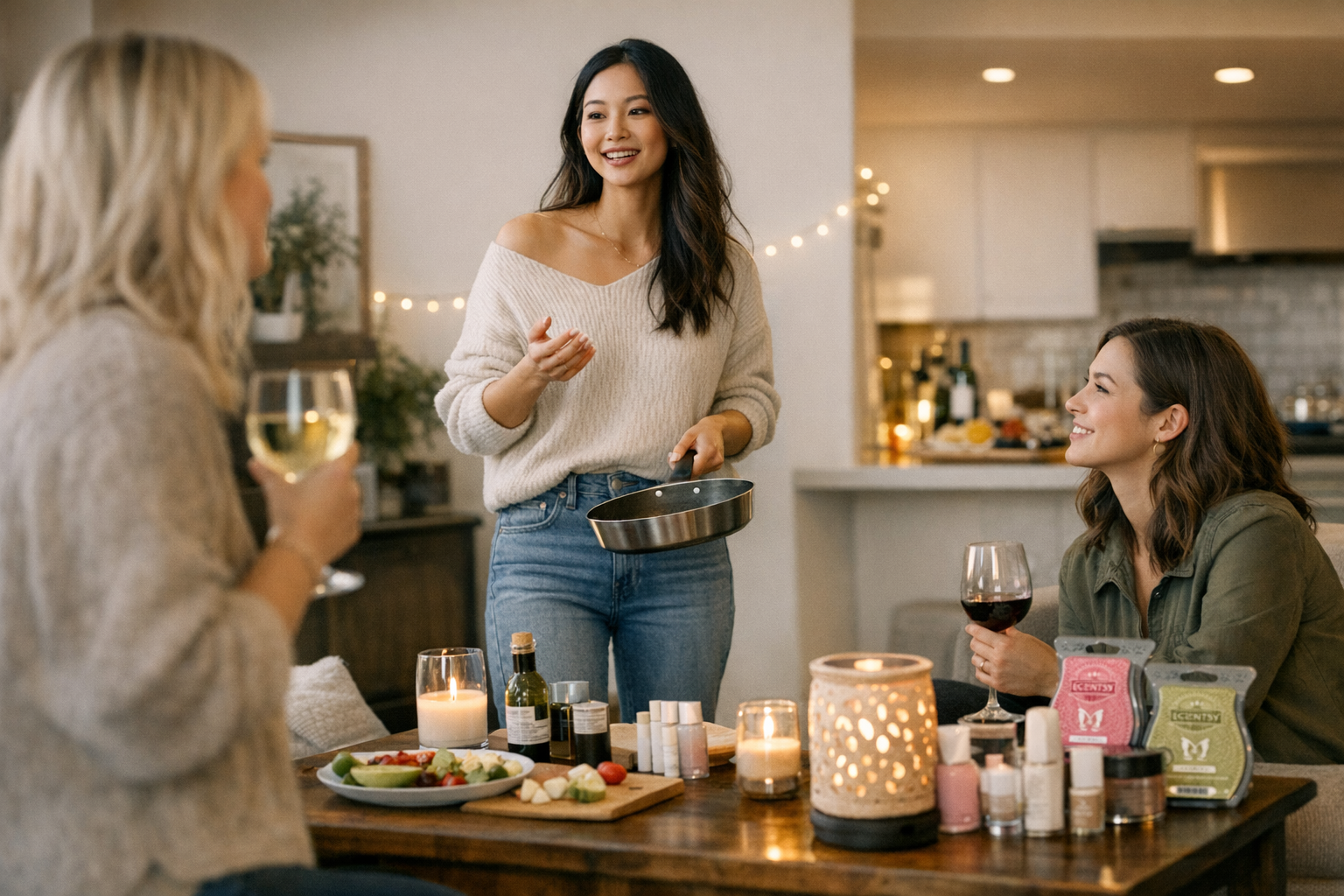
Somewhere in America right now, a Pampered Chef consultant is setting up a cooking demo in someone's living room.
A Scentsy party is being hosted over Facebook by a mom in Ohio who schedules the posts in advance so she can still do bath time. A wine guide from Traveling Vineyard is walking a group of friends through a tasting in a suburban kitchen in Georgia. A Thirty-One Gifts consultant is setting up a display of monogrammed totes at a fall fundraiser. And somewhere a woman who has been selling Arbonne clean beauty products for three years is signing up her fourth recruit of the month and wondering if she should go full-time.
The home party model — that peculiarly American invention born in the postwar suburbs when housewives needed income and plastic containers needed explaining — is not dead. It is not what it was. It has not recovered the cultural centrality it held when Tupperware parties were a ritual, Longaberger baskets were a status symbol, and the Pampered Chef cooking show was the social event of the suburban Tuesday night. But it is also not gone, and the forces reshaping it in 2026 are more interesting than the simple narrative of decline suggests.
This is the story of what happened to the home party, who is still doing it, and why the millennial mom — the woman the model was not built for and never quite figured out how to reach — might be the most important figure in whatever the home party becomes next.
How It Worked and Why It Worked So Well
The home party model was not a gimmick. At the peak of its cultural influence — roughly from the 1950s through the late 1990s — it was one of the most effective consumer sales mechanisms ever invented, and the reason it worked so well is worth understanding precisely because understanding it explains both the decline and the potential revival.
The model was invented, more or less, by Brownie Wise at Tupperware in the early 1950s. Earl Tupper had built an exceptional product — food-safe, airtight polyethylene containers that were genuinely revolutionary for household food storage. The problem was that nobody could figure out how to sell them in retail because customers had no idea how the seal worked until someone demonstrated it in their hands. Wise's insight was that the demonstration was the sale — and that the most compelling version of the demonstration happened in someone's living room, among friends, with a host who vouched for the product and social pressure that was warm rather than commercial.
The genius of the model was architectural. The home provided a trusted environment. The host provided social proof. The group setting created FOMO — if your friend bought three pieces, you felt the pull to buy at least one. The consultant provided expertise and the story behind the product. And the incentive structure — free products for the host based on total sales, commissions for the consultant, recruits for the next level up — created a self-replicating growth engine that required almost no traditional advertising.
At its peak, companies like Longaberger, Tupperware, Avon, Mary Kay, and Pampered Chef were not just selling products. They were selling community, income opportunity, and identity to women who wanted all three and found them unavailable through conventional channels. The Longaberger consultant who built a team of 40 women across three counties wasn't running a side hustle. She was running a business, building relationships, and participating in something that made her feel competent, valued, and seen. The product — the basket, the container, the cookware — was the vehicle. The experience was the point.
What Killed the Model (Sort Of)
The conventional explanation for the decline of the home party model goes like this: the internet made everything available online, women entered the workforce in greater numbers and had less time for Tuesday night parties, younger generations became skeptical of MLM structures, and the whole model quietly became obsolete.
All of that is true. None of it is complete.
The deeper problem was a slow erosion of the thing that made the model powerful in the first place: the educated sale. When Tupperware was demonstrating an airtight seal that customers genuinely didn't understand, the home party was the perfect mechanism for the product. When Longaberger consultants were telling the story of J.W. Longaberger and his twelve children and the handwoven maple basket that took six hours to make, the home party was the perfect mechanism for the product. When Pampered Chef was showing a room full of women how a garlic press and a flexible cutting mat could cut their dinner prep time in half, the home party was the perfect mechanism for the product.
The model began to struggle when companies decided that the mechanism — the party, the consultant, the social pressure — was powerful enough to sell anything. It wasn't. Longaberger's attempt to become a full home and lifestyle brand pushed its consultants to sell hand cream and jewelry that didn't carry the basket story and didn't need the party environment to be understood. Tupperware's fatal admission in its 2024 bankruptcy filing — that only 13% of its products were even listed on its own website — revealed a company that had so completely confused its distribution model with its product identity that it had lost the ability to reach customers who wanted the product but didn't want the party.
Avon filed for bankruptcy in 2024. Tupperware filed for Chapter 11 in September 2024 with $818 million in debt, its stock having fallen 75% in that year alone, and was subsequently acquired by a group of lenders for a fraction of its value. LuLaRoe, the direct-sales leggings brand that became a cultural phenomenon and then a cautionary tale in roughly the same decade, has been the subject of a documentary and thousands of horror stories from consultants who bought inventory they couldn't sell. The reputational damage that LuLaRoe, and the broader conversation around MLM predatory practices, did to the entire direct sales category cannot be overstated. When a generation of women grew up watching The Office mock pyramid schemes and then watched documentaries about MLM consultants losing money while the companies at the top extracted wealth, the cultural permission that the model had always relied on — the idea that this was a legitimate and admirable path to income and community — took a serious hit.
Who Is Still Doing It and Why It Persists
And yet.
Scentsy — the Meridian, Idaho-based fragrance and home scent company — has over 100,000 active consultants worldwide and continues to grow internationally. It still hosts in-person parties, online parties, on-the-go basket parties, and virtual Facebook events, and it still generates enough revenue to appear on Happi magazine's Top 50 household and personal products companies list. The product is genuinely experiential — you cannot replicate the experience of smelling 30 different wax scents and choosing your favorites through an Amazon listing — and the party model remains the best mechanism for that sale.
Pampered Chef, owned by Berkshire Hathaway since 2002, still runs over one million cooking shows per year in the United States. Its revenue has declined from a $320 million peak in 2015, but it still has approximately 35,000 active consultants and a functioning party model that it has adapted to include virtual Facebook parties and online booking platforms. The cooking demo — watching a consultant show you how a specific tool transforms a specific recipe — is still a more compelling sales experience than a product page with five photos and 47 reviews.
Mary Kay, Arbonne, Traveling Vineyard, Thirty-One Gifts, Origami Owl — all of them continue to operate, some of them growing, none of them at the cultural peak they reached in the 2000s. The model has not disappeared. It has contracted to the use cases where it is genuinely superior to the alternatives.
What those use cases have in common is the sensory, demonstrable, experiential product. Fragrance you have to smell. Kitchen tools you have to use. Wine you have to taste. Jewelry you have to try on. Products where the consultant's story and the product's story are genuinely inseparable and the living room environment creates the conditions for the sale that no digital channel can replicate. The home party has not lost its power in these categories. It has simply stopped pretending to have power in categories where it never belonged.
The Millennial Mom Question
Here is where the story gets genuinely interesting.
The millennial mom — roughly speaking, the woman born between 1981 and 1996 who is now 30 to 45 years old, likely with children, likely with some combination of full-time work, part-time work, and domestic labor that leaves her perpetually time-squeezed — was never the target customer for the classic home party model. She was a child or teenager when the model was at its peak. She came of age during the internet boom that began to hollow out direct sales. She watched her own mother's generation get burned by MLM schemes, or watched it happen to friends and online communities. She is deeply skeptical of anything that smells like a pyramid, and she has a finely tuned radar for the difference between a genuine product recommendation and a commission-motivated sales pitch.
And yet she is also, in several important ways, exactly the consumer the home party model was designed for.
She is overwhelmed with choice and desperately values trusted recommendations. She buys Stanley tumblers because a blogger she trusts told her the Stanley tumbler would change her life — and it did — and she trusts that blogger more than she trusts any brand advertisement because the blogger has a track record of being right about things that matter to her daily routine. She is part of Facebook groups where women share honest reviews of baby gear, kitchen products, and home organization systems with an intensity that would have looked familiar to any Tupperware hostess from 1965. She buys through influencers and affiliate links in a way that is structurally identical to the consultant model — a trusted person in her network recommends a product and gets compensated when she buys — but the transaction is mediated by a platform rather than a living room.
She craves in-person connection with other women in ways that the pandemic made acute and the post-pandemic era has not fully satisfied. The explosion of "girls' nights," wine clubs, book clubs, supper clubs, and what Pinterest catalogues as "Galentine's party aesthetic" content — up 1,285% year over year in recent searches — points to a woman who is actively looking for reasons to gather with friends in someone's home and experience something together. She just doesn't necessarily want to be sold to while she's doing it.
That last sentence is the crux of everything. The millennial mom is not hostile to the home party. She is hostile to the pretense that the party is social when it is actually commercial. She will happily attend a cooking night at a friend's house and buy a $90 baking stone if it genuinely solves a problem she has. She will recoil from the exact same experience if she senses that her friend invited her primarily to hit a monthly sales target.
The distinction is real, it is felt immediately, and it is the precise line that separates the home party experiences that millennial women are willing to participate in from the ones they quietly decline.
What a Revival Actually Looks Like
The home party model that works for millennial moms in 2026 looks different from the model that worked for their mothers in 1992, but the core mechanic is identical: a trusted person in a trusted setting demonstrates a genuinely excellent product that is better understood in person than online, and the social environment creates the conditions for a purchase decision that feels good rather than pressured.
The version of this that is quietly working in 2026:
The "experience first" party. The Pampered Chef cooking demo that is genuinely about cooking, with the product recommendation as the natural conclusion rather than the starting point. The Scentsy gathering where the fragrance discovery is the actual activity and the order sheet is incidental. The wine tasting where the knowledge transfer is real. The hosts who run these events successfully have internalized what every great salesperson knows: the moment the customer feels sold to, you've lost them. The moment they feel served, you've won.
The micro-influencer as the new consultant. The millennial mom who has 8,000 Instagram followers and a reputation for honest product reviews of kitchen tools, baby gear, or home organization products is doing exactly what a Longaberger consultant did — building a trusted network, demonstrating products in context, and earning from recommendations — but the living room is now a camera phone and the party is a Reel. The brands that have figured out how to convert this person into a genuine brand partner, rather than a paid advertiser, are building the 2026 version of the consultant model.
The hybrid party. Pampered Chef's virtual Facebook party model, whatever its awkwardness, points toward a real insight: the millennial mom has friends in three time zones and a schedule that does not accommodate a Tuesday night commitment. The party that starts in someone's kitchen and extends to a Facebook event for people who couldn't come in person, or that begins as a social media share and converts to a small in-home gathering for the most interested members, is adapting the model to the reality of how this woman's social life actually works.
The product that genuinely earns the party. Longaberger baskets earned the party because they were genuinely exceptional objects with a genuine story. Pampered Chef tools earn the party because they genuinely work better than what you'd find at Target. Scentsy earns the party because fragrance genuinely needs to be experienced in person. The brands that will build the next generation of the home party model are the ones building products that are demonstrably better in a room than on a screen — and then finding the women who love them enough to want to share them.
The Condition for Revival
The millennial mom is not the obstacle to the home party's revival. She is the opportunity. She wants to gather with friends. She values trusted recommendations over advertising. She is willing to spend money on things that are genuinely good. She will share what she loves with extraordinary reach and conviction on the platforms where she already lives. She has the social capital, the digital fluency, and the genuine community hunger that the home party model has always run on.
What she needs from the model is different from what her mother needed. She does not need the income opportunity to be the primary pitch — she has other income options and she knows what a recruitment-heavy compensation structure looks like. She does not need the party to pretend it is something other than a commercial event — she is too sophisticated for that and will feel the pretense immediately. She does not need to host in her living room — she will host on her Instagram story, in a private Facebook group, at a wine bar, or through a text thread with her six closest friends.
What she needs is a product that is genuinely worth talking about, a model that compensates her honestly for talking about it, and a company that understands that the transaction is the last thing that happens in the relationship rather than the first.
The brands that give her that will find out that the millennial mom is not just willing to participate in the home party model. She is perhaps the most powerful version of it that has ever existed — equipped with platforms, communities, and trust networks that would have made Brownie Wise's head spin.
The party is not over. It has just moved somewhere new.
Ritner Digital works with brands at every stage of growth — helping them find the right audience, tell the right story, and build the marketing infrastructure to scale. Let's talk.
Frequently Asked Questions
Are home parties and direct sales still a thing in 2026?
Yes — but the model has contracted significantly from its cultural peak in the 1990s and early 2000s. Companies like Scentsy, Pampered Chef, Mary Kay, Arbonne, Traveling Vineyard, and Thirty-One Gifts all still operate active party-based sales models with hundreds of thousands of consultants worldwide. What has changed is which products and which experiences the model still works for. The home party persists most strongly in categories where the product is genuinely better experienced in person than on a screen — fragrance, cooking demonstrations, wine tasting, jewelry — and where the consultant's story adds meaningful context to the purchase. In categories where the product can be understood and compared online just as well as in a living room, the model has collapsed, as Tupperware's 2024 bankruptcy and Avon's Chapter 11 filing made clear. The home party is not dead. It has become specific.
What happened to Tupperware and why did it fail?
Tupperware filed for Chapter 11 bankruptcy in September 2024 with over $818 million in debt, and the brand was subsequently acquired by a group of lenders for a fraction of that value. The causes were layered. The company clung to a direct sales model that still drove over 90% of its revenue in 2023 even as that model's relevance eroded — at the time of bankruptcy, only 13% of Tupperware's products were listed for sale on its own website. It was late to e-commerce, failed to build digital infrastructure for its sellers, and watched its sales force shrink as consultants left for platforms that offered better tools and faster income. Beyond the business model problems, Tupperware also faced rising competition from cheaper competitors, growing anti-plastic sentiment, and a consumer culture that had moved well past the era when an airtight seal needed to be demonstrated in person to be understood. The brand is not gone — the name was acquired and operations continue — but the company that pioneered the home party model did not survive the digital age intact.
Why are millennials skeptical of MLM and direct sales companies?
Millennial skepticism toward the MLM model is earned and specific. This generation came of age during the internet era that made product comparison and peer review instantly accessible, which made the information asymmetry that home party selling once exploited disappear. They watched companies like LuLaRoe become the subject of documentaries about consultants losing thousands of dollars buying inventory they couldn't sell. They received enough Facebook messages from acquaintances pitching them on "business opportunities" that the phrase itself became a meme. And they developed a finely tuned radar for the difference between a genuine recommendation from someone who loves a product and a commission-motivated pitch from someone who needs to hit a monthly sales target. The skepticism is not toward the home party itself — it is toward the recruitment-heavy compensation structures that prioritize growing the downline over delivering genuine value to customers. The brands that separate those things clearly are the ones that have maintained credibility with this audience.
What would a successful modern home party brand look like for millennial moms?
It would start with a product that is genuinely excellent and genuinely better experienced in person than online — something that earns the party rather than using the party to compensate for the product's mediocrity. It would have a compensation structure that is transparent and honest about the income opportunity, without making recruitment the primary pitch. It would meet women where they already are — Instagram, private Facebook groups, text threads with close friends, small gatherings at wine bars — rather than demanding a specific format that doesn't fit how millennial women's social lives actually work. It would treat the consultant's authentic enthusiasm for the product as the marketing asset rather than something to be scripted and systematized out of existence. And it would understand that the millennial mom is not hostile to being sold to when she trusts the person doing the selling and believes in what's being sold. She buys Stanley tumblers, Le Creuset Dutch ovens, and Beis carry-ons based on trusted recommendations from women in her network. The home party model that earns her trust operates on exactly the same principle.
Is there a real opportunity for a new Longaberger-style brand targeting millennial women?
Yes, but the opportunity looks different from what Longaberger was. The Longaberger model worked because the product was extraordinary, the origin story was genuine and emotionally resonant, and the founder's personality turned customers into believers rather than just buyers. A brand that could replicate those three elements — an exceptional handcrafted product with a real story behind it, sold through trusted social networks rather than a formal MLM structure — would find in the millennial mom one of the most powerful distribution networks ever assembled. She already sells the products she loves for free, every day, through her social platforms and word of mouth. The question is whether a brand can build the product and the model compelling enough to convert that organic enthusiasm into something structured and sustainable. The brands that come closest today are the ones operating in the influencer-affiliate space with genuine product quality behind them — not the legacy MLM companies trying to migrate their 1990s model to TikTok, but new brands built from the ground up for the way millennial women actually discover, evaluate, and share the things they love.