The Outdoor District Is Eating the Mall. Mosaic, Avalon, and Why the Suburbs Are Building Downtowns From Scratch.
There is a moment that every American suburb eventually reaches.
The mall is half-empty. The strip centers are aging. The fast food corridor along the main arterial road looks exactly like every other fast food corridor in every other suburb in the country. The residents — educated, affluent, increasingly tired of driving everywhere to do everything — start asking a question that sounds simple but turns out to be expensive: why doesn't this place feel like a place?
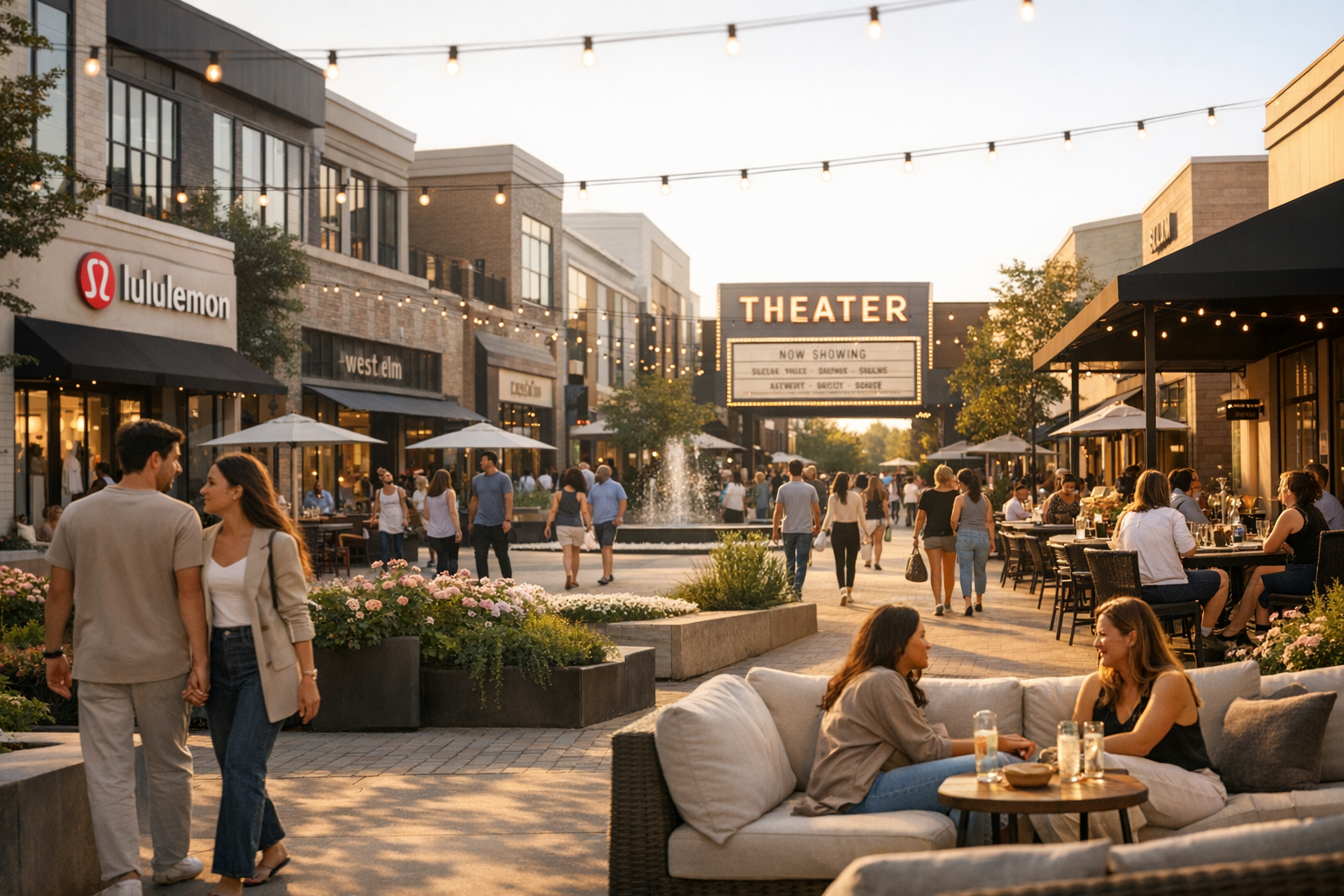
The answer that developers, municipalities, and real estate investors have arrived at over the past two decades is the outdoor mixed-use district. Call it a lifestyle center, a town center, an urbanburb, a third-place development — the names vary but the model is consistent. Walkable streets. Ground-floor retail and restaurants. Residential above. A hotel. A central green space with programming. An arthouse cinema or a boutique grocery as the anchor instead of a Sears. Parking hidden in structures at the perimeter. Events that fill the plaza on weekends. The feeling, carefully engineered, of a downtown that was always here.
The Mosaic District in Merrifield, Virginia and Avalon in Alpharetta, Georgia are two of the most studied examples of this model in America. They are not the same project. They are not solving the same problem. They don't look the same, position themselves the same way, or serve the same consumer. But they are both, in their own way, answering the same fundamental question about what suburban Americans want from the places they spend their time and money — and their success contains some of the most useful lessons in placemaking and place marketing available anywhere.
What the Outdoor District Model Is Really Selling
Before getting to the specific projects, it helps to understand what the outdoor district is actually selling — because it is not primarily selling retail. Retail is how it generates revenue. What it is selling is something more fundamental and more valuable: the experience of belonging to a place.
The intellectual framework behind the best of these developments comes from Ray Oldenburg's 1989 book The Great Good Place, which introduced the concept of the "third place" — the gathering spot that is neither home nor work, where people connect, linger, and feel like members of a community rather than consumers at a transaction. Oldenburg's examples were the European café, the English pub, the American barbershop. The outdoor district is the 21st-century suburban version of the same concept — engineered, expensive, and deliberately designed to create the conditions for spontaneous human connection that traditional suburbs systematically design out.
Edens, the developer behind the Mosaic District, explicitly cited Oldenburg's work in its design philosophy. North American Properties, the developer behind Avalon, talks about winning "heart share" rather than market share, and describes their secret sauce as "everything to do with the community that is created in the spaces between the buildings." Santana Row in San Jose, Legacy West in Plano, Domain Northside in Austin, Americana at Brand in Glendale — all of the best projects in this category share this orientation. The buildings are the container. The experience is the product.
This distinction has enormous implications for how these places should be marketed. You cannot market a third place the way you market a shopping center. You cannot lead with the tenant list or the parking ratios. You have to market the feeling — the Sunday morning farmers market, the ice rink in December, the dog on the green, the spontaneous conversation at the outdoor bar that turns into a two-hour evening. The marketing job is to make people believe they will feel something here that they cannot feel in their own living room or at the Target on the strip.
The Mosaic District: Suburban Retrofit Done Right
The Mosaic District is not the most glamorous project in this category. That is, in a way, precisely what makes it interesting.
Merrifield, Virginia is not Alpharetta, Georgia. It is not a rapidly growing Sunbelt suburb with demographic gold and disposable income pouring in from everywhere. It is an unincorporated area of Fairfax County, Virginia, wedged between I-66 and I-495 and surrounded by the conventional suburban commercial fabric of the Washington D.C. exurban orbit — strip malls, fast food corridors, industrial parks, garden centers. In 2006 when developer Edens purchased the failing multiplex cinema at the center of what would become the Mosaic District, the site was a degraded public realm in an affluent county with no coherent identity and no gathering place worth the name.
The decision Edens made was to start not with retail but with community. The central element of the design — Strawberry Park, named after the Beatles song, with a sister street called Penny Lane — was built first, as a gathering place, before the surrounding retail was complete. By insisting on managing the ground-floor retail surrounding the park, Edens controlled the experience from the street level up, and used that control to attract a mix of tenants that genuinely differentiated the district from the suburban retail landscape around it. Locally owned restaurants alongside regional favorites. Mom's Organic Market as the grocery anchor rather than a conventional supermarket. The Angelika Film Center — an arthouse cinema — rather than a multiplex. West Elm. Barnes & Noble. A curated mix that signals a specific identity: creative, educated, community-oriented, locally rooted.
The Mosaic District is 31 acres. The average household income within three miles exceeds $162,000. It earned LEED Neighborhood Development certification. It has become a catalyst for the redevelopment of the surrounding Merrifield corridor, and Fairfax County has explicitly used it as a test case for the much larger suburban retrofit underway at Tysons Corner. The 2020 launch of an autonomous circulator connecting the Mosaic to the Dunn-Loring Metro station, a mile away, was a genuine infrastructure commitment to the transit-oriented vision the development embodied from the start.
What Mosaic does in marketing is lean into diversity and community in ways that reflect the genuine demographics of Merrifield — approximately one-third Asian, multigenerational, highly educated, and culturally eclectic. The FRESHFARM Mosaic Market that takes over the district on Sundays is not a tourism draw. It is a community ritual. The Sip & Stroll initiative — designated areas where visitors can carry cocktails as they shop — understands how people actually want to move through a walkable outdoor space in the evening. The programming is regular enough to create habit and varied enough to create anticipation.
Mosaic's marketing challenge is one that many suburban retrofit projects share: it sits in the shadow of a better-known neighbor. Tysons Corner, three miles away, is one of the largest retail concentrations in the country. The Mosaic District does not compete with Tysons on scale, on anchor brands, or on regional draw. What it competes on is character — and character is a brand asset that Tysons, for all its size, has never fully developed. The Mosaic is not trying to be everywhere. It is trying to be the specific place that the specific people of Merrifield and its surrounding neighborhoods need. That narrowness of purpose is a strength, not a limitation.
Avalon: The Urbanburb That Became a National Template
If the Mosaic District is the thoughtful suburban retrofit, Avalon is the touchdown pass.
The site that North American Properties acquired in 2011 in Alpharetta, Georgia was a genuine disaster — 86 acres of Georgia red clay, unfinished streets, and the weedy skeleton of a development called Prospect Park that had stalled completely in the 2008 recession, leaving nothing but concrete foundations and ambition. The demographic context was extraordinary: Alpharetta is one of the most affluent suburbs in America, the "Technology City of the South" with over 600 tech-focused companies, a population that trends young, highly educated, and deliberately lifestyle-oriented, and a consumer market that had been driving into Atlanta for urban experiences because nothing within reach could provide them.
NAP recognized the gap and built directly into it. Avalon opened in October 2014 at a cost of over $1 billion across both phases, and from the first weekend it was clear something different had happened. Celebrated intown Atlanta chefs couldn't open outposts fast enough. The single-family homes within the development — an unusual choice for a mixed-use project — communicated permanence and commitment to a residential consumer who had been skeptical that suburban density could actually work. The central Plaza, with its turf lawn and fountain, converted to an ice skating rink every winter. The concierge desk at the heart of the project offered hotel-style services to tenants and visitors. Every detail was oriented toward the same operating principle that NAP managing partner Mark Toro articulated plainly: the secret has nothing to do with the buildings, and everything to do with the community created in the spaces between them.
The results are staggering by any standard. Over the first decade, Avalon drew more than 7.5 million annual visitors — remarkable for a project 40 minutes outside of Atlanta. It generated more than $3 billion in retail sales, 700,000 hotel room nights, and over 15,400 conference center bookings. It created 4,000 jobs. It triggered a 13% increase in Alpharetta's households and a 10% increase in its overall population since opening. It generated $17 million in annual tax revenue. And it became a literal template — developers and city officials from around the world toured Avalon to understand what it had done and figure out how to replicate it. The "Avalon Effect" became industry shorthand for the premium in performance that all uses — retail, hotel, residential, office — enjoy when they are embedded in a well-executed mixed-use community rather than isolated in conventional single-use development.
Avalon's marketing is polished, aspirational, and consistent in a way that most retail developments never achieve. The brand holds across every touchpoint — the signage, the website, the events calendar, the hotel positioning, the residential leasing materials. NAP made early on what turned out to be an essential decision: one brand, one community. No management companies or partners are allowed to display their own branding at the expense of the Avalon identity. The development functions as a place brand, not a collection of tenant brands sharing a parking lot. That single decision — common sense in retrospect, genuinely unusual in practice — is one of the most important brand management lessons the outdoor district model has produced.
What Separates the Projects That Work From the Ones That Don't
The outdoor district model has produced genuine successes — Mosaic, Avalon, Santana Row, Legacy West in Plano, Domain Northside in Austin, Americana at Brand in Glendale, Reston Town Center in Virginia. It has also produced a long list of lifestyle center failures and outdoor malls that feel exactly like enclosed malls with the roof removed.
The difference between the projects that create genuine places and the ones that create upscale strip malls with landscaping comes down to a few things that are easy to identify in retrospect and genuinely difficult to get right in execution.
The plaza has to be the heart, not the throat. The central gathering space is the make-or-break design decision in every one of these projects. It has to be the right size — large enough to hold events and generate energy, small enough to feel intimate and human-scaled rather than civic and empty. It has to be surrounded by food and beverage tenants rather than fashion retailers, because people linger at restaurants and move quickly through clothing stores. It has to be programmed with 200-plus events per year to prevent the emptiness that kills a public space's perceived value. And the parking has to be at the perimeter so that people actually walk through the plaza rather than approaching the nearest retailer directly from their car. These are design decisions that determine whether the experience works before anyone signs a lease or runs a marketing campaign.
Tenant curation is brand curation. The outdoor district that fills its ground floor with the same brands available at every mall within 20 miles is not building a place — it is building a slightly more attractive version of the thing it is supposed to replace. The projects that work resist the temptation to lease to whoever shows up with the strongest covenant, and hold space for locally owned restaurants, regional brands making their suburban debut, and experiential retailers that require visitors to be physically present rather than shopping from their phone. This is a financial sacrifice in the short term and a competitive moat in the long term. The Mosaic's Mom's Organic Market, the Angelika Film Center, and its roster of locally operated restaurants communicate identity. Avalon's chef-driven restaurant lineup — which NAP specifically describes as the South's first in a suburban mixed-use context — communicates identity. Identity is what makes people choose to drive to your project instead of the one down the road.
Events are not marketing. Events are the product. The outdoor district that markets events as a way to drive traffic to its retail tenants is thinking about events incorrectly. Events are the experience. They are the reason people feel that the place belongs to them. The Sunday market, the holiday ice rink, the summer concert series, the dog-friendly morning hours — these are not promotions. They are the rituals through which a community is built. The best outdoor district operators understand this and invest in programming as infrastructure rather than as advertising. Avalon's more than 1,000 events and $500,000-plus in charitable giving are not marketing budget line items. They are the compounding investment in community that creates the brand loyalty that no advertising campaign can manufacture.
The residential component is not optional. The projects that sustain themselves over time — through economic cycles, through retail market shifts, through tenant turnover — are the ones that have genuine residents. People who live at Mosaic or Avalon are not tourists. They are daily users who generate foot traffic in February, buy coffee every morning, eat dinner twice a week, and become the organic brand ambassadors that the project cannot buy. The lifestyle center model — outdoor retail with no residential — is more vulnerable to the same forces that are destroying enclosed malls because it has the same fundamental problem: everything depends on people choosing to come here rather than anywhere else. The mixed-use district with residents embedded in it has people who don't have to choose. They are already there.
What This Means for Every Business Operating Inside These Districts
If you operate a business inside a Mosaic, an Avalon, or any outdoor mixed-use district in America, the place brand is one of your most valuable marketing assets — and most businesses in these districts dramatically underleverage it.
The customer who comes to the Mosaic District on a Sunday for the farmers market is predisposed toward quality, local sourcing, and community. The customer who comes to Avalon for the ice skating in December is already in an experiential mindset that makes them receptive to discovering new restaurants and retailers. The place has done significant brand work on your behalf before your customer walks in your door. The question is whether your own marketing, your own digital presence, your own social content is aligned with that work or indifferent to it.
The businesses that win inside outdoor districts are the ones that lean into the place identity — that reference the community, participate visibly in the events, show up on the platforms where the district's audience already lives, and present themselves as essential parts of a place rather than interchangeable tenants in a retail center. Local SEO that captures "restaurants in the Mosaic District" or "things to do at Avalon" is not just tactical keyword work. It is an expression of belonging to a specific place with a specific audience — and that belonging is worth more than any amount of generic digital advertising.
The outdoor district model has not won because it solved the retail problem. It has won because it solved the belonging problem. The suburbs have always been places people live. The outdoor district is what happens when you try, deliberately and expensively, to build places people belong to.
The ones that get it right are among the most interesting marketing and brand case studies in contemporary American real estate. The ones that get it wrong are just shopping centers with better landscaping.
Ritner Digital helps brands inside and around mixed-use districts, suburban corridors, and regional markets build the digital presence and marketing systems that connect them to the communities they serve. Let's talk.
Frequently Asked Questions
What is an outdoor mixed-use district and how is it different from a mall?
An outdoor mixed-use district combines retail, restaurants, residential units, office space, a hotel, and public gathering spaces along walkable streets — all within a single development designed to feel like a downtown rather than a shopping center. The difference from a mall is fundamental and goes well beyond the roof. A mall is a retail container optimized for transactions — every design decision, from the parking lot to the anchor placement to the interior layout, is built to move people past stores as efficiently as possible. An outdoor mixed-use district is optimized for lingering. The parking is at the perimeter so people walk. The central plaza is surrounded by restaurants rather than retailers because people sit at restaurants and move through clothing stores. Residents live above the shops. Events fill the green space year-round. The goal is not a purchase. It is the feeling of belonging to a place — what urban theorist Ray Oldenburg called a "third place," somewhere that is neither home nor work but where community actually forms.
What makes the Mosaic District in Merrifield, Virginia successful?
The Mosaic District succeeded where many suburban retrofit projects fail because Edens, the developer, started with the gathering space rather than the retail. Strawberry Park — the central green at the heart of the district — was built first, before the surrounding tenants were complete, establishing the place before the commerce arrived. Edens then controlled the ground-floor retail experience by insisting on managing those leases directly, which allowed them to curate a tenant mix that genuinely differentiated the district from the suburban landscape around it: Mom's Organic Market, the Angelika Film Center, locally owned restaurants, and regional brands making their suburban debuts. The result is a project that serves the specific community around it — diverse, educated, multigenerational — rather than trying to be a generic destination for everyone. The FRESHFARM Sunday market, the Sip & Stroll initiative, and the regular events calendar turned the Mosaic into a community ritual rather than a retail option. That distinction is what separates projects that last from projects that struggle.
What is the Avalon Effect and why do developers reference it so often?
The Avalon Effect is the term North American Properties coined to describe the performance premium that all uses in a well-executed mixed-use development enjoy simply by being embedded in it. The Hotel at Avalon outperformed virtually every other hotel in metro Atlanta not because of its rooms or its brand but because of the energy and foot traffic generated by the surrounding community. The office buildings at Avalon leased at premium rates because tenants wanted the restaurants, fitness studios, and walkable environment steps from their desks. The residential units commanded higher rents because of the same. When developers and city officials talk about wanting to build "their own Avalon," they are not just talking about the physical format — walkable streets, central plaza, mixed uses. They are talking about achieving this compounding premium where every component of the project makes every other component more valuable. It is a network effect applied to real estate, and Avalon is the clearest demonstration of it in suburban America over the past decade.
Why do some outdoor districts fail while others become genuine community institutions?
The outdoor districts that fail typically make one or more of three mistakes. The first is tenant curation — filling the ground floor with the same brands available at every mall within 20 miles rather than holding space for locally owned restaurants, regional brands, and experiential retailers that give the place a genuine identity. The second is the plaza problem — building a central space that is the wrong size, poorly surrounded, under-programmed, or disconnected from the parking in a way that means people never actually move through it. The third is treating events as marketing rather than as the product itself. The outdoor districts that become community institutions program their public spaces 200 or more times per year and understand those events as the rituals through which belonging is built — not as promotions designed to drive retail traffic. The ones that get all three right create something that compounds over time. The ones that get them wrong build an upscale strip mall with better landscaping.
What should a business inside an outdoor district do differently with its marketing?
The single biggest missed opportunity for businesses inside outdoor districts is failing to align their own marketing with the place brand that the district has already built. The customer who comes to the Mosaic District for the Sunday farmers market is already predisposed toward quality and local identity. The customer who comes to Avalon for the holiday ice rink is already in an experiential mindset. The place has done significant brand work before that customer walks through your door. The businesses that leverage this most effectively present themselves as essential parts of the place rather than interchangeable tenants — they reference the community in their content, participate visibly in district events, maintain local SEO that captures searches for experiences within the district rather than just their own name, and build their social media presence around the place identity that their customers already feel. Local SEO for "restaurants in the Mosaic District" or "things to do at Avalon" is not just a tactical keyword decision. It is an expression of belonging that the most successful businesses in these districts have figured out and most of their competitors have not.