The Longaberger Story Is One of the Greatest Brand Lessons in American Business History
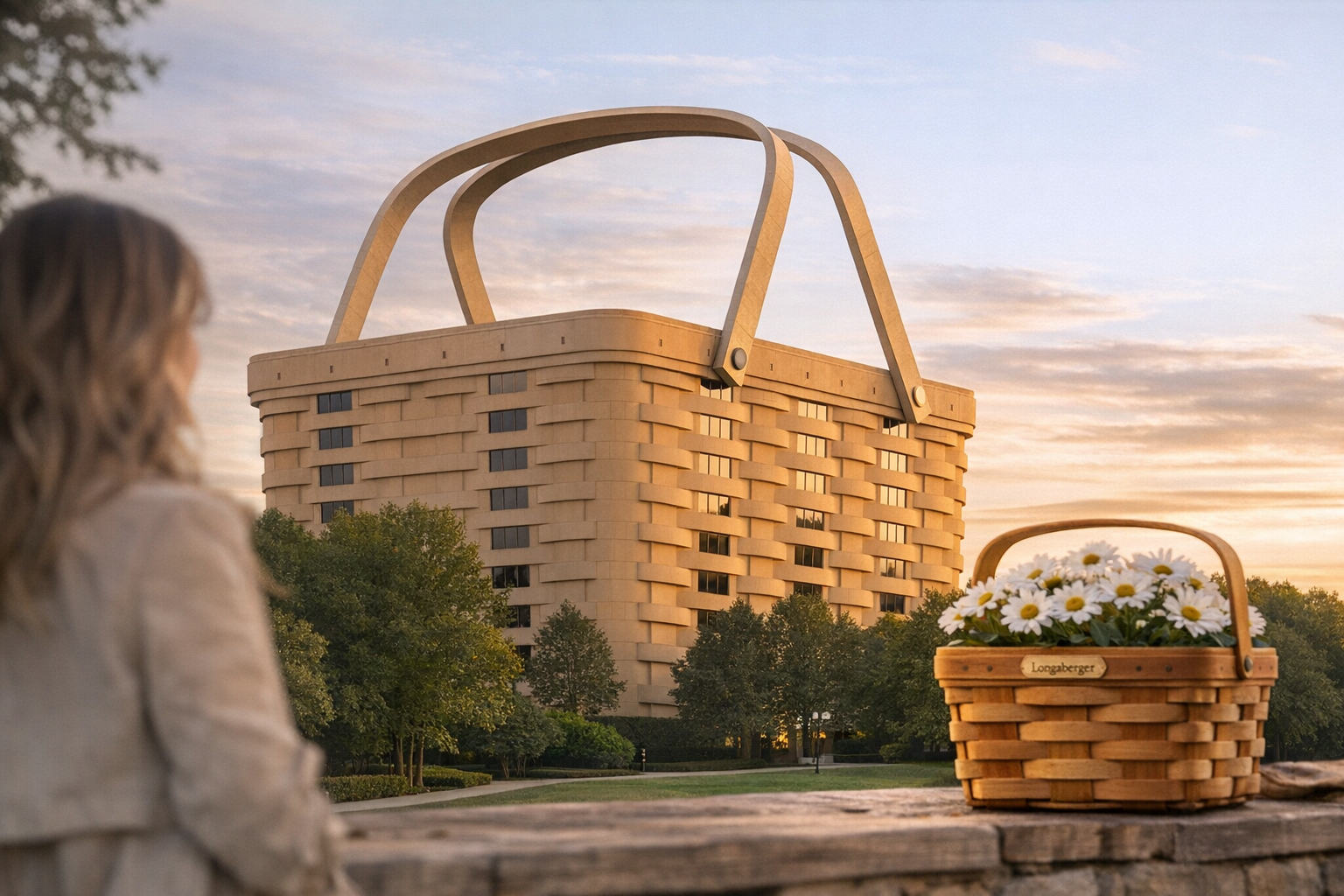
There is a seven-story building on State Route 16 in Newark, Ohio that is shaped like a basket.
Not inspired by a basket. Not vaguely reminiscent of a basket. Shaped, precisely and literally, like the Medium Market Basket — the top-selling product of the company that built it — scaled to 160 times its original size, complete with 150-ton handles that had to be engineered to heat themselves in winter to keep ice from falling onto the glass roof below. It took 18 months just to build the handles. The whole project cost $30 million.
Dave Longaberger wanted to build it. His architects told him it couldn't be done. He walked into the meeting carrying a basket, set it on the table, and said: this is what I want. If you can't do it, find someone who can.
They built the basket.
That story — the vision, the audacity, the refusal to accept conventional thinking about what a company headquarters should look like — is the Longaberger brand in miniature. And the fact that the basket building now sits largely empty, available for redevelopment at a fraction of what it cost to build, while the company that commissioned it went bankrupt in 2018, is the other half of the lesson.
The Longaberger story is one of the most complete brand case studies in American business history — a textbook example of how to build something extraordinary, what happens when the builder disappears, and why the most durable brands are not products or buildings but people and the cultures they create.
What Dave Longaberger Built
Dave Longaberger was not supposed to build a company worth a billion dollars. He was born the fifth of twelve children in Dresden, Ohio — a small town in the rolling Appalachian foothills of east-central Ohio — failed first grade once, fifth grade twice, finished high school at twenty, and struggled with a severe stutter and epilepsy his entire life. He drove a delivery truck for a local bakery for eight years. He bought an ice cream shop. He tried grocery retail. None of it was destiny.
What it was, was school. Every job Dave Longaberger held before starting his company taught him something about customers, about relationships, about the gap between what businesses offer and what people actually want. When he started selling his father's handwoven maple baskets in 1973 — first out of a small building in Dresden with five weavers, then at retail, then at home shows modeled on the Tupperware party model that a sales contact introduced him to in 1978 — he brought everything he had learned about people with him.
The product itself was remarkable. J.W. Longaberger, Dave's father, had learned basket weaving at the Dresden Basket Factory in 1919, purchased the factory during the Great Depression for $1,900 when it closed, and spent decades making handwoven maple baskets by hand with his children's help. The craft was real. The materials were American hardwood. The construction was durable enough to last generations. When Dave started selling these baskets to American consumers in an era when mass-produced plastic and imported goods were flooding every category, he was offering something that most of the market had stopped offering: a product made by hand, in America, by people who knew and cared about what they were making.
The home party model turned out to be the perfect channel for this product. Longaberger baskets were not the kind of thing you bought on impulse in a department store. They were the kind of thing you bought after someone showed you how they were made, told you the story of the family that made them, and let you hold one and feel the difference between it and everything else available at the same price point. The educated sale — the sale that happens when a customer understands the full context of what they're buying — was the engine of Longaberger's growth, and it produced something more durable than a transaction. It produced loyalty. It produced collectors. It produced women who owned 50, 100, 200 baskets and came back for the new ones every season.
By 1997, Longaberger was a Fortune 500-level private company. At its peak in 2000 it had over $1 billion in annual sales, more than 8,200 direct employees, and approximately 70,000 independent home consultants selling its products across the country. The basket building opened that year. Dave Longaberger had built not just a successful company but an institution — a community, a culture, a movement around a handcrafted product from small-town Ohio that somehow captured the imagination of suburban America at the exact moment suburban America was most hungry for something authentic.
The Brand Was Dave
This is the most important thing to understand about Longaberger — and the thing that explains everything that came after.
The brand was Dave. Not the baskets, though the baskets were genuinely exceptional. Not the home party model, though it was brilliantly executed. Not the basket building, though it was an extraordinary act of brand commitment. Dave Longaberger — his personality, his story, his specific kind of charismatic, self-made, heartland American optimism — was the irreplaceable element in everything the company built.
He was the kind of leader that customers didn't just buy from — they believed in. His consultants weren't selling baskets. They were selling a man's dream, a family's legacy, the idea that American craftsmanship still meant something and that you could build a billion-dollar company in a small Ohio town without selling out, without cheapening the product, without abandoning the people who made it. Dave Longaberger made 8,000 people feel like they were part of something that mattered, and made 70,000 more feel like they were not just selling but evangelizing.
When he died in March 1999 — just two years after moving into the basket building he had fought to construct — 8,000 people came to his two-day memorial service. Not employees. Not consultants. People who loved him. That is not a business metric. That is a cultural one. It tells you everything about what kind of brand Longaberger actually was: a personality cult, in the best sense of that phrase, built around a man who was genuinely extraordinary and genuinely irreplaceable.
His daughters Tami and Rachel took over the company. They were capable, committed, and deeply loyal to their father's vision. But no one — not family, not the most talented professional successor in the world — could replace what Dave Longaberger brought to that business. The consultants had sold a relationship with a founder. The customers had bought into a story that was fundamentally his. When he was gone, the company still had the product. It no longer had the brand at its most essential level.
What Happened Next Is a Marketing Lesson in Itself
The decline of Longaberger after 2000 is often attributed to external forces — and those forces were real. The September 11 attacks wounded the American consumer economy. The 2008 recession devastated discretionary spending. The rise of e-commerce disrupted the home party model that had been Longaberger's exclusive channel for a generation. Changing home decor tastes moved away from the country crafts aesthetic that Longaberger baskets embodied at their commercial peak.
All of that is true. None of it is the whole story.
The company also made strategic decisions in the years after Dave's death that accelerated rather than arrested the decline. It diversified aggressively — into pottery, wrought iron, jewelry, home accessories, clothing, food products — in an attempt to transform Longaberger from a basket company into a full home and lifestyle brand. The instinct was understandable. Dave himself had articulated the vision of Longaberger eventually making everything for the home and then building the homes as well. But the diversification diluted the very thing that made the baskets worth what they cost. A Longaberger basket justified its price because it was handwoven from American maple by trained artisans with decades of craft knowledge behind them. A Longaberger candle or hand cream or picture frame had no equivalent reason to command a premium. The consultants who had built their businesses on the power of the basket story found themselves being asked to sell things that didn't carry that story — and couldn't.
One longtime consultant summed it up with perfect clarity: "My goal was to market baskets, because when I joined the business, it was a basket company. I could sell them now if I could find somebody to make them. They didn't want to buy hand cream, jewelry, pictures."
In 2013, the company was acquired by CVSL, Inc. — later renamed JRJR Networks — a Dallas-based holding company that saw Longaberger as a platform for revival. The new management's vision was ambitious. One executive told Columbus Monthly in 2017 that Longaberger would become a $1 billion brand again within five years. By 2016 there were fewer than 75 employees. On May 4, 2018, a note went out to the sales force: Longaberger, at this time, has ceased operations. The company filed for bankruptcy the following month. Legal battles between Tami and Rachel Longaberger and the new ownership had resulted in judgments totaling nearly $5 million against JRJR, and the New York Stock Exchange had suspended trading of JRJR shares. The company was gone.
The Revival and What It Means
In 2019, Xcel Brands — the company behind Isaac Mizrahi and other relaunched heritage brands — acquired the Longaberger intellectual property and began a revival effort with Tami Longaberger's involvement. The baskets are back, produced under a licensing agreement with Dresden & Co. The brand has expanded again into home goods, tableware, food, and lifestyle products. The direct selling model has been updated for social media — "stylists" selling through social shopping and referrals rather than home parties.
The revival is earnest, and the affection for the brand among its original customer base remains real and deep. Longaberger baskets on resale platforms sell for hundreds of dollars. The collector community never entirely disappeared. The heritage is genuine and it resonates.
What the revival cannot fully solve is the core challenge that ended the original company: Longaberger without Dave Longaberger is a product without its most powerful story. The baskets are still exceptional. The craft is still genuine. The American-made, family-rooted, small-town Ohio origin is still true and still compelling. But the personality that made those facts feel urgent and personal to millions of customers is gone, and no branding exercise can replace it. The revival succeeds to the extent that it honors the craft and the heritage without trying to manufacture the charisma that animated the original. The best version of the Longaberger brand going forward is one that puts the basket back at the center — the product itself, the hands that make it, the wood that goes into it, the generations of family craft behind it — and trusts that the story is strong enough to do the work without the man.
What Longaberger Teaches Every Brand Builder
The founder is a brand asset that has no replacement value. This is the hardest lesson Longaberger offers, because it is the one most difficult to act on. When a company's brand is fundamentally an expression of a founder's personality — their story, their values, their specific way of connecting with customers — that brand is extraordinarily powerful while the founder is present and extraordinarily vulnerable when they are gone. The businesses that navigate this transition best are the ones that begin early to embed the founder's values into systems, culture, and product rather than keeping them exclusively in the founder's person. Apple had to solve this. Longaberger did not fully solve it before the loss became irreversible.
Product clarity is a strategic asset. Longaberger was the greatest handwoven maple basket company in America and possibly the world. That specificity was the source of all its pricing power, all its loyal collectors, and all its cultural resonance. The moment it became a home and lifestyle brand that also happened to make baskets, the anchor that held everything else in place began to drag. Diversification is a legitimate growth strategy — but not when it dilutes the very quality that made the core product worth the premium. Growth that undermines the brand is not growth. It is the beginning of the end, moving slowly enough that it looks like strategy.
The distribution model can become the product's enemy. The home party model was brilliant in 1978 and remained effective through the 1990s because it was the mechanism by which the educated sale happened — the sale that justified the price and built the collector relationship. As the model aged and the consultant base grew, maintaining the quality of the selling experience became harder, and the consultants' ability to tell the basket story with the conviction that drove purchases became diluted by product line complexity. A distribution model that depends on thousands of independent representatives telling your brand story is only as strong as the story those representatives are equipped and motivated to tell.
A building cannot save a brand — but it can define one. The basket building is the most extraordinary piece of brand architecture in American business history. It said, more clearly than any advertisement ever could, that Dave Longaberger believed in what he was building and was willing to commit to it completely and permanently. It generated millions of impressions, enormous publicity, and a pilgrimage mentality among the brand's most devoted customers. It was also a $30 million bet on a business trajectory that did not continue upward. The building outlasted the company. The lesson is not that bold brand statements are foolish — the basket building was a magnificent statement. The lesson is that a statement, however magnificent, is not a strategy.
The brand is worth saving. Longaberger's customer loyalty is one of the most durable in American consumer goods. The people who loved these baskets loved them with a conviction that tracked across decades and survived bankruptcy. There are collectors who own hundreds of them. There are families for whom a Longaberger basket is a piece of inheritance passed across generations. The product genuinely earned this loyalty — it deserved it. The revived brand has real material to work with. Whether it can convert the warmth of its heritage into a sustainable business at modern scale is the question its current operators are still answering. The early signs suggest they understand that the answer begins with the basket.
It always did.
Ritner Digital believes the best brands are built on something real. If you're building one and want a marketing partner who understands what that takes, let's talk.
Frequently Asked Questions
What was the Longaberger Company and what made it famous?
The Longaberger Company was an American manufacturer and direct seller of handwoven maple wood baskets and home products, founded in 1973 by Dave Longaberger in Dresden, Ohio. It became famous for three things simultaneously: the exceptional quality of its handcrafted baskets, which were made by trained artisans using traditional weaving techniques passed down through the Longaberger family since the early 1900s; the home party direct sales model that turned tens of thousands of independent consultants into passionate brand evangelists; and the personality and story of Dave Longaberger himself, a self-made entrepreneur with a stutter and a fifth-grade education who built a billion-dollar company in small-town Ohio through sheer force of belief. At its peak in 2000, the company had over $1 billion in annual sales, more than 8,200 direct employees, and approximately 70,000 independent consultants selling its products nationwide. It was also famous for its headquarters — a seven-story building on State Route 16 in Newark, Ohio, built to look exactly like the company's top-selling Medium Market Basket, scaled to 160 times its original size.
Why did the Longaberger Company fail?
The decline of Longaberger had multiple causes that compounded over time. The most fundamental was the loss of Dave Longaberger himself, who died in 1999 — the brand was so deeply tied to his personality, his story, and his specific ability to inspire both customers and consultants that his absence left a gap no successor could fill. External forces accelerated the decline: the September 11 attacks wounded the consumer economy at exactly the wrong moment, the 2008 recession further devastated discretionary spending, and changing home decor tastes moved away from the country crafts aesthetic the baskets represented. But internal decisions mattered too. The company diversified aggressively into pottery, jewelry, clothing, and home accessories in an attempt to grow beyond baskets — and in doing so diluted the brand story that had made the baskets worth their premium price. Consultants who had built their businesses on the power of the basket narrative found themselves selling products that didn't carry that story and couldn't justify the same conviction. The company was sold to outside holding companies in 2013, went through legal battles, and ceased operations entirely in May 2018, filing for bankruptcy the following month.
What is the Longaberger basket building and what happened to it?
The Longaberger basket building is a seven-story, 180,000-square-foot corporate headquarters on State Route 16 in Newark, Ohio, built between 1995 and 1997 at a cost of $30 million. Dave Longaberger commissioned it to look exactly like the company's Medium Market Basket — the building's upper floors are wider than its lower floors, mirroring the basket's profile, and its two massive handles each weigh approximately 75 tons and are equipped with a heating system to prevent ice buildup in Ohio winters. The building opened in 1997 and became an immediate landmark and tourist attraction. The company stopped paying property taxes on it in 2014, employees moved out in 2016, and it was sold in 2017 for $1.2 million — a fraction of its original cost — to a Canton, Ohio developer who also paid over $800,000 in back taxes. Various redevelopment plans including a boutique hotel have been proposed but not completed. As of 2025 the developer intends to convert it into a mixed-use development, possibly including condos and retail. It remains one of the most recognized pieces of novelty architecture in America and a genuine Ohio landmark.
Is the Longaberger brand still alive today?
Yes. In 2019, Xcel Brands — a company that specializes in acquiring and relaunching heritage consumer brands — purchased the Longaberger intellectual property and relaunched the brand with the involvement of Tami Longaberger, Dave's daughter. The revived brand produces handmade baskets through a licensing agreement with basket-weavers Dresden & Co., and has expanded the product line to include home goods, tableware, food products, and lifestyle items. The direct sales model has been updated for the social media era, with independent sellers called stylists using digital and social channels rather than home parties. The collector community and heritage customer base remain genuinely loyal — vintage Longaberger baskets sell for hundreds of dollars on resale platforms, and demand surged during the pandemic as outdoor and picnic culture experienced a national revival.
What are the biggest branding lessons from the Longaberger story?
Several lessons emerge from Longaberger's rise and fall that apply to virtually any brand in any category. The first is that a founder-dependent brand is both the most powerful and the most fragile kind — powerful because a genuine personality and story build loyalty no advertising can replicate, fragile because that asset is irreplaceable when it is gone. The second is that product clarity is a competitive moat: Longaberger's pricing power, collector loyalty, and cultural resonance all flowed from being the best handwoven maple basket company in America, and diluting that identity through aggressive diversification weakened the very foundation it was built on. The third is that distribution models must evolve without losing the quality of the selling experience — the home party model worked as long as consultants could tell the basket story with conviction, and suffered when product line complexity made that story harder to tell. And the fourth, perhaps most hopeful, is that genuine product quality and earned customer loyalty are durable even when the business structure around them collapses. The baskets were worth loving. The people who loved them never stopped. That is the asset the revived brand has to work with — and it is more than most second-chance stories get.