Two Coasts, Two Playbooks: How the Jersey Shore and the South Carolina Lowcountry Market Themselves Completely Differently — and What Every Beach Town Can Learn From Both
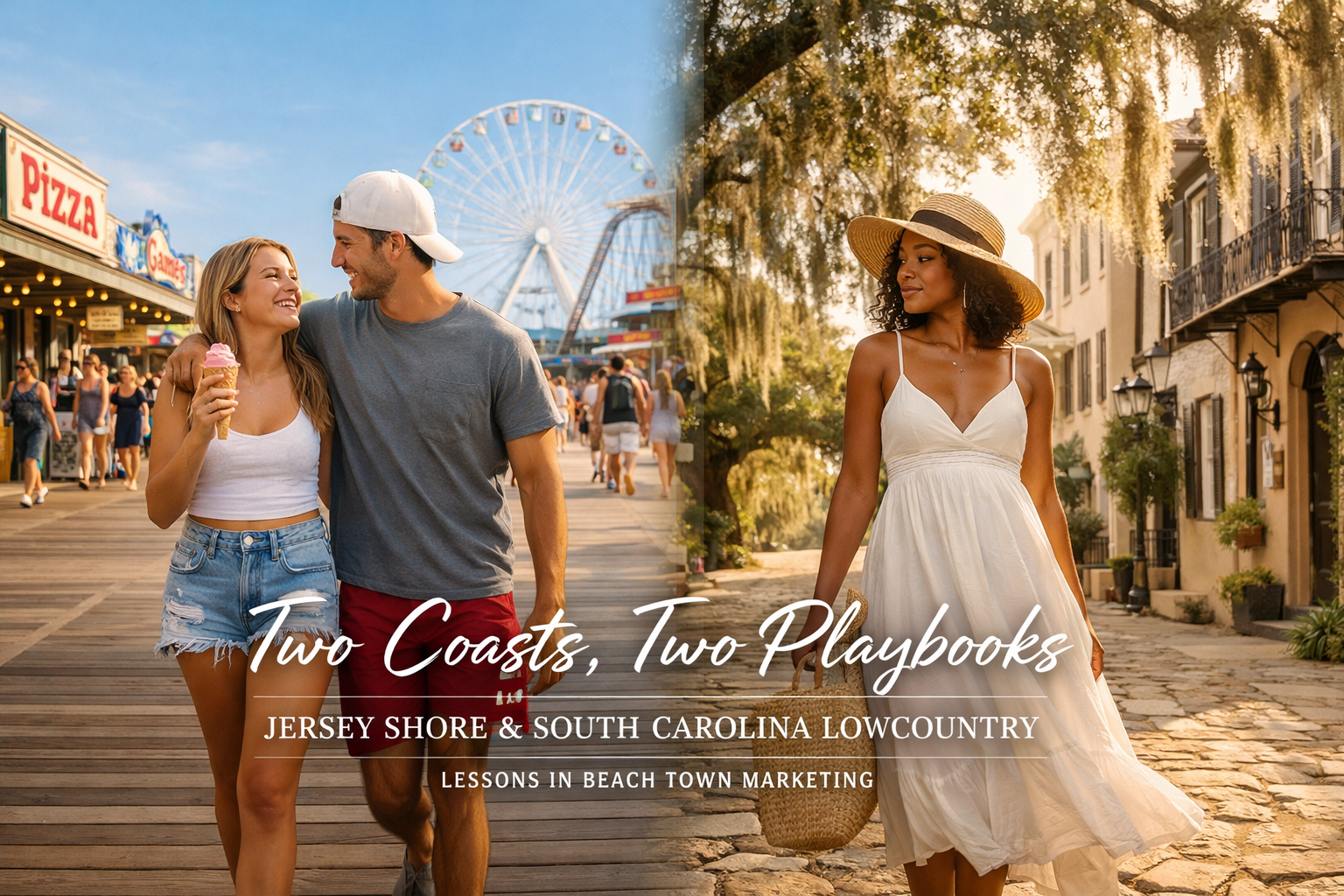
There are two kinds of coastal tourism marketing in America.
The first kind says: come here, it's fun, we have a beach, here are the things you can do. The second kind says: come here and become someone different for a week — more relaxed, more present, more yourself — and carry something home that proves you were here.
The Jersey Shore and the South Carolina Lowcountry — specifically Hilton Head Island and Mount Pleasant — represent these two philosophies as clearly as any comparable destinations in the country. They are both beloved. They both draw millions of visitors. They both have loyal repeat customer bases that return year after year. And the way they talk about themselves, market themselves, and build their tourism brands could not be more different.
Neither approach is wrong. But they have different strengths, different vulnerabilities, and very different lessons for the businesses and tourism organizations that operate within them. Understanding the contrast is one of the most useful exercises in destination marketing available on the East Coast.
The Jersey Shore: Energy, Nostalgia, and the Honest Hustle
The Jersey Shore doesn't try to be anything it isn't. That is simultaneously its greatest marketing asset and its most persistent challenge.
The Shore is boardwalks and funnel cake and Skee-Ball and traffic on the Garden State Parkway. It is families from North Jersey who have been going to the same town since their parents were children. It is the particular kind of summer that is defined less by luxury than by ritual — the beach tag, the morning walk for bagels, the argument about whose turn it is to pick dinner. It is affordable, accessible, and unabashedly itself, and the loyalty it generates from its core audience is extraordinary. A Wildwood family doesn't vacation at Wildwood because it's the best beach in the world. They vacation there because it's their beach, and there is no amount of marketing sophistication that can manufacture that kind of attachment from scratch.
The challenge is that this identity is hard to export. Individual Shore towns — Wildwood, Ocean City, Cape May, Atlantic City, Sea Isle City, Asbury Park — each market themselves separately, with individual tourism budgets ranging from $80,000 to $4 million, and sometimes competing with each other as much as with destinations in other states. The Wildwoods' 2025 campaign centers on "Welcome to the Wildwoods" and leans into the destination's free beaches and family-friendly reputation. Atlantic City recently retired its long-running "Do AC" brand in favor of "Endless Reasons to Celebrate" — a rebranding designed to shift perception from a city in decline to one genuinely busy with visitors. Cape May County runs its "Escape to the Jersey Cape" campaign, which leans into natural beauty, historic architecture, and the quieter end of the Shore experience.
What's notable about all of these is that they are largely defensive brands. They spend significant energy managing perception — countering the MTV-era Jersey Shore stereotype, reassuring people that Atlantic City is open and operational, distinguishing Cape May from the boardwalk towns further north. The Shore has a reputation that precedes it in ways that both help and hinder, and much of its tourism marketing is an ongoing negotiation with that reputation rather than a confident articulation of what it actually is.
The state of New Jersey's Division of Travel and Tourism runs approximately $32 million annually in tourism advertising — significant money that primarily goes toward television and digital media buys targeting the regional Northeast audience that makes up the Shore's most reliable and highest-spending visitor base. The strategy is essentially correct: out-of-state visitors spend roughly ten times what in-state visitors spend per day, so converting Day-Tripper New Jerseyans into overnight guests and attracting visitors from Philadelphia, New York, and beyond is the economic objective. But the state-level campaigns rarely have the specificity or the emotional resonance of place-based marketing, and individual Shore towns are left to build their own identity below the state umbrella.
The Jersey Shore's most authentic and powerful marketing has never come from campaigns. It has come from the culture itself — the music, the food, the specific rituals that families repeat across generations. Springsteen is marketing. Skeeball is marketing. The fact that you can get a good pork roll sandwich at 7am on a Saturday in Belmar is marketing. The Shore knows who it is. The challenge is convincing people who don't already know it to show up and find out.
Hilton Head: Curated, Sustainable, and Deliberately Upmarket
Hilton Head Island's destination marketing approach is almost the mirror image of the Jersey Shore's, and the contrast starts at the philosophical level.
Hilton Head has a Destination Marketing Organization — the Hilton Head Island-Bluffton Visitor & Convention Bureau — with a full annual destination marketing plan, a 10-year destination management vision, and a three-year strategic framework. Its most recent brand campaign, "Naturally Your Favorite," launched in 2025 and is built around the island's natural ecosystems — the Loggerhead Sea Turtles that nest on its beaches, the lush golf courses that overlook Port Royal Sound, the marshes and wildlife corridors that define the Lowcountry landscape. The campaign rolled out across web, email, social media, and audio platforms including Spotify podcast ads featuring authentic island sounds.
The strategy is to attract what the VCB calls "the right visitor" — a phrase that reveals the core of Hilton Head's tourism philosophy. This is not a destination that is trying to maximize headcount. It is a destination that is trying to maximize quality of visit, spending per visitor, environmental stewardship, and alignment between the tourism experience and the community that lives there year-round. Eight consecutive wins as Best Domestic Island in Condé Nast Traveler Reader's Choice Awards have given the destination a credibility signal that functions independently of any individual campaign — it is the kind of third-party endorsement that no advertising budget can buy and that shapes the expectations of first-time visitors before they ever arrive.
Hilton Head's marketing language is consistently elevated, nature-forward, and experience-focused. The "Keep It Pleasant Promise" that Mount Pleasant tourism layers on top of this — an invitation for visitors to commit to protecting the natural environment they're experiencing — is the same philosophy in a slightly different package. Both destinations are selling an identity as much as a place: the Lowcountry visitor is someone who appreciates unspoiled natural beauty, moves at a deliberate pace, eats well, plays golf or kayaks or bikes the extensive trail network, and leaves having felt genuinely renewed rather than simply entertained.
The pricing architecture supports this positioning. Hilton Head's resort communities — Sea Pines, Palmetto Dunes, Shipyard — are gated, carefully maintained, and deliberately exclusive in a way that communicates value before a visitor even checks in. The restaurant scene, anchored by decades of culinary investment and the proximity to Charleston's food culture, consistently outperforms what a market its size would typically support. The Salty Dog t-shirt, as previously explored, turns every departing visitor into a brand ambassador for the island's identity — which is exactly the kind of organic, high-credibility marketing that the VCB's paid campaigns can't replicate and doesn't need to.
Mount Pleasant: The Underdog Brand Playing a Sophisticated Game
Of the three destinations in this comparison, Mount Pleasant is the most interesting from a marketing strategy standpoint — because it is doing something genuinely difficult and doing it well.
Mount Pleasant is the largest coastal town in South Carolina and one of the fastest-growing communities in the state. It sits across the Cooper River from Charleston, connected by the Arthur Ravenel Jr. Bridge — the third-longest cable-stayed bridge in the Western Hemisphere — and its tourism brand has to solve a problem that neither the Jersey Shore nor Hilton Head faces: how do you market a destination that most people think of as a suburb of somewhere else?
The answer the Experience Mount Pleasant brand has landed on is elegant. Rather than competing with Charleston or positioning itself as a discount alternative, Mount Pleasant markets itself as the quieter, more livable version of the Charleston experience — the place where the Lowcountry is real and unhurried, where you can kayak Shem Creek and encounter dolphins and manatees without navigating tourist traffic, where the sweetgrass basket weavers and the Gullah Geechee cultural heritage are genuinely present rather than performed for visitors. The tagline language — "Make the Most of the Coast" — is active and inviting without overpromising. The "Keep It Pleasant Promise" environmental commitment positions the destination as one that takes its natural assets seriously.
The anchor attractions are genuine and distinctive. Patriots Point Naval and Maritime Museum — home to the USS Yorktown aircraft carrier and the only replica Vietnam Naval Support Base in the country — is the kind of experience that cannot be replicated elsewhere and that drives multi-generational visits. Boone Hall Plantation, one of the oldest working farms in the country with an Avenue of Oaks that has been photographed millions of times, anchors the historical identity. Shem Creek's waterfront restaurant district generates the food and nightlife content that performs on Instagram and TikTok without the destination needing to manufacture it.
Mount Pleasant is also one of the clearest examples in the Southeast of a destination leaning into its residential identity as a tourism asset rather than treating residents and visitors as separate audiences. The Farmers Market, the weekly Party at the Point concert series, the local brewery scene — these are things that exist for the people who live there, and their authenticity is precisely what makes them compelling to visitors. This is the antidote to tourism marketing that creates Potemkin village experiences: instead of building something for visitors to consume, build something for residents to love and let visitors discover it.
What the Contrast Teaches Every Tourism Marketer
Identity clarity is the foundation of everything. Hilton Head knows it is selling nature, quiet, and world-class experience to a visitor who wants all three and is willing to pay for them. Mount Pleasant knows it is selling the real Lowcountry to someone who wants depth over performance. The Jersey Shore, at its best — Cape May doing Victorian architecture and birding, Asbury Park doing music and arts, the Wildwoods doing classic boardwalk Americana — knows what it is and markets it directly. The destinations that struggle are the ones caught between identities, trying to be everything and communicating nothing clearly.
Your competitors are not who you think they are. Hilton Head doesn't compete with Myrtle Beach. It competes with Nantucket, Kiawah Island, and the Turks and Caicos for the same wallet and the same two weeks of vacation time. The Jersey Shore doesn't compete with Hilton Head. It competes with the Poconos, the Catskills, and the Delaware beaches for the mid-Atlantic family that wants a drivable summer vacation. Understanding your actual competitive set is what allows you to build a brand that differentiates rather than one that blends into the category.
The best tourism marketing is experience delivery, not promotion. The Salty Dog t-shirt, Boone Hall's Avenue of Oaks, the Wildwood boardwalk at night, the Ravenel Bridge pedestrian path at sunrise — these are not marketing assets that anyone invented. They are real things that exist because someone built or protected something genuinely worth experiencing. Tourism marketing's highest leverage is almost always in helping visitors find and feel the real experience, not in manufacturing a substitute for it.
Seasonal identity is both a constraint and an opportunity. The Jersey Shore is still figuring out its year-round identity as remote work and population growth transform its customer base from seasonal visitors to permanent residents. Hilton Head has built a four-season destination with golf, tennis, and shoulder-season packages that extend the revenue window significantly beyond summer. Mount Pleasant benefits from Charleston's year-round tourism draw and markets itself accordingly. For beach destinations everywhere, the question of whether to lean into the seasonal ritual or invest in extending the calendar is the central strategic marketing decision — and there is no universal right answer, only the answer that fits the destination's actual assets and audience.
Two coasts. Two philosophies. Both worth studying.
Ritner Digital works with hospitality businesses, tourism destinations, and the local brands that define them — helping them build digital and marketing strategies that reflect what they've actually built. Let's talk.
Frequently Asked Questions
What is destination marketing and why does it matter for beach towns?
Destination marketing is the practice of promoting a geographic area — a town, region, or landmark — as a place worth visiting, spending money in, and returning to. For beach towns it matters enormously because the competition for leisure travel dollars is genuinely fierce, and the visitor who chooses your boardwalk over the next one down the coast is making a decision that is heavily influenced by brand perception long before they pack a bag. The destinations that invest in clear, consistent identity marketing — knowing who they are, who their ideal visitor is, and what makes them irreplaceable — consistently outperform the ones that treat tourism promotion as a seasonal afterthought. The difference between a destination that fills hotels in October and one that goes dark after Labor Day is almost always a marketing decision, not a geography one.
How does Hilton Head Island market itself differently than the Jersey Shore?
Hilton Head markets itself as a curated, nature-forward, upscale destination that is trying to attract a specific kind of visitor — one who values environmental stewardship, world-class golf and outdoor recreation, and a genuinely unhurried Lowcountry experience. Its "Naturally Your Favorite" campaign and eight consecutive Condé Nast Traveler Best Domestic Island wins are both expressions of a destination that competes with Nantucket and Kiawah rather than Myrtle Beach. The Jersey Shore, by contrast, is a collection of individual towns each marketing themselves to a largely regional audience with deep, multigenerational loyalty to specific places. The Shore's marketing strength is authenticity and nostalgia — people return because it is their beach, not because a campaign convinced them to try it. Its challenge is managing a complicated cultural reputation and converting day-trippers into overnight guests. Both work. They are simply solving different problems for different audiences.
What makes Mount Pleasant's tourism brand unique?
Mount Pleasant is doing something genuinely difficult well — marketing a destination that most visitors initially think of as a suburb of somewhere more famous. Rather than competing with Charleston or positioning itself as a cheaper alternative, the Experience Mount Pleasant brand leans into what makes the town genuinely distinct: the real, unhurried Lowcountry experience, the sweetgrass basket weaving and Gullah Geechee cultural heritage, the kayaking and wildlife of Shem Creek, the USS Yorktown at Patriots Point, and the residential authenticity of a community that has built its food and events scene for the people who actually live there. That last point is the key. Mount Pleasant's most compelling tourism assets are things that exist because residents love them, and that authenticity is what makes them interesting to visitors. The "Keep It Pleasant Promise" environmental commitment reinforces a brand identity built around genuine care for place rather than performance for tourists.
Why do some beach towns struggle with their tourism brand?
The most common reason beach towns struggle with their tourism brand is identity confusion — trying to appeal to everyone and communicating clearly to no one. A destination cannot simultaneously be the affordable family choice, the romantic getaway, the outdoors adventure destination, and the nightlife hub. The ones that work have made a choice about who they are and who their best visitor is, and they have built their marketing around serving that visitor exceptionally well rather than chasing every possible demographic. The second most common reason is seasonal tunnel vision — treating marketing as a summer switch that gets flipped on in May and off in September, rather than a year-round investment in building the kind of brand awareness and search presence that fills rooms in the shoulder season. The destinations that are growing their off-season revenue are almost always the ones that stayed visible and consistent when their competitors went quiet.
What can local businesses inside these destinations learn from how the destinations market themselves?
The most important lesson is alignment. A seafood restaurant on Shem Creek in Mount Pleasant benefits enormously from the Experience Mount Pleasant brand positioning it within a destination known for outdoor beauty, local authenticity, and the real Lowcountry. A boutique hotel in Cape May benefits from the "Escape to the Jersey Cape" campaign's messaging around Victorian architecture and natural beauty. Local businesses that understand the umbrella brand their destination is building — and align their own marketing voice, visual identity, and customer experience with it — capture halo benefit from the destination's broader marketing spend. The ones that ignore it or contradict it are fighting upstream. The Salty Dog Cafe is the most extreme example of this alignment done right: its brand and Hilton Head Island's brand are so intertwined that each one reinforces the other, and both are stronger for it.