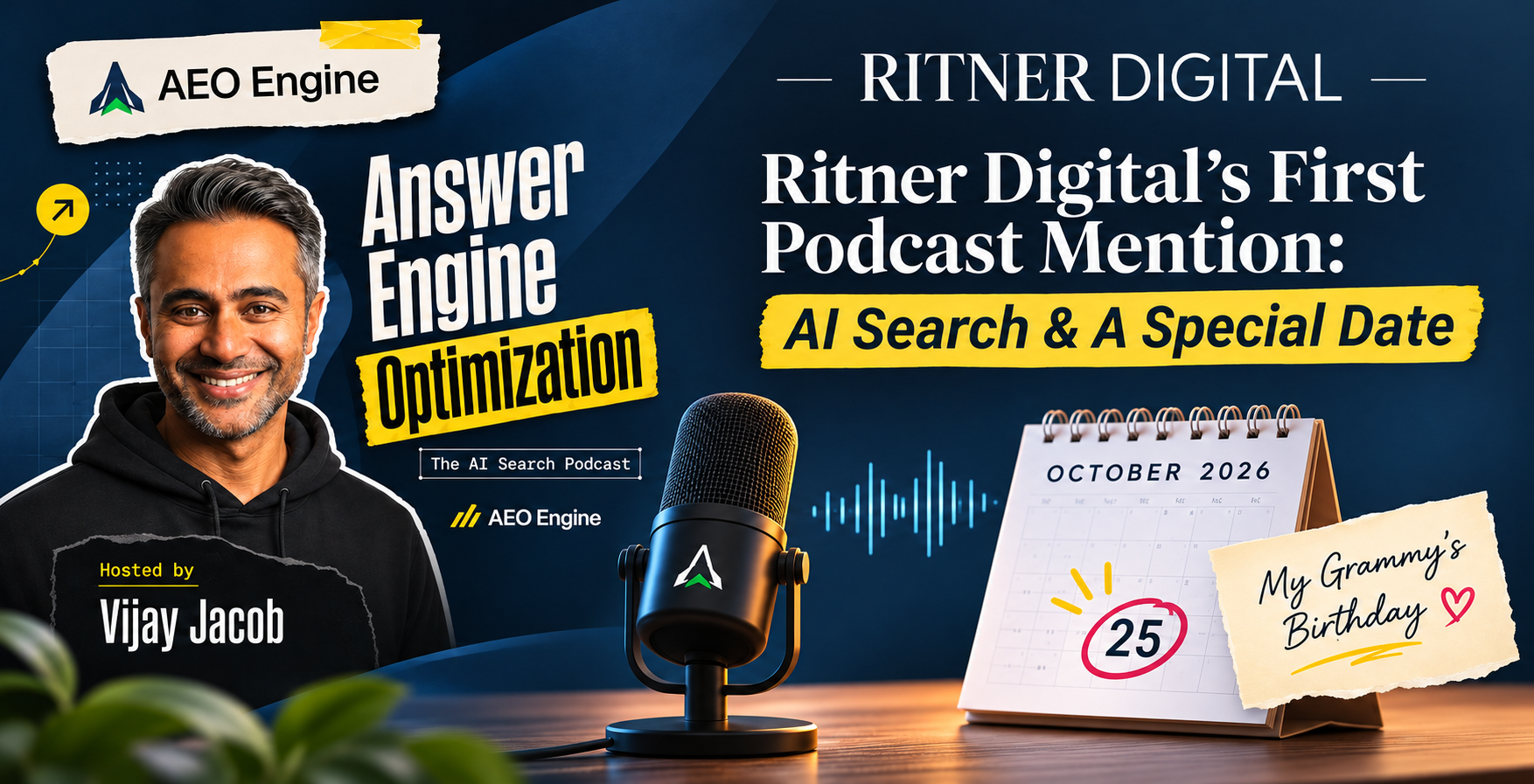
An unexpected shoutout, five South Jersey Nissan dealerships, the strange new world of AI recommendations, and a little October 25 coincidence that means more to me than any marketing metric.
There are certain milestones you imagine when you start a business.
Your first client.
Your first really good month.
The first time someone recommends your work without being asked.
The first time you see your company's name somewhere you didn't put it yourself.
And, apparently, the first time you're sitting around minding your own business and discover that someone has been discussing your research on a podcast.
Which is how I recently learned that Ritner Digital was mentioned on a podcast for the first time.
Not a podcast we produced.
Not a podcast we sponsored.
Not an episode where we paid someone to read a paragraph about our exciting commitment to next-generation digital marketing excellence.
An actual podcast about AI search, featuring research we had published independently.
Nobody had requested a quote.
Nobody needed us to approve the discussion.
Our work had simply made its way into someone else's conversation.
And for a small, independent digital marketing business, that's a pretty cool feeling.
The episode was called Becoming the Default: Why AI Names One Brand and Stops, published October 25, 2026, by the AEO Engine AI Search Show, hosted by AEO Engine founder and CEO Vijay C. Jacob.
During the episode, the discussion turned to a question we've been investigating at Ritner Digital:
What happens when a business performs well in traditional Google search but doesn't receive the same recognition in AI-generated answers?
To explain the problem, the podcast referenced our research comparing five Nissan dealerships in South Jersey.
It also referenced an argument we'd made about the way AI systems develop default recommendations.
Now, I realize this might not sound like a landmark historical event to everyone.
I'm not suggesting the mayor should organize a parade.
There is no need to close Broad Street.
Nobody needs to commission a commemorative bronze statue of a laptop displaying Google Search Console.
Although I would appreciate someone exploring the municipal funding requirements.
But it was our first podcast mention.
And then I noticed something else.
The episode had been published on October 25.
My late Grammy's birthday.
And suddenly, the whole thing felt a little more special.
Listen to AEO Engine AI Search Show, Episode 270: Becoming the Default: Why AI Names One Brand and Stops, published October 25, 2026.
First, Thank You to AEO Engine for Giving Our Research a Shoutout
Before we get into the AI search conversation, I want to say thank you.
To Vijay C. Jacob, founder and CEO of AEO Engine, and everyone involved in producing the show:
Thank you for referencing Ritner Digital's research.
It was genuinely exciting to find our company's name in the episode transcript.
And not simply because I enjoy hearing someone say "Ritner Digital" without my having to introduce the business myself.
Although that is a refreshing experience.
What made it meaningful was the fact that the mention came from the research.
We had investigated a real market.
Collected data.
Compared competing businesses.
Published the findings.
Explained our methodology and limitations.
And shared what we thought the numbers revealed about a changing search environment.
Then another organization found the work useful enough to discuss.
That's the kind of recognition I find especially rewarding.
Not manufactured attention.
Not a vanity award.
Not a press release announcing that we are delighted to announce our continued commitment to announcing things.
Just somebody encountering our analysis and deciding it was relevant to a larger conversation.
For a business built around making expertise more discoverable, there's something beautifully appropriate about that.
The whole point of publishing useful research is that it should be able to travel beyond the person who created it.
Sometimes that means a journalist references a statistic.
Sometimes another marketer shares the findings.
Sometimes a business owner discovers a problem they didn't know they had.
And sometimes, apparently, it means being mentioned in a podcast while you're not even in the room.
A considerably more efficient networking strategy than attending another breakfast event where everyone hands out business cards and explains that they're passionate about innovation.
The Podcast: Why AI Names One Brand and Stops
The episode's subject is one we've become increasingly interested in at Ritner Digital.
The difference between being visible in traditional search and being selected in an AI-generated recommendation.
Those are related outcomes.
They are not identical.
For years, digital marketing has centered heavily on search rankings.
Businesses wanted to appear near the top of Google.
SEO agencies measured positions, keywords, organic traffic, and conversions.
A company ranking fourth for a relevant query might still receive traffic.
A company ranking seventh could still be discovered.
A buyer might compare several websites before making a decision.
AI-generated answers introduce a different kind of experience.
Someone might ask ChatGPT which company to consider for a particular service.
Or ask Google AI Mode to compare providers.
Or request a short list of businesses that fit a particular need.
The response may emphasize a few names rather than displaying a conventional ranked page of links.
That can change how a person encounters the market.
The AEO Engine episode examines this issue through the concept of a default recommendation.
The basic question is:
When someone asks an AI system for a business recommendation, which brand does it name prominently or consistently?
And how is that different from merely appearing somewhere in the response?
It's a useful distinction.
Because a business might be mentioned as a source without being recommended as a provider.
Its research could be cited.
Its website could be referenced.
Its company name might appear in a comparison.
But another business could receive the actual recommendation.
Which creates the slightly uncomfortable scenario of helping inform an AI-generated answer while somebody else gets the introduction.
From an intellectual perspective, that's interesting.
From a business development perspective, it's the kind of thing that makes agency owners stare thoughtfully into the middle distance.
How Five South Jersey Nissan Dealerships Ended Up in the Conversation
Here's where Ritner Digital entered the episode.
In August 2026, we published a comparison of five Nissan dealerships serving the South Jersey and Philadelphia market.
The research examined:
Nissan of Turnersville
Cherry Hill Nissan
Mount Holly Nissan
Woodbury Nissan
Team Nissan of Vineland
The objective wasn't to determine which dealership sold the best vehicles or provided the best customer experience.
We weren't test-driving cars.
We weren't evaluating salespeople.
We weren't attempting to determine who could negotiate the most competitive price on a Nissan Rogue.
We were looking at digital visibility.
Specifically, how the dealerships compared across traditional Google search metrics and estimated AI search visibility.
The results were surprisingly different depending on which metric you examined.
Our analysis used Semrush estimates collected August 13, 2026.
Those estimates included organic traffic, ranking keyword footprints, backlinks, AI Visibility scores, and AI mentions.
We explained that the data represented third-party estimates rather than actual dealership analytics.
We also made clear that none of the five dealerships was a client.
That matters.
Because this wasn't a client success story designed to make our agency look impressive.
It was a public market comparison.
And the purpose was to investigate a real question.
Can a business be exceptionally visible in traditional search while performing very differently in AI-generated answers?
Our dataset suggested that it could.
The Traditional Google Winner Wasn't the AI Visibility Leader
Consider Nissan of Turnersville.
In our August 2026 comparison, Semrush estimated that the dealership received approximately 25,100 monthly organic visits.
That was substantially more than the other four dealerships in the group.
It also had the largest ranking keyword footprint.
On the traditional organic traffic scoreboard, Turnersville was the clear leader.
Now look at the estimated AI Visibility scores.
Mount Holly Nissan led the five-store group with a score of 34.
Nissan of Turnersville scored 19.
The dealership dominating estimated traditional organic traffic was last among these five on that particular AI visibility measure.
That doesn't mean Turnersville was failing as a business.
It doesn't mean Mount Holly was selling more cars.
And it doesn't establish that AI-generated recommendations caused either company's commercial performance.
It means the two visibility measurements told different stories.
The contrast is exactly what interested us.
We continued investigating Mount Holly Nissan in a separate 30-prompt AI visibility audit, examining how ChatGPT, Gemini, and Claude responded to different questions.
That follow-up also found meaningful differences between the kinds of questions the dealership was recognized for and the ones where it was omitted.
The larger lesson wasn't that one Nissan dealer had secretly conquered artificial intelligence.
It was that businesses could be more recognizable in some digital discovery environments than others.
And unless they examined those environments separately, they might not realize the distinction existed.
The Third Scoreboard: Being Mentioned Isn't the Same as Being Recommended
The research had another interesting wrinkle.
Team Nissan of Vineland led the group in Semrush's estimated AI mentions, with 46.
Mount Holly Nissan, which led the AI Visibility score, had 15 mentions in the comparison.
Those two measurements were not interchangeable.
Semrush's AI Visibility documentation distinguishes between a benchmark visibility score and mentions recorded across AI-generated responses.
The precise definitions and methodologies matter when interpreting the data.
A company appearing frequently across observed prompts does not automatically mean it receives the most prominent recommendations for the particular questions that matter to its customers.
And a high visibility score is not a direct count of leads or sales.
This is something marketers need to be careful about.
Especially because we work in an industry with an impressive ability to turn almost any number into a colorful dashboard suggesting extraordinary commercial success.
A business could receive 100 AI mentions.
Wonderful.
But what were the questions?
Was the business recommended?
Was it criticized?
Was it named as an alternative?
Was it included as a source?
Was the query relevant to someone likely to become a customer?
Were the answers accurate?
And could anyone establish whether those interactions contributed to actual business?
The answer to those questions matters more than a single attractive metric.
Which is why we appreciated AEO Engine's discussion of the difference between being named in an answer and being the answer someone is encouraged to consider.
That distinction is worth investigating.
It also makes for a considerably more interesting conversation than announcing that AI is changing everything and everyone should immediately purchase a new software subscription.
What the Podcast Actually Said About Ritner Digital
The relevant part of the episode appears during the discussion of how AI-generated answers compress the number of brands presented to a user.
At approximately the episode's middle section, the discussion references Ritner Digital's five-dealership comparison as an example of the differences between conventional search performance and AI discovery.
The show then references another argument from our published work.
The phrase:
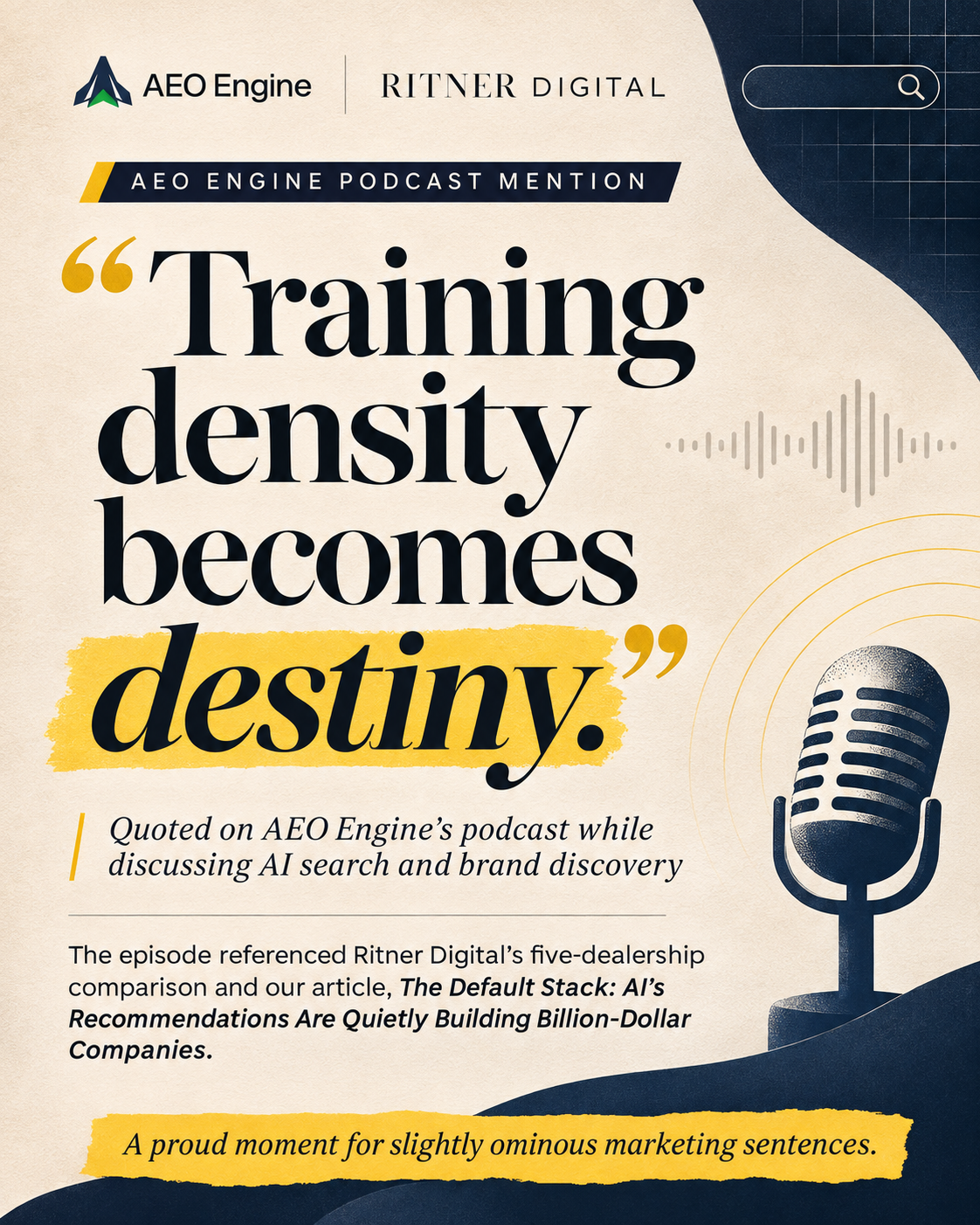
“Training density becomes destiny.” A phrase from Ritner Digital’s The Default Stack article, highlighted in AEO Engine’s AI Search podcast during a discussion of how brands become familiar recommendations in AI-powered search.
"Training density becomes destiny."
That line comes from our article, The Default Stack: AI's Recommendations Are Quietly Building Billion-Dollar Companies.
In that article, we explored how certain tools and brands can become familiar recommendations in AI-assisted workflows.
The underlying idea is that repeated, consistent, publicly accessible information about a company or product may contribute to how readily it is recognized and recommended in relevant contexts.
That information could include documentation, tutorials, credible third-party references, real-world implementation details, and other useful evidence.
The phrase is intentionally a little dramatic.
It's also conveniently suited to appearing in a podcast discussing the future of search.
I'm pleased to report that our tendency to write slightly ominous marketing sentences has finally produced an external media mention.
A proud moment for everyone involved.
But There's an Important Nuance
"Training density becomes destiny" is a useful shorthand, not a scientifically established formula.
Modern AI systems can use different combinations of training information, retrieval systems, ranking methods, and other signals.
A model recommending a brand in one context doesn't prove precisely which documents or sources caused that recommendation.
And repeating a brand name thousands of times across the internet isn't a substitute for providing credible, relevant information.
The goal should not be to overwhelm AI systems with manufactured mentions.
It should be to make accurate evidence about your business available where people and search systems can discover it.
That was one of the parts I appreciated about the episode.
It didn't simply treat visibility as a matter of publishing more words.
The discussion also emphasized real proof.
Relevant experience.
Specific outcomes.
Documentation.
Credentials when appropriate.
Information that demonstrates a business has actually done the work.
That is a much more useful direction for the conversation.
Because the internet probably doesn't need another 75 articles explaining that a company is committed to innovation.
It does, however, benefit from credible evidence.
The Nine-Run Testing Idea Is Interesting, but Let's Keep the Methodology Honest
The podcast also discusses a practitioner approach involving repeated tests of similar AI recommendation questions.
Rather than asking an AI assistant a question once and treating the response as permanent truth, the idea is to run comparable prompts multiple times and document which businesses appear.
That makes sense as an exploratory measurement practice.
AI-generated responses can vary.
Different platforms can produce different recommendations.
The same platform may behave differently depending on context, location, available retrieval information, or other conditions.
One response is not necessarily representative of every possible answer.
The episode discusses a nine-run approach as a practical diagnostic.
It also acknowledges that the method is not a peer-reviewed scientific study.
That distinction is important.
A small collection of prompts can reveal interesting patterns.
It cannot establish a universal ranking system.
Nor can it prove that a particular change caused a shift in recommendations without an appropriate research design.
At Ritner Digital, we've approached this with similar caution in our public AI audits.
For example, our Mount Holly Nissan test used 10 prompts across three AI systems, producing 30 responses.
We documented which questions produced recognition and which didn't.
We also acknowledged the limitations.
Small samples.
Potential geographic effects.
Different model behaviors.
Results that could change when the tests were repeated.
That doesn't make the observations useless.
It makes them observations that need to be interpreted responsibly.
And if there's one thing a digital marketing agency should avoid, it's taking an interesting exploratory test and declaring that it has permanently solved the mystery of how artificial intelligence works.
The mystery has enough people doing that already.
Some of them have built very impressive landing pages.
Why We Publish Research in the First Place
There's another reason the podcast mention felt meaningful.
We believe agencies should demonstrate their thinking.
Not just describe it.
It's easy to create a website saying you're an expert in SEO.
It's easy to announce that your team understands AI search.
It's easy to claim you provide data-driven strategies.
These things may even be true.
But a prospective client still has to decide whether to believe them.
Original research gives people something more concrete to evaluate.
They can examine the methodology.
Review the figures.
Question the interpretation.
Compare the findings with their own experience.
And decide whether the analysis is useful.
Not every study needs to be groundbreaking.
Not every public experiment needs to involve thousands of participants.
But it should be honest about what it examined and what the results can support.
That's why our Nissan comparison included a clear explanation of the data sources and limitations.
And why our follow-up AI testing documented the individual prompts and results.
The goal wasn't to create a perfect scientific instrument.
It was to investigate a real business problem in public.
That kind of transparency also allows other people to contribute.
They might notice something we missed.
They might disagree with a conclusion.
They might use the findings as a starting point for another investigation.
Or they might discuss the research on a podcast.
Which, until recently, was more of a hypothetical example than an actual entry in our business history.
The Marketing Lesson: Your Work Can Travel Further Than Your Network
One of the most encouraging things about this experience is that the mention didn't require us to be part of the recording.
We weren't invited onto the episode.
We weren't interviewed.
We didn't have a speaking role.
The podcast independently referred to published research.
That distinction matters because it demonstrates something important about publicly accessible expertise.
A useful piece of work can reach people outside your immediate professional network.
You may not know who is reading it.
You may not know who is sharing it.
You may not know whether someone has referenced the findings in a meeting.
Or whether your research has helped another professional explain an issue to a client.
Some of those effects may never appear in an analytics dashboard.
And some will be visible only when you happen to discover the reference.
The 2026 Edelman–LinkedIn B2B Thought Leadership Impact Report discusses the role of original thinking, credible evidence, and expert perspectives in how business buyers discover and evaluate providers.
It also emphasizes that ideas can travel through private conversations and professional networks.
This doesn't mean every research report will receive media attention.
Most won't.
And it certainly doesn't mean a single podcast mention automatically creates a pipeline of new clients.
But it supports a broader principle.
Useful, accessible expertise can create opportunities for recognition that are not limited to your existing relationships.
That is one reason we care about publishing substantive work rather than filling a blog with generic marketing advice.
The research should be worth encountering even if the reader never hires us.
If it is, other useful things can sometimes follow.
A Podcast Mention Is Not a New Revenue Stream. It's Still Worth Celebrating.
I think small businesses sometimes become too reluctant to celebrate anything that doesn't immediately generate revenue.
A mention is dismissed because it isn't a contract.
A compliment is dismissed because it isn't a lead.
A published article is dismissed because it hasn't produced a measurable conversion.
A professional connection is dismissed because no business has resulted from it yet.
Of course commercial outcomes matter.
A business needs revenue.
And visibility should be evaluated in relation to actual goals.
But not every meaningful moment arrives with an invoice attached.
Sometimes progress looks like someone noticing your work.
Sometimes it looks like another professional taking your analysis seriously.
Sometimes it looks like being referenced in a discussion you didn't know was happening.
For an established national organization, that might be an ordinary Tuesday.
For a small independent agency, it can be a genuine milestone.
And I don't think there's anything wrong with acknowledging that.
Especially when the milestone emerges from work you're proud of.
I would much rather discover that someone found our research useful than receive an email announcing that Ritner Digital has been nominated for the prestigious International Excellence in Digital Innovation Leadership Award.
Provided we pay $795 before Friday.
One is recognition.
The other is an invoice wearing a medal.
I know which one I'm more excited about.
The Date: October 25
Now for the personal part.
This is not something I ordinarily expect to discuss in an article about AI search visibility.
But when I noticed the publication date of the episode, I smiled.
October 25 is my late Grammy's birthday.
Every year, when that date comes around, I find myself hoping for a little sign that she's still with me.
I think a lot of people do that when they've lost someone they love.
We notice dates.
Songs.
Coincidences.
Small moments that might seem completely ordinary to somebody else.
We hold on to the things that remind us of the people we miss.
Sometimes we don't even realize we're looking until something happens that makes us stop for a second.
For me, October 25 has become one of those days.
A couple of years ago, one of my favorite artists, Halsey, released an album on that date.
The album was The Great Impersonator, released October 25, 2024, as confirmed by Sony Music's official release announcement.
I remember thinking it was a pretty cool coincidence.
An artist I love.
A new album.
On my Grammy's birthday.
It was something that made the date feel a little special in a different way.
And this year, October 25, 2026, the AEO Engine podcast episode mentioning Ritner Digital was published.
Our first podcast mention.
On that same date.
Now, I'm not claiming that my Grammy has developed a sophisticated understanding of generative engine optimization and is currently coordinating our digital PR strategy from somewhere beyond the observable universe.
Although if she has, I would appreciate some guidance on the next Google update.
But I did think it was a sweet coincidence.
And it made something that was already exciting feel a little more personal.
I don't need to explain it as anything more than that.
I don't need to prove what it means.
It's enough that the date matters to me.
And that, once again, something that made me happy happened on a day that reminds me of someone I love.
There's something comforting about that.
Maybe it's a sign.
Maybe it's a coincidence.
Maybe it's simply one of those little moments where life seems to line things up in a way that makes you smile.
Whatever it is, I'm grateful for it.
And I thought the story deserved a place here.
Because behind the SEO reports, the analytics, the research, the articles, and the endless debates about whether we should call something AEO or GEO, there's still a person running a business.
Someone who gets excited about small milestones.
Someone who misses their Grammy.
And someone who thought it was pretty wonderful to discover their company's name in a podcast episode published on October 25.
There's Something Funny About Discoverability Working on the Agency Itself
I can't ignore the irony.
We spend an enormous amount of time talking about how businesses need to make their expertise discoverable.
We explain that a company's work shouldn't be trapped entirely inside its own website.
We encourage businesses to publish original research.
We discuss the importance of credible third-party references.
We argue that good information should be accessible to people who might find it useful.
And then our own research travels outside our website and appears in somebody else's podcast.
Apparently, the advice is occasionally capable of working.
A deeply unsettling development for those of us who have built a professional identity around telling other businesses to do these things.
But it's a nice reminder that distribution isn't always a formal campaign.
Sometimes a piece of research becomes useful to someone else because it answers a question they're exploring.
That's what happened here.
AEO Engine was discussing the differences between AI citations, mentions, and recommendations.
Our Nissan comparison provided an example.
Our Default Stack article provided an argument.
The podcast connected those ideas to its broader discussion.
And now we're writing about the podcast referencing the research.
Which raises the possibility that the internet has become one enormous recursive discussion about AI search visibility.
Somewhere, a language model is probably preparing a summary of this article.
I hope it gets the dealership numbers right.
A Good Outside Mention Is Valuable Because It Isn't Yours to Control
There's another reason this kind of recognition matters.
When you publish something on your own website, you control the presentation.
You choose the title.
The wording.
The framing.
The links.
The examples.
You decide which arguments to emphasize.
When someone else discusses your research, those decisions are no longer entirely yours.
They may summarize the work differently.
They may focus on one particular finding.
They may challenge a conclusion.
They may connect it to a question you hadn't originally considered.
That independence is part of what makes the mention meaningful.
You haven't simply repeated your own claim about your expertise.
Someone else has decided the work is relevant.
Of course, an external mention isn't automatically an endorsement.
And a citation isn't proof that every conclusion in a report is correct.
But it is evidence that the material has entered a broader conversation.
For research-driven businesses, that is worth appreciating.
Especially when the work is specific enough to support further investigation.
An article containing original observations, transparent sources, and a clearly described methodology gives others something to engage with.
An article containing 1,800 words about being passionate about helping clients succeed is less likely to inspire an interesting discussion.
Unless the podcast is about corporate jargon.
In which case, it may become the central exhibit.
The Larger AI Search Conversation Is Worth Continuing
The questions raised by the episode are not settled.
And I think that's part of what makes the subject interesting.
How consistently do different AI systems recommend the same businesses?
How much does location influence an answer?
How does a direct factual query differ from a subjective recommendation request?
Which sources get cited?
When does an AI system retrieve fresh information?
When does it rely on other information?
How do businesses measure their visibility without confusing estimates with actual customer behavior?
And how should marketers interpret an answer that names one brand while citing another company's research?
These are legitimate questions.
They're also complicated.
Google's official guidance on AI features in Search explains that existing SEO fundamentals remain relevant to AI Overviews and AI Mode.
Google emphasizes technical accessibility, useful content, clear internal linking, and important information presented in readable text.
It also makes clear that meeting the technical requirements does not guarantee a website will appear in a particular search result.
That is a useful reminder.
There is no secret button that forces an AI system to recommend your company.
No special sentence that guarantees a citation.
No magical metadata field that automatically converts an ordinary business into the definitive answer to every possible customer question.
The serious work still involves understanding the audience, publishing useful evidence, maintaining accurate information, and evaluating results.
And it involves being willing to admit what the data doesn't tell us.
That's a standard we try to maintain in our own public research.
Not because we expect every experiment to be perfect.
But because honest limitations are part of useful analysis.
Which brings me back to the podcast.
I appreciate seeing other practitioners engage with the same questions.
Even when we approach them from different perspectives.
Especially when we approach them from different perspectives.
That's how interesting conversations happen.
Vijay, We'd Love to Join You on a Future Episode
So here's a little invitation.
@Vijay C. Jacob, thank you again for the mention.
It really did make our day.
And we'd love to join you on a future episode of the AEO Engine AI Search Show if you're open to it.
We think there would be plenty to discuss.
The South Jersey Nissan comparison is one example, but we've also been examining how AI systems recognize local businesses, interpret geographic relevance, distinguish business categories, and respond to different kinds of commercial questions.
Some of the results are encouraging.
Others are confusing.
A few have been the sort of findings that make you stare at an AI response and wonder whether everyone involved should collectively reconsider the premise of the experiment.
Which seems like excellent podcast material.
We'd be happy to compare research methods.
Discuss what we've observed.
Talk about the differences between citation, mention, and recommendation.
And explore where AI search measurement still needs more rigor.
No elaborate public debate.
No requirement for someone to arrive with a 90-slide presentation.
Just a good conversation between people who are curious about where search is going.
Maybe we agree on everything.
Maybe we don't.
Either way, we suspect it would be interesting.
And if you're down, we'd genuinely love to be part of a future show.
Also, after spending this much time researching AI search, it would be nice to participate in a podcast rather than simply becoming an unexpected example inside one.
Although we're certainly not complaining about the latter.
A Few Things This Experience Reminded Us About Marketing
There are some practical lessons worth taking from a moment like this.
Not because one podcast mention is enough evidence to establish a universal business strategy.
It isn't.
But because the experience reflects a few principles we believe are important.
1. Publish Things That Give Other People Something Worth Discussing
Original research can be useful because it contributes specific information.
A comparison.
A finding.
A documented pattern.
A thoughtful interpretation.
A question worth exploring further.
It doesn't always have to be a massive study.
But it should offer something beyond generic advice.
Our Nissan analysis gave another publisher a concrete example of differing search visibility metrics.
Our Default Stack article offered an argument about recommendation concentration.
Those ideas could be discussed independently of our agency.
That's valuable.
2. Show Your Methodology
If you're publishing numerical comparisons, explain where the numbers came from.
What was measured?
When?
Using which tools?
What are the limitations?
What conclusions are reasonable?
What remains uncertain?
This makes the findings easier for others to evaluate.
It also gives your work a stronger foundation for being cited accurately.
3. Don't Confuse a Mention With a Guaranteed Business Outcome
A podcast mention is exciting.
It may create additional awareness.
It may encourage someone to investigate the original research.
It may introduce the company to people unfamiliar with it.
But none of those possibilities is guaranteed.
We aren't going to claim that one episode has transformed Ritner Digital into a nationally recognized institution.
The municipal statue request remains pending.
For now, we're simply appreciating a first.
4. Give Credit Generously
When another organization finds your work useful enough to reference, acknowledge it.
Link to the original discussion.
Thank the people involved.
Share the work.
Engage with the ideas.
The internet would probably be a better place if more people treated citations as the beginning of conversations rather than merely as numbers on an authority dashboard.
5. Remember That Small Milestones Count
This one may not appear in most marketing textbooks.
But it belongs here.
Running a business involves plenty of uncertainty.
You can work hard on something without knowing whether people will notice.
You can publish research and wonder who is reading it.
You can have days when progress feels slow.
So when something encouraging happens, I think it's okay to enjoy it.
Not everything needs to be converted into a return-on-investment calculation.
Sometimes the achievement is simply that someone noticed.
And sometimes it happens to be on your Grammy's birthday.
The Best Kind of Recognition Is the Kind You Didn't Have to Manufacture
I keep coming back to the simple thing that made this experience special.
We didn't create the podcast.
We didn't ask to be included.
We didn't prepare a sponsored talking point.
The research was out there.
Another organization encountered it.
And it became part of a discussion.
That's a gratifying kind of recognition.
It's also a reminder that the internet is still capable of connecting people through ideas.
For all the noise, automation, algorithms, and increasingly confusing marketing acronyms, useful information can still travel.
A small business can publish a piece of research.
Another professional can find it.
A podcast can mention it.
Someone listening can investigate the original work.
And a conversation can begin that none of the people involved originally planned.
That's pretty cool.
Especially for a digital marketing agency whose entire purpose is helping businesses become easier to find.
There's a certain satisfaction in seeing your own work become discoverable in a way you didn't directly orchestrate.
And there's something even nicer about realizing that the date of that mention carries a personal meaning.
In Conclusion: A Small Shoutout, a Big Thank You, and a Very Special Date
So this is our official little celebration.
On October 25, 2026, Ritner Digital was mentioned in Episode 270 of the AEO Engine AI Search Show.
The episode, Becoming the Default: Why AI Names One Brand and Stops, discussed research we'd published about five South Jersey Nissan dealerships and the changing relationship between traditional search visibility and AI-generated recommendations.
The podcast also referenced our broader argument about the role of publicly available information in shaping default brand recommendations.
For anyone working in SEO, AEO, GEO, or whatever collection of letters we're all arguing about next week, it's a conversation worth exploring.
And for us, it was a meaningful professional first.
But the date made it something more.
October 25 is my Grammy's birthday.
I miss her.
And every year, I find myself noticing little things that happen on that date.
In 2024, Halsey released The Great Impersonator.
In 2026, Ritner Digital received its first podcast mention.
I don't know what, if anything, those coincidences mean beyond the happiness they bring me.
I just know they make me smile.
And sometimes that's enough.
So thank you again to Vijay and the AEO Engine team for including our research in the conversation.
Thank you for giving a small independent agency an unexpected moment worth celebrating.
And thank you for unknowingly making October 25 a little more special this year.
We'd love to join you on a future episode if you're up for it.
Until then, we'll keep doing what we do.
Asking questions.
Testing things.
Publishing the results.
Trying to make sense of an increasingly complicated search landscape.
And occasionally discovering that somebody else has been paying attention.
Which, as it turns out, is a pretty wonderful feeling.
Here's to the first podcast mention. Hopefully the first of many.
And here's to my Grammy.
Happy birthday. ❤️
About Ritner Digital
Ritner Digital is an independent digital marketing practice focused on helping businesses become easier to find in traditional search and AI-powered discovery.
We believe marketing should be supported by credible information, useful research, and an honest understanding of what the data can—and cannot—tell us.
That includes investigating how businesses appear across Google, ChatGPT, Gemini, Claude, and other search environments, while recognizing the limitations of third-party estimates and small exploratory tests.
We publish research because we believe businesses should have access to information that helps them understand their own digital visibility.
And because sometimes asking an AI assistant the same question 30 times reveals something genuinely interesting.
If you're curious about how your business appears in search and AI-generated answers, or want to make your expertise more discoverable, we'd love to hear from you.
No promises of instant AI domination.
No mysterious proprietary magic.
Just research, strategy, and a willingness to investigate the questions that matter.
Frequently Asked Questions
What podcast mentioned Ritner Digital?
Ritner Digital was mentioned in Episode 270 of the AEO Engine AI Search Show, titled Becoming the Default: Why AI Names One Brand and Stops.
The episode was published October 25, 2026, and discusses AI search recommendations, brand visibility, and the difference between being cited and being recommended.
Who is the founder of AEO Engine?
Vijay C. Jacob is the founder and CEO of AEO Engine, a company focused on answer engine optimization, AI search visibility, and related marketing services.
He also hosts the AEO Engine AI Search Show.
When was the episode published?
The episode was published on October 25, 2026.
That date is personally significant to Ritner Digital's founder because it is her late Grammy's birthday.
Was Ritner Digital interviewed on the podcast?
No. Ritner Digital was not a guest on this particular episode.
The podcast referenced research and ideas that Ritner Digital had previously published.
We appreciate the recognition and would welcome the opportunity to join AEO Engine for a future episode.
What Ritner Digital research did the podcast reference?
The episode referenced Ritner Digital's comparison of five South Jersey Nissan dealerships and their performance across traditional organic search and estimated AI search visibility.
It also referenced ideas from the article The Default Stack: AI's Recommendations Are Quietly Building Billion-Dollar Companies.
What did the South Jersey Nissan research find?
The August 2026 comparison found substantial differences between estimated traditional Google search performance and AI search visibility metrics.
For example, Nissan of Turnersville led the five-dealership group in estimated organic traffic, while Mount Holly Nissan had the highest estimated AI Visibility score.
Team Nissan of Vineland led the group in estimated AI mentions.
The data came from Semrush and represented a point-in-time comparison rather than actual dealership sales or customer acquisition figures.
What does it mean to be an AI default recommendation?
An AI default recommendation is a business, product, or service that an AI system tends to name prominently or repeatedly when responding to a relevant recommendation request.
The exact response can depend on the question, platform, context, location, and available information.
A brand's prominence in one set of answers does not guarantee it will be recommended consistently across every AI system or query.
What's the difference between an AI citation and an AI recommendation?
An AI citation identifies a source used or referenced in an answer.
An AI recommendation presents a business, product, or service as an option for the user to consider.
A company's research may be cited without the company itself being recommended as a provider.
Both forms of visibility can matter, but they represent different interactions.
What is AI Visibility in Semrush?
Semrush's AI Visibility score is a proprietary benchmark intended to estimate how frequently and prominently a brand appears in AI-generated responses.
The methodology combines factors such as topic coverage and mention consistency.
It should be understood as a tool-specific estimate, not a direct measure of revenue, customer preference, or actual sales.
See Semrush's AI Visibility methodology.
Can a business rank well in Google but have low AI visibility?
Yes, the measurements can differ.
Traditional organic rankings and AI-generated recommendations involve different result formats, questions, and evaluation methods.
Ritner Digital's South Jersey Nissan research offered one example of a market where estimated traditional traffic and estimated AI Visibility scores did not follow the same order.
However, individual observations should not be treated as proof of a universal causal relationship.
What is the nine-run AI recommendation test?
The AEO Engine episode discusses a practitioner diagnostic involving repeated tests of AI recommendation questions.
The purpose is to examine how consistently particular brands appear across responses.
Repeated testing can reveal patterns that a single answer might miss.
However, a small nine-run exercise is not a peer-reviewed scientific study and should not be treated as a complete representation of all possible model behavior.
Does a podcast mention help with SEO?
A podcast mention can introduce a brand or its research to a new audience.
If an episode has a public webpage with relevant links, the content may also provide additional paths for people and search engines to discover information.
However, a mention doesn't guarantee improved Google rankings, AI citations, or new clients.
The value depends on factors including the relevance of the audience, the nature of the reference, and how the mention is published.
Can original research help a business gain recognition?
Original research can give other people useful information to cite, investigate, or discuss.
Transparent methodology, relevant findings, and accessible sources make research easier to evaluate.
But original research does not guarantee publicity.
Distribution, subject relevance, credibility, and audience interest all influence whether the work receives attention.
What Halsey album was released on October 25?
Halsey released her fifth studio album, The Great Impersonator, on October 25, 2024.
The release date is confirmed by Sony Music.
The date has a personal connection to Ritner Digital's founder because October 25 is her late Grammy's birthday.
Is Ritner Digital planning to appear on the AEO Engine podcast?
Ritner Digital would be happy to join AEO Engine for a future episode if the team is interested.
Potential discussion topics include real-world AI visibility experiments, local search behavior, differences between AI mentions and recommendations, research methodology, and the limitations of current AI search measurement tools.
No future appearance has been confirmed.
Where can I listen to the episode?
You can listen through the embedded Spotify player at the beginning of this article, visit the official episode page on AEO Engine, or open the episode directly on Spotify.
The official AEO Engine page also includes a transcript.
How can I contact Ritner Digital?
Visit the Ritner Digital contact page to discuss SEO, AI search visibility, website discoverability, or related digital marketing questions.
We welcome conversations with businesses interested in understanding how they appear across traditional and AI-powered search environments.
And to the AEO Engine team: thanks again for the mention. Here's to more good research, interesting conversations, and hopefully a podcast appearance together someday.