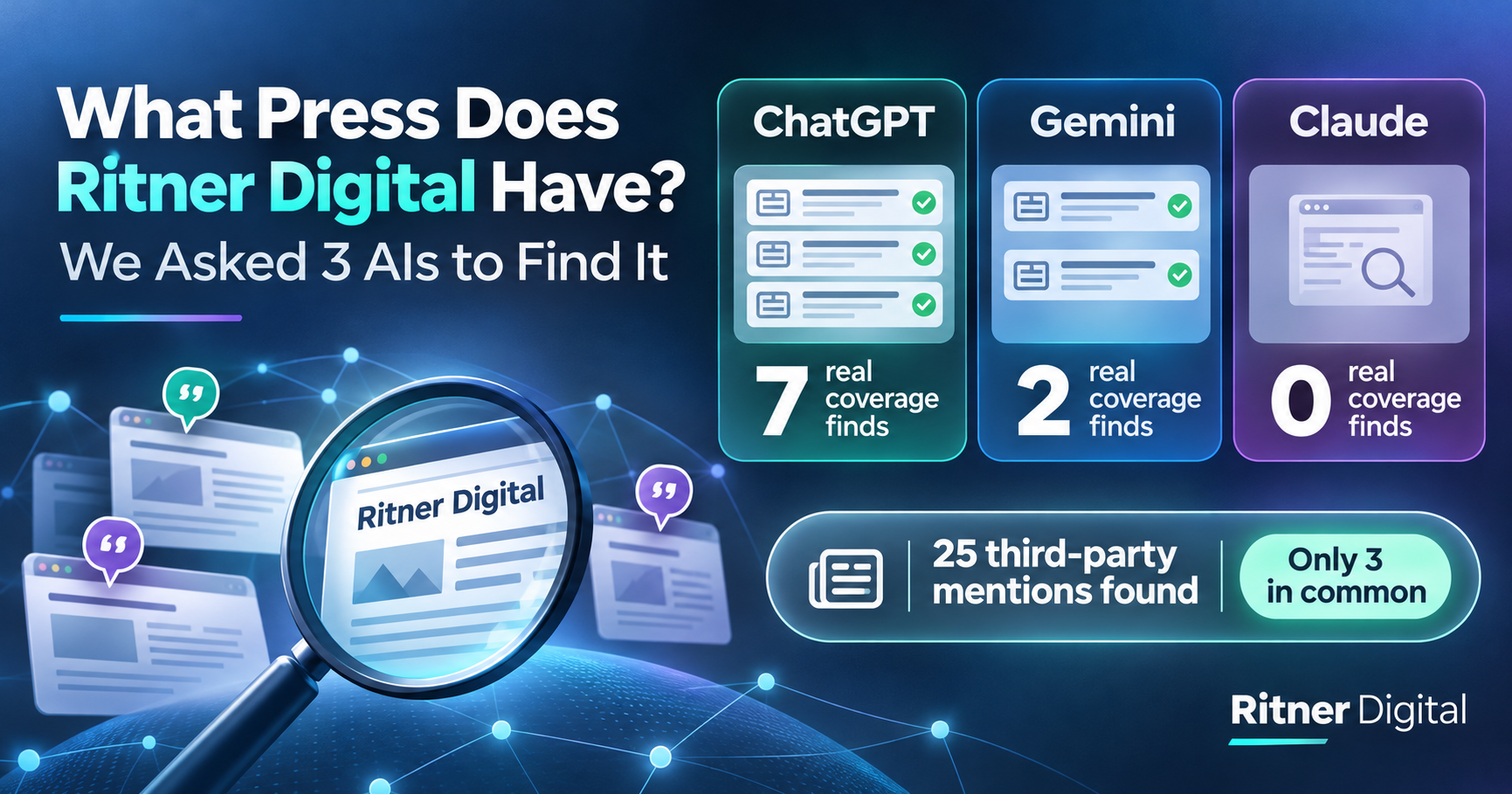
I asked ChatGPT, Gemini and Claude to find every third-party mention of Ritner Digital: press, citations, rankings, anything not published by us. Then I asked them to sort what they found into real editorial coverage and everything else.
Together, they found 25 different mentions. Only three appeared in all three answers. When asked how many count as independent editorial coverage, ChatGPT said seven, Gemini said two and Claude said zero.
The disagreement matters more than the count. Our best piece of earned media, a citation in an XDA Developers article, was found by only one of the three. If a journalist, a prospect or a partner asked one of the other two, they would never know it existed.
Below are all three conversations in full and unedited, a table of everything they found, and what this test shows about the difference between being mentioned and being covered.
How I ran the test
This is part five of the series. Part one asked what makes us different, part two asked about truck dealership SEO, part three asked about veterinary SEO, and part four asked whether we're legit.
Part four ended with a clear gap: almost everything online about us is something we wrote. So this time, I ruled our own content out:
The question: "What third-party press coverage, mentions, or recognition does Ritner Digital have? Only include sources not published by Ritner Digital, and link to each one."
The follow-up: "Which of these are paid listings, self-submitted directories, or agency-published rankings, and which are independent editorial coverage?"
Each AI got both questions in the same conversation. I ran each once, with no custom instructions, and none of the answers have been edited.
For the record, as far as I know we have never paid for a placement on any of the lists below. All three AIs looked for evidence of paid placements, and none found any.
ChatGPT: 16 mentions, and the only one that found our best press
ChatGPT gave the longest, most thorough answer. It found 16 third-party pages and sorted them into agency rankings, editorial citations and one client account. When asked to classify them, it took the most detailed approach: it checked each publisher's business model, looked for submission and sponsorship policies, and reported what it could and couldn't verify.
What stood out to me:
It found the XDA Developers citation. Neither of the other AIs did. ChatGPT called it the strongest potential example of earned media, then admitted in its follow-up that it couldn't recheck the citation in the full article. I checked: the article, by Nolen Jonker and published September 28, 2026, cites a Ritner Digital roundup about Claude users getting pushback and caveats.
It found an independent writer's citation. ChatGPT was also the only one to find The Harperverse, a film-marketing Substack by Daniel Harper. His Toy Story 5 campaign breakdown cites our analysis of the film's marketing and opening-weekend audience.
It was careful about what citations mean. ChatGPT pointed out that an article citing Ritner Digital as a source shows our research is being used. It isn't the same as coverage about Ritner Digital.
It flagged two suspicious comparison articles. It noted that the Digital MarkEthics and Orion Global pages, which both rank us eighth, heavily promote another company called Rankera. It called them commercially influenced in appearance, while saying it couldn't confirm anyone paid for them.
It caught a ranking change. ChatGPT noted that LenGreo's live article ranks us 14th, even though an earlier claim elsewhere said 12th.
Its final count: 0 verified paid listings, 0 confirmed self-submissions, 8 agency rankings and comparisons, 7 editorial and podcast references, and 1 client-published case study. Its advice was to keep rankings in a separate "Industry Listings & Comparisons" section and never present them as press.
Gemini: "Only two" count as independent
Gemini found a different set of mentions and held a stricter view of what counts. In its follow-up, it said only two sources were independent or earned coverage, and that everything else was agency marketing content, a submission-based directory or an automated index.
What stood out to me:
It missed our strongest coverage. Gemini didn't find XDA Developers, The Harperverse, The Rank Masters, Demand Local or Orion Global. It also said it couldn't find links for the True Blue Autos article or Web Tonic's Philadelphia list, both of which ChatGPT linked directly.
It found things the others didn't. Gemini found three additional Web Tonic pages citing our data: an enterprise SEO statistics roundup and two guides about domain authority. It also found Parse, an AI-visibility tracker that keeps an automatically generated profile of what AI says about Ritner Digital.
It was clear-eyed about the listicle economy. Gemini described Web Tonic, LenGreo, Digital MarkEthics and SEOS.co as agency blogs or directory sites built to rank in Google and AI answers for "best agency" searches. It said those aren't traditional business press or trade journalism. That's fair, and it's true for many agencies' visibility, not just ours.
It counted the podcast as independent. Gemini called the AEO Engine AI Search Show episode 270, where host Vijay C. Jacob discusses our research on South Jersey Nissan dealerships, independent editorial coverage. It counted True Blue Autos' article as a client account.
It reported an outdated ranking. Gemini said LenGreo ranks us 12th. ChatGPT, checking the live page, said 14th, and Claude agreed with 14th.
Gemini also noted that none of the placements appeared to be paid advertisements, and that we label our own directory mentions as publisher-created comparisons, not verified performance audits.
Claude: "No traditional press coverage"
Claude gave the bluntest answer. It opened by saying it found no news articles, interviews or awards, only agency roundup lists and other companies' blog posts citing our research. In the follow-up, it said none of the nine sources it found was independent editorial coverage.
What stood out to me:
It found a completely different set of citations. Claude found two articles from Big Red Jelly, a marketing agency in Provo, Utah, that cite our guides on evaluating agencies and on agency contract terms. It also found a Directorist article crediting a B2B leads statistic to our fall traffic analysis, and a WhoIsTheOwnerOf page citing our analysis of Lemme's Walmart expansion. Neither of the other AIs found any of these.
It found a directory ranking. Claude found the GEO Agency Directory, which ranks us 108th of 277 agencies using a formula based on Google visibility. It noted that listings are free, nobody can pay for position, and the rank measures search visibility, not anyone's opinion of our work.
It examined the publishers closely. Claude noted that LenGreo's list was written by LenGreo's own CEO and co-founder, ranks LenGreo first, doesn't flag that as a conflict of interest, and that LenGreo is based in the Netherlands despite publishing a Philadelphia list.
It missed the strongest items. Claude didn't find XDA Developers, The Harperverse, the AEO Engine podcast or True Blue Autos' article. So its "no independent coverage" verdict was based on an incomplete list.
Claude's closing point is the one I keep coming back to: our outside visibility so far comes from SEO-driven listicles, a directory listing and other companies citing our blog posts. It said that's typical for an agency in its first year, but that a prospect or journalist running the same search will see it.
Side by side
Same question, same day, three very different pictures of our reputation.
Only three mentions appeared in all three answers: LenGreo's Philadelphia list, Web Tonic's franchise GEO list and Web Tonic's automotive marketing statistics page. All three are agency-published content. So the only mentions every AI agreed on are the ones that count for the least.
The gap between "7" and "0" isn't only about strictness. It's mostly about what each AI found. Claude might well have counted XDA Developers as independent, but it never saw it.
Everything they found, sorted honestly
Here are all 25 mentions, combined from the three answers and grouped by what they actually are. This is the list I'd want a prospect to see, with the weakest evidence labeled as such.
Editorial citations by independent writers (2)
Industry discussion and citations by companies (12)
Agency rankings and comparisons (8)
Directories and trackers (2)
Client-published (1)
What counts as press: the XDA test
The three AIs disagreed partly because they found different things, and partly because "press" means different things. Here's the distinction that matters, using our own list.
Coverage about you is when a journalist or writer makes your business the subject: an interview, a profile, a news story. We don't have any yet. All three AIs agreed on that, and they're right.
Editorial citations are when an independent writer uses your work as a source. The XDA Developers article is the clearest example. A tech journalist, writing for a major publication, linked to our roundup to support a point about Claude. Nobody asked them to and nobody paid them. That's earned, even though the article isn't about us.
Industry citations are when other companies cite your data in their own content marketing. Web Tonic's statistics pages, Big Red Jelly's guides and the AEO Engine podcast fall here. They show our research is being used, but every one of those publishers also has something to sell.
Rankings and directories are where most small agencies' third-party visibility comes from, and they're the weakest evidence. Most are published by competing agencies that rank themselves first. They help with visibility in search and AI answers, which is partly why they exist. But they aren't awards,
and presenting them as press would mislead.
Here's the useful part. The strongest items on our list came from publishing original research that other people found worth citing. The XDA citation came from a roundup of user experiences. The Harperverse citation came from an audience analysis. The podcast came from a test we ran on car dealerships. None came from asking to be listed.
What this means for your business
Five tests in, the pattern holds, and this one adds a new lesson.
Your best press may be invisible to most AI tools. Only one of three AIs found our XDA citation. If you have real coverage, don't assume AI knows about it. Link to it from your own site, mention it on your About or press page, and make it easy to find.
AI tools agree most on your weakest evidence. The only mentions all three found were agency-published pages. Those pages are built to be found, so they show up everywhere. Real editorial coverage is often harder for AI to locate.
Keep a press page and label it honestly. Separate editorial coverage, industry citations, rankings and client stories. ChatGPT gave us this advice directly, and it's right. An honest page is more credible than a long one.
Original research earns citations. Every independent citation we have came from publishing something new: data, analysis or a test. Lists don't do that. Research does.
Check the numbers AI repeats about you. Gemini reported an outdated LenGreo ranking. Small errors like that spread if nobody corrects them.
Run this test on yourself. Ask each AI what third-party coverage you have, and ask it to classify each source. You'll learn what a journalist or prospect will find, and what they'll miss.
Next, we're building a press page that lists every item above with its correct label, and we'll keep publishing the kind of original research that got us cited in the first place.
Find out what AI can find about your business
If someone asked ChatGPT, Gemini or Claude what press your business has, what would they find, and what would they miss? I'll run this test for your business across the major AI assistants. I'll show you every mention each one finds, how it classifies them, which real coverage it's missing, and how to make sure your strongest proof is the easiest to find.
Frequently asked questions
Has Ritner Digital been featured in the press?
Not as the subject of a news story, interview or profile. Ritner Digital's research has been cited by independent writers, including in an XDA Developers article and The Harperverse, and discussed on the AEO Engine podcast. It also appears in agency-published rankings, which are not press coverage.
What is Ritner Digital's strongest third-party mention?
A September 28, 2026 XDA Developers article by Nolen Jonker cites a Ritner Digital roundup about Claude users getting pushback and caveats. Of the three AIs tested, only ChatGPT found it.
Did Ritner Digital pay for any of these listings?
All three AIs looked for evidence of paid placements and found none. ChatGPT noted that SEOS.co accepts agency submissions and sponsorship inquiries while saying rankings can't be bought, and that two comparison articles looked promotional, but it found no evidence that Ritner Digital paid or submitted.
Why did the AIs find different mentions?
Each AI searches the web differently and stops at different points. Together, they found 25 mentions, but only three appeared in all three answers. That's why it's worth checking more than one AI.
Are "best agency" lists press coverage?
No. Most are published by competing agencies that rank themselves first. They can help with visibility in search and AI answers, but they shouldn't be presented as awards or editorial coverage.
What's the difference between a citation and coverage?
Coverage is about you: a story, interview or profile. A citation uses your work as a source in a story about something else. Both are useful, but they show different things, and an honest press page labels them separately.
How can a small business earn real press?
Publish original research, data or analysis that's useful to writers in your field, make it easy to find and cite, and link to any coverage you earn from your own site so people and AI tools can find it.
Where are the earlier parts of this series?
Part one, part two, part three and part four.
Sources
I Finally Got Claude to Stop Arguing With Me, and All It Took Was This One Instruction (XDA Developers)
The Toy Story 5 Marketing & Media Breakdown (The Harperverse)
Becoming the Default: Why AI Names One Brand and Stops, episode 270 (AEO Engine)
Philadelphia Veterinary Marketing Agencies, Reviewed for 2026 (Web Tonic)
Parts one, two, three and four of this series (Ritner Digital)