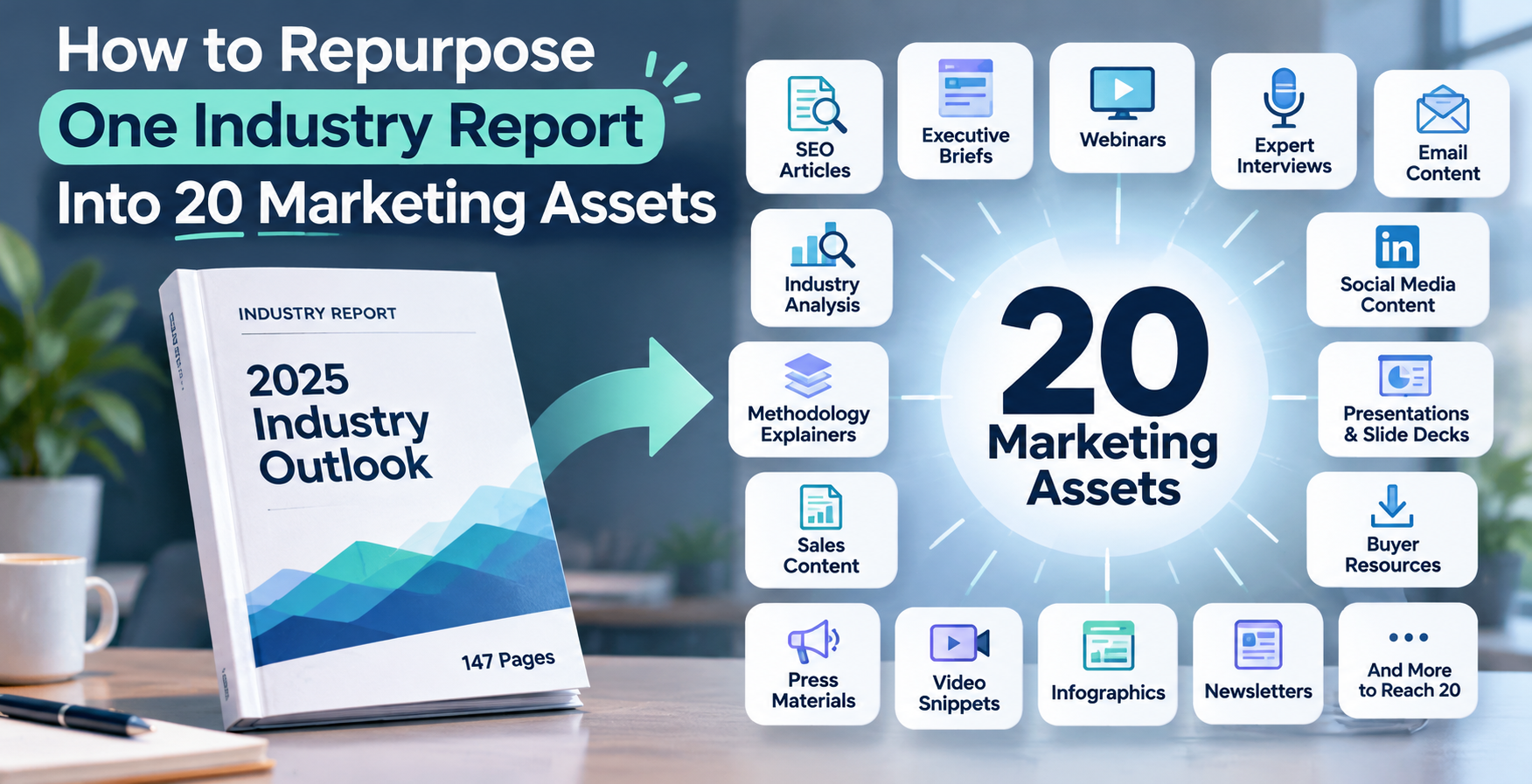
An investigation into why your research organization spent nine months producing a 147-page industry report, promoted it for eleven days, and is now holding an emergency meeting about how to create more content.
Somewhere in America, a market intelligence company has just published the most comprehensive industry report in its history.
The research took nine months.
The analysts interviewed 430 industry professionals.
The team examined thousands of data points.
The methodology was rigorous.
The findings were original.
The publication contained insights that could influence important decisions at large companies.
The executive director was delighted.
The research team was proud.
The marketing director organized a launch campaign.
There was a press release.
There was a LinkedIn announcement.
There was an email with the subject line:
"Our 2026 Industry Outlook Is Here!"
Several employees shared the announcement.
The research director appeared in a short video.
The membership director mentioned the report during a webinar.
For approximately eleven days, the organization talked about nothing else.
Then something extraordinary happened.
Everyone stopped.
The report was moved to the Publications section.
The LinkedIn announcement disappeared into the feed.
The email became one of several thousand messages in subscribers' inboxes.
And the 147-page study—representing nine months of original intelligence—began its long and distinguished career as a downloadable PDF.
Six weeks later, the marketing director presented the next quarter's content strategy.
"We need more thought leadership."
The executive director agreed.
"Perhaps we could commission another industry report."
The research director looked up.
"We just finished one."
"Yes, and it was very successful."
"Have people finished reading it?"
"Some."
"Have we published the analysis of its regional findings?"
"No."
"The methodology discussion?"
"No."
"The article about the biggest misconception the research uncovered?"
"No."
"The industry-specific implications?"
"Not yet."
"The interview with the lead analyst?"
"We posted a 32-second video."
"What was in it?"
"The analyst said the research was exciting."
A pause.
The research director closed the laptop.
The CFO, who had approved a considerable research budget, asked whether the report could perhaps do more than exist.
An excellent question.
And one increasingly relevant to research publishers, market intelligence providers, professional associations, advisory firms, and B2B organizations that invest substantial resources in original information.
How do you turn one major industry report into an ongoing source of useful content without simply repeating the same findings 20 times?
Because research production and research distribution are different disciplines.
Your analysts may be excellent at producing intelligence.
Your organization may be less effective at turning that intelligence into useful resources for different audiences.
And publishing a report once does not mean every person who could benefit from it has encountered, understood, or evaluated it.
Fortunately, there's a better approach.
One original research project can become the foundation for multiple substantial marketing assets.
Some can support search discovery.
Others can explain findings to executives.
Some can introduce the research to new professional audiences.
Others can help qualified buyers evaluate the paid offering.
And the underlying report can remain the authoritative source connecting them.
But there's a catch.
Twenty useful assets are not the same as 20 versions of the same paragraph.
And in a world where AI tools can generate content remarkably quickly, that distinction has become more important than ever.
Let's investigate.
The Research Is Expensive. The Distribution Strategy Shouldn't Be an Afterthought.
Research firms routinely invest substantial effort in producing original intelligence.
They may spend months gathering evidence.
Conduct interviews.
Purchase datasets.
Develop forecasts.
Analyze responses.
Review methodology.
And produce carefully written reports.
The resulting publication may be commercially valuable.
But too often, the distribution plan receives a small fraction of the attention.
The report is announced.
Promoted through several channels.
Then archived.
The organization moves on to its next publication.
Meanwhile, people who might benefit from the research have never encountered it.
Your Audience Doesn't Experience Research as One Publication
A chief strategy officer may need a short executive interpretation.
A market analyst may want methodology details.
A journalist may need a clearly sourced finding.
An industry association member may want implications for their sector.
A procurement team may need to understand what a research subscription includes.
An existing customer may want access to detailed supporting data.
These are different information needs.
And the same 147-page PDF may not be the most effective format for all of them.
This doesn't mean the report is poorly written.
It means readers have different reasons for engaging with it.
A research organization can respond by creating useful material tailored to those purposes.
The original study remains the source.
The supporting assets help people discover, interpret, discuss, and apply it.
That is a distribution strategy.
Not merely a content production strategy.
The 2026 Research: More Content Isn't Necessarily Better Content
There's an important reason to approach repurposing carefully.
The Content Marketing Institute's 2027 B2B Content and Marketing Trends report, published November 4, 2026, surveyed 861 B2B marketers as part of its annual research.
It found that 88% of respondents' organizations used AI-powered content creation tools.
When marketers identified the biggest contributions of AI, the leading answers were:
Speed: 78%.
Efficiency: 59%.
Volume: 44%.
But only 17% identified improved quality among AI's most important contributions.
The most commonly reported AI-content challenges included accuracy and quality control, both at 54%, and maintaining brand voice or authenticity at 52%.
These are self-reported perceptions from B2B marketers.
They are not controlled measurements of AI-generated writing quality.
But the findings expose a problem.
Organizations can now produce content faster than ever.
That doesn't automatically make the content more useful.
The Content Factory Is Not the Research Strategy
Imagine a marketing director uploading the report to an AI system and asking:
"Create 20 engaging blog posts based on this research."
The system produces:
"Five Industry Trends You Can't Ignore."
"Seven Game-Changing Industry Insights."
"Ten Strategic Takeaways for Industry Leaders."
"How Industry Transformation Is Reshaping the Future."
"What Executives Need to Know About Industry Innovation."
The organization now has 20 articles.
Unfortunately, they all say approximately the same thing.
Some statistics have lost their methodological context.
A few findings are overstated.
The reports' geographic limitations have disappeared.
And the phrase "transformative industry landscape" appears with disturbing frequency.
This is not an effective repurposing strategy.
It's content multiplication.
The organization has increased the number of pages without necessarily increasing the amount of useful information.
Google's people-first content guidance specifically asks whether material provides original information, meaningful analysis, and value beyond what is already available.
Its spam policies also warn against scaled production of unoriginal, low-value pages primarily intended to manipulate rankings.
The takeaway is not that repurposing is bad.
It's that each new resource should serve a distinct purpose.
The goal is not to turn one report into 20 excuses to publish. It's to turn one research investment into 20 opportunities to provide relevant value.
An important difference.
Especially for organizations whose reputation depends on intellectual rigor.
Start With One Report Worth Repurposing
Let's create a fictional example.
Our research publisher is Meridian Industry Intelligence.
It sells specialized manufacturing research and enterprise intelligence subscriptions.
Its latest publication is:
The 2026 U.S. Manufacturing Outlook: Demand, Workforce, Investment, and Regional Market Conditions.
The complete report includes proprietary forecasts, survey results, historical comparisons, and sector-level analysis.
The underlying data supports multiple questions.
Which industries are experiencing changing demand?
How do workforce challenges differ across markets?
What are companies planning to invest in?
What assumptions influence the forecasts?
Which findings matter to executives, analysts, and industry associations?
This is the kind of study that could support a substantial content program.
Not because every page needs a separate article.
But because the original research addresses multiple legitimate information needs.
Before doing anything else, the organization should examine the report's structure.
Which findings are suitable for public release?
Which require paid access?
Which can support independent analysis?
Which are especially relevant to prospective buyers?
Which would benefit from explanation by the original researchers?
And where could additional context make the findings useful to different audiences?
Those questions determine the content opportunities.
Not an arbitrary instruction that every report must produce exactly 20 deliverables.
The following framework offers 20 possible assets.
A publisher should select those justified by its research, audience, permissions, and available resources.
Not manufacture all 20 to meet a quota.
That would merely replace an inefficient publication process with an ambitious new one.
Part One: Five Assets That Make the Research Discoverable
The first objective is straightforward.
Help relevant people find the study and understand why it matters.
Not everyone needs the complete report immediately.
But they should have a useful way to learn what it covers.
Asset 1: The Permanent Research Landing Page
This is the foundation.
Every major report should have a clear public identity.
Not necessarily a public copy of the full study.
A public page describing the research.
For Meridian, the page might be titled:
2026 U.S. Manufacturing Outlook: Key Findings, Methodology, and Report Access
It would explain the scope of the study, the research period, authors, relevant industries, methodology, and selected findings approved for release.
It would also describe the complete paid offering.
The page becomes a permanent reference point.
Journalists can link to it.
Search engines can evaluate the public content.
Prospective customers can understand the research.
And the membership team has a relevant destination for people interested in deeper access.
This matters because Google can index PDFs, but a dedicated HTML page often provides more flexibility for descriptions, internal links, and product information.
Distribution: Organic search, research archive, topic hubs, press coverage, and relevant member communications.
Primary purpose: Establish a discoverable, authoritative home for the report.
Asset 2: The Two-Page Executive Brief
A corporate executive may not have time to read 147 pages.
This doesn't indicate a lack of intellectual curiosity.
It may indicate that the executive has a job.
An executive brief should answer several questions clearly.
What did the research examine?
What are the most consequential approved findings?
Why do they matter?
What uncertainties or limitations should leaders understand?
And what deeper analysis is available?
This should not simply reproduce the original executive summary verbatim.
It may need a different structure.
The full report might be organized around methodology and research categories.
The executive brief can emphasize decisions, implications, and limitations.
For example, Meridian might explain what regional demand differences could mean for strategic planning without publishing every proprietary forecast value.
Distribution: Executive newsletters, professional events, selected account follow-up, and the report landing page.
Primary purpose: Make the research useful to time-constrained decision-makers.
Asset 3: The Methodology Explainer
Research buyers care about credibility.
At least the serious ones.
A useful methodology explainer can describe how the study was conducted.
Who participated.
How data was collected.
What time period was analyzed.
How important terms were defined.
Which limitations exist.
And how the findings should be interpreted.
It should not disclose confidential information or proprietary methods that require protection.
But a public overview can support informed evaluation.
For Meridian, an article might be called:
How We Developed the 2026 U.S. Manufacturing Outlook
The content could explain the research process and clarify what the forecasts do—and do not—represent.
This is particularly valuable when buyers are considering expensive intelligence subscriptions.
They need more than the assertion that the research is industry-leading.
Distribution: Report landing page, researcher biographies, sales follow-up, and relevant research library pages.
Primary purpose: Demonstrate methodological credibility.
Asset 4: The Search-Focused Question Article
Now identify a real question prospective readers might investigate.
For example:
What Is Driving Regional Manufacturing Demand in 2026?
A substantive article could address that question using appropriately released findings.
It should provide an actual answer.
Not simply say that the answer is available in the paid report.
Google's helpful-content guidance emphasizes satisfying users' needs and providing original analysis.
That's the standard.
If the report contains a finding relevant to the question, explain it accurately.
Include necessary context.
Link to the primary research.
And describe what additional information is available through the full report.
Distribution: Organic search, internal linking from topic hubs, professional newsletters, and relevant third-party references.
Primary purpose: Introduce the research through a recognizable audience question.
Asset 5: The Original Finding Spotlight
Sometimes one finding deserves its own substantive treatment.
Perhaps Meridian discovered a meaningful difference between workforce expectations in two regions.
A dedicated article could explain that result.
Not merely publish the number in large blue typography.
What was measured?
Why is the difference notable?
What might explain it?
What limitations apply?
How does it compare with other relevant evidence?
A strong finding spotlight can help a journalist, analyst, or industry professional understand a particular observation.
It can also create a useful source for people who don't need the entire report.
Distribution: Public website, industry publications, research newsletters, and relevant external coverage.
Primary purpose: Make a significant original finding understandable and citeable.
Five assets.
Each has a distinct role.
And none requires rewriting the entire report under a slightly different headline.
A promising beginning.
Part Two: Five Assets That Turn Research Into New Context
Now the challenge changes.
Different readers may encounter the same evidence but need different interpretations.
This is where research expertise becomes especially valuable.
A computer can reformat a paragraph.
A qualified analyst can explain why a finding matters in a particular context.
Those are not equivalent activities.
Asset 6: The Industry-Specific Implications Article
A broad manufacturing report may cover several industry segments.
But an automotive supplier may care about different findings than an industrial equipment producer.
If the underlying study supports the distinction, Meridian could publish:
What the 2026 Manufacturing Outlook Means for Industrial Equipment Companies
The article would focus on relevant evidence from the original study.
It would explain implications for that industry.
And identify where the broader conclusions do or do not apply.
This is not an excuse to create identical pages for 20 industries.
If the report contains no meaningful segment-level evidence, don't invent it.
Distribution: Industry-specific newsletters, relevant trade associations, sales conversations, and sector topic pages.
Primary purpose: Connect broad research with a specific audience's decisions.
Asset 7: The Regional Analysis
Research may contain geographic differences that deserve additional explanation.
For example:
Why Manufacturing Investment Expectations Differ Across U.S. Regions
A useful article could examine selected regional observations and their context.
It should distinguish genuine differences supported by the data from speculation.
And preserve geographic definitions.
If the study surveyed manufacturers in six regions, don't describe it as a comprehensive assessment of every U.S. locality.
That's how an otherwise credible report becomes a very confident but poorly supported marketing article.
Distribution: Regional business publications, local industry associations, relevant email segments, and geography-focused search pages.
Primary purpose: Make findings relevant to specific markets.
Asset 8: The Historical Comparison
Perhaps Meridian has conducted similar research over several years.
Now the current report can be interpreted in a broader context.
A new article might examine:
How Manufacturing Investment Priorities Have Changed Since 2020
But only if the underlying data permits appropriate comparison.
Survey wording may have changed.
Respondent populations may differ.
Industry classifications may have evolved.
A responsible analyst needs to review those differences.
Where direct comparisons aren't defensible, the article can discuss broader historical themes while clearly identifying the limitations.
This is valuable because historical context may distinguish a long-established research publisher from a general content company.
Distribution: Search, research libraries, analyst newsletters, existing members, and professional discussions.
Primary purpose: Show how evidence changes over time.
Asset 9: The Misconception or Myth-Busting Article
Good research sometimes challenges widely accepted assumptions.
Perhaps Meridian's study reveals that an industry problem is more complicated than commonly described.
That could support an article such as:
Three Assumptions About Manufacturing Labor Shortages That Our Research Challenges
The article should identify the assumption.
Explain the evidence.
Discuss the limits.
And avoid exaggeration.
If the survey provides mixed results, don't transform them into a dramatic claim that the entire industry has been wrong for twenty years.
A finding can be interesting without becoming a revolution.
Distribution: Organic search, professional social channels, industry newsletters, and discussion-oriented events.
Primary purpose: Make original research relevant to an existing debate.
Asset 10: The Analyst's Interpretation
Here's something a general AI summary cannot necessarily provide.
The original researcher's informed judgment.
A senior analyst might write:
What Surprised Us Most in the 2026 Manufacturing Outlook
This article could explain unexpected findings.
Questions that emerged during analysis.
Uncertainty that didn't fit neatly into the executive summary.
Or implications the team considers important.
The analyst should distinguish observed data from interpretation.
The article shouldn't claim that every impression is a statistically supported result.
But thoughtful expert commentary can add depth that a simple summary doesn't offer.
Distribution: Company blog, analyst profiles, professional networks, guest bylines, and newsletter features.
Primary purpose: Demonstrate the human expertise behind the research.
These five assets add new context.
Not merely new packaging.
Which is a significant achievement in an industry currently capable of producing 300 content variations before anyone has finished reading the original report.
Part Three: Six Assets That Bring the Research to Different Audiences
Now let's discuss distribution.
Because publishing excellent material on your website is not the same as making sure anyone encounters it.
A content asset should have a credible reason to exist on the channel where it appears.
And the audience should influence the presentation.
The 2027 Budget Findings Are Relevant
The Content Marketing Institute's November 2026 research found that B2B marketers expected increased or substantial investment in several areas for 2027.
Among the cited priorities were owned media at 42%, events and experiential marketing at 35%, and social or earned media at 25%.
These findings describe surveyed marketers' investment expectations.
They are not proof that every research publisher should allocate budget in those proportions.
But they show continued interest in combining channels.
For a research firm, that can mean creating a useful central resource on its own website and distributing appropriate material through email, social channels, events, and external publications.
The channels should reinforce the research.
Not operate as unrelated activities.
Asset 11: The Research Newsletter Feature
Your report should have a place in the ongoing editorial relationship with subscribers.
But the newsletter doesn't have to reproduce the report announcement.
A useful issue might focus on a particular question.
For example:
What Our Latest Research Reveals About Manufacturing Investment Decisions
It could discuss one important finding.
Explain its implications.
Link to relevant public analysis.
And give readers the option to explore the full study.
This is especially valuable for people who aren't actively purchasing.
They may still want to understand their industry.
The 2026 6sense B2B Buyer Experience Report found that buyers often follow relevant categories between formal purchasing evaluations.
That supports a role for ongoing useful information.
It doesn't guarantee newsletter-driven sales.
Distribution: Opted-in research subscribers and relevant existing customer audiences.
Primary purpose: Sustain a useful relationship beyond the initial report launch.
Asset 12: The Executive LinkedIn Perspective
The company page can announce the report.
But a senior researcher or executive can also explain what the findings mean.
For example:
"I've spent the past nine months studying how manufacturers evaluate investment risk. One finding challenges the way many organizations discuss regional demand."
Then the person explains the finding.
Provides context.
And links to the original research.
The post should contain a complete, useful thought.
Not merely say:
"Big news! Proud of our incredible team. Link in comments."
That may be a perfectly sincere expression of pride.
It is not particularly informative.
Distribution: Relevant executives' and analysts' professional networks.
Primary purpose: Introduce the research through a credible human perspective.
Asset 13: The Short Analyst Video
Some professional audiences may prefer to hear the researcher explain an issue directly.
A short video can address one specific question.
For example:
"Why are the manufacturing demand forecasts different across regions?"
The analyst explains the finding.
States the essential limitation.
And points viewers to the fuller analysis.
The video should have clear audio, captions, and a useful description.
No elaborate production is necessary.
A confident researcher explaining a substantive idea can be more useful than a cinematic montage of industrial facilities accompanied by dramatic music.
Distribution: Website, appropriate professional social channels, newsletter, and event promotion.
Primary purpose: Make expert interpretation accessible in a short audiovisual format.
Asset 14: The Live Research Briefing or Webinar
Some findings deserve discussion rather than a short summary.
A webinar can allow researchers to explain the methodology, examine implications, and answer relevant questions.
For example:
Inside the 2026 Manufacturing Outlook: What the Research Actually Shows
The program could include the lead analyst and an industry practitioner.
The conversation should add value beyond reading the executive summary aloud.
Attendees may want clarification.
They may challenge assumptions.
They may ask how particular findings apply to their organizations.
Those interactions can also reveal what future content would be useful.
But webinar attendance isn't automatically purchasing intent.
A person interested in learning about market conditions isn't necessarily requesting a consulting proposal.
Distribution: Relevant subscribers, industry associations, current members, and professional audiences.
Primary purpose: Support deeper learning and substantive discussion.
Asset 15: The Researcher Interview or Podcast Episode
A longer conversation can explore the researcher's judgment.
How was the project designed?
What changed during the analysis?
What findings were unexpected?
Which limitations should readers take seriously?
What questions remain unresolved?
This can produce useful material distinct from the written report.
For example:
A Conversation With the Analysts Behind the Manufacturing Outlook
The strongest discussion isn't a promotional interview in which every answer begins by praising the organization's leadership.
It should reveal something about the research itself.
Distribution: Podcast platforms, the organization's website, newsletter, and professional audio or video channels.
Primary purpose: Give relevant audiences a deeper understanding of the people and thinking behind the evidence.
Asset 16: The Journalist and Industry Media Brief
Now create a resource specifically for people who may report on the findings.
This is not simply another press release.
A good media brief could provide the study title, original source URL, research period, methodology, approved statistics, contact information, and relevant researcher availability.
It can identify several distinct potential story angles.
For example, one outlet may be interested in workforce findings.
Another may cover regional investment.
A third may focus on industrial supply chains.
Journalists should still exercise independent editorial judgment.
The publisher should not expect them to reproduce preapproved talking points verbatim.
But the brief can make accurate reporting easier.
And help ensure the original source is identifiable.
Distribution: Relevant journalists, editors, industry publications, association media, and appropriate professional contacts.
Primary purpose: Encourage accurate, well-sourced external coverage.
Six more assets.
Different channels.
Different audience needs.
And, crucially, different reasons to engage.
Because not every executive wants a podcast.
Not every analyst wants a video.
And not every journalist wants to complete a 17-field form before discovering who conducted the research.
Part Four: Four Assets That Help Qualified Buyers Evaluate the Research
Now we reach the commercial question.
What should happen when a relevant visitor becomes interested in the organization's actual offering?
Perhaps they want the full report.
Perhaps they are considering a subscription.
Perhaps their company needs access to proprietary data.
Or perhaps they want to understand whether the research can support a specific project.
These needs are different from general education.
The content should reflect that.
Asset 17: The Buyer Questions and Licensing FAQ
A serious institutional buyer may need to know exactly what they're purchasing.
Does the subscription include the complete dataset?
How often is it updated?
Can multiple employees access the research?
Are commercial redistribution rights included?
Can data be downloaded?
Does the license cover international offices?
What research support is available?
These questions deserve clear answers.
A buyer FAQ can support evaluation without requiring someone to request a sales meeting for every basic detail.
It may also help the buyer explain the product internally.
Distribution: Membership pages, sales follow-up, product evaluation emails, and appropriate help resources.
Primary purpose: Reduce confusion about the paid offering.
Asset 18: The Sample Report or Product Preview
Some organizations protect their research so thoroughly that prospective customers cannot evaluate its quality.
A sample can help.
It might include selected report pages, a demonstration of data organization, or an approved historical example.
The preview should genuinely represent the product.
But it should respect commercial and licensing restrictions.
The publisher doesn't need to release every forecast to demonstrate that the research is rigorous.
And it shouldn't publish a misleading sample that contains only promotional material.
Distribution: Research product pages, appropriate inquiry responses, enterprise sales conversations, and member acquisition campaigns.
Primary purpose: Give buyers meaningful evidence of what they're considering.
Asset 19: The Internal Decision-Maker Brief
This is an overlooked opportunity.
Your prospect may understand the value of the research.
But they still need approval.
The CFO may want to understand the costs.
Procurement may need licensing terms.
The strategy team may need to explain the use case.
A concise, factual decision-maker brief could describe the research scope, relevant applications, delivery format, update schedule, licensing conditions, and limitations.
It should not invent a financial return.
And it shouldn't pretend that purchasing the study guarantees better investment decisions.
But it can give internal stakeholders the information needed to evaluate the product.
Distribution: Qualified enterprise prospects, account teams, and purchasing stakeholders.
Primary purpose: Help buyers evaluate and justify the actual purchase.
Asset 20: The Research-Based Follow-Up Sequence
Finally, create a useful follow-up program for people who have expressed relevant interest.
Not a sequence that automatically sends everyone six emails asking whether they're ready to buy.
A thoughtful program might provide:
A first message delivering the requested research.
A later follow-up addressing the topic the prospect actually expressed interest in.
An appropriate methodology or product preview.
And a clear opportunity to ask questions when the person is evaluating the service.
Timing should reflect the relationship.
Some prospects may have an active need.
Others may simply want future research updates.
The goal is relevance and continuity.
Not relentless contact.
Distribution: Appropriate, permissioned prospect communications and account-specific follow-up.
Primary purpose: Support evaluation over time without mistaking content engagement for immediate purchase intent.
And there they are.
Twenty potential marketing assets from one original research project.
Not twenty blog posts.
Not twenty slightly different advertisements.
And not twenty excuses to publish the same statistic accompanied by increasingly dramatic adjectives.
Twenty distinct opportunities to help people discover, understand, discuss, evaluate, and use the research.
The number is useful as a planning exercise.
It is not a quota.
A smaller report might only justify four or five of these.
A truly substantial research project may support many more.
The goal is to select assets that serve genuine needs.
Not prove that the marketing team can count to twenty.
The Critical Step: Create a Research-to-Content Map Before Producing Anything
Now we need to discuss workflow.
Because a list of twenty possibilities can quickly become a production nightmare.
The research director receives twenty requests.
Marketing wants quotes.
Sales wants executive summaries.
The podcast team wants an interview.
The communications team needs an approved press release.
Someone asks whether the regional data can be published.
A designer wants statistics for social posts.
And an AI tool has generated three completely different interpretations of the same finding.
The research director begins questioning several life choices.
This is why the work needs a controlled process.
Start With the Research's Actual Findings
Before selecting formats, identify the major evidence.
What was measured?
Which findings are significant?
What methodological qualifications apply?
Which statements are suitable for public release?
Which require licensing or confidentiality protection?
Who is authorized to approve interpretations?
This creates a reliable foundation.
Then Identify the Audience Question
A research finding is not automatically a content idea.
The marketing team should connect it to something relevant people want to understand.
For example:
Finding: Regional manufacturing investment expectations vary.
Audience question: Why are some manufacturing markets more attractive for expansion than others?
Potential assets: A public explanatory article, regional analysis, executive brief, and analyst interview.
Each resource should address a distinct aspect of the question.
Not repeat the finding word for word.
Finally, Choose the Appropriate Format and Channel
A methodology explainer may work best as a website article.
An expert interpretation may suit a professional social post.
A complex debate may benefit from a webinar.
A product preview may be more useful in sales evaluation.
Channel selection should follow audience needs.
Not the marketing team's desire to announce that the report has now been published on every platform currently available.
Including three platforms its customers haven't used since 2019.
Create One Approved Source of Truth
For a complex report, maintain an internal source document.
It should identify approved findings, source references, methodological limitations, publication dates, permissions, and relevant contacts.
Each marketing asset can draw from that foundation.
This reduces the risk of inconsistencies.
For example, if the original survey included 430 respondents, every derivative resource should describe the sample accurately.
If a finding applies only to manufacturers above a certain size, the qualification should remain attached.
If a forecast depends on specified assumptions, those assumptions shouldn't disappear in the shorter version.
The Sentence That Must Survive Repurposing
Sometimes the most important part of a finding is its limitation.
Imagine a report states:
"Among surveyed manufacturers with more than 500 employees, 62% expect increased investment over the next 12 months."
A careless social post becomes:
"62% of manufacturers are increasing investment."
Those statements are not equivalent.
The first reports an expectation within a defined survey population.
The second suggests an industry-wide observed outcome.
The problem isn't the format.
It's the loss of meaning.
A useful review process should ensure that the substance survives adaptation.
Because a research organization's credibility is not worth sacrificing for a shorter caption.
Especially if the shorter caption is followed by twelve fire emojis.
Should All Twenty Assets Be Public?
No.
And this is particularly important for research publishers.
The full report may be a paid product.
The underlying dataset may contain proprietary information.
Some analyses may involve third-party licensed material.
Certain findings may be contractually restricted.
A content strategy must account for those realities.
The Public Discovery Layer
Some resources help unfamiliar audiences recognize the research.
The landing page.
Methodology summary.
Approved findings.
Public articles.
And selected expert commentary.
These can support discoverability and credibility.
The Evaluation Layer
Other resources help qualified buyers understand the commercial offering.
Sample reports.
Product FAQs.
Licensing explanations.
And decision-maker briefs.
These may be public, registration-based, or shared in an appropriate sales process.
The Protected Research Layer
The complete proprietary dataset, premium forecasts, restricted analysis, and licensed tools may remain behind access controls.
The right boundary depends on the business.
Google's paywalled content guidance explains how certain subscription content can be identified for search indexing.
But its documentation also distinguishes search markup from actual access protection.
The publisher should decide deliberately what may be public.
And use appropriate technical controls for material that must remain restricted.
Repurposing should increase the number of ways people can understand the value of your research—not unintentionally increase the number of ways they can obtain licensed data for free.
A surprisingly important distinction.
One the CFO will appreciate.
Distribution Is a Separate Job From Asset Production
Here's another common mistake.
The research publisher creates 20 assets.
Excellent.
Then it publishes everything on the website in the same week.
The newsletter links to the report.
LinkedIn shares five posts.
The webinar is scheduled.
The podcast is released.
The press release goes out.
And the entire campaign concludes before most prospective buyers realize the report exists.
Six weeks later, marketing needs another content idea.
We've returned to the beginning.
Think in Distribution Windows, Not Just Launch Days
A major research report can support an extended editorial program.
The launch period introduces the study.
The following weeks explore important findings.
Later content examines specific industries or questions.
A webinar provides deeper discussion.
A historical comparison adds new interpretation.
A buyer-focused resource supports active evaluations.
This sequence doesn't have to be rigid.
And the publisher shouldn't artificially prolong a topic after it stops being relevant.
But the report doesn't need to exhaust its usefulness in eleven days.
Different Channels Serve Different Roles
Organic search can help new audiences discover public research over time.
Email can provide ongoing value to existing subscribers.
Professional social media can introduce ideas through researchers and executives.
Earned media can connect findings with broader industry discussions.
Webinars and interviews can support deeper understanding.
Sales resources can help qualified buyers evaluate the paid offering.
These channels can reinforce one another.
But their outcomes should be measured differently.
A journalist citing the original report is not equivalent to a sales-qualified inquiry.
A webinar attendee is not necessarily ready to buy.
And a LinkedIn impression doesn't mean someone has evaluated an enterprise research subscription.
The distribution strategy should recognize those distinctions.
Otherwise, the performance report will consist of adding together unrelated numbers and declaring the campaign an enormous success.
Why Original Research Can Matter Before a Buyer Contacts You
The 2026 6sense B2B Buyer Experience Report found that approximately 92% of eventual winning vendors were on the buyer's initial shortlist.
It also found that buyers first contacted sellers around 59% of the way through an average 10.3-month formal purchasing journey.
The study concerned substantial B2B purchases across multiple categories.
It wasn't a specific analysis of research-publisher subscriptions.
But it highlights why being discoverable early may matter.
A relevant professional may first encounter your research months before needing to purchase anything.
They may read an article.
Share a finding.
Subscribe to a newsletter.
Attend a briefing.
And later consider the full research product.
No single asset guarantees that outcome.
But useful content distributed through relevant channels can create opportunities for familiarity and evaluation.
The important word is useful.
Because buyers do not need twenty pieces of content announcing that you are pleased to have published a report.
They need information that helps them do their jobs.
The AI Repurposing Question: What Should Be Automated, and What Requires Human Review?
Now let's return to artificial intelligence.
AI can help streamline parts of content production.
It may assist with organizing material.
Generating draft outlines.
Identifying potential audience questions.
Suggesting content formats.
Preparing transcripts.
Or converting approved information into draft summaries for human review.
Those capabilities can be useful.
But research-driven content carries special risks.
AI Can Produce a Plausible Summary That Is Wrong
It may confuse a forecast with an observed result.
Omit methodological limitations.
Misinterpret a data table.
Change the population represented by a statistic.
Combine findings from separate studies.
Or introduce unsupported implications.
These errors can be difficult to notice because the prose is often confident and polished.
The content may sound excellent.
The actual research may say something different.
The Review Standard Should Match the Risk
A short social post citing an original finding should still be checked against the study.
A detailed industry analysis may require subject-matter review.
A resource used by buyers to evaluate a substantial research subscription may need additional editorial, product, or legal approval.
And proprietary or confidential data should not be uploaded into third-party systems without appropriate authorization and data-handling review.
The goal isn't to prohibit AI from helping.
It's to use it where it adds value without allowing it to rewrite the evidence.
The Content Marketing Institute's 2027 research found that 65% of surveyed marketers reported increasing pressure to produce content faster.
Among individual contributors experiencing that pressure, 48% reported burnout.
That makes efficiency important.
But the same research highlighted concerns about accuracy, quality, and authenticity.
The practical lesson is that production speed should not become the overriding objective.
A research firm has more to lose from a misleading statistic than a generic content publisher has from a slightly awkward headline.
The original evidence is part of its reputation.
Treat it accordingly.
How to Measure the Twenty-Asset Program Without Inventing Twenty Different Success Stories
Let's talk about measurement.
Your organization has published the report.
Developed several supporting assets.
Distributed them across relevant channels.
And begun receiving engagement.
Wonderful.
What did the program accomplish?
That depends on what each asset was intended to do.
Discovery Assets
For the research landing page and search-focused articles, examine relevant organic impressions, traffic, and engagement.
Did the content reach people investigating the topic?
Were they able to find the primary study?
Did related resources receive meaningful visits?
Interpretation Assets
For historical comparisons, regional analysis, and analyst commentary, evaluate whether the content attracted relevant readers and supported deeper engagement.
Did people explore the underlying research?
Did credible industry publications reference the findings?
Were the studies accurately attributed?
Distribution Assets
For email, social media, webinars, and interviews, examine appropriate engagement.
Not simply raw impressions.
Did the content reach the intended audience?
Did people engage with the substantive material?
Did relevant professionals choose to continue the relationship?
Buyer Evaluation Assets
For previews, FAQs, and decision-maker briefs, look at qualified interactions.
Were prospects able to understand the subscription?
Did the resources address important purchasing questions?
Did they support legitimate inquiries or active evaluations?
Commercial Outcomes
Ultimately, the organization may want to understand whether the program contributes to subscriptions, enterprise inquiries, renewals, or other business goals.
But attribution has limitations.
A buyer may encounter several assets over months.
They may discuss research privately with colleagues.
The organization may not observe every interaction.
And the eventual purchase may depend on needs that develop much later.
Twenty assets do not mean twenty independent revenue streams.
Nor should every asset be assigned a fictional dollar value.
Measure what can be observed.
Interpret it carefully.
And distinguish association from causation.
A sophisticated research organization should be particularly good at this.
Even when the marketing director would prefer a more exciting number.
An Illustrative Performance Scenario
Let's imagine Meridian launches its report program.
The public research page attracts relevant organic traffic.
Several industry articles bring visitors to the study.
The newsletter generates repeat readership.
An analyst interview receives professional engagement.
A trade publication cites the report.
Several qualified organizations investigate the paid research product.
And two enterprise prospects eventually request access discussions.
Those are observable activities.
But we cannot automatically conclude that the twenty-asset framework caused the inquiries.
Perhaps some buyers already knew Meridian.
Perhaps the report addressed a particularly timely industry problem.
Perhaps a partner recommendation influenced the decision.
The organization should examine the available evidence.
And avoid claiming a precise return without an appropriate method.
The program may be promising.
It may require refinement.
Or it may not justify the investment.
The correct answer comes from evaluating actual outcomes.
Not from multiplying the number of assets by an invented conversion rate.
The 90-Day Plan: Turn One Report Into an Ongoing Content Program
Now let's organize the work.
The report is ready.
The research team has approved it.
The marketing department wants a meaningful campaign.
The CFO wants reasonable use of the original research investment.
And nobody wants 20 separate emergency approvals.
A sensible 90-day program can establish an effective process.
Days 1–30: Build the Foundation
Start with the original report.
Identify the most significant findings.
Review the methodology.
Clarify disclosure and licensing restrictions.
Document source references.
Identify the intended audiences.
And select the assets most relevant to the organization's goals.
Prioritize the permanent landing page.
The useful executive summary.
The methodology explanation.
And one or two substantive search-focused articles.
Prepare relevant distribution materials.
Don't attempt to produce every asset simultaneously.
The goal is to create a reliable source of truth and a strong public foundation.
Establish Editorial Ownership
Assign responsibility for the original findings.
Designate research reviewers.
Clarify marketing and communications responsibilities.
Identify who can approve public data releases.
And establish a manageable publishing process.
Without these decisions, the program may generate unnecessary revisions and misunderstandings.
Particularly when the research team discovers that its forecast has been described as a guaranteed industry outcome in a social media post scheduled for tomorrow morning.
Days 31–60: Expand Into Relevant Contexts
Now develop the most useful supporting analysis.
Perhaps the regional differences deserve a dedicated article.
Perhaps a major finding needs explanation.
Perhaps a historical comparison would add value.
Schedule the relevant analyst interview.
Publish useful newsletter coverage.
Pitch appropriate industry media.
And link the supporting content to the original study.
Every asset should have a clear audience and purpose.
Not simply a production deadline.
Review early performance.
What questions are readers asking?
Which research topics attract relevant attention?
Which findings are being misunderstood?
Use that information to guide additional material.
This is where distribution can inform editorial decisions.
The organization learns what people need help understanding.
Then produces content that addresses those needs.
A rather satisfying arrangement.
For a research business.
Days 61–90: Support Deeper Engagement and Buyer Evaluation
By this point, the organization may have identified relevant interest.
Now consider whether additional resources would help.
Perhaps prospective members need clearer licensing information.
Perhaps a live briefing would address recurring questions.
Perhaps the research team's interpretation deserves a longer discussion.
Perhaps a sample report would help qualified buyers evaluate the product.
Develop those resources where the need is established.
Then examine performance across the program.
Which assets reached relevant audiences?
Which supported research discovery?
Which contributed to useful engagement?
Which helped buyers understand the paid product?
What was expensive to produce?
What could be improved?
And which proposed assets turned out to be unnecessary?
That last question matters.
An effective strategy can decide not to produce something.
If the report doesn't justify a podcast, skip it.
If the historical data isn't comparable, don't force a retrospective.
If a regional article would repeat the general analysis without adding value, don't publish it.
You don't need all twenty assets to declare success.
The goal is useful distribution.
Not completing a content-production bingo card.
Seven Repurposing Mistakes That Research Firms Should Avoid
Before we conclude, let's address several traps.
Because producing a major report is difficult.
And it's surprisingly easy to damage the value of that work through careless marketing.
Mistake One: Repeating the Same Finding in Twenty Formats
Different formats can be useful.
But each asset should have a recognizable purpose.
If every piece contains the same three statistics and the same conclusion, the audience isn't learning much.
Mistake Two: Removing Important Qualifications
A shorter version should preserve the essential meaning.
If a study examines 430 respondents in a defined population, don't describe its finding as applying to every company in the industry.
Mistake Three: Publishing Everything at Once
A major report may have a useful life beyond launch week.
Relevant analysis can be developed and distributed over time.
But don't extend the campaign artificially once the subject stops being useful.
Mistake Four: Treating Every Format as an SEO Asset
A webinar may be valuable because of the questions it enables.
A decision-maker brief may be useful because it supports internal evaluation.
Neither needs to become another indexable blog post.
Different assets have different jobs.
Mistake Five: Giving Away the Paid Product Accidentally
Public previews should respect the commercial and contractual value of restricted research.
The goal is to demonstrate expertise without unintentionally disclosing licensed material.
Mistake Six: Confusing Engagement With Purchase Intent
Someone reading an article, attending a webinar, or downloading an executive brief may be interested in the topic.
That does not automatically mean they intend to buy a research subscription.
Qualification requires more context.
Mistake Seven: Measuring Output Instead of Impact
Twenty published assets is an activity measure.
It doesn't establish that the program reached qualified audiences or improved business performance.
The relevant question is whether the materials helped people discover, understand, and evaluate the research.
And whether the outcomes justify the effort.
An inconvenient question.
But considerably more useful than celebrating the fact that the team has created its seventeenth LinkedIn post based on the same executive summary.
The Bigger Opportunity: Build a Research Distribution System, Not a One-Time Campaign
Here's the strategic shift.
A good repurposing program can help one report reach more relevant people.
A good research distribution system can make the process repeatable.
Imagine Meridian produces four major studies each year.
Instead of launching each one independently, the organization maintains a clear editorial process.
Every report receives a stable landing page.
Important findings are reviewed for public distribution.
Audience questions inform supporting articles.
Researchers contribute appropriate interpretation.
The newsletter introduces relevant analysis.
The research library connects related work.
And qualified buyers can find useful information about the paid offering.
Now the organization has a system.
Not simply an annual campaign followed by a collective loss of memory.
Each Report Strengthens the Larger Research Library
The manufacturing outlook can link to previous editions.
The workforce study can reference related benchmarks.
The regional analysis can connect to a broader topic hub.
The methodology information can help readers understand the research program.
And future publications can build on the earlier evidence.
That structure may improve discoverability.
But it can also improve the usefulness of the research for members and prospects.
The organization's knowledge becomes easier to explore.
And the marketing team no longer needs to reinvent its entire content strategy each time a new report appears.
The Most Valuable Result Is Not Necessarily More Content
The greatest benefit may be clearer communication of the research's relevance.
A prospect discovers the organization through a useful article.
An executive reads a brief.
An analyst reviews the methodology.
A journalist cites the primary source.
A subscriber attends a discussion.
A qualified buyer investigates the complete data product.
Each interaction serves a different purpose.
And they connect through the original research.
That's more valuable than twenty disconnected assets published merely because marketing needed more content.
The report remains the intellectual foundation. The supporting content makes its value easier for different people to recognize.
That is the opportunity.
Not the number twenty.
Not the number of platforms.
And certainly not the size of the content calendar.
In Conclusion: Your Research Doesn't Need Twenty Different Personalities. It Needs a Distribution Strategy.
Let's return to Meridian Industry Intelligence.
The research team spent nine months producing an extraordinary report.
The marketing team launched it.
The press release performed well.
The newsletter generated some traffic.
The analysts received congratulations.
Then the organization moved on.
Six weeks later, leadership wanted more thought leadership.
Another report.
Another campaign.
Another expensive research investment.
But the first report hadn't exhausted its value.
It had barely begun to reach the audiences that might benefit from it.
The research contained original findings.
Methodological insight.
Regional differences.
Industry implications.
Questions worth discussing.
And information that could help qualified buyers evaluate the paid research offering.
Those opportunities didn't require inventing new evidence.
They required interpreting, presenting, and distributing existing evidence appropriately.
A permanent landing page could make the report easier to find.
An executive brief could help time-constrained leaders.
A methodology article could build confidence.
Industry analysis could provide relevant context.
An expert interview could reveal the reasoning behind the findings.
A webinar could support substantive discussion.
And buyer-focused resources could help organizations evaluate whether deeper access was worth purchasing.
Different audiences.
Different needs.
Different outcomes.
One original research investment.
The key is to preserve the integrity of the work.
Don't turn one survey into twenty unsupported conclusions.
Don't confuse a polished AI summary with expert analysis.
Don't manufacture articles to satisfy a content quota.
And don't treat every impression, download, or webinar registration as a future enterprise subscription.
One great industry report can support twenty useful marketing assets. But only when each asset provides a genuine reason for someone to engage.
The objective isn't to publish more for the sake of publishing more.
It's to help the right people discover what your organization knows.
Understand why it matters.
Evaluate its credibility.
And recognize when deeper access or professional expertise could be valuable.
Because there's something deeply strange about investing hundreds of thousands of dollars in original intelligence, promoting it for eleven days, and then announcing that the organization has run out of content ideas.
You haven't necessarily run out of content.
You may simply have stopped thinking about the research as soon as the PDF was finished.
And the next time someone proposes commissioning another report because the blog needs more material, perhaps the research director should ask one simple question.
"Have we actually finished explaining the last one?"
There is a good chance the answer is no.
And an even better chance the marketing team already has a meeting scheduled to discuss it.
Ritner Digital: Make Your Research Work Harder Without Turning It Into Content Spam
At Ritner Digital, we believe organizations that produce valuable research deserve a marketing strategy that makes that expertise easier to discover, understand, and evaluate.
For research publishers, market intelligence firms, professional associations, subscription businesses, and research-driven advisory organizations, that often means looking beyond the initial report launch.
A major study can become the foundation for useful search content.
Executive interpretation.
Industry-specific analysis.
Professional discussion.
And better communication of the paid research product.
But the strategy should reflect the research's actual substance.
Not simply create more pages.
Through SEO, AI search visibility, content strategy, and related digital marketing, Ritner Digital helps organizations communicate their expertise and reach relevant audiences.
We don't believe one report should automatically become twenty blog posts.
We don't believe every research finding belongs in a LinkedIn graphic.
And we definitely don't believe the solution to every content shortage is uploading a 147-page PDF into an AI tool and requesting thirty variations of the phrase "industry transformation."
We believe original research deserves thoughtful distribution.
If your organization invests heavily in research but struggles to turn that expertise into sustained digital visibility, contact Ritner Digital.
Let's make your research easier to find and more useful to the people you're trying to reach.
No guarantees of viral posts.
No invented conversion benchmarks.
No content factory producing five different versions of the same conclusion.
Just practical digital marketing grounded in the intelligence your organization has already worked hard to create.
Because the report shouldn't be the end of the campaign.
It should be the beginning of a more useful conversation.
Frequently Asked Questions
1. How can a research firm turn one report into multiple marketing assets?
Start by identifying the report's most useful findings, audience questions, and commercially relevant topics.
Then create resources serving different purposes, such as an executive brief, public research landing page, methodology explainer, industry analysis, newsletter feature, webinar, and buyer FAQ.
Each asset should add distinct value rather than simply repeat the same summary.
2. Can one industry report really produce 20 useful marketing assets?
Potentially, but not every report justifies that many.
A substantial study with multiple original findings, audiences, and research questions may support numerous assets.
A narrow report may support far fewer.
Twenty is a planning framework, not a performance standard.
The publisher should prioritize useful assets over arbitrary volume.
3. What is content repurposing for research firms?
Research content repurposing means adapting original evidence into new resources for specific audiences or purposes.
That may include explaining a finding, providing industry context, creating educational material, or supporting buyer evaluation.
Responsible repurposing preserves the underlying evidence and adds useful interpretation.
It should not misrepresent the original study.
4. Does repurposing research help SEO?
It can, when the new content addresses legitimate search questions and provides useful, original information.
Google's people-first guidance emphasizes value beyond simply rewriting existing content.
Creating many near-duplicate pages primarily for search rankings may provide little benefit and can introduce quality or spam-policy risks.
5. Should every research report have a public landing page?
Important reports often benefit from a clear, permanent public page describing the research.
The page can explain the study's scope, methodology, authors, publication date, selected findings, and access requirements.
The complete report or proprietary dataset may remain restricted.
The goal is to help relevant people identify and evaluate the work.
6. What is the difference between a research executive summary and an executive brief?
An executive summary usually condenses the report's main contents and conclusions.
An executive brief may be designed for a particular audience or decision context.
For example, a manufacturing strategy executive may need a concise explanation of implications, uncertainties, and possible decisions.
The two can overlap, but they need not serve identical purposes.
7. What types of blog posts can come from one research report?
Possible articles include a search-focused explanation, an important finding spotlight, industry-specific implications, a regional analysis, a historical comparison, a misconception analysis, or an expert interpretation.
Each should answer a meaningful question and add context.
Avoid creating multiple articles that repeat the same findings with minor wording changes.
8. How can research reports support LinkedIn marketing?
Researchers and executives can use relevant findings to explain a professional issue, challenge an assumption, or introduce an original perspective.
A useful LinkedIn post should provide an understandable idea and reference the source.
It shouldn't simply announce that the report has been published.
The goal is professional relevance rather than promotional volume.
9. Should research firms create videos from industry reports?
Videos can be useful when a researcher can explain a finding, methodology, or implication clearly.
A short expert explanation may be more valuable than a promotional montage.
The format should suit the audience, include accessible captions, and preserve the accuracy of the original research.
Not every report requires video.
10. Can a research report become a webinar?
Yes.
A live research discussion can provide deeper interpretation, explain methods, and answer relevant questions.
It should add value beyond reading the report aloud.
Attendance may indicate topic interest but does not automatically establish purchasing intent.
The publisher should evaluate the webinar according to its intended educational and commercial objectives.
11. Should research firms publish their methodology publicly?
An appropriate methodology overview can help buyers evaluate research credibility.
It may describe the population studied, methods used, period covered, and limitations.
However, confidential inputs, proprietary techniques, or licensed information may require protection.
The appropriate level of detail depends on the research and the publisher's obligations.
12. How should proprietary research be handled during repurposing?
Classify findings and resources according to public release permissions, commercial value, confidentiality, and licensing restrictions.
Use approved data in public content.
Maintain appropriate authorization for premium datasets and reports.
Marketing teams should not independently publish restricted information simply because doing so may improve discoverability.
13. Can AI tools help repurpose original research?
Yes.
AI can assist with organizing findings, drafting outlines, transcribing interviews, and preparing material for editorial review.
But subject-matter experts should verify statistical claims, methodology, limitations, and interpretations.
AI-generated text may sound plausible while misstating the evidence.
The research publisher remains responsible for what it publishes.
14. Is producing 20 AI-generated blog posts from one report a good idea?
Not necessarily.
If the articles are repetitive, unoriginal, or created primarily to manipulate search rankings, they may provide little audience value.
Google's scaled content abuse policy addresses large quantities of low-value content created through automation or other methods.
The better goal is to produce a smaller number of genuinely useful resources when appropriate.
15. What is the best way to distribute original B2B research?
Distribution should reflect the intended audience and content's purpose.
Possible channels include organic search, opted-in email, professional social media, industry publications, webinars, events, and relevant sales follow-up.
A report landing page can serve as the central source, while other assets address specific questions.
There is no universally effective distribution mix.
16. How long should a major report be promoted?
There is no fixed promotional period.
A major study may support initial launch communications, later thematic analysis, expert discussions, and buyer-focused resources over several months.
The useful life depends on the subject's relevance and the continuing value of the findings.
Avoid artificially extending campaigns with repetitive material.
17. How can research firms measure the success of repurposed content?
Evaluate each asset according to its purpose.
Discovery content may be measured through relevant search traffic and engagement.
Thought leadership may support meaningful professional attention and accurate citations.
Buyer resources may help qualified prospects evaluate the offering.
Commercial outcomes should be examined without assuming every interaction caused a purchase.
18. Can repurposed research generate enterprise membership leads?
Potentially.
Useful public material can help relevant professionals discover a research provider and investigate its paid offering.
However, readership and engagement don't automatically indicate purchase intent.
The 2026 6sense research illustrates how substantial B2B purchasing journeys can unfold over months before seller contact.
Meaningful business outcomes may take time to develop.
19. What is the biggest mistake companies make when repurposing research?
One major mistake is treating repurposing as a volume exercise.
Another is removing limitations or context from original findings.
Effective repurposing serves distinct audience needs while accurately representing the evidence.
A publisher's reputation depends on maintaining that accuracy across every format.
20. How can Ritner Digital help research firms repurpose and distribute their content?
Ritner Digital provides SEO, AI search visibility, content strategy, and related digital marketing services.
For research publishers, intelligence companies, and membership organizations, this may involve improving public research pages, identifying useful content opportunities, developing audience-focused articles, and strengthening distribution through relevant digital channels.
Specialized statistical analysis, legal licensing, and technical access controls may require additional expertise.
To discuss your research marketing strategy, contact Ritner Digital.
One exceptional research report can become the foundation of an effective content program. The goal isn't to create twenty things. It's to create the right things, for the right people, using evidence worth sharing.