
Why the work nobody sees matters more than the moment everybody celebrates—and what athletes, entrepreneurs, creators, and businesses can learn from the psychology of preparation.
Somewhere in America, a young athlete is standing on a podium.
There are cameras.
There are congratulations.
There are smiling parents.
Someone is holding a microphone.
A trophy is being presented.
The athlete's name is announced.
The crowd applauds.
And everyone sees the victory.
What they don't see is the Tuesday morning six months earlier.
The athlete was tired.
The weather was miserable.
The alarm went off before sunrise.
The workout wasn't particularly exciting.
Nobody was filming.
Nobody was applauding.
And nobody was offering a trophy for showing up.
They also didn't see the afternoon when the athlete couldn't get a technique right.
Or the weekend spent correcting a mistake.
Or the countless repetitions of something that looked painfully ordinary.
Or the competition that ended in disappointment.
Or the session after that disappointment when the athlete returned to practice anyway.
The audience sees the final performance.
The athlete remembers the preparation.
And that's what makes this quote so powerful:
"You earn trophies at practice. You just pick them up at competitions."
It's a beautiful way of explaining something we frequently misunderstand about achievement.
We celebrate the visible result.
But much of the ability that makes the result possible is developed beforehand.
The competition is exciting.
The practice is usually not.
The award ceremony has flowers, music, and photographs.
Practice has repetition, correction, and someone telling you to do it again because your left foot is in the wrong position.
The trophy gets displayed in a cabinet.
The practice often disappears from the story entirely.
And yet, without the preparation, the celebration might never have happened.
The same principle applies far beyond sports.
A musician doesn't develop technical skill during the applause.
A business owner doesn't build trust during the award ceremony.
A speaker doesn't become comfortable presenting simply by walking onto a stage.
And a company doesn't develop an effective marketing strategy the day a major prospect finally submits an inquiry.
Those visible moments are often the results of work that started much earlier.
But the quote also deserves a little investigation.
Because practice matters enormously.
It is not, however, a magical machine that dispenses trophies in exchange for hours worked.
The quality of practice matters.
Feedback matters.
Recovery matters.
Circumstances matter.
And the ability to perform under pressure matters.
So let's explore why this quote resonates, what the science of performance actually supports, and how to turn the philosophy into something useful in sports, business, creativity, and everyday life.
Because the trophy may arrive on Saturday.
But the habits that make you ready are built on ordinary days when absolutely nobody is watching.
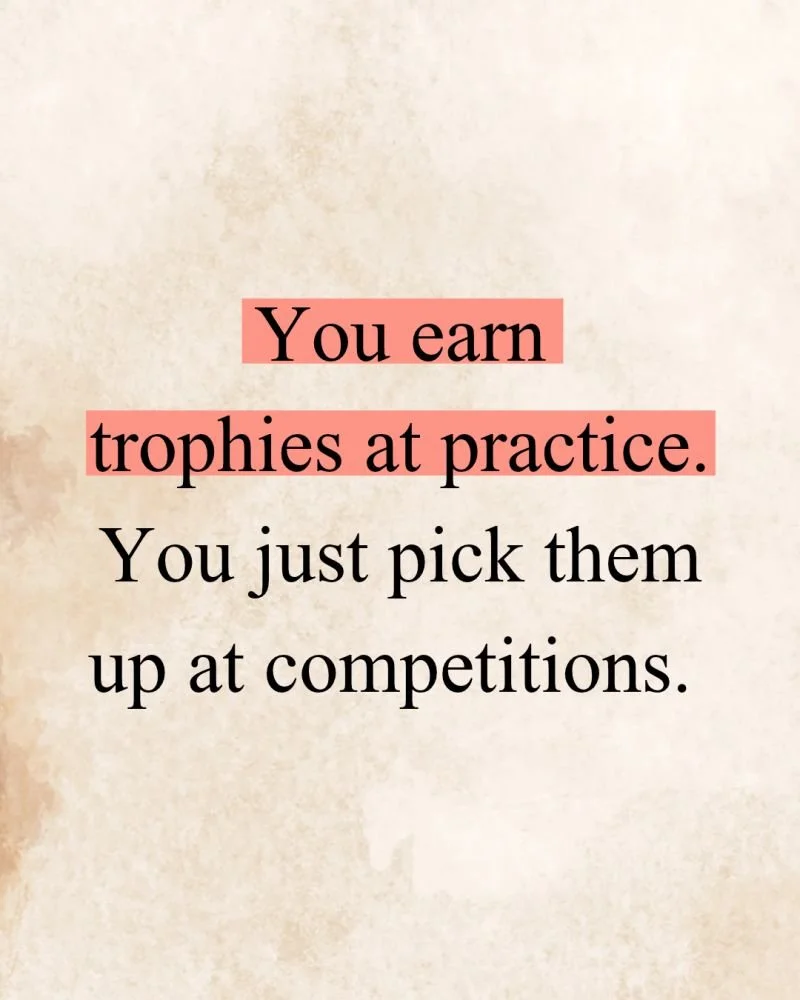
The recognition happens in public. Much of the preparation happens in private.
What the Quote Really Means
The message isn't that competition is irrelevant.
Competition matters.
It tests your preparation.
It exposes weaknesses.
It reveals how you respond to pressure.
And sometimes it teaches you things that practice cannot fully reproduce.
But the moment of performance is usually not the best place to develop an entirely new skill.
Imagine a basketball player practicing free throws.
During training, the player can adjust technique.
Repeat the movement.
Receive coaching.
Identify problems.
And try again.
During the final seconds of a close game, the priority changes.
There may be no opportunity to experiment with a completely new shooting motion.
The player needs to execute.
The same distinction applies to a musician.
A pianist can stop midway through a difficult passage during rehearsal.
Repeat it slowly.
Identify the problem.
Correct the movement.
And gradually increase the difficulty.
During a concert, the pianist has a different objective.
Perform the music.
Preferably without stopping in front of 800 people to announce that the fourth measure needs additional work.
Practice Is Where You Build Capacity
The purpose of good practice is to improve what you're capable of doing.
A competition or public performance gives you an opportunity to demonstrate that capability.
And ideally, the improvement becomes visible.
But the result can never be guaranteed.
An opponent may perform exceptionally well.
Unexpected circumstances may arise.
A small error may have enormous consequences.
And sometimes people who prepared thoroughly still lose.
That doesn't make the preparation meaningless.
Practice improves your capacity to perform. Competition reveals what happened when that capacity met a particular challenge.
That is a stronger and more realistic interpretation of the quote than assuming every hour of work produces a predetermined reward.
Because the world doesn't distribute trophies according to a perfectly fair attendance system.
If it did, the person who stayed latest at the office would be the most successful executive.
And anyone who has attended a corporate strategy meeting knows this is not necessarily true.
The Psychology of Practice: What the Research Actually Says
The idea that excellence develops through structured practice has a substantial history in psychology.
In 1993, psychologists K. Anders Ericsson, Ralf Krampe, and Clemens Tesch-Römer published an influential paper in Psychological Review titled The Role of Deliberate Practice in the Acquisition of Expert Performance.
Their work emphasized that expert performance often develops through sustained, effortful training designed specifically to improve skills.
The important phrase is designed to improve.
Not simply repeated.
Not merely performed for a long time.
And not necessarily enjoyable.
The researchers distinguished deliberate practice from work, play, and public performance.
Those activities can be valuable.
But they don't always create the same opportunities for focused improvement.
Doing Something Frequently Isn't Necessarily Practicing It
Imagine someone who has given the same sales presentation for ten years.
They know every slide.
They have memorized the opening.
They can explain the company's services without looking at their notes.
They are experienced.
But are they improving?
Perhaps.
Perhaps not.
If the presentation has never been critically evaluated, the person may simply be repeating the same ineffective habits.
Now imagine a colleague who practices one difficult part of the presentation each week.
They test how clearly they explain the firm's value.
Ask for useful feedback.
Review audience questions.
And improve the parts that create confusion.
The second person might spend less time presenting overall but more time deliberately improving.
Experience and improvement are not identical.
Which is inconvenient.
Because most professional biographies are excellent at describing the former.
And much less interested in proving the latter.
But Practice Isn't Everything—and the Science Is Clear About That
Here's where motivational writing sometimes gets carried away.
You'll hear claims like:
"Success is 100% practice."
"Talent doesn't matter."
"Anyone can become the best if they work hard enough."
Those statements are emotionally appealing.
They are not established scientific conclusions.
In a 2014 meta-analysis published in Psychological Science, researchers Brooke Macnamara, David Hambrick, and Frederick Oswald examined the relationship between deliberate practice and performance across multiple fields.
The study found that deliberate practice accounted for approximately:
26% of measured performance variation in games.
21% in music.
18% in sports.
4% in education.
Less than 1% in the professional domains included.
These figures describe statistical associations across the studies reviewed.
They do not mean that practicing improves an individual's sports performance by exactly 18%.
And they don't imply that practice is unimportant in professional settings.
The findings illustrate something more nuanced.
Practice matters, but performance is shaped by more than the amount of practice someone completes.
Prior experience.
Physical characteristics.
Training quality.
Coaching.
Opportunity.
Motivation.
Health.
Resources.
And many other circumstances can influence outcomes.
That's important because a good motivational message should encourage action without pretending that everyone begins with identical resources or faces identical conditions.
The quote is powerful precisely because it directs attention toward something people can influence.
Their preparation.
But preparation is a source of possibility.
Not a guarantee of victory.
And the moment we turn the quote into a guarantee, we start blaming people for every loss as though all outcomes are perfectly controllable.
They aren't.
Even the best-prepared athlete occasionally discovers that the other team also practiced.
A deeply inconvenient feature of competition.
The Five Things That Make Practice Valuable
Let's turn the philosophy into something practical.
Not all repetition produces the same improvement.
Useful practice generally requires more intention than simply showing up.
1. A Specific Skill to Improve
"Get better" is an aspiration.
"Improve the clarity of my opening presentation" is a practice objective.
"Become a champion" is a dream.
"Correct my footwork when changing direction" is something a coach can work on.
"Grow my business" is a broad ambition.
"Improve how clearly our website explains our services to unfamiliar prospects" is a specific task.
The clearer the improvement objective, the easier it is to identify what to practice.
Replace Vague Ambition With Observable Behavior
Imagine a small business owner who wants to become a better communicator.
What exactly needs improvement?
Explaining the company's services?
Listening during discovery calls?
Presenting research?
Handling difficult questions?
Writing useful articles?
Each requires different kinds of practice.
Without clarity, the person may spend months working hard without knowing which capability is developing.
They are busy.
Possibly exhausted.
But the effort lacks a defined direction.
It's the professional equivalent of going to the gym, walking around the equipment with a determined expression, and telling everyone you're training for something important.
That might be true.
But eventually, it helps to know what.
2. Repetition With Feedback
Practice needs opportunities to correct errors.
Otherwise, repetition can reinforce mistakes.
Consider a tennis player who repeatedly uses an inefficient technique.
Performing the movement thousands of times doesn't automatically solve the problem.
The player may become extremely consistent at doing it incorrectly.
Feedback can help.
But feedback itself needs to be useful.
A 1996 meta-analysis by psychologists Avraham Kluger and Angelo DeNisi examined feedback interventions across many settings.
Their research found that feedback improved performance on average.
However, more than one-third of the feedback interventions examined were associated with worse performance.
The researchers emphasized that feedback can be less effective when it shifts attention away from the task and toward the person's self-image.
This is an important finding.
Telling someone they're brilliant doesn't necessarily help them improve.
Telling them they're terrible doesn't necessarily help either.
Useful feedback identifies something about the work that can be understood and changed.
Better Feedback Sounds Different
Instead of:
"You're bad at presentations."
Try:
"The opening takes three minutes before you explain the audience's problem. Can we make the point clearer in the first 30 seconds?"
Instead of:
"Your marketing isn't working."
Try:
"Visitors reach the services page, but relatively few continue to the contact section. Let's examine whether the offering is clear and whether the inquiry process creates unnecessary friction."
The second version gives the person something to investigate.
Practice works better when learning is possible.
Not when the main objective is to survive criticism.
3. The Ability to Start Again
A surprisingly important part of practice is tolerating imperfection.
Nobody enjoys discovering that the skill they've been working on still needs work.
It's annoying.
Sometimes embarrassing.
Occasionally infuriating.
The person who confidently announces that they've mastered a technique may discover, five minutes later, that they haven't.
The temptation is to avoid the uncomfortable part.
Practice what already feels good.
Repeat what you're already competent at.
And enjoy the reassuring sensation of success.
But targeted improvement often requires addressing weaknesses.
Practice Is Supposed to Reveal What Needs Work
If every practice session is effortless, it may not be challenging the specific skill you're trying to improve.
That doesn't mean every session should be exhausting or punishing.
It means improvement requires appropriate challenge.
And enough honesty to recognize where correction is needed.
An athlete can miss a shot during practice.
A musician can play the passage incorrectly.
A business owner can rehearse an awkward explanation.
A writer can produce a bad draft.
None of these moments needs to become a verdict on the person's worth.
They are information.
And information can guide the next attempt.
The practice environment should make improvement possible.
Not make every mistake feel like a public humiliation.
4. Consistency Over Time
Here's the part nobody wants to put on a motivational poster.
Consistency is often boring.
It doesn't always feel inspirational.
Some sessions are excellent.
Some are ordinary.
Some involve correcting the exact mistake you thought you fixed last week.
There's no dramatic soundtrack.
No slow-motion montage.
And nobody appears at the end to announce:
"Congratulations. You've officially developed discipline."
You simply return.
Again.
And again.
And gradually, under the right conditions, certain tasks may become more familiar or more reliable.
Planning Helps When Motivation Fluctuates
Psychologists Peter Gollwitzer and Paschal Sheeran examined a strategy called implementation intentions.
These are specific plans connecting a situation with an action.
For example:
"If it is Tuesday at 8 a.m., I will spend 30 minutes practicing my presentation."
Or:
"If I finish a client call, I will record one thing I could explain more clearly next time."
Their 2006 meta-analysis examined 94 independent tests and found that implementation intentions improved goal attainment, with an overall effect of approximately d = 0.65.
That does not mean a calendar plan guarantees success.
But it suggests that specifying when and how to act can help translate intentions into behavior.
The important lesson is simple.
Don't depend entirely on feeling motivated.
Create reasonable conditions that help you follow through.
Because motivation can be wonderful.
It can also disappear on Wednesday because you're tired and the weather is unpleasant.
A workable plan is less interested in the weather.
5. Recovery and Perspective
This is where the quote needs an important qualification.
Practice does not mean working without rest.
More effort isn't always better.
And exhaustion is not proof that improvement is occurring.
The American Academy of Pediatrics' 2024 clinical report on overtraining and burnout in young athletes explains that excessive training without sufficient recovery can increase injury risk and contribute to physical and psychological strain.
That guidance addresses young athletes specifically.
It should not be treated as an exact training prescription for adults or every profession.
But the broader lesson is reasonable.
Human beings need recovery.
Rest Is Not the Opposite of Preparation
An athlete needs time to recover.
A musician needs breaks during demanding practice.
A founder may need time away from work to make clearer decisions.
A writer may return to a difficult draft with a fresh perspective.
The goal is sustainable improvement.
Not proving dedication by remaining busy every waking hour.
A person who practices thoughtfully four days a week may accomplish more than someone who works without direction seven days a week.
The outcome depends on the activity and individual.
But the principle is worth remembering.
Discipline isn't the same as refusing to rest. It's organizing effort so improvement can continue.
A particularly useful message for business owners who treat answering emails at 11:47 p.m. as a competitive advantage.
Sometimes it's simply a scheduling problem.
What Happens When Practice Meets Pressure?
Now let's return to competition.
You can practice something successfully and still struggle when it matters.
A musician may play a piece beautifully in rehearsal.
Then experience intense anxiety on stage.
A basketball player may shoot accurately during practice.
Then miss a crucial free throw.
A business owner may explain a proposal perfectly in an empty conference room.
Then become nervous when six senior executives begin asking difficult questions.
That doesn't necessarily mean the practice was useless.
It means public performance introduces additional demands.
Pressure Is Its Own Skill to Prepare For
A 2026 position statement from Exercise and Sports Science Australia examined evidence about performing under pressure in sport.
It emphasized the importance of attention, preparation, psychological strategies, and training environments that appropriately reflect competitive demands.
The statement also discussed pressure training—practice designed to expose athletes to controlled elements of stressful performance situations.
The guidance stresses careful implementation and warns against excessive pressure that may harm well-being.
This research is sport-specific.
It doesn't establish that every business meeting should be treated like an Olympic final.
But the underlying idea can be adapted thoughtfully.
Sometimes practice should resemble the situation in which the skill will be used.
Don't Rehearse Only in Perfect Conditions
If you're preparing for a major presentation, don't merely read the slides in silence.
Practice explaining the main point aloud.
Have someone ask difficult questions.
Rehearse what you'll do if you lose your place.
Practice answering without becoming defensive.
If you're preparing for a competitive athletic event, your coach may introduce appropriate conditions that resemble competition.
If you're launching a business website, test it with people who don't already understand the company.
If you're writing an important proposal, ask someone unfamiliar with the project to explain what they think you're offering.
The point is not to create unnecessary stress.
It's to discover weaknesses before they become expensive.
Because it's easier to find out that your presentation is confusing when the audience consists of two supportive colleagues.
Finding out during a $250,000 proposal meeting is considerably more memorable.
And perhaps less enjoyable.
Why the World Rewards the Performance but Rarely Sees the Preparation
There is a psychological reason the quote feels so familiar.
We tend to encounter other people's results.
Not their complete development process.
We see the business announcement.
The award.
The book launch.
The championship.
The impressive presentation.
The social media post celebrating a milestone.
We don't see every ordinary decision that preceded it.
And we certainly don't see all the moments when the person considered stopping.
Success Has Excellent Public Relations
Nobody publishes a press release announcing:
"Local Entrepreneur Completes Forty-Third Consecutive Week of Improving Their Service Descriptions."
There are no photographers.
No champagne.
No business journal feature.
The entrepreneur is simply working.
But one day, the business may receive recognition.
Now the story becomes interesting.
The founder is invited onto a podcast.
The interviewer asks:
"What's the secret to your success?"
The founder has approximately thirty seconds to explain seven years of work.
So they say something memorable about believing in yourself.
Wonderful.
But the explanation is incomplete.
The actual history probably involved repeated work, changing circumstances, help from other people, mistakes, learning, and opportunities.
The public story is shorter.
Much shorter.
And usually accompanied by a photograph of the founder leaning against a glass conference room wall.
Success looks remarkably elegant in professional photography.
The preparation is considerably less photogenic.
Comparing Your Practice to Someone Else's Trophy Is Misleading
This is one of the most important personal lessons.
When you're learning something, you experience every error.
You see every unfinished attempt.
Every mistake.
Every awkward beginning.
Then you look at someone else's polished result and assume their process must have been smoother.
It probably wasn't.
But you aren't seeing the same stage of development.
You're comparing your private practice with their public performance.
A misleading comparison.
And one that can discourage people from continuing exactly when continued learning would be useful.
The solution isn't to believe every successful person struggled in precisely the same way.
We don't know that.
It's to recognize that a visible result doesn't tell the full story.
And your current learning process shouldn't be judged as though it were already the final performance.
What This Quote Means for Business Owners
Let's move from sports to business.
Because the metaphor becomes surprisingly useful.
Imagine two businesses.
Both want to attract better clients.
Both want stronger marketing.
Both want a recognizable brand.
Both want to become more credible in their industry.
Business A concentrates on the visible result.
More leads.
More awards.
More followers.
More publicity.
More impressive case studies.
Business B also wants those outcomes.
But it pays attention to the capabilities that make them possible.
Clear service positioning.
Useful content.
A website that answers customer questions.
A consistent research and publishing process.
Thoughtful follow-up.
Reliable delivery.
And an understanding of what customers actually need.
Which business is guaranteed to win?
Neither.
Markets are competitive.
Resources differ.
And business outcomes are influenced by many factors.
But the second organization is investing in things it can improve deliberately.
Rather than relying exclusively on the hope that recognition will arrive.
Winning the Client Is the Competition. Building Trust Is the Practice.
A qualified customer inquiry is a visible event.
The prospect completes a form.
Calls the business.
Requests a proposal.
Or signs a contract.
Everyone celebrates.
But that moment may have been developing for months.
The customer might have encountered a useful article.
Read several research reports.
Visited the website.
Compared providers.
Shared information with colleagues.
And formed an opinion before contacting the company.
The final inquiry is visible.
Much of the preparation happened earlier.
That's why effective marketing is often cumulative.
A business doesn't become credible only when a prospect decides to purchase.
It develops the information, experience, and reputation that help relevant people evaluate it.
The contact form is where the opportunity becomes visible. The preparation is what makes the business worth contacting.
Of course, not every inquiry comes from a long process.
Some customers have urgent needs.
Others arrive through referrals.
But the metaphor remains useful.
The business can invest in the capabilities that support good outcomes.
Even when those efforts don't generate immediate applause.
Your Website Is a Practice Field, Not Just a Trophy Case
Here's a marketing mistake worth examining.
Many businesses treat their websites as displays of past accomplishments.
Awards.
Testimonials.
Leadership photographs.
Impressive logos.
Announcements about excellence.
And a homepage describing the company's extraordinary commitment to delivering transformative solutions.
The business looks successful.
Wonderful.
But can a potential customer understand what it actually does?
Who it serves?
What problems it solves?
How the process works?
And why its expertise is relevant?
Those questions matter.
A website should certainly communicate credibility.
But it should also help people make decisions.
Improve the Experience Before Celebrating the Conversion
Practice in digital marketing can involve reviewing the site's structure.
Clarifying confusing language.
Testing important forms.
Making research easier to find.
Improving page performance.
Publishing genuinely useful material.
And studying the questions prospective clients ask.
These tasks are not glamorous.
Nobody throws a party because the services page finally explains the offering in plain English.
But a visitor who understands the business is in a better position to evaluate it.
That can matter more than another paragraph announcing that the company is a leader in innovative excellence.
Which raises an interesting question.
If every company is an industry leader, who exactly is following?
Perhaps the answer is in the next quarterly marketing report.
SEO Is One of the Clearest Examples of Practicing Before the Trophy
Search visibility can take sustained work.
A business may need to improve website organization.
Publish useful content.
Correct technical issues.
Build meaningful internal links.
Clarify its expertise.
And evaluate what relevant people are searching for.
The visible outcome might be an increase in qualified organic traffic.
Or a new inquiry.
Or recognition of an original research article.
But those results don't necessarily appear immediately after the work is completed.
And they aren't guaranteed.
A useful SEO strategy involves repeated assessment and improvement.
Not publishing one article and expecting Google to reward the organization with an enterprise client by Thursday.
The same principle applies to email marketing, content distribution, and customer experience.
The preparation includes developing a useful system.
The visible outcomes are opportunities to evaluate whether that system is working.
The Award Isn't the Strategy
A business award can be meaningful.
A positive testimonial can be useful.
An impressive client win can deserve celebration.
But the recognition should not become a substitute for the work that supports future results.
Your customers are not buying your trophy.
They're buying the value your business can deliver.
And maintaining that value may require continued improvement long after the award ceremony ends.
The trophy belongs on the shelf.
The practice should remain on the calendar.
What This Quote Means for Creators, Writers, and Professionals
The principle also applies to creative work.
Consider a writer.
The published article is the performance.
The drafts are the practice.
The sentences removed.
The structure reconsidered.
The research verified.
The confusing argument rewritten.
And the introduction that took three hours to produce before being deleted in seven seconds.
The reader sees the finished piece.
The writer remembers the process.
A Finished Piece Often Hides a Difficult Beginning
Good writing can appear effortless.
That doesn't mean it was.
A polished article may have required extensive revision.
A compelling speech may have been practiced repeatedly.
A strong design may have emerged after several rejected versions.
A successful presentation may be supported by dozens of awkward attempts.
The important lesson isn't that every task should take a long time.
It's that revision and correction are legitimate parts of producing good work.
Not evidence that you're incapable.
Practice the Component That Needs Improvement
A writer struggling with openings might practice introductions.
A designer struggling with hierarchy might study and test layout decisions.
A speaker who loses the audience during technical explanations can rehearse making complex material understandable.
A salesperson who becomes defensive when questioned can practice listening and responding.
The objective is to improve a particular capability.
Not merely complete more work.
This echoes the deliberate-practice distinction.
Simply producing something repeatedly doesn't guarantee improvement.
A targeted effort to understand and correct weaknesses can be more useful.
And unlike the motivational posters suggest, the answer isn't always to work harder.
Sometimes it's to work differently.
A less dramatic message.
But considerably more actionable.
How to Build a Practice Habit That Actually Supports Improvement
Now let's make this practical.
You don't need to be an elite athlete.
You don't need a professional coach for every skill.
And you don't need to wake up at 4:30 a.m. unless your schedule actually requires it.
The goal is to develop a useful approach to getting better.
Step One: Name the Performance You Care About
What do you want to do more effectively?
Give presentations?
Write?
Compete?
Communicate?
Lead a team?
Run your business?
Be specific.
A useful goal describes something observable.
Not merely an identity you want to acquire.
Step Two: Identify the Weakest Relevant Component
What makes the task difficult?
Perhaps the speaker understands the subject but struggles to explain it simply.
Perhaps the athlete has good technique but finds competitive situations stressful.
Perhaps the business produces excellent research but has difficulty making it discoverable.
The point is to identify the bottleneck.
Don't spend every practice session repeating the part you're already good at.
Step Three: Design a Repeatable Exercise
Create a manageable practice task.
A speaker might rehearse answering one difficult question.
A writer might revise one paragraph for clarity.
A business owner might test one explanation of the company's services.
An athlete might work on one technical movement under appropriate coaching.
The task should be relevant to the desired improvement.
Step Four: Decide How You Will Evaluate It
What would count as progress?
Greater accuracy?
Clearer explanations?
Fewer repeated mistakes?
Better execution under realistic conditions?
More reliable completion?
Select measures appropriate to the skill.
Not every meaningful improvement can be reduced to a single number.
But the evaluation should be more useful than merely saying, "I felt productive."
Step Five: Get Appropriate Feedback
Ask for feedback connected to the task.
Use qualified coaches, mentors, colleagues, or actual user behavior where appropriate.
Avoid treating every opinion as equally informative.
And look for feedback that helps identify the next improvement.
The goal is learning.
Not collecting praise.
Step Six: Practice Again, Then Adjust
Review what happened.
Keep what worked.
Change what didn't.
And repeat the process.
This is where consistency matters.
But consistency should include learning.
Performing an ineffective routine every week is not necessarily discipline.
Sometimes it's stubbornness with a calendar invitation.
A 30-Day Practice Challenge
If the quote inspires you, here's a simple way to apply it.
The following is a practical planning exercise, not a scientifically validated training program.
Adapt it to your goals, health, schedule, and experience.
Week One: Identify What Needs Work
Choose one meaningful skill.
Define what successful performance would look like.
Identify a specific weakness.
Then complete several manageable practice sessions.
Don't attempt to transform every part of your life simultaneously.
You're developing a skill.
Not launching a complete personal rebrand.
Week Two: Add Feedback
Continue practicing.
But now gather useful information.
Record your attempt where appropriate.
Ask a knowledgeable person for input.
Review errors.
Or test the result with someone who represents the real audience.
Then identify one correction to make.
The goal is to turn repetition into learning.
Week Three: Make Practice More Realistic
Introduce an appropriate version of the actual performance environment.
A speaker might practice in front of colleagues.
A writer might ask readers to evaluate clarity.
A business might test its website with unfamiliar visitors.
An athlete can work with a coach on realistic competitive conditions.
Avoid unnecessary or excessive pressure.
The objective is preparation.
Not proving that discomfort itself is valuable.
Week Four: Evaluate Progress and Plan the Next Cycle
Review the original goal.
What improved?
What remained difficult?
What feedback was useful?
What practice conditions supported progress?
What should change next?
Celebrate meaningful improvements.
And decide whether to continue, increase complexity, or shift attention to another component.
You may not have won a trophy.
That's fine.
Thirty days is not a universal deadline for excellence.
But you may have developed a more intentional way to improve.
And that habit can be worth considerably more than a burst of motivation that disappears by the following Monday.
The Uncomfortable Truth: Practice Sometimes Ends in Losing
Now let's talk about the part motivational quotes frequently leave out.
You can prepare well and still lose.
You can study and perform poorly.
You can build an excellent business and lose a contract.
You can practice for months and encounter someone better prepared.
You can follow an intelligent strategy and be affected by circumstances beyond your control.
That doesn't make practice pointless.
But it does make the relationship between preparation and success more complicated than a simple formula.
Competition Is Not a Moral Judgment
Winning doesn't automatically mean someone worked harder.
Losing doesn't automatically mean someone lacked discipline.
Different people have different resources.
Opportunities.
Training environments.
Health circumstances.
And constraints.
Some athletes have access to exceptional coaching and facilities.
Others do not.
Some entrepreneurs begin with substantial financial support.
Others are building their businesses while managing multiple jobs.
Acknowledging those differences doesn't undermine the value of practice.
It makes the message more humane and accurate.
Preparation is something you can influence. Outcomes are something you can influence, but not completely control.
That distinction matters.
Because when every loss is treated as a character failure, people can begin interpreting ordinary setbacks as evidence that they aren't worthy of success.
A more useful response is to learn from the outcome.
What was within your control?
What wasn't?
What should you adjust?
What deserves another attempt?
And what might require a different goal altogether?
Sometimes perseverance is appropriate.
Sometimes adaptation is wiser.
And sometimes stopping an unproductive pursuit is a legitimate decision.
Not every trophy is worth the cost of chasing it.
Why Quiet Progress Deserves More Respect
Here's something worth remembering.
Not every important improvement produces public recognition.
A business owner may learn to communicate more clearly.
A manager may become better at listening.
An athlete may improve a technical weakness.
A writer may develop stronger research habits.
A person may learn to remain composed during difficult conversations.
These accomplishments may not generate awards.
But they can change how the person performs.
And that is meaningful.
The Process Is Worth Evaluating, Not Just the Result
A trophy can be a wonderful symbol.
It marks a moment.
An achievement.
A competitive result.
Sometimes years of dedication.
But the skills developed along the way don't disappear when the competition ends.
The discipline.
The knowledge.
The ability to evaluate mistakes.
The experience of working toward a difficult goal.
Those capabilities can remain useful.
And that's one reason the metaphor resonates.
The most enduring benefit of preparation isn't necessarily the object someone hands you at the end.
It's what you've learned to do.
Although the trophy is nice.
And looks considerably better on a shelf than the notebook containing 84 pages of practice corrections.
The Real Competition Might Be With Yesterday's Version of Yourself
Let's end with a different perspective.
Sometimes the most useful comparison isn't with another person.
It's with your own previous performance.
Are you communicating more clearly than six months ago?
Do you handle setbacks more constructively?
Have you improved a skill that used to intimidate you?
Are you making better decisions?
Have you developed a more reliable process?
Have you become more thoughtful in how you approach your work?
These are meaningful questions.
Not because external competition doesn't matter.
It does.
But because not every measure of progress needs to involve defeating someone else.
An athlete can improve a personal best without winning the event.
A creator can produce stronger work without receiving an award.
A business can improve its customer experience without appearing on an industry ranking.
And a person can develop a valuable capability without anyone else noticing.
Build Something That Lasts Beyond the Applause
The applause fades.
The event ends.
The photographs get uploaded.
The awards ceremony concludes.
And eventually, it's Monday again.
Now what?
If the only goal was the visible recognition, the return to ordinary work may feel disappointing.
But if the deeper goal was improvement, Monday has a purpose.
Another opportunity to learn.
Another opportunity to refine.
Another opportunity to prepare.
Not because every week must be a heroic demonstration of discipline.
But because meaningful progress often develops through ordinary, repeatable actions.
The kind nobody applauds.
Until something happens that makes the effort visible.
And sometimes, even then, the preparation remains the most important part of the story.
In Conclusion: The Trophy Is a Moment. The Preparation Is a Process.
Let's return to the athlete on the podium.
The crowd is applauding.
The trophy is presented.
The cameras flash.
The athlete smiles.
And everyone sees the result.
But the athlete remembers the practice.
The difficult sessions.
The corrections.
The repetitions.
The rest.
The support.
The setbacks.
And the moments when improvement seemed painfully slow.
The award is real.
The recognition matters.
But it doesn't tell the entire story.
The same is true in business.
A major client win may reflect months of relationship-building.
A successful article may reflect years of learning how to communicate.
A respected brand may have developed through repeated delivery of useful work.
And a confident presentation may be supported by hours of rehearsal that nobody ever witnessed.
Those outcomes aren't guaranteed by preparation.
But preparation can make better performance more possible.
And that's the lasting truth inside the quote.
You earn trophies at practice. You just pick them up at competitions.
Not because every practice session guarantees a victory.
Not because the hardest-working person always wins.
And not because rest, support, or circumstances don't matter.
But because the moment people celebrate is often supported by countless moments they never saw.
So do the work that matters.
Practice deliberately.
Ask for useful feedback.
Protect your ability to recover.
Improve what needs improvement.
And stop expecting every worthwhile action to come with immediate recognition.
There may be no audience today.
No medal.
No congratulations.
No photographer.
Just you, a skill that needs work, and the opportunity to get a little better.
That may not feel like winning.
But it can be part of becoming more capable of it.
And someday, when you're standing in a moment you've worked toward for months or years, you may realize that the most important part happened long before anyone handed you an award.
The trophy was presented in public. Much of the growth happened in private.
And maybe that's what deserves the most respect.
Ritner Digital: The Same Principle Applies to Building a Business
At Ritner Digital, we believe sustainable marketing results often depend on the work that happens before a prospect is ready to become a customer.
The research.
The content strategy.
The website improvements.
The clear messaging.
The thoughtful distribution.
And the consistent effort to help the right people understand the value a business provides.
A successful marketing outcome is worth celebrating.
But the process behind it matters.
A strong website doesn't become useful merely because it looks impressive.
A research article doesn't become discoverable simply because it's published.
And a company doesn't build a trusted digital presence through one dramatic campaign.
Through SEO, AI search visibility, content strategy, and related digital marketing, Ritner Digital helps businesses strengthen the digital foundations that support meaningful visibility and growth.
We don't promise trophies.
We don't promise overnight results.
And we definitely don't believe that working longer hours automatically creates better marketing.
We believe in thoughtful work, useful information, informed decisions, and continuous improvement.
If your business is ready to strengthen the work behind its next major opportunity, contact Ritner Digital.
Because the next big client win may be the moment everyone remembers.
But the preparation starts much earlier.
And that part deserves attention too.
Frequently Asked Questions
1. What does "You earn trophies at practice. You just pick them up at competitions" mean?
The quote emphasizes that many of the skills supporting achievement are developed before the public performance.
Practice provides opportunities for repetition, feedback, learning, and correction.
Competition is where those capabilities are tested.
The message is metaphorical; preparation increases the possibility of success but doesn't guarantee winning.
2. Why is practice important for success?
Practice can help people develop skills, improve consistency, correct mistakes, and prepare for demanding situations.
Its effectiveness depends on quality, feedback, task difficulty, recovery, and individual circumstances.
Practice is an important contributor to performance, but not the only factor influencing outcomes.
3. What is deliberate practice?
Deliberate practice is structured activity designed specifically to improve performance.
The concept was popularized through Ericsson and colleagues' 1993 research.
It emphasizes focused effort, targeted improvement, and opportunities for feedback rather than simple repetition.
4. Is practice more important than talent?
Research doesn't support a universal answer.
A 2014 meta-analysis found that deliberate practice accounted for meaningful but varying proportions of performance differences across fields.
Performance is influenced by multiple factors, including experience, individual characteristics, opportunities, and training conditions.
5. Does practicing every day guarantee improvement?
No.
Repeating an ineffective technique can reinforce errors.
Practice should be appropriate to the skill and include opportunities for evaluation.
Some activities also require recovery between sessions.
Consistency helps when paired with a useful learning process, not simply when measured by uninterrupted attendance.
6. Why do successful people often make difficult things look easy?
Highly developed skills can make complicated actions appear more controlled or fluent.
But observers usually see the finished performance rather than the process of learning.
The visible result may conceal considerable preparation.
That doesn't mean every successful person had the same developmental experience.
7. Can you practice hard and still lose?
Yes.
Competition involves other performers, unexpected circumstances, and factors outside any individual's control.
Preparation can improve capability without guaranteeing a particular result.
A loss may provide useful information, but it isn't automatically evidence of inadequate effort.
8. What is the difference between practice and experience?
Experience means having performed an activity or encountered relevant situations.
Practice, particularly deliberate practice, involves activities specifically designed to improve performance.
Repeated experience can contribute to learning, but simply performing the same task for years doesn't ensure continued improvement.
9. Why is feedback important during practice?
Feedback can help identify errors and guide correction.
However, its effectiveness depends on content and delivery.
A 1996 meta-analysis found that feedback improved performance on average, but more than one-third of studied interventions were associated with worse performance.
Specific, task-relevant information is generally more useful than vague personal judgment.
10. How can I practice more consistently?
Choose a manageable skill, define an appropriate exercise, and plan when you'll perform it.
Research on implementation intentions suggests that specific if-then plans can support goal-directed behavior.
For example: "If it's Tuesday at 8 a.m., I'll practice my presentation for 20 minutes."
Consistency should also allow for changing circumstances and necessary recovery.
11. Is it better to practice longer or practice smarter?
The answer depends on the skill and training conditions.
Longer practice can be useful when it provides appropriate repetition and learning.
But focused practice with relevant feedback may be more productive than simply accumulating hours.
Quality and quantity are both worth considering.
12. How do you prepare for performing under pressure?
Preparation may include practicing relevant skills under gradually more realistic conditions, developing appropriate routines, and learning strategies for managing attention.
A 2026 sports science position statement discusses these approaches for athletes.
Pressure training should be introduced carefully and adapted to the individual and situation.
13. Why is rest important when trying to improve?
Recovery can help manage fatigue and reduce the risks associated with excessive training.
The American Academy of Pediatrics warns that inadequate recovery in young athletes can contribute to overuse injuries and burnout.
Appropriate rest requirements depend on the activity and person.
14. How does this quote apply to entrepreneurs?
For business owners, practice may involve improving communication, service delivery, customer understanding, planning, and marketing.
A visible win may be supported by earlier work that made the business easier to trust or evaluate.
However, business outcomes also depend on demand, resources, competition, and external conditions.
15. What does practice look like in marketing?
It can include improving website messaging, evaluating content usefulness, testing user experiences, strengthening internal processes, and studying audience needs.
The objective is to improve marketing capabilities through informed, repeated work.
A successful campaign may reflect those capabilities, but no amount of practice guarantees a specific ranking or conversion result.
16. How can writers and creators apply the quote?
They can treat drafting, revision, research, rehearsal, and feedback as opportunities to improve.
Rather than judging every early attempt against a finished professional work, they can identify specific skills to develop.
The public result may be important, but the process can create capabilities that carry into future projects.
17. How do I know if my practice is working?
Look for changes in performance relevant to the skill.
These might include improved accuracy, clarity, consistency, control, or ability to respond to difficult situations.
Use appropriate feedback and realistic comparisons over time.
Avoid relying exclusively on how busy or motivated you feel.
18. What if nobody recognizes the work I'm putting in?
Lack of recognition doesn't automatically mean the effort lacks value.
But it's worth evaluating whether the work is improving a meaningful skill, whether your goals still fit your circumstances, and whether the environment provides a fair opportunity to use that skill.
Recognition can matter, but it's not the only measure of progress.
19. Is discipline more important than motivation?
Discipline and motivation can both contribute to pursuing goals.
Motivation may fluctuate, while specific routines and plans can make useful action more reliable.
Neither guarantees success.
The goal is to establish a sustainable practice process appropriate to the individual and activity.
20. What's the biggest lesson in this quote?
The central lesson is to respect the process behind visible success.
Public achievements may be memorable, but many valuable skills develop through repeated, thoughtful preparation.
Focus on what you can improve, seek useful feedback, allow for recovery, and remember that effort is meaningful even when the outcome isn't guaranteed.
The applause belongs to the moment. The preparation belongs to everything that made the moment possible.