Cleveland Local SEO: How to Rank Across the City and Suburbs
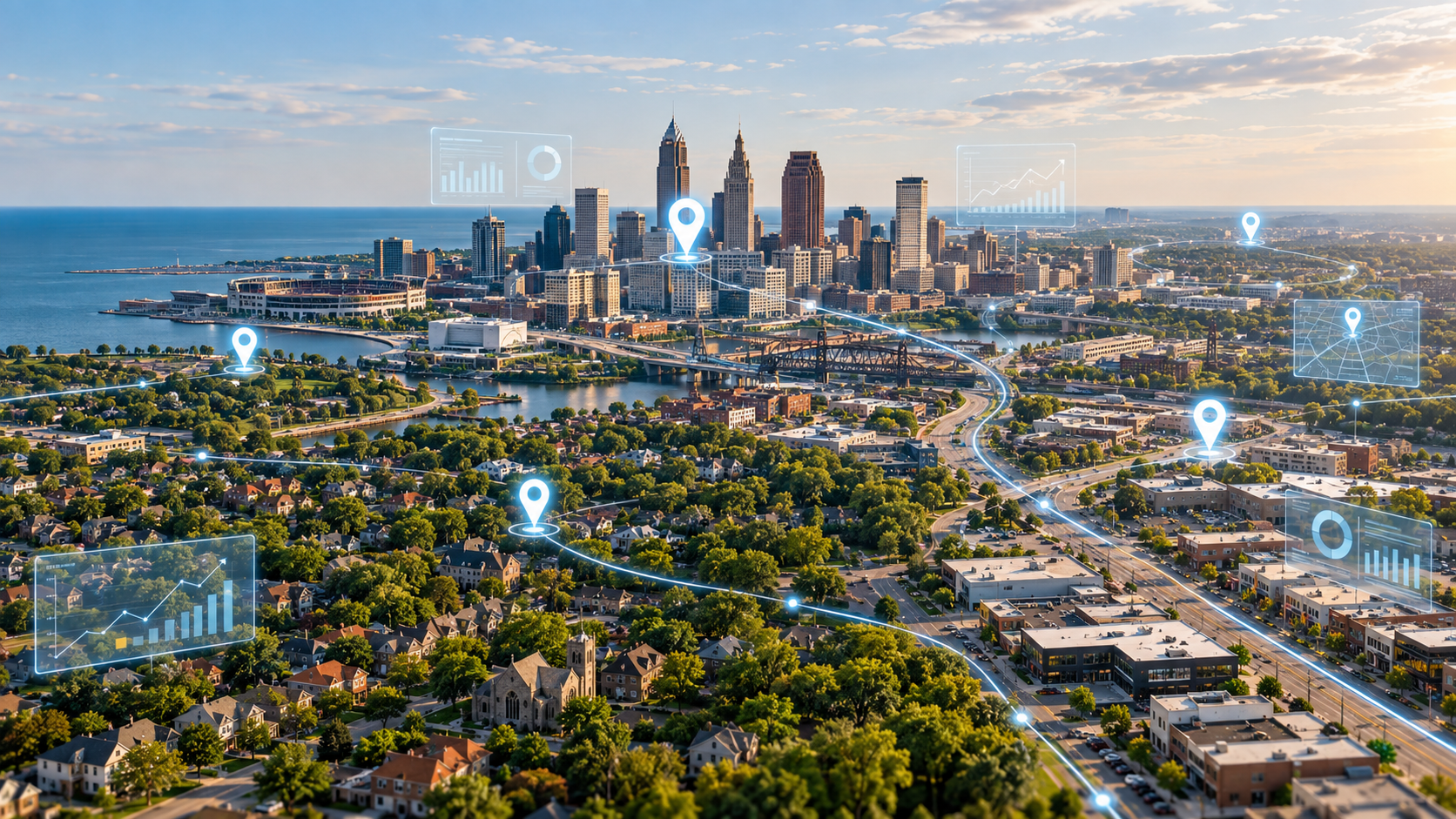
Ranking for local searches in Cleveland is one thing.
Ranking across Cleveland and the surrounding suburbs is another.
A business might appear prominently when someone searches near Downtown Cleveland but barely show up when the same search is performed in Lakewood, Parma, Westlake, Cleveland Heights, Shaker Heights, Strongsville, or another nearby community.
That does not necessarily mean your SEO is failing.
It is a consequence of how local search works.
Google states that local results are primarily based on relevance, distance, and prominence. Distance specifically considers how far a potential search result is from the location used in the search.
That means proximity creates a challenge for any Cleveland business trying to generate customers across a larger geographic area.
You cannot simply add every suburb to your Google Business Profile and expect to rank first everywhere.
You also should not create dozens of nearly identical city pages and swap "Cleveland" for "Lakewood," "Parma," or "Westlake."
A stronger Cleveland local SEO strategy builds geographic relevance through a combination of:
Google Business Profile optimization
Strong service pages
Useful location content
Reviews
Local backlinks
Internal linking
Accurate business information
Local authority
Technical SEO
Geographic rank tracking
A website that demonstrates genuine experience throughout the market
This guide explains how to build that strategy.
What Is Local SEO?
Local SEO is the process of improving your business's visibility when people search for products or services in a particular geographic area.
For a Cleveland company, that might involve searches such as:
plumber Cleveland Ohio
Cleveland roofing company
dentist Cleveland
HVAC repair Cleveland
personal injury lawyer Cleveland
Cleveland digital marketing agency
electrician near me
SEO company Cleveland Ohio
restaurant near me
landscaper Cleveland
Local search can appear in several places.
These include:
Google Maps
The local map pack
Traditional organic search results
Google Business Profiles
Mobile search
Other local discovery platforms
Google remains an especially important local discovery channel.
BrightLocal's 2026 consumer search research found that 84% of surveyed U.S. consumers had searched online for a local business during the previous three months. The study also found that most local searches happened on mobile devices and that consumers commonly used multiple platforms during the decision process.
For a Cleveland business, local SEO is therefore not simply about ranking a website.
It is about making the entire local presence easier for customers and search engines to understand.
Why Ranking Across Cleveland Is Different From Ranking in One Location
Imagine that you operate an HVAC company based in Cleveland.
You may serve:
Cleveland
Lakewood
Parma
Rocky River
Westlake
Cleveland Heights
Shaker Heights
Strongsville
Beachwood
North Olmsted
Independence
Broadview Heights
From a business perspective, these communities may all be part of your service area.
From Google's perspective, however, each search takes place from a particular location.
Someone searching for "furnace repair near me" in Lakewood may see different businesses from someone performing the same search in Beachwood.
That is because local rankings are personalized geographically.
Google states that when a user does not specify a location in the query, it can calculate distance based on what it knows about the searcher's location.
So your rankings are not one fixed position.
They can change block by block, neighborhood by neighborhood, and suburb by suburb.
This is one of the most important concepts to understand about local SEO in Cleveland, Ohio.
Google's Three Core Local Ranking Concepts
Google publicly describes three main concepts behind local results:
Relevance
Relevance measures how closely a business matches what someone is searching for.
If someone searches:
commercial roofing Cleveland
Google needs to understand whether your company actually provides commercial roofing.
Your:
Business category
Services
Website content
Page titles
Business description
Landing pages
Reviews
Other online information
can all help establish what your business does.
Google specifically recommends maintaining complete and accurate Business Profile information so it can better understand a business and match it with relevant searches.
Distance
Distance considers how far the business is from the searcher's location or the place named in the query.
You have limited control over this factor.
A business located in Westlake cannot optimize its way into physically being located in Cleveland Heights.
This is why a local strategy needs to focus on maximizing the signals you can control.
Prominence
Prominence reflects how well-known or established a business appears.
Google says its local systems can consider information found around the web, including links and reviews.
Prominence may therefore be strengthened through:
Genuine customer reviews
Relevant backlinks
Local press
Business directories
Industry associations
Community involvement
Strong organic rankings
Brand searches
Online mentions
The strongest local SEO campaigns address all three concepts rather than focusing on one tactic.
1. Start With Your Real Cleveland Business Location
Where your business is physically located matters.
Third-party local SEO research consistently identifies proximity as an important Maps factor.
Whitespark's 2026 Local Search Ranking Factors survey ranked proximity of the business address to the searcheramong the strongest perceived Local Pack and Maps factors. The survey also highlighted primary Google Business Profile category and whether the business is physically located within the searched city.
Whitespark's report is expert survey research rather than a disclosure of Google's actual algorithm, but its findings are consistent with Google's own acknowledgement that distance matters.
This has practical implications.
A business physically located near Downtown Cleveland may have a geographic advantage for nearby searches.
The same business may find it more difficult to compete in:
Westlake
Strongsville
Beachwood
Solon
North Olmsted
That does not mean those markets are impossible.
It means your strategy outside your immediate location may need to rely more heavily on organic search, local authority, content, reviews, and brand prominence.
2. Optimize Your Google Business Profile Completely
For a Cleveland local business, your Google Business Profile should be one of the first assets you optimize.
Google recommends providing complete and accurate information.
Review:
Business name
Address
Phone number
Website
Primary category
Secondary categories
Business hours
Holiday hours
Services
Products where relevant
Business description
Photos
Videos
Service areas
Other applicable attributes
Every field should reflect the actual business.
Do not optimize your profile by inventing information.
The goal is clarity, not manipulation.
3. Choose the Most Accurate Primary Category
Your primary Business Profile category is one of the strongest ways to communicate what your company actually is.
Google instructs businesses to use as few categories as necessary and choose categories that accurately represent the company's core activity.
If you operate an HVAC company, choose the most specific appropriate HVAC-related category available.
If you are a roofer, do not use a broader construction category when an accurate roofing category better describes your main business.
If you are a law firm, your category should accurately represent the practice.
Do not select unrelated categories solely because you want visibility for additional searches.
Whitespark's 2026 survey placed the primary GBP category at the top of its expert ranking-factor list for Local Pack and Maps visibility.
Again, that is industry research rather than an official Google ranking formula, but it reinforces the importance of getting the category right.
4. Add the Services You Actually Provide
Google Business Profiles for many service businesses allow companies to list individual services.
Google says customers searching for a service you offer may see that service highlighted on your profile. Businesses can add suggested services as well as eligible custom services.
A Cleveland plumbing company might include:
Drain cleaning
Water heater repair
Water heater installation
Sewer repair
Faucet installation
Toilet repair
Emergency plumbing
A Cleveland SEO company might include:
Local SEO
Technical SEO
SEO audits
Google Business Profile optimization
Keyword research
Content marketing
Link building
Use the service editor as a factual description of your offerings.
Do not turn it into a keyword-stuffing exercise.
5. Configure Service Areas Correctly
This is especially important for:
Plumbers
Electricians
Roofers
HVAC companies
Landscapers
Contractors
Cleaning businesses
Pest control companies
Mobile services
Google currently allows eligible service-area and hybrid businesses to specify up to 20 service areas.
These can be based on cities, postal codes, or other supported geographic areas. Google also recommends keeping the overall area within roughly two hours of driving time from the business's base.
A Cleveland-area service business could therefore list legitimate areas it serves.
For example:
Cleveland
Lakewood
Parma
Westlake
Rocky River
Cleveland Heights
Shaker Heights
Strongsville
Beachwood
North Olmsted
But there is an important distinction:
Adding a city as a service area does not give you a physical location in that city.
It does not neutralize the distance factor.
It tells customers where you provide services.
That is useful, but it should not be confused with a guaranteed ranking advantage.
6. Do Not Create Fake Offices in Cleveland Suburbs
One tempting strategy is to rent inexpensive addresses throughout Greater Cleveland.
For example:
A mailbox in Lakewood
A virtual office in Westlake
An unstaffed suite in Parma
A coworking address in Beachwood
Then the business creates a Google Business Profile at each location.
That can create serious problems.
Google says Business Profiles should represent actual real-world locations. P.O. boxes and remote mailboxes are not acceptable business addresses, and virtual offices are generally ineligible. Coworking spaces have additional eligibility requirements, including clear signage, customer access, and staffing by the business during stated hours.
Google also says there should generally be only one profile for each real business location.
If you genuinely open a staffed Lakewood office where customers can visit and it meets Google's rules, that is different.
But creating addresses primarily to manipulate geographic visibility is risky.
7. Build a Strong Cleveland Service Page Architecture
Your website should make it easy for Google to understand the relationship between:
Service + Location
One of the strongest structures for a local business is to begin with detailed service pages.
For example, an HVAC website might contain:
Furnace Repair
Furnace Installation
AC Repair
AC Installation
Boiler Repair
Commercial HVAC
A roofing business might contain:
Roof Repair
Roof Replacement
Commercial Roofing
Metal Roofing
Flat Roofing
Storm Damage Repair
A marketing company might contain:
Local SEO
Search Engine Optimization
Google Ads
Website Design
Social Media Marketing
Content Marketing
Each page should thoroughly explain the individual service.
This gives Google a strong understanding of your core offerings before you begin adding geographic relevance.
Whitespark's 2026 industry survey ranked having a dedicated page for each service as the strongest factor in its local organic ranking section.
8. Create a Strong Cleveland Landing Page
If Cleveland is your primary market, you may benefit from a dedicated Cleveland page.
Depending on your site's architecture, that could be:
/cleveland/
or a service-specific page such as:
/cleveland-seo/
The page should not simply say:
We provide [service] in Cleveland, Ohio.
and then repeat "Cleveland" 30 times.
A strong Cleveland landing page might include:
Services available in Cleveland
Neighborhoods served
Local customer examples
Cleveland-specific projects
Testimonials
Original photos
Common local problems
Relevant FAQs
Service process
Local contact information
Links to detailed service pages
The page should still be valuable if search engines did not exist.
Google recommends creating content primarily for people rather than content designed mainly to manipulate search rankings.
9. Create Suburb Pages Only When They Deserve to Exist
This is where many local SEO strategies go wrong.
A business decides it wants to rank in 30 Cleveland suburbs.
So it creates:
/plumber-lakewood/
/plumber-parma/
/plumber-westlake/
/plumber-rocky-river/
/plumber-strongsville/
/plumber-beachwood/
There is nothing inherently wrong with geographic landing pages.
The problem is what is on them.
If every page contains the same text and only the city name changes, the pages provide little unique value.
Worse, aggressively creating substantially similar pages for different cities solely to funnel visitors into the same service can resemble what Google defines as doorway abuse.
Google's spam policies specifically give examples including pages targeted at specific regions or cities that funnel users toward one destination and substantially similar pages designed mainly to capture search traffic.
That does not mean every location page is a doorway page.
It means every page should have a legitimate reason to exist.
What Makes a Good Cleveland Suburb Page?
A strong suburb page could contain genuinely unique information such as:
Projects completed in that suburb
Testimonials from customers in that area
Unique service considerations
Neighborhood-specific information
Original photos
Local staff
Local office information when applicable
Relevant service statistics
Local FAQs
Driving or scheduling information
Case studies
Community involvement
For example, a roofing contractor's Lakewood page could discuss actual work performed on older homes in Lakewood, include photos from real projects, answer questions relevant to local homeowners, and link to detailed roofing services.
A generic 400-word page where "Lakewood" is replaced with "Parma" is much weaker.
10. Target Cleveland Neighborhoods Naturally
You do not necessarily need a separate page for every Cleveland neighborhood.
In many cases, relevant neighborhood references can be incorporated naturally into a strong Cleveland page or supporting content.
Depending on your actual service footprint, this might include areas such as:
Downtown Cleveland
Ohio City
Tremont
Detroit-Shoreway
University Circle
Edgewater
Old Brooklyn
Collinwood
Only reference locations that are genuinely relevant to your business.
Do not insert dozens of neighborhood names into a footer solely for SEO.
That may create a poor user experience and provides little useful information.
11. Use Internal Links to Build Geographic Relevance
Internal linking is one of the most overlooked local SEO tactics.
If you have a Cleveland location page, it should link naturally to relevant services.
For example:
Cleveland Local SEO → Google Business Profile Optimization
Cleveland Roofing → Roof Repair
Cleveland HVAC → Furnace Repair
Your service pages can also link back to relevant geographic pages where appropriate.
This creates a logical architecture.
Google's Search Essentials recommends making links crawlable so Google can discover and understand other pages on your site.
Whitespark's 2026 local SEO survey also identified internal linking as an important perceived local organic factor.
12. Use Cleveland Keywords Naturally
Your website should use the language customers actually use.
Google's Search Essentials explicitly recommends using words people would use to search for your content and placing them in prominent locations such as the page title and main heading.
That might include terms such as:
Cleveland SEO
local SEO Cleveland Ohio
Cleveland roofing contractor
Cleveland HVAC company
Cleveland dentist
Cleveland attorney
Cleveland plumber
Relevant location terms may appear in:
Page titles
H1 headings
Subheadings
Body copy
Image alt text where appropriate
Internal links
Meta descriptions
The goal is not to repeat the keyword endlessly.
Write naturally.
A page about SEO services in Cleveland should obviously mention Cleveland.
It does not need to say "Cleveland SEO company" in every paragraph.
13. Build Local Backlinks
Links are an important part of Google's broader understanding of websites and businesses.
Google identifies links as one of the types of information that can contribute to local prominence.
For Cleveland businesses, valuable local links and mentions may come from:
Chambers of commerce
Local organizations
Industry associations
Sponsorships
Community events
Charities
Local publications
Business partners
Suppliers
Neighborhood organizations
Universities
Trade groups
The goal should be relevance and legitimacy.
Ask:
Would this organization have a genuine reason to mention our company?
If the answer is yes, the link or mention may be valuable even without considering SEO.
14. Build Links Across the Suburbs You Want to Reach
If you genuinely operate throughout Greater Cleveland, look for legitimate relationships within those communities.
For example, a contractor serving Westlake might:
Sponsor a local event
Join a business organization
Partner with a local supplier
Contribute expertise to a local publication
Support a nonprofit
Participate in community programs
A company active in Lakewood could pursue similar opportunities there.
This creates a more authentic connection between your brand and the geographic areas you claim to serve.
Local SEO becomes stronger when your offline activity and online presence reinforce each other.
15. Earn More Genuine Google Reviews
Reviews are important for both rankings and conversions.
Google explicitly says that more reviews and positive ratings can help local ranking.
They also influence customers.
BrightLocal's 2026 Local Consumer Review Survey found that 97% of surveyed consumers use reviews when making purchase decisions, while review recency and rating expectations have become increasingly important.
That makes reputation management a core component of Cleveland local SEO.
Ask genuine customers for reviews consistently.
Google allows businesses to create a direct review link or QR code, which can be shared through receipts, thank-you emails, chat interactions, and other customer communications.
16. Let Reviews Reflect Your Geographic Footprint Naturally
Reviews can also help prospective customers understand where you operate.
Suppose customers voluntarily write:
They replaced our roof in Lakewood.
or:
Great HVAC company for our home in Parma.
or:
We hired them for our Cleveland Heights property.
Those comments can reinforce your real market presence.
However, do not instruct customers to include specific keywords or city names.
Google prohibits attempts to manipulate review content and says merchants should not request that customers include specific content in reviews.
Ask for an honest review.
Let the customer decide what to write.
17. Never Buy or Incentivize Reviews
Do not offer:
Discounts
Gift cards
Free services
Cash
Contest entries
in exchange for Google reviews.
Google's policies explicitly prohibit incentivized reviews and fake engagement.
You also should not selectively solicit only customers you expect to leave positive feedback.
A sustainable local SEO strategy depends on genuine customer experiences.
18. Respond to Reviews
Review management does not end when a customer clicks "Post."
Respond professionally.
For positive reviews, acknowledge the customer's experience.
For negative reviews, avoid becoming defensive.
A thoughtful response demonstrates that someone is actively managing the business.
BrightLocal's 2026 review survey found that consumers increasingly consider review responses and freshness when evaluating local businesses.
Your review section is effectively part of your public customer service.
19. Publish Cleveland-Specific Content
Local content can expand the number of relevant searches your website can appear for.
A roofing company could publish:
How Cleveland Winters Affect Your Roof
When to Replace a Roof in Northeast Ohio
What Cleveland Homeowners Should Know About Ice Dams
How Much Does a Roof Replacement Cost in Cleveland?
An HVAC company might publish:
How to Prepare Your Furnace for a Cleveland Winter
Furnace Repair vs. Replacement in Northeast Ohio
Why Cleveland Homes Have Uneven Heating
A digital marketing agency might publish:
How Much Does SEO Cost in Cleveland?
How to Rank Higher on Google Maps in Cleveland
Cleveland Local SEO: How to Rank Across the City and Suburbs
Best Ways to Generate Leads for a Cleveland Small Business
This is where a content strategy becomes more powerful than isolated blog posts.
Each article can support a larger topical cluster.
20. Create Content for Suburban Search Intent
You can also create content that addresses legitimate questions from customers throughout the suburbs.
The key is to avoid manufacturing low-value pages simply because a keyword exists.
A useful page might answer:
Does your company serve Lakewood?
How quickly can you reach customers in Westlake?
Do you offer emergency service in Parma?
Are appointments available in Cleveland Heights?
If there is enough genuinely useful information to create a dedicated page, create one.
If there is not, include that information within a broader service-area resource.
Google's people-first content guidance emphasizes original, useful, comprehensive information rather than content created primarily to attract search traffic.
21. Optimize Your Website for Mobile Visitors
Local searches frequently happen on phones.
BrightLocal's 2026 consumer behavior research found that the majority of local searches in its study occurred on mobile devices.
That means your website should make it easy to:
Call
Request a quote
Book an appointment
Find your address
Read reviews
View services
Submit a form
Navigate the site
Avoid:
Tiny text
Intrusive popups
Broken menus
Slow pages
Forms with 15 required fields
Phone numbers that cannot be tapped
Local SEO traffic is only valuable if the website turns visitors into customers.
22. Maintain Accurate Business Information Across the Web
Your core business information should remain accurate across important platforms.
This commonly includes:
Name
Address
Phone number
You may also want to review:
Website URL
Hours
Categories
Social profiles
Service information
Check major:
Business directories
Industry directories
Associations
Local listings
Review platforms
Social networks
Do not obsess over trivial formatting differences.
"Road" versus "Rd." is usually not the kind of issue worth spending hours correcting.
Focus on meaningful inaccuracies such as:
Old addresses
Wrong phone numbers
Duplicate profiles
Incorrect business names
Broken website links
23. Add LocalBusiness Structured Data
Google supports LocalBusiness structured data for eligible websites.
Depending on the business, structured data can communicate information such as:
Business name
Address
Phone number
Opening hours
Geographic coordinates
URL
Business type
Structured data helps search engines interpret information more consistently.
It does not automatically cause a company to rank throughout Cleveland.
Think of it as supporting infrastructure rather than a ranking shortcut.
24. Build Individual Pages for Real Business Locations
If your company genuinely operates multiple physical locations, each legitimate location may deserve its own page.
For example:
Cleveland office
Lakewood office
Westlake office
Each page could contain:
Exact address
Phone number
Hours
Staff information
Services
Photos
Directions
Local testimonials
Appointment information
LocalBusiness schema
Google's Business Profile guidelines require real locations to be accurately represented and prohibit creating profiles for fake or virtual locations that do not meet eligibility requirements.
Real expansion can legitimately increase your geographic footprint.
Fake expansion cannot.
25. Do Not Confuse Organic Rankings With Map Rankings
This is critical.
You can sometimes rank organically in a suburb even when your Google Maps visibility there is limited by distance.
Imagine a company based in Cleveland.
Its website might rank organically for:
roof repair Westlake
because it has a strong, relevant Westlake service page.
At the same time, businesses physically located closer to the searcher may dominate the Maps results.
That is normal.
The organic and local algorithms overlap in some ways, but they are not identical.
This is why a strong Cleveland SEO strategy should pursue both.
26. Track Rankings Geographically
Do not evaluate local SEO by sitting at your office and Googling one keyword.
Your search is taking place from one geographic point.
Customers may search from dozens of locations.
A more useful local ranking report uses a geographic grid.
For example, you might track visibility across:
Downtown Cleveland
Ohio City
Lakewood
Parma
Rocky River
Westlake
Cleveland Heights
Shaker Heights
Beachwood
Strongsville
This lets you see where your visibility is strong and where it declines.
A typical pattern may look like:
Strong near the business
↓
Moderate several miles away
↓
Weak farther from the business
Understanding that pattern helps you make better decisions about:
Content
Location pages
Reviews
Local links
Expansion
Advertising
27. Track Leads by Location
Rankings are not the final goal.
Customers are.
Your analytics should help answer:
Which cities generate calls?
Which suburbs generate form submissions?
Which location pages convert?
Which organic searches generate leads?
Which Google Business Profile actions result in customers?
Which service areas produce revenue?
Imagine you rank extremely well in one suburb but the leads are low-value.
Meanwhile, another suburb may generate fewer leads but larger contracts.
That information should influence your strategy.
Local SEO should be connected to business economics.
28. Track Google Business Profile Performance
Google provides performance information for eligible verified profiles.
You can evaluate metrics such as:
Searches
Profile views
Calls
Website interactions
Direction requests
Other customer actions
Use this information alongside:
Google Analytics
Search Console
Call tracking
Form tracking
CRM data
No single metric tells the entire story.
29. Build Local Authority Beyond Google
A strong local brand should exist beyond one search engine.
BrightLocal's 2026 research found that consumers commonly use multiple channels when evaluating local businesses.
Depending on your industry, customers may encounter you through:
Google
Facebook
YouTube
Instagram
Industry directories
Yelp
BBB
Local publications
AI assistants
Referrals
A broader presence can support customer trust and create additional signals about your business.
Local SEO should therefore be part of a larger visibility strategy.
30. Think in Terms of Market Coverage, Not Just Rankings
A business serving Greater Cleveland should ask:
Where are our customers?
Then map that against:
Search demand
Revenue potential
Competition
Distance from your location
Existing visibility
Customer history
Operational capacity
You may discover that you should focus heavily on:
Cleveland
Lakewood
Parma
Rocky River
rather than trying to rank equally across 30 cities.
A focused strategy often produces more meaningful results than attempting to cover every municipality in Northeast Ohio immediately.
Example: Cleveland HVAC Local SEO Strategy
Imagine an HVAC company based in Cleveland.
Its strategy might look like this.
Core Service Pages
Furnace Repair
Furnace Installation
AC Repair
AC Installation
Boiler Repair
Commercial HVAC
Main Geographic Page
Cleveland HVAC
High-Priority Suburb Pages
Lakewood HVAC
Parma HVAC
Cleveland Heights HVAC
Westlake HVAC
These would only be built when the company has enough unique experience and information to make the pages useful.
Google Business Profile
The company would maintain:
Accurate category
Services
Hours
Photos
Reviews
Service areas
Correct contact information
Content
Supporting articles might include:
Cleveland Furnace Replacement Guide
How to Prepare Your Furnace for an Ohio Winter
Why Older Cleveland Homes Have Uneven Heating
When to Repair vs. Replace an HVAC System
Authority
The company could pursue legitimate:
Local organization links
Industry associations
Partnerships
Community sponsorships
Local press
That is much stronger than simply creating 50 pages saying:
"We are the best HVAC company in [CITY]."
Example: Cleveland Law Firm Local SEO Strategy
A Cleveland law firm may take a different approach.
Its core pages could cover practice areas.
For example:
Personal Injury
Car Accidents
Truck Accidents
Workers' Compensation
Medical Malpractice
Geographic pages may focus on markets where the firm genuinely handles cases.
Reviews and authoritative links may become particularly important.
The firm might publish substantial educational resources around Ohio law while connecting them naturally to Cleveland-area clients.
The specific SEO strategy changes by industry.
The principles remain similar.
Example: Cleveland Contractor Local SEO Strategy
A contractor may benefit heavily from project-based geographic proof.
Instead of generic suburb pages, include:
Before-and-after photos
Project descriptions
Customer testimonials
Property type
Scope of work
Location
Challenges
Results
A page showing actual projects completed in Lakewood provides far more credibility than simply inserting the word "Lakewood" into generic copy.
The same applies to:
Roofing
Remodeling
Landscaping
Painting
Flooring
Concrete
Electrical
Plumbing
Real-world evidence gives both customers and search engines better context.
Common Cleveland Local SEO Mistakes
Avoid these mistakes.
Trying to Rank Everywhere From One Location Overnight
Distance matters.
Geographic growth usually happens gradually.
Stuffing City Names Into Your Website Footer
A giant list of every suburb does not create genuine relevance.
Creating 100 Nearly Identical City Pages
Google explicitly warns against substantially similar regional pages designed mainly to capture search traffic.
Creating Fake Google Business Profile Locations
Google requires legitimate, real-world locations that meet its eligibility requirements.
Keyword Stuffing Your Business Name
Google requires the profile name to reflect the business's real-world name.
Buying Reviews
Paid and incentivized Google reviews violate Google's policies.
Ignoring Organic SEO
Google Maps is only part of the search results.
Ignoring Your Website
A weak website makes it harder to convert increased visibility into revenue.
Tracking One Ranking Position
Local rankings can vary considerably by geographic location.
Measuring Traffic Instead of Leads
More visitors are not automatically more customers.
Cleveland Local SEO Checklist
Use this checklist to review your campaign:
Verify your Google Business Profile.
Use your real business name.
Confirm your address.
Configure legitimate service areas.
Select the right primary category.
Add accurate secondary categories.
Add all important services.
Keep hours current.
Add high-quality real photos.
Ask genuine customers for reviews.
Respond to reviews.
Never incentivize reviews.
Create strong individual service pages.
Build a comprehensive Cleveland landing page.
Create suburb pages only when they add unique value.
Avoid duplicate city pages.
Build internal links between relevant pages.
Earn local backlinks and mentions.
Publish useful Cleveland content.
Add appropriate structured data.
Improve mobile usability.
Track rankings geographically.
Track calls and form submissions.
Track leads by city.
Measure revenue, not just rankings.
Frequently Asked Questions
What is local SEO in Cleveland?
Cleveland local SEO is the process of improving a company's visibility for geographically relevant searches in Cleveland and surrounding communities.
It typically includes Google Business Profile optimization, website SEO, local content, reviews, backlinks, citations, technical SEO, and geographic tracking.
How do I rank higher in local searches in Cleveland?
Start by optimizing your Google Business Profile and website around the services you genuinely provide.
Build strong service pages, earn legitimate reviews, improve local authority, create useful Cleveland-specific content, and keep your business information accurate.
Google says local results are mainly influenced by relevance, distance, and prominence.
Can I rank in Cleveland if my business is outside Cleveland?
Potentially, especially in organic search.
Google Maps visibility may be more difficult because proximity matters.
Your ability to rank will depend on your location, competition, relevance, authority, content, and overall prominence.
Can my Cleveland business rank in Lakewood?
Yes, but rankings can vary.
A business physically closer to a Lakewood searcher may have an advantage in Maps.
A strong website can still compete organically for relevant Lakewood searches when it provides useful information and demonstrates legitimate service activity in the area.
Can I rank in Parma without having a Parma office?
You may be able to rank organically for Parma searches and potentially appear in local results depending on proximity and other factors.
However, adding Parma as a service area does not create a physical location there.
Google continues to consider distance in local ranking.
Should I create a page for every Cleveland suburb?
Not automatically.
Create suburb pages when you have enough unique and useful information to justify them.
Avoid producing dozens of substantially similar pages where only the location name changes.
Google's spam policies identify substantially similar location pages created mainly to funnel search traffic as a potential form of doorway abuse.
How many service areas can I add to Google Business Profile?
Google currently allows eligible businesses to add up to 20 service areas.
Only add areas your company genuinely serves.
Does adding more service areas improve rankings?
Adding service areas tells customers where your company operates.
It does not mean Google will rank you equally throughout those areas.
Distance remains part of Google's local ranking system.
Does having an address in Cleveland help local SEO?
Physical location can affect Google Maps visibility because Google uses distance when determining local results.
Third-party local search research also consistently identifies proximity and city location as strong Maps signals.
Can I use a virtual office to rank in another Cleveland suburb?
Generally, a virtual office that exists primarily as a mailing address is not eligible for a Google Business Profile.
Google has specific requirements for coworking and staffed locations.
How important are Google reviews for Cleveland local SEO?
Google states that more reviews and positive ratings can help local ranking.
Reviews are also important to consumers. BrightLocal's 2026 survey found that 97% of respondents use reviews when making purchase decisions.
Should customers mention Cleveland in reviews?
Customers should write reviews in their own words.
Do not tell customers to include "Cleveland" or specific keywords.
Google says businesses should not request that reviewers include specific content.
How many Google reviews do I need?
There is no universal number.
Review expectations vary by industry and competitive market.
Compare your profile to the legitimate businesses currently ranking for the searches you want.
Focus on building a consistent stream of genuine customer reviews rather than chasing an arbitrary number.
How long does Cleveland local SEO take?
There is no fixed timeline.
Results depend on:
Competition
Website condition
Existing authority
Physical location
Reviews
Content
Backlinks
Technical issues
Geographic scope
A company with an established website may progress differently from a new business starting from zero.
Why does my ranking change when I search from another suburb?
Because local rankings are geographically sensitive.
Google considers the distance between the searcher and potential businesses.
The same company may therefore rank differently in Cleveland, Lakewood, Westlake, and Strongsville.
Is local SEO different from regular SEO?
Yes, although they overlap.
Traditional SEO focuses heavily on website visibility.
Local SEO adds location-specific factors such as:
Google Business Profile
Distance
Reviews
Local citations
Geographic relevance
Local links
A strong Cleveland campaign typically uses both.
Are city pages bad for SEO?
No.
Useful city pages can be excellent SEO assets.
The problem is creating large numbers of substantially similar pages with little unique value.
Google's spam policies specifically caution against doorway pages targeting different cities when their primary purpose is manipulating rankings or funneling visitors.
What should I put on a Cleveland suburb landing page?
Useful elements can include:
Services offered
Local projects
Testimonials
Photos
Local FAQs
Case studies
Staff information
Area-specific service details
The page should genuinely help someone in that community.
How do I know which Cleveland suburbs to target first?
Start with business data.
Look at:
Existing customers
Revenue by location
Search demand
Competition
Travel time
Average project value
Operational capacity
Prioritize markets where visibility is commercially valuable rather than creating pages for every location imaginable.
How do I measure Cleveland local SEO results?
Track:
Local rankings
Organic rankings
Calls
Contact forms
Appointments
Google Business Profile interactions
Website traffic
Conversion rates
Leads by location
Sales
Revenue
Rankings are useful indicators, but revenue and qualified leads are stronger business outcomes.
Build a Local SEO Strategy That Reaches More of Greater Cleveland
Ranking across Cleveland and its suburbs requires more than adding city names to a website.
Google's local results are inherently geographic.
Distance matters.
But distance is only one piece of the system.
You can strengthen the signals you control by:
Building a complete Google Business Profile
Creating authoritative service pages
Publishing useful Cleveland content
Developing legitimate suburb landing pages
Earning genuine reviews
Building local links
Improving your website
Tracking results geographically
The strongest strategy is not to convince Google that your business has locations everywhere.
It is to demonstrate that your business is a legitimate, trusted, relevant company serving customers throughout the areas you actually operate.
That takes more work than duplicating pages.
It also creates a much stronger foundation for long-term visibility.
Ritner Digital helps Cleveland-area businesses improve their visibility across Google Search, Google Maps, and the communities they serve.
If your company is struggling to rank beyond its immediate location—or you want to build a local SEO strategy designed to reach more customers throughout Greater Cleveland—we can help identify your highest-value opportunities and build a plan around them.
Sources
Google Business Profile Help, Tips to Improve Your Local Ranking on Google. Google local ranking guidance
Google Business Profile Help, Guidelines for Representing Your Business on Google. Google Business Profile guidelines
Google Business Profile Help, Manage Your Service Areas for Service-Area & Hybrid Businesses. Google service-area guidance
Google Business Profile Help, Manage Your Services on Your Business Profile. Google Business Profile services guidance
Google Search Central, Creating Helpful, Reliable, People-First Content. Google people-first content guidance
Google Search Central, Spam Policies for Google Web Search. Google spam and doorway-page policies
Google Search Central, Google Search Essentials. Google Search Essentials
Google Business Profile Help, Create a Google Link or QR Code to Request Reviews. Google review request guidance
Google Business Profile Help, Prohibited & Restricted Content. Google review policies
BrightLocal, Local Consumer Review Survey 2026. BrightLocal 2026 review research
BrightLocal, Where Are Your Customers Really Searching? BrightLocal 2026 local search behavior research
Whitespark, 2026 Local Search Ranking Factors. Whitespark 2026 Local Search Ranking Factors