Credit Card SEO: How Community Banks Can Compete for High-Intent Searches
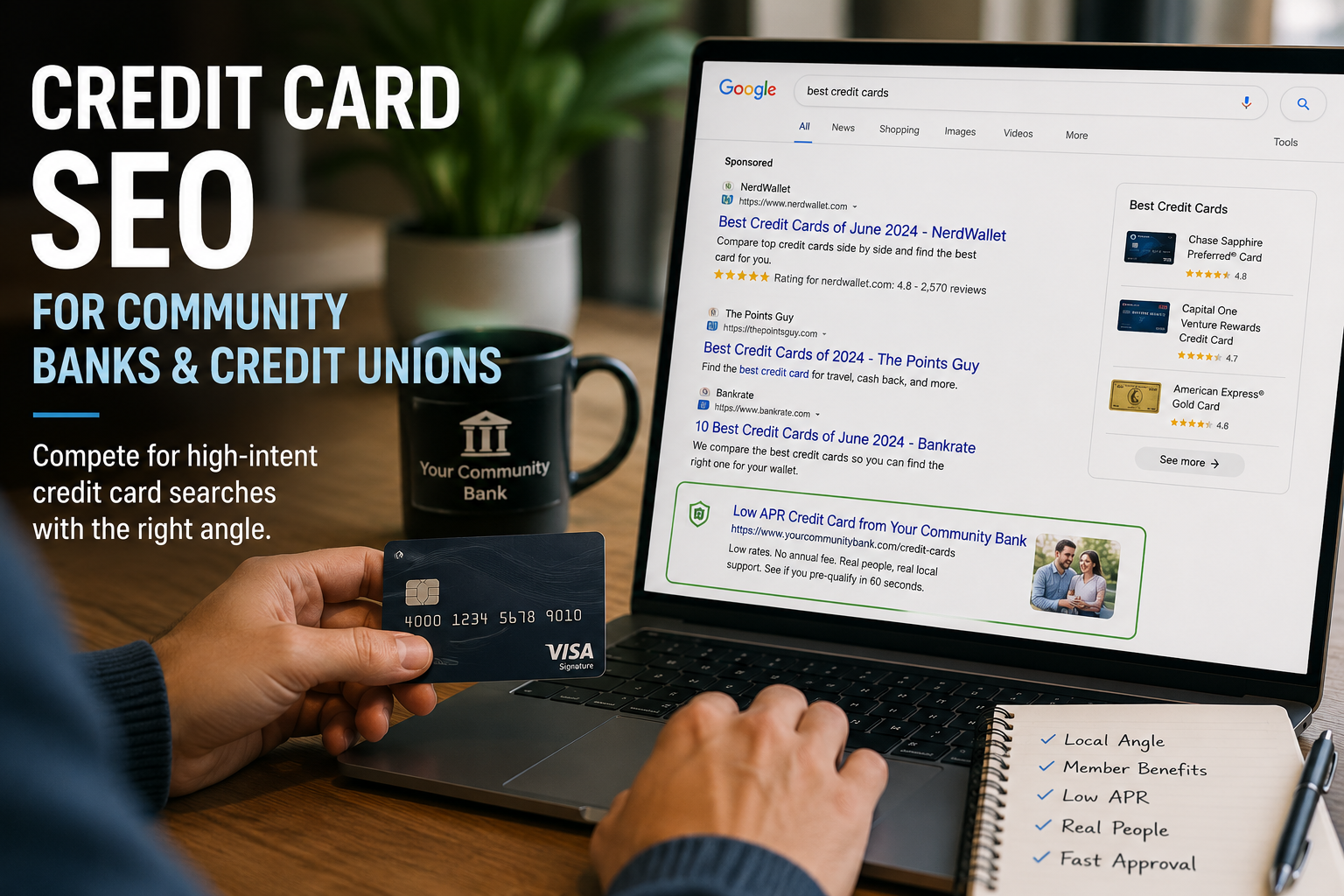
Credit card search is arguably the toughest battlefield in all of financial SEO. The keywords are dominated by deep-pocketed aggregators and national issuers, the search behavior skews away from local intent, and the volume gap between what people search and what your institution offers is enormous. For a community bank or credit union, "best credit card" can look like a wall you'll never climb.
But there's a real, often-overlooked opportunity here — and it starts with understanding a striking gap. As one credit union SEO analysis points out, credit union credit cards consistently rank among the lowest APR options available, but consumers don't know to search for them: "credit union credit card" gets only 2,400 searches a month while "best credit card" gets 165,000. That mismatch is the whole game. Your card products are genuinely competitive, but the search demand is concentrated on terms aggregators own. This guide shows how community banks and credit unions can compete for high-intent credit card searches anyway — by changing the angle of attack rather than fighting where you can't win. DASH-SEO
First, Understand Why Credit Cards Are Different From Your Other Products
Most financial SEO advice leans hard on local search, because that's where community institutions have a structural edge. For the majority of banks and credit unions, local search is the highest-impact SEO opportunity — people searching for financial services in a specific geographic area have strong intent, and winning those searches translates directly into new accounts. That's true for checking accounts, auto loans, and mortgages. Csp
Credit cards are the exception that complicates this. People rarely search "credit card near me." Card decisions are made nationally, by features and APR, not by proximity to a branch. So the pure local playbook that wins you "auto loans in [city]" doesn't map cleanly onto credit cards. You can't out-local your way to the top of "best rewards card."
This means your credit card SEO strategy has to be built differently — around your genuine product advantages (low APR, low fees, member ownership) and around capturing the dissatisfied searcher, rather than around geography alone. The good news, as the broader credit union SEO playbook notes, is that winning requires both local authority and product-level content that intercepts intent before the banks do. For cards, that second half — product-level intercept content — is where you'll win. SEO Hermit
Step 1: Accept the Volume Reality and Reframe Your Targets
Don't waste budget on the head terms. Generic "best credit card" queries at a national level have high volume but low local conversion intent and are dominated by aggregator sites like NerdWallet and Bankrate, so credit unions are better served owning local and product-specific queries. Authorityspecialist
Instead of "best credit card," your target list should look like this:
Institution-type terms: "credit union credit card," "credit union credit card low APR" — lower volume, but searchers on these terms are pre-qualified and actively looking for what you offer.
Local + product terms: "[city] credit union credit card," "low interest credit card [region]" — these layer in the local relevance you do have.
Problem/intent terms: "low APR credit card for bad credit," "credit card to rebuild credit," "first credit card for students."
Comparison terms: "credit union credit card vs. bank," "best low-APR alternative to [common bank card complaint]."
The thread connecting all of these is high intent. The most valuable financial searches consistently sit at the intersection of a specific need and a specific solution — and for cards, your specific solution is the low-rate, low-fee, member-first card the aggregator tables under-emphasize.
Step 2: Win With Comparison and Intercept Content
This is your single most powerful credit card SEO move. Because you can't out-rank aggregators for the head term, you instead intercept the searcher who has already decided they want an alternative to their current high-APR card. Position your card products in the broader credit card comparison landscape, building content that captures consumers frustrated with high APR bank cards and looking for alternatives. DASH-SEO
These searchers convert at a high rate precisely because they're already in motion. The same dynamic that makes comparison pages effective for other products applies here: a reader comparing your card to a big-bank card is already dissatisfied with their bank and evaluating alternatives, and an honest comparison page that presents your real advantages converts far better than a generic product page. DASH-SEO
Content to build:
A "credit union credit card vs. bank credit card" comparison page that honestly lays out APR, fees, and the member-ownership benefit.
A rewards-vs-low-APR explainer that helps searchers self-select toward the kind of card you offer well.
Problem-solution pages like "best credit card to rebuild your credit" or "low-APR card for carrying a balance," matched to the real reasons people switch.
A compliance note that's especially important for cards: rate and rewards claims are tightly regulated. Creating SEO content that ranks while staying compliant — no misleading rate claims, accurate disclosures, truthful testimonials — requires building these guardrails in, not retrofitting them. Always route card content through compliance review before it goes live. SEO Hermit
Step 3: Build Product-Level Pages That Convert, Not Just Rank
A common failure mode is publishing blog content that ranks but never connects to a product. Many credit unions publish blog content, but a significant share targets low-intent informational topics without a clear connection to product pages or member acquisition — content that ranks but doesn't convert is a resource allocation problem, not an SEO success. Authorityspecialist
For credit cards, make sure every piece of educational content links to a strong, optimized card product page, and that the product page itself is built to convert. The broader principle holds: credit unions that publish member-relevant content like loan calculators and financial education tend to rank for higher-intent keywords than those with static brochure sites — but that content must funnel toward application, not dead-end as a blog post. DASH-SEO
Step 4: Target the Younger Searcher Through Card Content
Credit cards are one of the best products for reaching the demographic community institutions most need to attract. A first credit card is often a young person's entry into a banking relationship, and that audience is exactly where credit unions are weakest. Younger consumers are shaping the future of banking, yet they're the least likely to choose credit unions — because they don't see them. Agency 102
Build credit-building and student-focused card content to meet them. Pages targeting "first credit card for students," "how to build credit with a credit card," and "secured credit card to build credit" capture searchers at a formative moment. This connects to a known strategic gap: youth-focused content, including credit-building card pages, is a core way credit unions can begin reversing an aging membership base. Pair that content with the trust-building moves that resonate with younger audiences — encouraging authentic Google reviews and highlighting the real people behind your organization — so the credibility is there when they arrive. Agency 102
Step 5: Don't Neglect AI Search for Card Recommendations
Increasingly, people don't search "best low-APR credit card" in Google at all — they ask ChatGPT or Perplexity. For a product where your offering is genuinely competitive but under-searched, AI answers are a real opportunity to get recommended on the merits. The credit union SEO playbook explicitly includes getting found where members are increasingly looking — AI Overviews, ChatGPT, Perplexity. SEO Hermit
To earn those citations, structure your card content with clear, extractable answers: direct one-sentence comparisons, FAQ blocks, and plainly stated APR and fee facts that an AI can lift cleanly. This is also where your structural advantage can finally surface — an AI weighing low-APR options on substance may well surface your card even though a human would never have searched for it by name.
Step 6: Maintain the Technical Foundation
Credit union sites are disproportionately prone to technical issues that suppress rankings. Technical SEO debt is common in older credit union platforms — Core Web Vitals scores, mobile usability, and site architecture issues are disproportionately prevalent on sites running legacy CMS platforms or vendor-managed templates. Authorityspecialist
Since credit card research happens heavily on mobile and involves comparison-shopping across tabs, speed and mobile experience directly affect whether you keep the visitor. Google uses page speed as a ranking factor, and slow-loading pages drive users away regardless of how good the content is — compress images, use modern formats like WebP, minimize render-blocking JavaScript, and monitor Core Web Vitals, treating issues as urgent. A clean, fast product page is the difference between an application and a bounce. Csp
Step 7: Measure and Stay Patient
As with all financial SEO, credit card rankings for competitive product terms take months to build, and the value compounds over time. The reason it's worth the wait is the economics: organic search delivers customers with higher lifetime value than almost any other channel, at a fraction of the acquisition cost of paid advertising — and because most banks and credit unions underinvest in SEO, those that commit strategically gain a competitive edge that compounds. Csp
A cardholder acquired through organic search often becomes a multi-product, long-term member. Measure your card SEO by applications and approved accounts sourced from organic traffic, not by rankings alone, so you can demonstrate that the content is driving real member acquisition and protect the investment internally.
Frequently Asked Questions
Can a community bank or credit union actually rank for credit card searches?
Not for the broad national terms, which aggregators own — but yes for product-specific and intent-driven terms. Generic "best credit card" queries are dominated by aggregator sites, so you're better served owning product-specific queries. The opportunity is amplified by a real gap: "credit union credit card" gets only 2,400 searches a month while "best credit card" gets 165,000, meaning the institution-specific terms are far less contested. AuthorityspecialistDASH-SEO
Why is credit card SEO different from other banking products?
Because credit cards lack strong local intent. People don't search "credit card near me" the way they search "bank near me," so the local-SEO advantage that wins you checking and auto-loan traffic doesn't apply as directly. Your edge instead comes from comparison content, genuine product advantages like low APR, and intercepting searchers who want an alternative to their current card.
What credit card content works best for community banks?
Comparison and intercept content. Build content that captures consumers frustrated with high-APR bank cards and looking for alternatives, plus problem-solution pages (rebuilding credit, first student card) and a clear "credit union card vs. bank card" comparison. Every piece should link to an optimized, conversion-ready product page. DASH-SEO
How can credit card content help us reach younger members?
A first or credit-building card is often a young person's entry into banking — and that's exactly the audience credit unions struggle to reach, since younger consumers are the least likely to choose credit unions because they don't see them. Targeting "first credit card for students" and "build credit" terms captures them at a formative moment that can start a long relationship. Agency 102
Does AI search matter for credit card SEO?
Increasingly, yes. Many people now ask ChatGPT or Perplexity for card recommendations, and getting found in AI Overviews, ChatGPT, and Perplexity is a real opportunity — especially because an AI weighing low-APR options on substance may surface your genuinely competitive card even when a human shopper would never have searched for it by name. Structure content with clear, extractable answers to earn those citations. SEO Hermit
Ready to Compete for Credit Card Searches?
Your card might beat the big banks on APR and fees — but if searchers never find it, that advantage is invisible. Ritner Digital helps community banks and credit unions build the comparison content, product pages, and AI-ready structure that capture high-intent credit card searches and turn frustrated big-bank cardholders into your members.
Get in touch with Ritner Digital → to build a credit card SEO strategy that turns your real product advantages into new accounts.
Sources
DASH-SEO — SEO for Credit Unions
AuthoritySpecialist — Credit Union SEO Statistics: Member Acquisition & Digital Banking
Customer Service Profiles — SEO in Banking: A Practical Guide for Banks and Credit Unions
SEO Hermit — Credit Union SEO: Grow Membership & Outrank Big Banks
Agency 102 — Building Digital Trust: How Credit Unions Can Compete Online in 2026
BSPKN — Credit Union Marketing: How to Compete With Banks in 2026
Jives Media — The Definitive Guide to Credit Union Marketing (2026)
LinkGraph — SEO for Banks: Benefits, Strategies, and How to Do It Right