How to Rank for "Best Savings Account Near Me" — A Tactical Guide
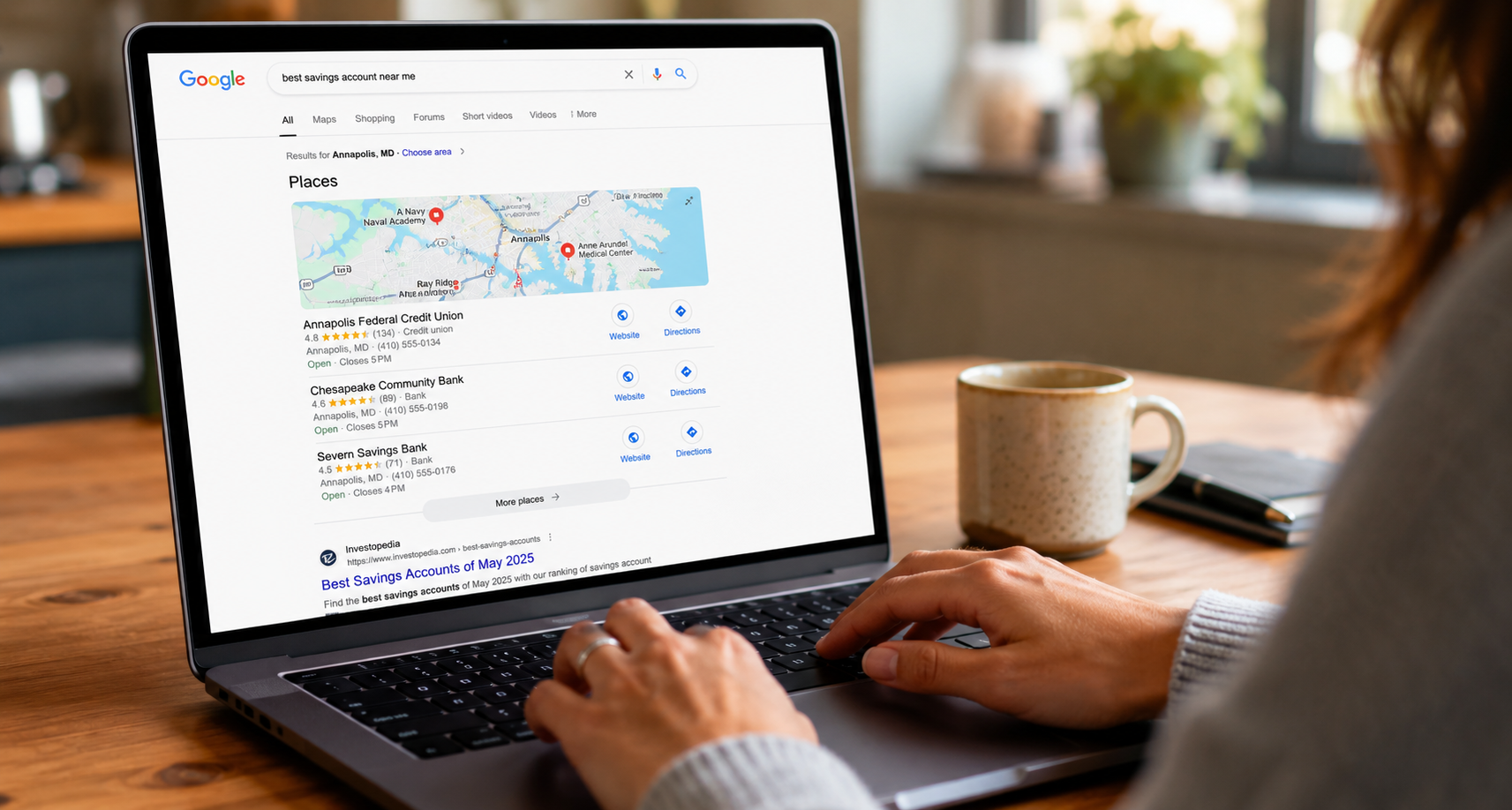
"Best savings account near me" is a deceptively tricky keyword. It combines two things that usually pull in opposite directions: a comparison-shopping intent ("best") that aggregators dominate, and a local intent ("near me") where community institutions have the edge. Win it, and you capture a saver who is both ready to act and physically in your market — about as valuable a lead as a bank or credit union can get.
The national savings SERP, like checking, is owned by the usual suspects. NerdWallet uses an objective scoring rubric to rate around 100 banks, credit unions and other providers, weighting APY most heavily. Bankrate, WalletHub, CNBC, and Yahoo run similar massive roundups. You won't beat them for "best high-yield savings account." But the "near me" modifier changes the math entirely — and this guide is a step-by-step playbook for winning it. NerdWallet
Understand What "Near Me" Actually Triggers
The tactical key is recognizing that "best savings account near me" usually fires Google's Local Pack — the map with three business listings — rather than (or above) the aggregator-dominated organic list. That's a different ranking system entirely, pulled from Google Business Profiles and weighted by proximity, relevance, and prominence. This is the system where a local institution can outrank a national brand, because your branch is physically closer to the searcher than an online-only bank with no local address.
So your strategy splits cleanly into two fronts: winning the Local Pack (driven by your Google Business Profile) and ranking a localized organic page (driven by your website). Work both. Here's how, tactically.
Tactic 1: Fully Optimize a Google Business Profile for Every Branch
This is the foundation of the Local Pack, and incomplete profiles are the most common reason institutions don't appear. Work through this checklist for each location:
Claim and verify every branch as its own listing — never one profile for the whole institution.
Set the correct primary category ("Credit Union," "Bank," or "Savings Bank"), not the generic "Financial Services."
Complete every field: address, local phone number, accurate hours, and services.
Add high-quality photos of the branch, team, and interior to establish legitimacy.
Post regular updates about savings rates, promotions, and community involvement to keep the profile active.
NAP consistency (Name, Address, Phone) across the web underpins all of this — mismatches between your profile and directory listings erode Google's confidence in your location and suppress rankings. Audit your citations and fix any inconsistencies before doing anything else.
Tactic 2: Make Reviews an Ongoing Engine
Reviews are both a Local Pack ranking factor and a conversion driver, and the key tactical insight is that recency and velocity matter more than total count. A steady stream of fresh reviews beats a large but stale pile. Build a simple, repeatable routine:
Train branch staff to ask satisfied members after positive interactions.
Make leaving a review frictionless with QR codes at the branch and direct links in email.
Respond to every review — positive and negative — promptly and professionally.
The goal is a consistent monthly flow of new reviews, not a one-time push.
Tactic 3: Build a Localized Savings Page (and Link Your GBP to It)
Alongside the Local Pack, you want a page on your own site engineered to rank for the localized query and to convert. Don't link your Google Business Profile to your homepage — link it to a dedicated, location-specific savings page. When the information on your GBP matches a unique, highly relevant page on your site, Google's confidence in your location increases, often lifting your Local Pack position.
Tactically, build the page around the localized keyword and structure it like the comparison content that ranks, but centered on your market:
Title tag: "Best Savings Account in [City] | [Institution Name]"
Location-specific H1 and content that names your city, neighborhoods, and branches.
A clear, compliant breakdown of your savings account's rate, fees, and minimums.
A frictionless path to open or apply.
Study what makes the aggregator pages effective and adapt it locally. Those pages rank partly because they thoroughly answer the question — covering APY, fees, minimum deposits, and account features in a clear, scannable format. Your localized page should do the same while adding what they can't: genuine local presence and in-person service.
Tactic 4: Lead With the Saver's Actual Decision Criteria
People searching for the best savings account weigh a consistent set of factors. Address each one explicitly on your page, because matching searcher intent is what signals relevance to both Google and the reader. The criteria savers (and the aggregators ranking them) prioritize are:
APY above the national average. For context to use honestly on your page: the national average savings rate is just 0.38%, while top high-yield accounts offer around 3% to 4% APY. Yahoo Finance
Low or no monthly fees. Accounts with no monthly fees are favored in rankings. Yahoo Finance
Low minimum balance and opening deposit. Accounts with no or low minimum requirements are given preference. Yahoo Finance
Federal insurance. State plainly that deposits are NCUA- or FDIC-insured up to $250,000.
Digital tools. Savers shouldn't have to compromise digital functionality by choosing a credit union over a bank, so highlight your mobile app and online account opening. U.S. News & World Report
Tactic 5: Turn the Credit Union Rate Story Into a Conversion Asset
If you're a credit union, you have a genuinely strong story to tell — use it on the page. Because the aim of credit unions is not to earn profit for a small percentage of owners, all members benefit from lower interest rates, fewer fees and more dividend earnings. As Bankrate's analyst frames it, credit unions are often overlooked as a banking option; as member-owned, not-for-profit institutions, they typically pass on profits in the form of higher savings yields or lower fees. U.S. News & World ReportBankrate
A tactically effective way to present this is the way some credit unions already do — directly contrasting your competitive rate with the community benefit. One credit union frames it as: our rates are right up there with those internet-only banks, but there's one big difference — the money you deposit stays here, from the interest you earn to the investments we make in the communities we serve. That's a conversion angle no online-only bank can match, and it speaks directly to the local searcher. Vibrant Credit Union
One more tactical product note: if your basic savings rate isn't competitive, lead with the product that is. In addition to savings accounts, consider money market accounts — for example, one credit union offers a savings account earning just 0.30% APY but a money market account earning between 1.76% and 2.22% APY on balances of $2,500 and above. Point your localized page at whichever savings product genuinely competes. Bankrate
Tactic 6: Handle Rate Accuracy and Compliance Carefully
Savings is the most rate-sensitive product you'll write about, which raises two tactical risks. First, accuracy — rates move constantly. HYSAs come with variable interest rates, meaning your APY can change at any time, generally rising when the Fed raises rates and dropping when it cuts. A page advertising a stale APY is both a trust problem and a compliance liability, so build a process to update rate content the moment rates change. Yahoo Finance
Second, disclosure. Savings rate claims require proper APY disclosures and accurate terms. Frame your page around "best savings account in [city]" or "how to choose a savings account" rather than unqualified superlatives, include the required disclosures, and route everything through compliance review before publishing. This keeps you both compliant and rankable.
Tactic 7: Don't Neglect Mobile and Page Speed
"Near me" searches are overwhelmingly mobile and often urgent — someone deciding right now where to move their savings. A slow or clunky mobile page loses them before they see your rate. Ensure your localized savings page loads fast, displays cleanly on mobile, and offers an obvious, low-friction way to open an account. Test it on an actual phone; if opening an account is hard on mobile, you're leaking the exact high-intent traffic this keyword delivers.
Tactic 8: Track the Right Signals
Measure progress with metrics tied to the keyword and to deposits, not vanity numbers:
Local Pack position for "savings account [city]" and "savings account near me" variants.
Google Business Profile insights: views, searches, calls, and direction requests.
Organic rankings for your localized savings page.
Account openings sourced from organic and local search.
Local Pack visibility is reachable in a reasonable window with consistent optimization — typically one to three months for local improvements to show — while the organic page builds authority over a longer horizon. Track both, and refresh your page and reviews continuously.
Quick-Start Checklist
If you do nothing else, do these in order:
Claim and fully complete a Google Business Profile for every branch, with consistent NAP.
Start a monthly review-generation routine to build velocity and recency.
Build one localized savings page per market, structured around the saver's decision criteria.
Link each GBP to its matching local page.
Keep rates accurate and compliant, and make the page fast on mobile.
Track Local Pack position and account openings, and iterate.
Frequently Asked Questions
Can a local bank or credit union rank for "best savings account near me"?
Yes — far more realistically than for the national term. The "near me" modifier triggers Google's Local Pack, which is driven by your Google Business Profile and weighted by proximity, so a local institution can outrank online-only banks and aggregators that have no physical presence in your market. The national "best high-yield savings account" term, by contrast, is dominated by aggregators like NerdWallet that rate around 100 institutions on rate-led rubrics. NerdWallet
What's the most important factor for ranking in the Local Pack?
Proximity matters most, but among factors you control, a complete Google Business Profile and a steady flow of fresh reviews are decisive — review recency and velocity tend to outweigh raw review count. Get one profile per branch fully optimized, then build an ongoing review routine.
What should my localized savings page include?
Build it around the saver's real decision criteria: a competitive APY (the national average is just 0.38%, so anything well above that is worth featuring), low or no fees, low minimum requirements, clear NCUA/FDIC insurance language, and strong digital tools — all wrapped in genuinely local content and a frictionless way to open an account.
How do credit unions stand out for savings searches?
By leaning into the member-owned advantage. As not-for-profit institutions, credit unions typically pass profits on as higher savings yields or lower fees, and pairing a competitive rate with a "your deposits stay and serve this community" message gives you a conversion angle online-only banks can't replicate. Bankrate
How do I keep my savings page from going stale?
Build a process to update it whenever rates change, because HYSA rates are variable and can change at any time, generally moving with the Fed. A page showing an outdated APY undermines trust and creates compliance risk, so treat rate updates as urgent and route changes through compliance. Yahoo Finance
Ready to Own "Savings Account Near Me" in Your Market?
You can't outrank the national aggregators for "best high-yield savings account" — but you can own the local results where savers in your community are ready to move their money today. Ritner Digital helps banks and credit unions dominate the Local Pack and rank the localized pages that turn high-intent "near me" searches into new accounts and deposits.
Get in touch with Ritner Digital → to build a local savings SEO strategy that puts your institution at the top of the map in your market.
Sources
NerdWallet — Best High-Yield Savings Accounts of June 2026
Bankrate — Best Credit Union Savings Account Rates in June 2026
U.S. News — Best Credit Unions of June 2026
Yahoo Finance — 10 Best High-Yield Savings Accounts for June 2026
CNBC Select — The Best High-Yield Savings Accounts of July 2026
WalletHub — Best High-Yield Savings Accounts of June 2026
Vibrant Credit Union — High-Yield Savings and Checking Accounts