Economic Uncertainty Is Here — Why Roswell Small Businesses Should Double Down on Digital Marketing (Not Cut It)
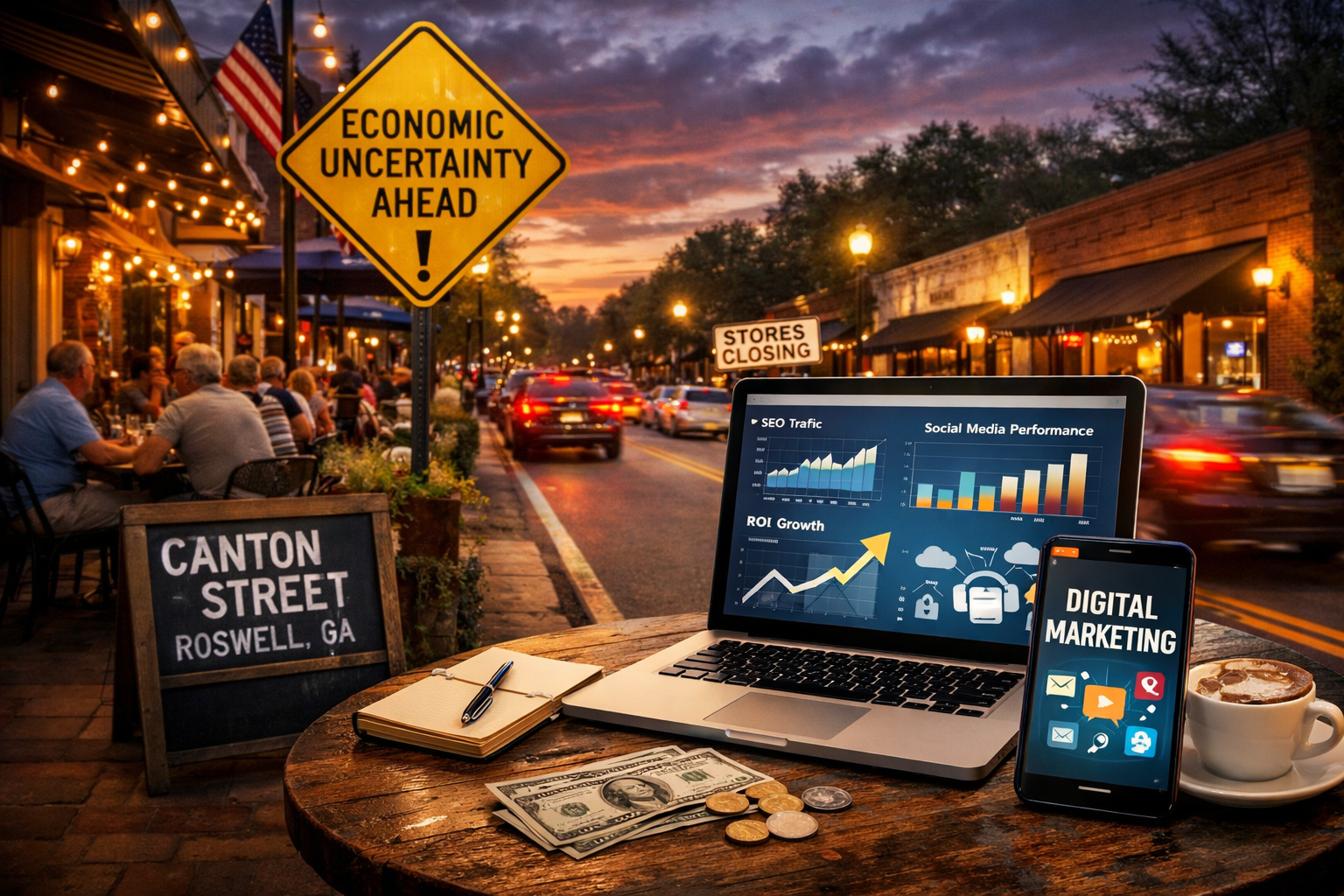
The headlines have been unsettling. Tariffs driving up supply costs. Inflation proving stickier than expected. Interest rates still elevated. Consumer confidence wavering. And for small business owners in Roswell — from the restaurants on Canton Street to the contractors on Sandy Plains Road to the service providers along Holcomb Bridge — the pressure is real and it is landing on the bottom line right now.
The instinct, when margins compress, is to look for costs to cut. Marketing budgets are an easy target. They're variable. They're hard to defend in a spreadsheet. And the results — especially from longer-term investments like SEO and content — can feel abstract when you're staring at a tighter month.
But here's what a century of economic research tells us: cutting your marketing budget during a downturn is one of the most reliable ways to make your situation worse — not better.
And here's what the 2026 data tells us about your Roswell competitors: most of them are nervous, some of them are cutting, and almost none of them are doubling down. That creates one of the most valuable opportunities a local business ever sees — a chance to gain market share while competitors go quiet.
This post makes the data-driven case for maintaining and strategically investing your marketing budget right now, and shows you exactly which channels deliver the highest ROI when every dollar needs to work harder.
The Economic Pressure Facing Roswell Businesses in 2026
Let's be honest about what North Fulton businesses are navigating. 66% of small businesses think economic uncertainty will be somewhat or very challenging in 2026 — up significantly from just 48% last year. This isn't surprising given continued inflation and the introduction of tariffs that have many businesses worried about the potential impact they might experience. This may include supply chain challenges, increased operational costs, and the need to increase prices — which could lead to customer complaints or fewer purchases overall. LocaliQ
For Roswell businesses specifically, that pressure manifests in concrete ways. A home services contractor faces higher costs for materials affected by tariffs. A restaurant owner deals with food cost inflation that squeezes already-thin margins. A retail boutique on Canton Street navigates cautious consumer spending from customers who are watching their own budgets. A professional services firm sees clients delaying discretionary projects.
Small business premiums are up 11% for 2026, nearly double the increase for businesses overall. Costs are up for the materials many small businesses need to buy, in part because of last year's tariffs. Marketplace The pressure is not imaginary and it is not uniform — but it is real, and it is shaping how Roswell business owners are thinking about every line item in their budget.
The question is not whether the pressure exists. The question is how you respond to it. And the answer, backed by more than a century of data, is almost certainly not to go dark.
What History Tells Us About Marketing in Downturns
The most important thing to understand about economic uncertainty and marketing is that it has happened before — many times — and the data on what works is unusually clear.
One hundred years ago, Harvard graduate Roland Vaile tracked the performance of 250 major U.S. companies from the post-World War I recession through the boom years of the 1920s. He found that companies that increased their marketing budgets during the recession increased sales by 20% over pre-recession levels. On the other hand, those who reduced their marketing spend saw sales drop 7% below pre-recession levels — a 27% swing in sales numbers that dramatically changes a company's financial outlook. Medium Giant
That finding has been replicated across every major economic downturn since. In 2002, McKinsey & Company concluded a study of nearly 1,000 U.S. companies over an 18-year period, covering the recession of 1990-91. The study found that the top-performing companies continued to invest in marketing, trading short-term profitability for long-term gain. A number of these companies actually spent more money on marketing during the recession than they did during economic growth periods. Medium Giant
The 2008 recession produced the same pattern. Companies that continued to invest in growth during the 2008 recession — including maintaining their marketing spend — achieved a 17% compound growth rate during the economic downturn, according to a comprehensive study of 3,900 companies worldwide. These companies focused on cost containment but continued to play offense. Rather than slash marketing budgets, they optimized their spend by shifting dollars into high-ROI tactics. Medium Giant
Harvard Business Review synthesized this evidence directly in their landmark piece on recession marketing: firms that maintain their marketing spend while reallocating it to suit the context — be it in product development, advertising and communication, or pricing — typically fare better than firms that cut their marketing investment. Harvard Business Review
A Harvard Business Review study of 4,700 publicly traded businesses during three different global recessions found that only 9% of brands managed to grow through the recession — and those were the ones that maintained strategic investment in their business. 80% of businesses that cut aggressively were still catching up to their pre-recession strength three years after the economy had recovered. Fratzkemedia
The math of going dark during a downturn is brutal and non-obvious: you save marketing dollars today and spend years trying to rebuild the brand presence, customer relationships, and search rankings that your competitors — the ones who stayed visible — built up while you were quiet.
The Opportunity Hidden Inside Everyone Else's Fear
Here is the strategic insight that most Roswell business owners are missing right now: when your competitors cut their marketing budgets, your marketing dollars buy more.
Think about what actually happens in a local market when businesses pull back. Fewer competitors bidding on Google Ads means lower cost-per-click rates. Fewer businesses producing local content means your SEO efforts face less competition for rankings. Fewer active social media presences means your posts face less noise. The customers who are still spending — and in Roswell, with its affluent North Fulton demographic, many are still spending — encounter fewer alternatives when they search.
During economic downturns, ad competition decreases, making it cheaper to run campaigns. Cost-per-click rates on digital advertising can drop by 20-30% during recessions, allowing brands to reach their audience at a lower cost while maintaining brand presence. Weareupspring
The evidence is clear: the companies that navigated recessions most successfully are those that viewed their marketing budgets not as optional expenditures, but as essential investments in their future. As competitors cut back, the opportunity to capture greater market share is monumental. On the other hand, failing to seize this opportunity can result in long-term competitive disadvantages that are difficult, if not impossible, to recover from once economic conditions stabilize. Strategic Vantage
For a Roswell business owner reading this in April 2026, the question is: which side of that dynamic do you want to be on?
What Your Roswell Competitors Are Likely Doing Right Now
Despite economic challenges, only 8% of small businesses are planning to decrease their marketing budgets in 2026. The majority — 54% — plan to keep the same budgets, while nearly 40% plan to increase. LocaliQ
That breakdown tells an interesting story. The businesses planning to stay the same or increase are the ones who understand that marketing is a revenue driver, not a cost center. The 8% cutting are the ones who are treating marketing as a luxury.
But here's the nuance that matters for Roswell: "maintaining" a budget in an environment where your competitors are cutting is actually a relative increase in presence. If you spend the same and they spend less, you're capturing a larger share of the available attention in the market. And if you strategically increase — even modestly — while competitors pull back, the compounding effect on market share can be significant.
Most SMBs surveyed are running their strategies across multiple marketing channels, but 52% have monthly marketing budgets under $1,000 and 50% have no employees dedicated to marketing. LocaliQ This is the competitive landscape in a typical Roswell small business market. You don't need a large budget to outperform competitors who have no marketing strategy at all. You need a smart one.
The Highest-ROI Channels for Tight Budgets in 2026
Not all marketing channels are created equal, and in a tight budget environment, channel selection is everything. The good news is that the channels with the highest ROI are generally the ones that require sustained effort rather than large spending — which means they're both budget-friendly and competitively defensible.
SEO and Content Marketing: The Highest Long-Term ROI Available
SEO leads with a 748% ROI — unlike paid ads that stop delivering once the budget runs out, SEO compounds over time, lowering acquisition costs and driving steady, high-intent traffic from Google. SEO leads close at 14.6%, compared to just 1.7% for outbound marketing. SeoProfy
Website, blog, and SEO remains the number one ROI-generating channel according to marketers in 2026. Small businesses are 23% more likely than average to see ROI from blog posts. HubSpot
For a Roswell business, SEO is particularly powerful during economic uncertainty for a structural reason: people don't stop searching for local services during downturns. They may be more selective about what they buy, but they still need plumbers when pipes burst, dentists when teeth ache, accountants when taxes are due, and restaurants when they want to celebrate. If your business shows up at the top of those searches and your competitor's doesn't, you capture the customer regardless of broader economic conditions.
The key advantage of SEO investment during a downturn is that it is cumulative. Every blog post you publish, every local landing page you optimize, every Google Business Profile update you make, every review you earn — these compound into search authority that keeps generating leads long after the initial work is done. You are not renting visibility; you are building it.
Email Marketing: The Highest ROI Per Dollar Spent
For B2C brands, email marketing is the top ROI-driving channel. Email marketing generates returns of $36 to $42 for every dollar spent. HubSpot
For existing customer relationships — which are your most valuable asset during economic uncertainty — email is irreplaceable. Paid media generates results while the spend is active, then stops. SEO, email lists, and brand equity compound. An over-indexed channel mix toward paid media leaves organizations exposed to cost increases. Brand Vision
Your email list is a direct line to customers who have already chosen you. During economic uncertainty, when customers are being more deliberate about their spending, staying top-of-mind with your warmest audience — through consistent, genuinely useful email communication — is the most efficient marketing investment available. A monthly newsletter, a seasonal promotion, a "we're thinking of you" touchpoint during a slow period costs almost nothing and keeps your business in consideration when the purchase decision moment arrives.
Focus on customer retention and maximizing lifetime value during downturns — acquiring new customers costs 5 to 25 times more than retaining existing ones. Allocate budget toward customer experience, success, and loyalty programs. ALM Corp
Google Business Profile: Free, Powerful, and Almost Always Neglected
Your Google Business Profile is the highest-leverage free marketing tool available to any Roswell small business — and most businesses are dramatically underutilizing it. During economic uncertainty, when every paid channel spend is scrutinized, GBP optimization is pure arbitrage: high impact, zero media cost.
Regular GBP posts, photo updates, review responses, accurate hours, and a complete service listing all signal to Google that your business is active and trustworthy — improving your visibility in local searches at no cost. A Roswell business that stays active on GBP while competitors go quiet will gain local search presence simply through consistent maintenance, no advertising spend required.
Targeted Local Ads: Getting More While Competitors Spend Less
For businesses with any advertising budget, the current environment is an unusually good time to run local Google Ads and social ads. With competitors reducing spend, auction competition drops — meaning your cost per click decreases and your ad dollar stretches further. Studies show that cost-per-click rates on digital advertising can drop by 20-30% during recessions, allowing brands to reach their audience at a lower cost while maintaining brand presence. Weareupspring
The strategic play is not to maintain the same budget and expect the same results — it's to understand that the same budget buys more visibility in a lower-competition environment, and to capitalize on that window before conditions normalize.
How to Stretch a Tight Marketing Budget Without Sacrificing Presence
If your Roswell business genuinely needs to reduce spending, the right approach is optimization — not elimination. Here's how to maintain meaningful presence while cutting costs:
Audit before cutting. Before reducing any marketing spend, identify which channels are actually driving leads and revenue. Many small businesses maintain spending on channels they've never properly measured. Cut the untracked, not the effective.
Shift from paid to earned. Reduce reliance on paid social media posts and redirect that budget toward SEO content that generates organic traffic permanently. A well-written blog post targeting a Roswell-specific search query keeps generating leads for years. A social media post disappears in hours.
Protect your review velocity. Reviews are free to generate and enormously powerful for local search visibility. Build a systematic process for requesting reviews from satisfied customers — a text or email the day after service completion. This costs nothing and compounds into a major competitive advantage over time.
Double down on your email list. If budget is tight, the highest-ROI activity is almost always communicating more frequently and more valuably with your existing customers. They already trust you. They're already easier to convert. And email costs almost nothing relative to its return.
Use AI tools to reduce content production costs. AI adoption held steady at 60% among small businesses, with content creation usage surging from 52% to 81%. PPC Land AI writing tools, image generators, and scheduling platforms can significantly reduce the time and cost of producing consistent content, making it possible to maintain marketing presence with less manual effort.
The Roswell-Specific Case for Staying Visible
Here's the local market reality that makes this argument even stronger for Roswell businesses specifically.
Roswell is a high-income, high-education, high-discretionary-spending market. The U.S. Chamber of Commerce and MetLife Small Business Index hit a record 72.0 in Q3 2025, marking the highest confidence level ever recorded among small business owners Deeleyinsurance — and affluent suburban markets like North Fulton tend to be more resilient than average during economic uncertainty. Customers here are not going to stop spending on quality services, quality food, quality experiences. They are going to be more selective about where they spend. And they will choose the businesses they can find, trust, and recognize.
That is a digital marketing problem as much as it is a quality problem. The best restaurant on Canton Street doesn't win if customers can't find it when they search. The most skilled contractor in East Roswell doesn't get the call if their Google Business Profile is outdated and their website doesn't rank. The economic uncertainty facing Roswell businesses is real — but the customers are still here, still searching, and still choosing. The businesses that win are the ones that stayed visible while others went quiet.
As the old Henry Ford line goes: stopping advertising to save money is like stopping your watch to save time.
Sources
LocaliQ — The Big Small Business Marketing Trends Report for 2026: localiq.com
WordStream — 10 Key Trends & Insights to Inform Your 2026 Marketing Planning: wordstream.com
Marketplace — Small Business Sentiment Is Down Again as Uncertainty Persists (March 2026): marketplace.org
JPMorganChase — U.S. Business Leaders Signal Optimism and Growth Plans for 2026: jpmorgan.com
Harvard Business Review — Don't Cut Your Marketing Budget in a Recession, Nirmalya Kumar and Koen Pauwels (2020): hbr.org
Medium Giant — Reduce Marketing Spend During a Recession? History Says No: mediumgiant.co
Strategic Vantage — Harvard Business Review: Don't Cut Your Marketing Budget in a Recession: strategicvantage.com
SeoProfy — SEO ROI Statistics for 2026: Data, Benchmarks & Trends: seoprofy.com
HubSpot — 2026 Marketing Statistics, Trends & Data: hubspot.com
Brand Vision — Marketing Budget Allocation by Channel: How to Distribute Spend Effectively in 2026: brandvm.com
ALM Corp — 2026 Digital Marketing Budget Allocation: Where to Invest for Maximum ROI: almcorp.com
Worried about your 2026 marketing budget?
The businesses that come out of economic uncertainty stronger are the ones that stayed visible and strategic while competitors pulled back. Ritner Digital builds high-ROI digital marketing campaigns specifically designed for lean times — SEO, email, Google Business Profile optimization, and targeted local ads that deliver measurable results without wasted spend.
👉🏼 Let's Talk About Your 2026 Strategy
Ritner Digital is a digital marketing agency serving businesses in Roswell, GA and the greater North Fulton area.
Frequently Asked Questions
Is it really a good idea to keep spending on marketing when my business revenue is under pressure?
It feels counterintuitive, but the data says yes — consistently, across more than a century of economic downturns. The businesses that cut marketing during difficult periods don't just lose visibility in the short term. They lose ground to competitors who stayed present, and research shows many are still catching up three years after the economy recovers. The question isn't whether you can afford to keep marketing — it's whether you can afford the long-term cost of going dark while your competitors stay visible.
What's the minimum a Roswell small business should spend on digital marketing during a downturn?
There's no universal right number, but the more useful question is: which channels give you the most return for the least spend? For most Roswell small businesses on tight budgets, the priority order should be Google Business Profile optimization (free), email marketing to your existing list (low cost), local SEO and content (moderate cost, high long-term return), and targeted local Google Ads only if you have budget left over. You can maintain a meaningful digital presence in a market like Roswell for a few hundred dollars a month if it's allocated correctly — which is dramatically less than the market share you'd lose by going silent.
Which digital marketing channels deliver the best ROI when budgets are tight?
SEO leads all channels with a documented ROI of around 748% over time, and email marketing returns $36 to $42 for every dollar spent — making these two the clear priorities for budget-constrained businesses. Both are also "compounding" channels, meaning your investment builds on itself over time rather than stopping the moment you pause spending. Google Business Profile optimization is effectively free and delivers outsized local search impact. Paid advertising becomes more efficient during downturns as competitor spend drops and cost-per-click rates fall — but it's a secondary priority if budget is genuinely limited.
How does economic uncertainty affect my competitors' marketing behavior — and what does that mean for me?
Research consistently shows that most businesses cut or freeze marketing during economic uncertainty. That means less competition for search rankings, lower ad auction prices, and more available attention from customers who are still spending. For a Roswell business that stays active — publishing content, maintaining its Google Business Profile, running targeted local ads — the downturn is actually a period of reduced competition for local search visibility. The businesses that understand this and act on it come out of the downturn with stronger brand recognition and better search positions than they had going in.
How do tariffs and inflation specifically affect Roswell small businesses' marketing decisions?
Rising costs from tariffs and inflation compress margins and make every spending decision feel higher stakes — which is exactly when many business owners make the mistake of cutting the wrong things. Marketing is often cut because it feels variable and discretionary, while operational costs feel fixed and necessary. But the customers who are choosing between your business and a competitor are making that choice based on visibility and trust — both of which are built through consistent marketing. Cutting marketing to protect margins today often accelerates the revenue decline that made margins tight in the first place.
What does "optimizing" a marketing budget mean versus simply cutting it?
Cutting means reducing spend across the board regardless of what's working. Optimizing means auditing which channels are actually driving leads and revenue, eliminating the ones with no measurable return, and reinvesting those dollars into proven high-ROI channels. For most Roswell small businesses, optimization typically means shifting away from untracked spending — boosted social posts with no clear ROI, print advertising, sponsorships that can't be measured — and redirecting toward SEO, email, and Google Business Profile, where results are trackable and the return is documented. You may end up spending the same or less while getting significantly more return.
Is this a good time to invest in SEO specifically, or should I wait until the economy stabilizes?
Now is actually one of the best times to invest in SEO, for two reasons. First, SEO takes time to build — the authority and rankings you develop today begin paying dividends in three to six months and compound for years. Businesses that start SEO during a downturn are positioned to dominate search results when economic conditions improve and consumer spending rebounds. Second, with competitors reducing their content output and SEO investment, it's easier right now to gain rankings you'd have to fight harder for in a buoyant market. Waiting for stability means starting from behind when everyone else re-enters simultaneously.
How do I know if my current marketing is actually working during this period?
If you can't answer that question, that's the first problem to solve — not budget size. Every marketing channel should have trackable metrics tied to actual business outcomes: organic search traffic and keyword rankings for SEO, open rates and conversion rates for email, call volume and direction requests for Google Business Profile, cost per lead and cost per acquisition for paid ads. Set up Google Analytics, Google Search Console, and call tracking before evaluating what to cut or keep. Businesses that measure their marketing ROI are significantly more likely to make smart allocation decisions — and significantly more likely to receive budget increases internally when leadership can see the return.
Should I be concerned that Roswell's market is more insulated than average during downturns?
Roswell and North Fulton County generally are more economically resilient than average during downturns — higher household incomes, higher homeownership rates, and a business-diversified local economy mean discretionary spending tends to hold up better here than in more economically vulnerable markets. That resilience is actually an argument for maintaining marketing investment, not reducing it. The customers are still here and still spending — they're just being more deliberate about where. The businesses they choose will be the ones they can find, recognize, and trust. That's a visibility problem, and visibility is what marketing solves.
What's the one marketing action a Roswell small business should take this week if they're worried about their budget?
Audit and optimize your Google Business Profile — it's free, it takes a few hours, and it directly impacts how many local customers find you in search right now. Make sure your hours are accurate, your photos are recent, your services are listed completely, and you're responding to every review. Then set up a process to request a review from every satisfied customer going forward. That single activity — done consistently and for free — can meaningfully improve your local search visibility within weeks. From there, the next highest-leverage investment is building or refreshing your email list and sending a single genuine, valuable email to your existing customers. Both actions cost almost nothing and both compound over time.
Related Reads
〰️
Related Reads 〰️

The Alpharetta Digital Marketing Agency Conversation Nobody Is Having (But Every Business Owner Here Should Be)
Alpharetta isn't a sleepy suburb. It's one of the most competitive business markets in the Southeast — and the businesses winning new clients here aren't necessarily the best ones. They're the most visible ones. Here's what a real Alpharetta digital marketing strategy looks like across SEO, GEO, web design, paid ads, email, social, and more — and why Ritner Digital is the agency built for this market.
Why Spending $12K on Marketing in Cherry Hill, NJ Isn't an Expense — It's the Cost of Staying in Business
If you're a local business owner in Cherry Hill or South Jersey, the money you're not spending on marketing is already costing you more than you think. Here's what a realistic $12,000 annual marketing budget actually gets you — and why it might be the best investment you'll ever make.
Whether You're Just Getting Started or Your Leads Have Gone Quiet, Passive Marketing Is Not the Answer
There are two moments in the life of a business when the stakes of marketing are highest and the temptation to underinvest is strongest. The first is the beginning — when everything is competing for your attention and marketing feels like something you can figure out later. The second is a plateau — when the leads that used to come reliably aren't coming anymore and the instinct is to wait and see if things correct themselves. Both instincts are understandable. Both of them are wrong. And both of them lead to the same place: a business falling further behind with every month that passes without an aggressive, intentional marketing strategy. Here's why that is, what it costs, and what doing something about it actually looks like.